Fill out contractor preference forms
with AI.
Contractor preference forms are essential documents used during the public bidding process to determine a company's eligibility for specific state or local advantages. These forms help government agencies, such as the California Department of Transportation, identify whether a bidder qualifies as a resident entity under state law. This classification is vital because it often triggers reciprocal preferences, ensuring that local businesses remain competitive against out-of-state contractors who might benefit from similar preference laws in their home jurisdictions.
By continuing, you acknowledge Instafill's Privacy Policy and agree to get occasional product update and promotional emails.
About contractor preference forms
These forms are typically required from construction firms, engineering consultants, and service providers participating in government procurement. When bidding on public works projects, contractors must certify their business status to comply with specific state regulations. For instance, documenting a company’s primary place of business is a mandatory step that can influence the final evaluation of a bid. Accurately completing these documents is crucial, as any errors or omissions could lead to bid rejection or the loss of a significant competitive edge during the selection process.
Managing the paperwork for multiple high-stakes bids can be a tedious task, but tools like Instafill.ai use AI to fill these forms in under 30 seconds while maintaining data accuracy and security. By automating the certification process, contractors can focus more on their project estimates and site logistics rather than manual data entry.
Every form on this page can be completed without typing. Instafill is form filling software that reads a PDF and fills it for you — including flat and scanned documents that carry no fillable fields at all.
Forms in This Category
The forms in this category have a median Form Complexity Index of 41/100 (Basic), measured across 1 forms by field count, input difficulty, length, conditional logic and structure. See how it is calculated.
| Form Name | Pages | FCI | |
|---|---|---|---|
| 1. | California Company Preference, DOT DES-OE-0102.9 | 1 | Basic 41 |
- Enterprise-grade security & data encryption
- 99%+ accuracy powered by AI
- 1,000+ forms from all industries
- Complete forms in under 60 seconds
How to Choose the Right Form
Navigating state procurement requirements can be complex, especially when bidding on large-scale infrastructure projects. In this category, the focus is on establishing local business status to ensure fair competition and preference eligibility within the state of California.
Determining Your Eligibility
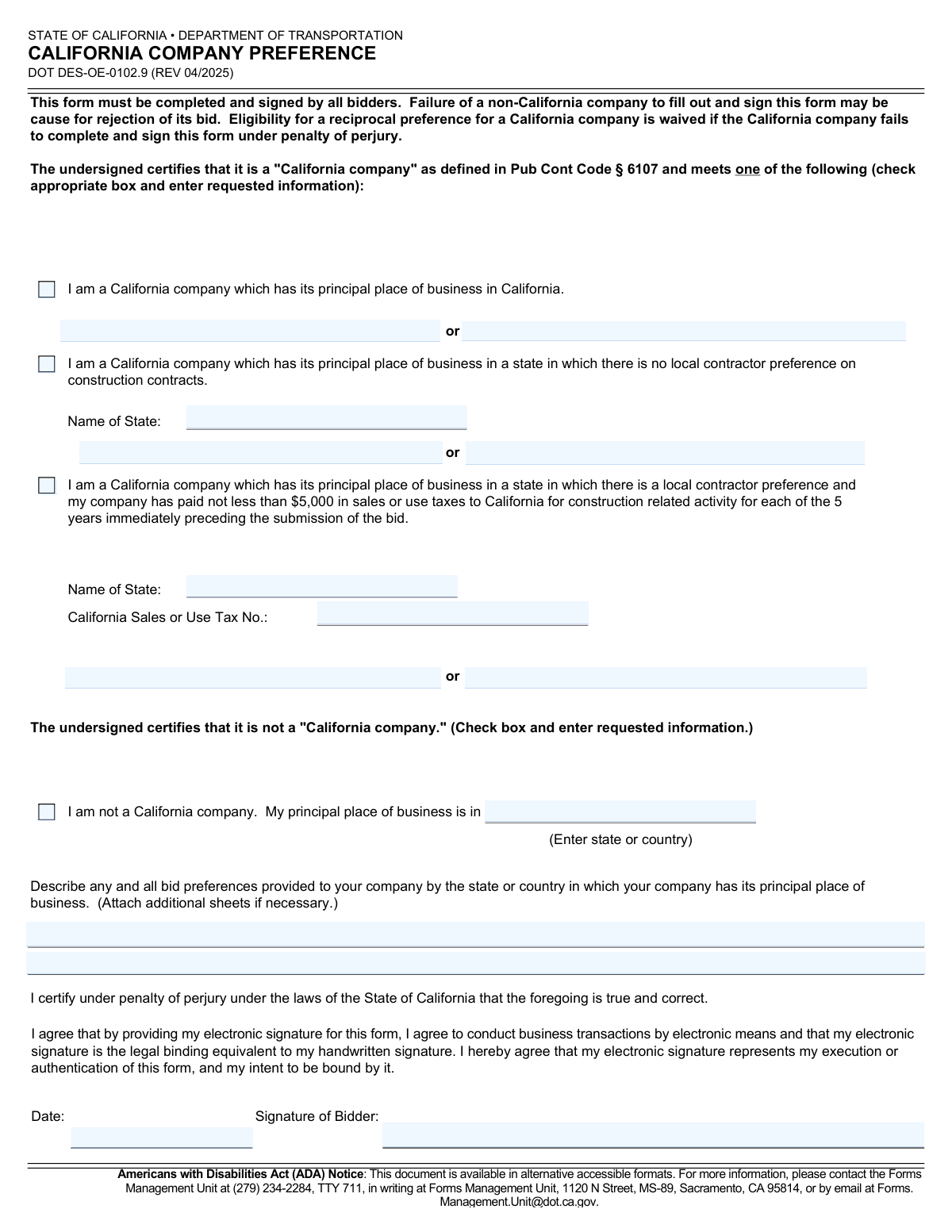
If you are bidding on a contract with the California Department of Transportation (Caltrans), you will likely encounter the California Company Preference, DOT DES-OE-0102.9. This is not an optional document; it is a mandatory certification required for all bidders to determine if they qualify as a "California company" under state law. Choosing the right form here is less about variety and more about ensuring you have the specific version required for Caltrans DES-OE compliance.
When to Use Form DOT DES-OE-0102.9
You should select and complete this form if your business meets the following criteria:
- Caltrans Bidding: You are currently submitting a bid for a Department of Transportation project in California and need to fulfill the mandatory submission requirements.
- Reciprocal Preference: You are seeking to benefit from (or are subject to) reciprocal preference laws that compare California-based businesses against out-of-state bidders.
- State Residency Certification: You need to legally certify that your business maintains a principal place of business in California or meets the specific statutory definitions of a local entity as defined by the Department of General Services.
Why Accuracy is Critical
Because the DOT DES-OE-0102.9 directly impacts how your bid is evaluated against your competitors, errors can lead to administrative delays, bid protests, or even disqualification. Using Instafill.ai to complete this form ensures that all fields are handled accurately, helping you maintain a competitive edge. If you are looking for general contractor licensing or private project preference forms, those are typically found in separate categories; this form is strictly for state-level transportation contracts.
Form Comparison
| Form | Purpose | Who Files It | Key Benefit |
|---|---|---|---|
| California Company Preference, DOT DES-OE-0102.9 | Certifies status as a California-based company for state contract bidding preferences. | All bidders competing for California Department of Transportation (Caltrans) contracts. | Establishes eligibility for reciprocal preferences against out-of-state bidders during evaluation. |
Tips for contractor preference forms
Ensure the address provided aligns with where your business is physically headquartered and pays taxes. Discrepancies between your mailing address and your legal principal place of business can lead to disqualification or the loss of preference status during the bid evaluation.
These forms determine how your bid is weighed against out-of-state competitors from states that grant preferences to their own residents. Accurate completion ensures you receive the maximum legal advantage allowed under California's reciprocal preference laws for Department of Transportation contracts.
AI-powered tools like Instafill.ai can complete these forms in under 30 seconds with high accuracy, ensuring no fields are missed. Your sensitive business data stays secure during the process, providing a practical and fast solution for contractors dealing with high volumes of paperwork.
A common mistake is having an unauthorized employee sign the preference certification. Ensure a certified officer or an officially authorized representative signs the document to satisfy state requirements and avoid having your entire bid package rejected for technical errors.
Ensure the company name and tax ID on the preference form match your primary bid proposal exactly. Inconsistent naming conventions or typos across different forms can cause administrative delays or lead to your company being incorrectly classified as an out-of-state entity.
While you may not need to attach tax returns to the form itself, have them ready in case the state requests proof of your California residency status. Maintaining an organized digital folder of these supporting documents will save significant time if your preference status is audited after bid submission.
Frequently Asked Questions
These forms are used by state agencies, such as the Department of Transportation (Caltrans), to determine if a bidder qualifies for specific preferences during the contract award process. By establishing whether a business is a 'California company,' the state can apply reciprocal preferences against bidders from states that provide similar advantages to their own local contractors.
Any contractor or company bidding on a California Department of Transportation project must complete this form as part of their bid package. It is a mandatory certification that helps the state verify the bidder's primary place of business and legal status within California.
Generally, a California company is defined as a business entity that has its principal place of business in California and has paid all applicable state taxes for the preceding years. The specific requirements are outlined in the California Public Contract Code, which these forms help enforce during the competitive bidding process.
These forms are typically submitted along with the formal bid proposal before the bid opening deadline. Failure to include a completed preference form can lead to a bid being declared non-responsive or can result in the loss of valuable bidding advantages.
A reciprocal preference allows California to apply the same percentage of preference to a local company that a non-resident bidder's home state would apply against a California company. This ensures a level playing field and prevents out-of-state contractors from having an unfair advantage based on their local state laws.
Yes, modern AI tools like Instafill.ai can automatically populate contractor preference forms by extracting necessary business details from your existing documents. This technology ensures that the certification data is accurately placed into the correct fields, reducing the risk of manual entry errors that could disqualify a bid.
Using AI-powered services, these forms can often be completed in under 30 seconds. The AI quickly analyzes your company's source documentation and maps the data to the PDF form, which is significantly faster than manually typing in repetitive business information.
If a bidder fails to submit the required preference forms, the contracting agency may treat the bid as incomplete. In many cases, this means the bid will not be considered for the project, or the company will be treated as a non-resident bidder without any preference benefits.
While the prime contractor is responsible for submitting the main bid package including the preference form, the information provided usually pertains to the bidding entity itself. However, certain contracts may require additional documentation regarding the status of subcontractors to meet overall project preference goals.
These forms are usually available through the official California Department of Transportation (Caltrans) website or within the specific bid solicitation documents. Online platforms also provide interactive versions of these PDFs to make the filing process more efficient for contractors.
Glossary
- Form Complexity Index
- Instafill’s 0–100 measure of how much effort a form takes to complete, calculated deterministically from the form’s own structure rather than estimated. It combines the number of fillable fields (the largest factor), how difficult those fields are to complete based on their type, the number of pages that contain fields, the amount of conditional “fill-only-if” logic, and how many sections the form is divided into, then adds modifiers for tables and repeating lists, bundled instruction pages, and dense page layouts. A higher score means the form is harder to fill out by hand. The forms in this category have a median Form Complexity Index of 41/100 (Basic). See exactly how it is calculated.
- California Company
- A business entity that maintains its principal place of business in California and has paid at least $5,000 in state sales or use taxes for at least one year prior to the bid date.
- Reciprocal Preference
- A state bidding policy where California applies a price preference against an out-of-state bidder if that bidder's home state grants a preference to its own local contractors.
- Principal Place of Business
- The primary location where a company's high-level officers direct, control, and coordinate the corporation's activities, often referred to as the 'nerve center' of the business.
- Non-Resident Bidder
- A contractor whose principal place of business is located outside of California and who does not meet the legal requirements to be certified as a California company.
- Public Contract Code (PCC)
- The body of California state law that regulates the bidding, awarding, and administration of contracts by public agencies like Caltrans.
- Lowest Responsible Bidder
- The contractor who submits the lowest price and is determined to have the financial capacity, technical skill, and integrity necessary to perform the work.
- Caltrans (DOT)
- The California Department of Transportation, the state agency responsible for the design, construction, and maintenance of the state's highway system.
- Bidder Certification
- A formal declaration by a contractor, under penalty of perjury, stating that the information provided regarding their business status and location is true and accurate.