Fill out corporate disclosure forms
with AI.
Corporate disclosure forms are essential documents used by businesses and financial institutions to maintain transparency and ensure regulatory compliance. These forms primarily focus on identifying the individuals who own or control a legal entity, such as a corporation or a Personal Investment Company (PIC). By documenting ultimate beneficial owners, these disclosures help organizations adhere to strict Anti-Money Laundering (AML) and Know Your Customer (KYC) regulations, which are designed to prevent financial crimes and verify the legitimacy of corporate structures.
By continuing, you acknowledge Instafill's Privacy Policy and agree to get occasional product update and promotional emails.
About corporate disclosure forms
These documents are typically required by business owners, corporate officers, and legal representatives during critical transitions, such as opening new bank accounts, establishing investment vehicles, or undergoing periodic compliance reviews. For example, a Beneficial Ownership Declaration is often a mandatory step when a company seeks to manage assets through private banking channels. Ensuring the accuracy of this data is vital, as these forms establish the legal and financial standing of the entity in the eyes of regulators and partners alike.
Manually completing complex disclosure paperwork can be a tedious process for busy professionals. Tools like Instafill.ai use AI to fill these forms in under 30 seconds, handling data accurately and securely to streamline the administrative burden of corporate compliance.
Every form on this page can be completed without typing. Instafill is form filling software that reads a PDF and fills it for you — including flat and scanned documents that carry no fillable fields at all.
Forms in This Category
The forms in this category have a median Form Complexity Index of 34/100 (Basic), measured across 1 forms by field count, input difficulty, length, conditional logic and structure. See how it is calculated.
| Form Name | Pages | FCI | |
|---|---|---|---|
| 1. | Template 1-1, Beneficial Ownership Declaration (PIC) | 1 | Basic 34 |
- Enterprise-grade security & data encryption
- 99%+ accuracy powered by AI
- 1,000+ forms from all industries
- Complete forms in under 60 seconds
How to Choose the Right Form
Navigating corporate disclosure requirements is a critical step in maintaining regulatory compliance and establishing secure financial accounts. While requirements can vary by institution, the forms in this category are designed to provide transparency regarding company structure and ultimate ownership.
Account Opening for Personal Investment Companies (PICs)
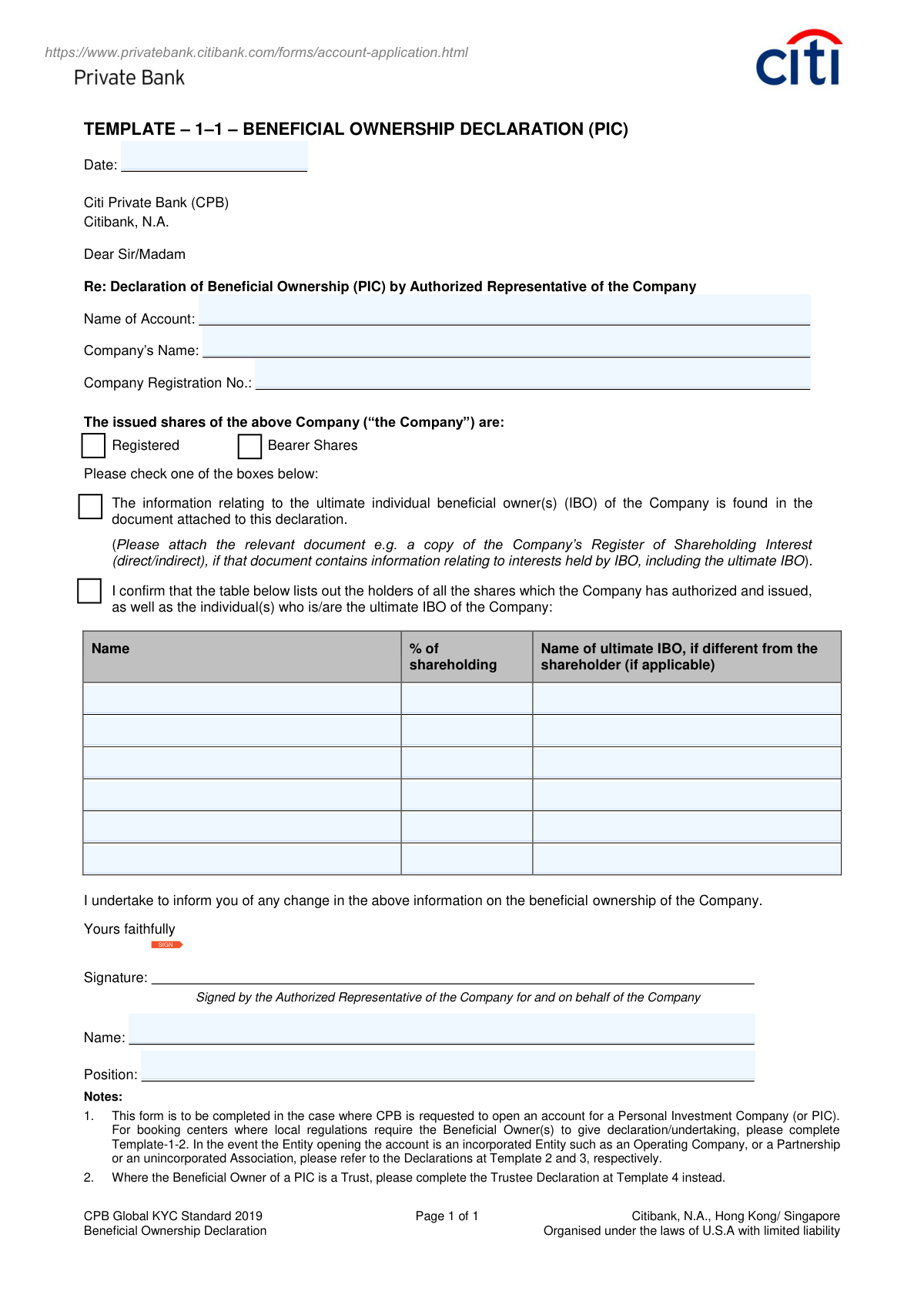
If you are establishing or managing a Private Bank account with Citibank for a Personal Investment Company (PIC), you will specifically need the Template 1-1, Beneficial Ownership Declaration (PIC).
This form is mandatory for several key regulatory functions:
- Identifying Ultimate Owners: It is used to document the Individual Beneficial Owners (IBOs) who ultimately control or profit from the entity.
- Regulatory Compliance: It helps your organization meet strict Anti-Money Laundering (AML) and Know Your Customer (KYC) standards required by global financial regulators.
- Institutional Requirements: This specific template is tailored to fulfill the documentation protocols set by Citibank Private Bank during the onboarding process.
When to Use This Form
You should select the Template 1-1, Beneficial Ownership Declaration (PIC) if your entity is classified as a PIC and you are currently undergoing the onboarding process or a periodic review with Citibank. Providing this declaration ensures that the bank has a clear, verified record of all individuals with a significant interest in the company, preventing administrative delays in account activation.
Streamlining Your Disclosure Process
Corporate disclosure forms often require precise legal and personal information that can be tedious to enter manually. Using Instafill.ai, you can complete the Template 1-1, Beneficial Ownership Declaration (PIC) efficiently by leveraging AI to help populate fields from your existing corporate records. If you are working with a non-interactive PDF version of this template, our platform can convert it into a fillable format, ensuring all required fields are addressed accurately before submission.
Form Comparison
| Form | Purpose | Primary Entity | Compliance Focus |
|---|---|---|---|
| Template 1-1, Beneficial Ownership Declaration (PIC) | Identifies ultimate individual beneficial owners for account verification and documentation. | Personal Investment Companies (PIC) opening accounts with Citibank Private Bank. | Adherence to financial regulations and Anti-Money Laundering (AML) standards. |
Tips for corporate disclosure forms
Ensure you are listing the natural persons who ultimately own or control the entity, rather than just listing other holding companies or legal entities. Financial institutions require the names of the actual individuals behind the corporate layers to satisfy anti-money laundering and 'Know Your Customer' standards.
Double-check that the total ownership percentages listed for all beneficial owners align with your company’s share register or articles of incorporation. Even a small discrepancy can cause the form to be flagged during the compliance review process, leading to significant delays.
Leverage AI-powered tools like Instafill.ai to complete these complex corporate forms in under 30 seconds with high accuracy. This technology ensures your sensitive data stays secure during the process while eliminating the need for tedious manual data entry across multiple fields.
Cross-reference the details on your disclosure form with other account opening documents to ensure names, addresses, and dates of birth are identical. Inconsistent information across different forms is a common reason for rejection by bank compliance departments.
Have digital copies of government-issued IDs and proof of residency for every individual named in the declaration ready before you start. Most corporate disclosures for private banking require these documents to be submitted alongside the form to verify the identities of the beneficial owners.
If your company is owned by a trust or foundation, clearly specify the roles of trustees, protectors, or beneficiaries as they relate to the beneficial ownership. Providing a clear organizational chart can help the bank understand complex structures more quickly and reduce follow-up questions.
Frequently Asked Questions
Corporate disclosure forms are used by financial institutions and regulatory bodies to identify the individuals who ultimately own or control a legal entity. These documents help organizations comply with Anti-Money Laundering (AML) and Know Your Customer (KYC) regulations by ensuring transparency in corporate structures.
This declaration is generally required by legal entities, such as Personal Investment Companies (PICs), when they are opening a new bank account or updating existing account information. Any individual who meets the criteria for significant ownership or control must be disclosed on the form.
For Personal Investment Companies (PICs) banking with Citibank, Template 1-1 is the standard Beneficial Ownership Declaration. This specific form is designed to capture the details of ultimate individual beneficial owners to meet the bank's internal compliance standards.
You will typically need to provide the full legal name, residential address, date of birth, and tax identification details for every beneficial owner. Some forms also require information regarding the percentage of ownership or the specific nature of the individual's control over the entity.
Yes, AI tools like Instafill.ai can fill out complex corporate disclosure forms in under 30 seconds. These systems accurately extract data from your source documents and place it into the correct fields on the PDF, reducing the risk of manual entry errors.
While manual completion can take significant time due to the precision required, using an AI-powered service allows you to complete the process almost instantly. The AI can convert non-fillable PDFs into interactive forms and populate them using your existing data records.
An IBO is generally defined as any natural person who ultimately owns or controls a company, often through a threshold of 25% or more of the shares or voting rights. It also includes individuals who exercise significant influence over the company's management or decision-making processes.
Most banking-specific disclosure forms, such as the PIC declaration, should be submitted directly to your relationship manager or the bank's compliance department. Unlike some corporate filings, these are usually kept on file by the financial institution rather than a public government registry.
Failure to provide accurate beneficial ownership information can result in the rejection of a bank account application or the freezing of existing accounts. Financial institutions are legally barred from providing services to entities that do not satisfy mandatory transparency and AML requirements.
Yes, most financial institutions require an updated disclosure whenever there is a significant change in the ownership structure or the individuals in control. Regularly updating these forms ensures that the company remains in good standing with the bank's compliance department.
Glossary
- Form Complexity Index
- Instafill’s 0–100 measure of how much effort a form takes to complete, calculated deterministically from the form’s own structure rather than estimated. It combines the number of fillable fields (the largest factor), how difficult those fields are to complete based on their type, the number of pages that contain fields, the amount of conditional “fill-only-if” logic, and how many sections the form is divided into, then adds modifiers for tables and repeating lists, bundled instruction pages, and dense page layouts. A higher score means the form is harder to fill out by hand. The forms in this category have a median Form Complexity Index of 34/100 (Basic). See exactly how it is calculated.
- Ultimate Beneficial Owner (UBO)
- The natural person who ultimately owns or controls a legal entity, typically defined as someone holding more than 25% of the shares or voting rights.
- Personal Investment Company (PIC)
- A private entity established by an individual or family to manage their personal assets and investments rather than engaging in active commercial trade.
- Anti-Money Laundering (AML)
- A set of laws and regulations requiring financial institutions to monitor and report suspicious activity to prevent the concealment of illegally obtained funds.
- Know Your Customer (KYC)
- A mandatory due diligence process used by banks to verify the identity of their clients and assess potential risks in the business relationship.
- Control Person
- An individual with significant authority to manage or direct the operations of a legal entity, such as a Chief Executive Officer, President, or Managing Member.
- Legal Entity
- An association, corporation, partnership, or trust that has legal standing and is recognized by law as having its own rights and duties separate from its owners.
- Intermediate Holding Company
- A company that sits between the operational level of a business and the ultimate owners in a corporate hierarchy, often used for structural or tax purposes.
- Passive NFFE
- A Non-Financial Foreign Entity that primarily earns passive income, such as dividends, interest, or rents, rather than income from active business operations.