Fill out disability insurance forms
with AI.
Disability insurance forms serve as the essential link between a medical condition and the financial support needed during a period of illness or injury. These documents are used to establish a claimant's eligibility for benefits, providing insurance carriers and government agencies with the necessary data to evaluate the impact of a disability on one's ability to work. Whether you are dealing with a short-term setback or a long-term condition, completing these forms accurately is a vital step in securing income protection and ensuring your claim is processed without unnecessary delays.
By continuing, you acknowledge Instafill's Privacy Policy and agree to get occasional product update and promotional emails.
About disability insurance forms
This category typically includes forms for individuals filing new claims, physicians providing medical evidence, and employers managing group benefit selections. For example, claimants may need to provide exhaustive accounts of their vocational background through employment history forms or submit specific applications like the VA Form 29-357 for government-backed insurance. Because these documents often require 15–20 years of work history and detailed clinical assessments, they can be time-consuming and mentally taxing to complete during a health crisis. Tools like Instafill.ai use AI to fill these disability insurance forms in under 30 seconds, handling sensitive data accurately and securely to streamline the application process.
Every form on this page can be completed without typing. Instafill is form filling software that reads a PDF and fills it for you — including flat and scanned documents that carry no fillable fields at all.
Forms in This Category
The forms in this category have a median Form Complexity Index of 69/100 (Complex), measured across 7 forms by field count, input difficulty, length, conditional logic and structure. See how it is calculated.
- Enterprise-grade security & data encryption
- 99%+ accuracy powered by AI
- 1,000+ forms from all industries
- Complete forms in under 60 seconds
How to Choose the Right Form
Navigating disability insurance paperwork can be complex, as the forms vary significantly depending on whether you are an individual claimant, a medical professional, or an employer setting up a plan. To find the correct document, identify your specific role and the insurance carrier involved.
For Prudential Claimants
If you are currently managing a claim through Prudential, you will likely need to provide a detailed account of your professional background. The Prudential Group Disability Insurance – Education and Employment History Form (GL.2009.009) is the standard document used to assess your vocational skills and past work experience. This helps the insurer determine if your disability prevents you from performing your specific job or other types of work based on your education and training.
For Veterans and Government Policyholders
Veterans who hold Government Life Insurance and have become totally disabled should look for VA Form 29-357, Claim for Disability Insurance Benefits. This form is dual-purpose: it allows you to apply for disability benefits and request a waiver of premiums. Note that this form requires a medical report (Part II) to be completed by a licensed practitioner or hospital official to substantiate the claim.
Medical and Physician Statements
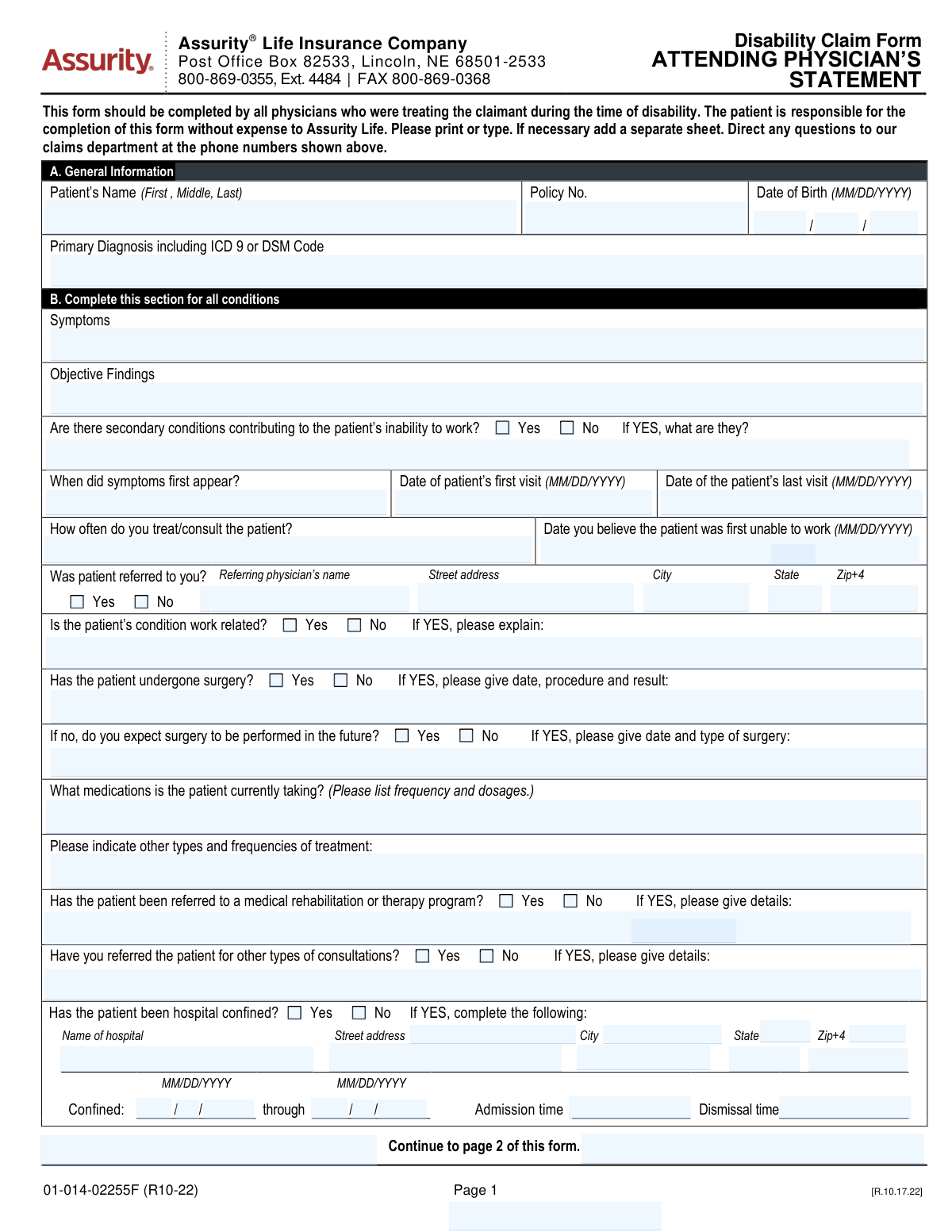
If you are a healthcare provider or a claimant needing to submit clinical evidence for an Assurity policy, use the Assurity Life Insurance Company Disability Claim Form — Attending Physician’s Statement. This form focuses on objective medical findings, ICD diagnoses, and specific work restrictions. It is essential for establishing the medical necessity and duration of the disability.
For Employers and Plan Selection
If you are an employer or HR representative looking to establish or update a benefits package, use the Principal Group Disability Insurance Options (Forms GC 3000-2, GC 4000-2, GP53705-05). Unlike the other forms in this category, this is a selection guide used to customize short-term and long-term disability coverage levels for a company's workforce.
Form Comparison
| Form | Purpose | Who Files It | When to Use |
|---|---|---|---|
| Prudential Group Disability Insurance – Education and Employment History Form (GL.2009.009, Ed. 06/2017) | Document employment history and skills for disability claim evaluation | Claimant (disabled employee) | During ongoing Prudential group disability claim review |
| Assurity Life Insurance Company Disability Claim Form — Attending Physician's Statement | Provide medical evidence of disability diagnosis and work restrictions | Attending/treating physician | When filing or supporting an Assurity disability insurance claim |
| The Prudential Insurance Company of America Group Disability Insurance – Education and Employment History Form (GL.2009.009, Ed. 06/2017) | Assess occupational background and transferable skills for claim eligibility | Claimant (disabled employee) | During Prudential Disability Management Services claim evaluation |
| VA Form 29-357, Claim for Disability Insurance Benefits (Government Life Insurance) | Claim disability benefits and premium waiver under Government Life Insurance | Veteran (Part I) and licensed physician or hospital official (Part II) | When veteran becomes totally disabled before age 65 |
| Prudential Group Disability Insurance – Education and Employment History Form (GL.2009.009, Ed. 06/2017) | Gather job history and return-to-work data for ongoing claim review | Claimant (disabled employee) | When Prudential requests employment background during claim process |
| VA Form 29-357, Claim for Disability Insurance Benefits (Government Life Insurance) | Apply for VA disability benefits and waiver of life insurance premiums | Veteran or representative (Part I) and attending practitioner (Part II) | When veteran with Government Life Insurance becomes totally disabled |
Tips for disability insurance forms
Many disability forms, such as those from Prudential, require a job history spanning up to 20 years. Be sure to list specific skills, such as computer proficiency or physical tasks, as insurers use this data to determine your transferable skills and vocational options.
Forms like the Assurity Claim Form or VA Form 29-357 require an Attending Physician’s Statement or medical report. Share these forms with your doctor early to ensure they have enough time to document clinical findings, symptoms, and specific work restrictions accurately.
Have documents like Social Security disability award letters or hospital discharge summaries ready when you begin. These documents often contain the exact onset dates and diagnostic codes needed to satisfy the requirements of both private and government insurance claims.
You can complete complex disability insurance forms in under 30 seconds with high accuracy by using AI-powered tools like Instafill.ai. This is a significant time-saver for those managing multiple claims, and the platform ensures your sensitive medical and personal data stays secure during the process.
A common mistake is missing a signature on the fraud notice or the authorization for the release of information. Review your completed forms to ensure every certification and signature field is filled, as missing signatures are a primary cause of claim processing delays.
Always save a copy of the final, signed version of your disability forms for your personal records. This helps you maintain consistency across future updates and provides a reference point if the insurance company requests clarification on your employment or medical history.
Frequently Asked Questions
Disability insurance forms are used to initiate or maintain a claim for benefits when an illness or injury prevents you from working. These documents allow insurance carriers, such as Prudential or Assurity, to evaluate your medical condition, work history, and eligibility for financial support under your specific policy.
A complete disability claim typically involves multiple parties. The claimant provides personal and employment history, the attending physician submits clinical evidence of the disability, and the employer may need to verify salary and specific job requirements.
Insurers request extensive work and education history to perform a vocational assessment. By understanding your past roles, skills, and training, the insurance company can determine if your disability prevents you from performing only your current job or if you are unable to perform any occupation for which you are reasonably qualified.
Yes, AI tools like Instafill.ai can fill out disability insurance forms in under 30 seconds. The platform accurately extracts data from your source documents and places it into the correct fields on forms like the VA 29-357 or Prudential claimant questionnaires, reducing the risk of manual entry errors.
An Attending Physician’s Statement is a critical medical document completed by your doctor. It provides the insurer with objective findings, such as ICD diagnoses, treatment plans, and specific physical or cognitive restrictions that limit your ability to work.
While manual completion of these detailed forms can take several hours, using an AI-powered service like Instafill.ai allows you to complete them in under a minute. The AI handles the data mapping and extraction, significantly speeding up the application process.
Veterans with Government Life Insurance should use VA Form 29-357 if they become totally disabled before age 65. This form acts as a claim for disability benefits and can also be used to request a waiver of insurance premiums while the disability persists.
Most claims require a signed claimant statement, a detailed education and employment history, and a medical certification from a licensed practitioner. You may also be asked to provide supporting evidence such as a Social Security disability award letter or hospital discharge summaries.
Claimant forms are for individuals seeking benefits due to a disability. In contrast, selection guides like those from Principal are used by employers to build and customize the disability insurance packages they offer to their employees, covering options like benefit percentages and waiting periods.
Submission instructions vary by provider, but forms are generally sent directly to the insurance company's claims department or the government agency managing the benefit. Many providers now offer secure online portals, though some may still require submission via mail or fax to ensure signature authenticity.
Glossary
- Form Complexity Index
- Instafill’s 0–100 measure of how much effort a form takes to complete, calculated deterministically from the form’s own structure rather than estimated. It combines the number of fillable fields (the largest factor), how difficult those fields are to complete based on their type, the number of pages that contain fields, the amount of conditional “fill-only-if” logic, and how many sections the form is divided into, then adds modifiers for tables and repeating lists, bundled instruction pages, and dense page layouts. A higher score means the form is harder to fill out by hand. The forms in this category have a median Form Complexity Index of 69/100 (Complex). See exactly how it is calculated.
- Attending Physician’s Statement (APS)
- A medical report completed by your treating doctor that provides clinical evidence of your condition. It is used by insurance companies to verify the severity of your disability and determine your eligibility for benefits.
- Elimination Period
- The specific amount of time you must be disabled before benefit payments begin, often referred to as a waiting period. No benefits are paid during this time, and you must remain disabled throughout the duration to qualify.
- Short-Term vs. Long-Term Disability (STD/LTD)
- Short-term disability typically covers a portion of your income for a few months, while long-term disability is intended for extended illnesses or injuries that last years or until retirement age.
- Transferable Skills
- The education, training, and work experience you possess that could allow you to perform a different type of job. Insurers evaluate these to see if you can work in another capacity if you can no longer perform your current role.
- Waiver of Premium
- A policy feature that allows you to stop paying your insurance premiums while you are disabled without losing your coverage. This ensures your life or disability insurance stays active even when you have no income.
- Functional Limitations
- Specific physical or mental restrictions defined by a doctor, such as an inability to lift more than ten pounds or sit for more than an hour. These limitations are used to prove that you are unable to fulfill your job requirements.
- ICD Codes
- A standardized system of medical codes (such as ICD-9 or ICD-10) used by healthcare providers to classify diseases and health problems. These codes are required on claim forms to provide an exact medical diagnosis to the insurer.
- Vocational Assessment
- A process where an insurance company evaluates your work history and skills to determine your potential for returning to the workforce. This often involves reviewing your education and previous job duties to plan for future employment options.