Fill out DNR forms
with AI.
DNR (Do Not Resuscitate) forms are critical components of advance healthcare planning. They are legal documents that communicate a person's preference to forgo life-sustaining treatments, such as CPR or intubation, in the event of cardiac or respiratory arrest. These forms are essential for ensuring that medical professionals respect an individual's wishes during emergency situations, particularly when the patient is unable to speak for themselves. By establishing clear boundaries for medical intervention, these documents provide peace of mind for both the individual and their loved ones.
By continuing, you acknowledge Instafill's Privacy Policy and agree to get occasional product update and promotional emails.
About DNR forms
These forms are typically utilized by individuals with chronic illnesses, those nearing the end of life, or anyone who has specific preferences regarding medical directives. They are especially important in "out-of-hospital" contexts, where emergency responders might otherwise be legally obligated to perform resuscitation. Whether you are coordinating care for an elderly family member or documenting your own end-of-life forms, having these papers properly completed and accessible is a vital step in advance directive planning.
Completing these sensitive medical directive forms requires high accuracy to ensure they are legally recognized and clear to healthcare providers. Tools like Instafill.ai use AI to fill these forms in under 30 seconds, handling the data accurately and securely to save time during the planning process. This allows you to focus on the important conversations with your family and physicians rather than the logistics of paperwork.
Every form on this page can be completed without typing. Instafill is form filling software that reads a PDF and fills it for you — including flat and scanned documents that carry no fillable fields at all.
Forms in This Category
The forms in this category have a median Form Complexity Index of 67/100 (Complex), measured across 1 forms by field count, input difficulty, length, conditional logic and structure. See how it is calculated.
| Form Name | Pages | FCI | |
|---|---|---|---|
| 1. | Texas Out-of-Hospital Do-Not-Resuscitate (OOH-DNR) Order | 1 | Complex 67 |
- Enterprise-grade security & data encryption
- 99%+ accuracy powered by AI
- 1,000+ forms from all industries
- Complete forms in under 60 seconds
How to Choose the Right Form
Choosing the right documentation for end-of-life care is a critical step in ensuring your medical wishes are honored. While many people look for general medical directive forms, the specific legal requirements vary significantly by state and the setting in which medical care is provided.
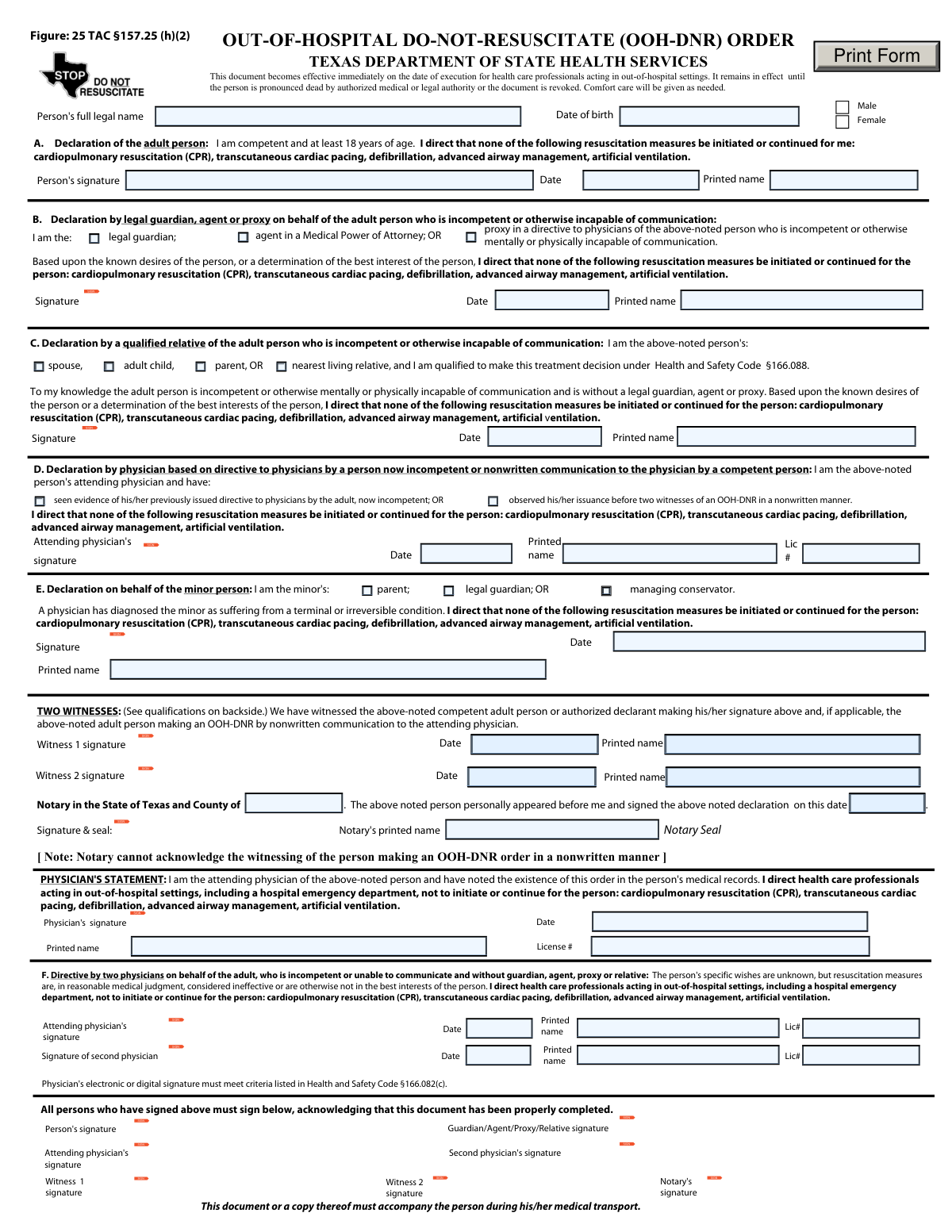
The Texas Out-of-Hospital Do-Not-Resuscitate (OOH-DNR) Order
If you are a resident of Texas or are currently receiving medical care within the state, the Texas Out-of-Hospital Do-Not-Resuscitate (OOH-DNR) Order is the primary legal document used to communicate your refusal of life-sustaining treatments in non-hospital environments.
You should choose this specific form if:
- You are in a non-hospital setting: This includes your private residence, assisted living facilities, nursing homes, or during transport via ambulance.
- You want to refuse specific interventions: This form explicitly instructs emergency medical services (EMS) and other healthcare professionals to withhold cardiopulmonary resuscitation (CPR), transcutaneous cardiac pacing, defibrillation, advanced airway management, and artificial ventilation.
- You have a terminal or irreversible condition: Typically, this form is completed by individuals who wish to allow for a natural death without aggressive intervention in the event of cardiac or respiratory arrest.
How it Differs from Other Advance Directives
It is important to distinguish the Texas OOH-DNR Order from other end-of-life forms you may encounter:
- Living Wills / Directive to Physicians: While a Living Will provides broad instructions for your care if you become incapacitated, the OOH-DNR is a specific medical order that emergency responders can follow immediately upon sight.
- In-Hospital DNR: A standard DNR issued within a hospital only applies during that specific stay. The OOH-DNR remains valid across different locations outside the hospital walls.
Using Instafill.ai allows you to complete the Texas OOH-DNR Order accurately before taking it to your attending physician for the required signature, ensuring the document is legally binding and ready when it is needed most.
Form Comparison
| Form | Purpose | Who Signs | Setting |
|---|---|---|---|
| Texas Out-of-Hospital Do-Not-Resuscitate (OOH-DNR) Order | Refuse life-sustaining treatments like CPR to allow for a natural death. | The patient or their legal representative and the attending physician. | Outside of hospitals, including homes, nursing facilities, or during medical transport. |
Tips for DNR forms
Discuss your medical history and specific end-of-life wishes with a healthcare provider before completing these forms. They can help you understand the clinical implications of opting out of resuscitation and ensure the form accurately reflects your medical needs.
Unlike a standard will, a DNR form must be found immediately during an emergency to be effective. Keep a copy on your refrigerator, in a glove box, or in a clearly marked folder near your front door so emergency responders can locate it instantly.
A DNR specifically addresses resuscitation efforts during cardiac or respiratory arrest. It does not replace a Living Will or Medical Power of Attorney, which cover broader preferences like tube feeding or appointing someone to make decisions on your behalf.
Many states require medical directives to be signed by disinterested witnesses or a notary public to be legally enforceable. Carefully review the signature section to ensure you meet all local requirements so the form is valid when it is needed most.
AI-powered tools like Instafill.ai can complete these forms in under 30 seconds with high accuracy, ensuring no critical fields are left blank. Your data stays secure during the process, providing a fast and reliable way to manage sensitive end-of-life documentation.
Once the form is signed, make sure your family members and designated healthcare proxy are aware of its location and your intent. Clear communication ahead of time prevents confusion and ensures your wishes are honored by loved ones during a crisis.
Frequently Asked Questions
A Do-Not-Resuscitate (DNR) form is a legal medical document that instructs healthcare providers not to perform CPR or other life-saving measures if a person's heart stops or they stop breathing. It is part of a broader set of advance directives designed to ensure a person's end-of-life wishes are honored by emergency responders and medical staff.
These forms are typically used by individuals with terminal illnesses, chronic health conditions, or those who wish to avoid invasive resuscitation procedures in non-hospital settings. It is recommended for anyone who wants to ensure their medical preferences are clear to first responders, such as EMTs and paramedics, who arrive at a home or public location.
An Out-of-Hospital DNR (OOH-DNR) is specifically designed for settings outside of a clinical hospital environment, such as a private home, nursing facility, or during transport. In contrast, in-hospital DNR orders are usually entered into a patient's medical record by a physician specifically for the duration of an inpatient stay.
It is important to keep the original signed form in an easily accessible and visible location, such as on the refrigerator or near the patient's bed. You should also provide copies to your primary care physician, family members, and any designated healthcare proxy to ensure the directive is known before an emergency occurs.
Generally, DNR forms do not have a set expiration date and remain valid as long as the patient's condition and wishes remain the same. However, it is a best practice to review the document periodically with a physician to ensure it still reflects current medical preferences and complies with any updated state regulations.
No, while both are types of advance directives, they serve different purposes. A Living Will outlines broader preferences for medical treatment and end-of-life care, whereas a DNR is a specific medical order focused strictly on refusing resuscitation efforts like chest compressions and defibrillation.
Yes, you can use AI to fill out DNR forms efficiently. Platforms like Instafill.ai use advanced data extraction to ensure accuracy when populating medical directive forms, and they can even turn non-fillable PDF versions into interactive documents for easier completion.
Filling out these forms online using AI tools like Instafill.ai usually takes under 30 seconds. The AI accurately extracts relevant data from your source documents and places it directly into the required fields, significantly reducing the manual effort and potential for errors.
For a DNR form to be valid, it typically requires the signature of the individual (or their legal guardian) and a licensed physician. Depending on state laws, the form may also require the signatures of competent witnesses or a notary public to verify the identity of the person making the request.
Yes, a DNR order can be revoked at any time by the individual, regardless of their physical or mental condition. This can be done by physically destroying the document, verbally informing medical personnel of the change in wishes, or creating a new directive that explicitly supersedes the previous one.
Emergency responders are trained to look for DNR indicators, such as the original form or a state-approved DNR bracelet, upon arrival. If they cannot quickly locate the documentation or verify its validity, they are legally required to provide full resuscitation efforts until the form is presented.
Glossary
- Form Complexity Index
- Instafill’s 0–100 measure of how much effort a form takes to complete, calculated deterministically from the form’s own structure rather than estimated. It combines the number of fillable fields (the largest factor), how difficult those fields are to complete based on their type, the number of pages that contain fields, the amount of conditional “fill-only-if” logic, and how many sections the form is divided into, then adds modifiers for tables and repeating lists, bundled instruction pages, and dense page layouts. A higher score means the form is harder to fill out by hand. The forms in this category have a median Form Complexity Index of 67/100 (Complex). See exactly how it is calculated.
- DNR (Do Not Resuscitate)
- A medical order instructing healthcare providers not to attempt life-saving measures like CPR if your heart stops or you stop breathing.
- OOH-DNR (Out-of-Hospital Do-Not-Resuscitate)
- A specific legal document that ensures your wish to refuse resuscitation is honored in non-hospital settings, such as your home, workplace, or during emergency transport.
- Advance Directive
- A general term for legal documents, including DNRs and living wills, that specify your medical treatment preferences if you become unable to communicate them yourself.
- CPR (Cardiopulmonary Resuscitation)
- An emergency procedure involving chest compressions and rescue breaths used to manually pump blood and oxygen when a person's heart has stopped.
- Medical Power of Attorney
- A legal designation that grants a specific person the authority to make healthcare decisions on your behalf if you are mentally or physically incapacitated.
- Artificial Ventilation
- The use of mechanical devices, such as ventilators or respirators, to assist or replace a patient's natural breathing process.
- Defibrillation
- The delivery of a therapeutic dose of electrical energy to the heart to stop an irregular rhythm and allow a normal heartbeat to resume.
- Attending Physician
- The primary doctor responsible for a patient's care who must usually certify and sign the DNR form for it to be legally valid.