Fill out DS forms
with AI.
Department of State (DS) forms represent a critical set of documents used by the U.S. government to manage various international and administrative processes. These forms cover a broad spectrum of needs, ranging from immigration and visa applications to specific medical clearances required for overseas service. Because these documents are used to establish legal status or eligibility for government programs, ensuring the accuracy of the information provided is essential for avoiding administrative delays or processing errors.
By continuing, you acknowledge Instafill's Privacy Policy and agree to get occasional product update and promotional emails.
About DS forms
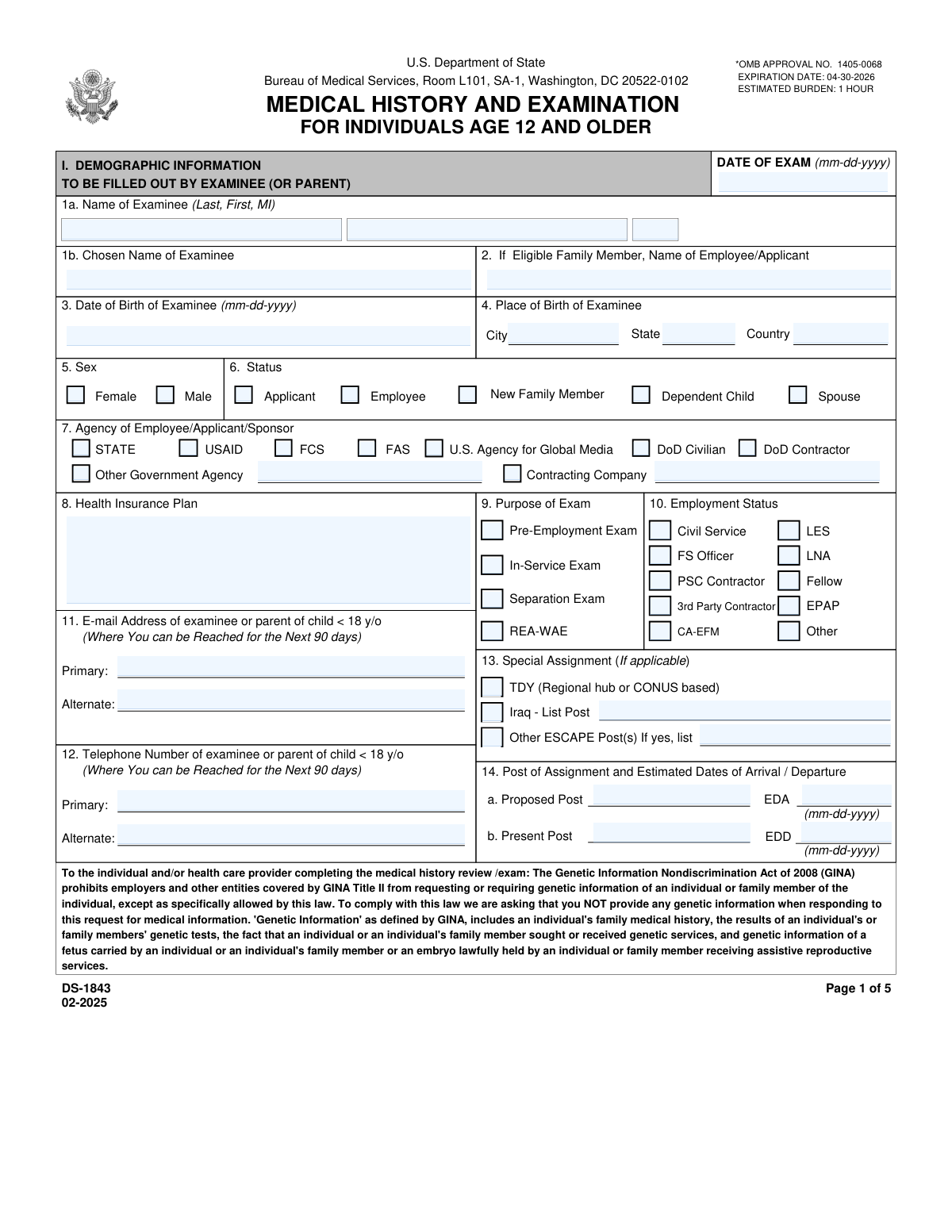
Typically, these forms are required by government employees, contractors, and their family members who are preparing for international assignments, as well as individuals navigating the immigration system. For instance, medical history forms like the DS-1843 are used to evaluate the health of individuals age 12 and older to ensure they are fit for duty or travel to specific global locations. Completing these forms often involves detailing extensive personal histories and clinical data, which can be a time-consuming and meticulous task for families and professionals alike.
To simplify this process, tools like Instafill.ai use AI to fill these DS forms in under 30 seconds, ensuring data is handled accurately and securely. This approach helps individuals manage their documentation efficiently, allowing them to focus on their preparations for travel or employment rather than the complexities of manual paperwork.
Every form on this page can be completed without typing. Instafill is form filling software that reads a PDF and fills it for you — including flat and scanned documents that carry no fillable fields at all.
Forms in This Category
The forms in this category have a median Form Complexity Index of 77/100 (Complex), measured across 1 forms by field count, input difficulty, length, conditional logic and structure. See how it is calculated.
| Form Name | Pages | FCI | |
|---|---|---|---|
| 1. | Form DS-1843, Medical History and Examination for Individuals Age 12 and Older | 5 | Complex 77 |
- Enterprise-grade security & data encryption
- 99%+ accuracy powered by AI
- 1,000+ forms from all industries
- Complete forms in under 60 seconds
How to Choose the Right Form
Navigating Department of State (DS) documentation can be complex, as these forms cover everything from visa applications to employee health clearances. When selecting the correct document from this category, your choice depends primarily on your relationship with the U.S. government and the specific administrative requirement you are trying to fulfill.
Medical Clearance for Overseas Posts
Most forms in this category are designed to ensure that employees and their families are medically fit for assignments at international posts. Choosing the right one is usually determined by the age of the applicant.
- Form DS-1843 (Medical History and Examination for Individuals Age 12 and Older): This is the essential document for adults and adolescents preparing for overseas service. You should choose Form DS-1843 if you are an employee, an applicant, or a family member aged 12 or older. It is a comprehensive form that requires you to provide a detailed medical history and includes sections that must be completed by a licensed medical professional during a clinical examination.
Determining Your Need
To ensure you are filling out the correct paperwork, consider the following criteria:
- Age of the Applicant: If the individual is under 12 years old, Form DS-1843 is not the correct choice; you would typically look for the pediatric equivalent (such as the DS-1144). For everyone else, the DS-1843 is the standard requirement.
- Purpose of Submission: This form is specifically for determining medical clearance for foreign service. If you are looking for immigration-related DS forms (like the DS-160 for non-immigrant visas), ensure you are in the correct sub-category, as medical clearance forms serve a very specific administrative function for the Department of State’s medical office.
Using Instafill.ai, you can quickly convert these detailed PDFs into interactive forms, making it easier to manage the extensive demographic and health data required by the Department of State.
Form Comparison
| Form | Purpose | Who Files It | Key Sections |
|---|---|---|---|
| Form DS-1843, Medical History and Examination for Individuals Age 12 and Older | Evaluates medical clearance for Department of State employees and families for overseas assignments. | Employees, job applicants, and family members aged 12 and older. | Demographic data, detailed medical history, and comprehensive clinical examination results. |
Tips for DS forms
Collect your immunization records, past diagnosis dates, and current medication lists before you begin filling out DS medical forms. Having these details ready prevents errors and ensures you don't have to pause mid-way to search for specific health history information.
When submitting forms for multiple family members, ensure that shared information like residential history and contact details is identical across all documents. Discrepancies in basic facts can lead to administrative delays or additional questions from the Department of State.
AI-powered tools like Instafill.ai can complete these complex forms in under 30 seconds with high accuracy. This is a significant time-saver for those managing multiple DS forms, and your sensitive personal health data remains secure throughout the entire process.
A common mistake is leaving sections empty if they don't seem to apply. Instead, use 'N/A' or 'None' as appropriate to show the reviewer that you have addressed every question, which helps avoid the form being returned as incomplete.
Many DS medical forms require the results of specific clinical examinations or specialist consultations. Keep digital copies of these reports organized so you can accurately transcribe the data and quickly attach necessary documentation to your submission.
Check the specific instructions for each DS form to see if it requires a digital signature, a physical signature, or a witness. Some medical forms must be signed in the presence of a healthcare provider or a notary to be considered valid for clearance.
Frequently Asked Questions
DS forms are official documents issued by the U.S. Department of State for various administrative processes, including visa applications, passport services, and medical clearances. In this specific category, the forms focus on medical history and health examinations required for individuals associated with overseas government assignments.
These forms are typically required for U.S. government employees, job applicants, and their eligible family members who are being considered for an assignment at a foreign post. The data collected helps the Department of State determine if the individual's health status is compatible with the medical resources available at a specific overseas location.
Yes, AI tools like Instafill.ai can be used to fill out DS forms quickly and accurately. These systems can extract relevant data from your source documents and place it into the correct form fields in under 30 seconds, ensuring high precision and saving significant time.
While manual entry for detailed medical history can take an hour or more, using an AI-powered service can reduce that time to less than a minute. AI technology automates the data placement process, allowing you to review and submit the form almost instantly.
Yes, the Department of State often utilizes different versions of medical forms based on the age of the individual. For example, specific forms exist for individuals age 12 and older to capture age-appropriate medical history and clinical examination results.
It is helpful to have your immunization records, a list of current medications, details of past surgeries, and any chronic health condition history on hand. Having these records ready allows AI tools or manual entry to proceed more smoothly without interruptions.
In most cases, DS medical forms include a section that must be completed and signed by a licensed medical professional following a physical examination. While you can fill out the personal history sections yourself, the clinical results must be verified by an authorized physician.
Completed forms are generally submitted to the U.S. Department of State's Office of Medical Services (MED). You should follow the specific submission instructions provided by your human resources representative or the medical office handling your clearance.
Medical clearances for overseas service are typically valid for a specific period, often two years, or until a person is assigned to a new post. You may be required to submit updated DS forms if your health status changes significantly or when your current clearance is nearing expiration.
Errors on official forms can cause delays in your medical clearance processing or your ability to travel to an overseas post. If you discover an error after submission, you should contact the Office of Medical Services immediately to provide a corrected version of the document.
Glossary
- Form Complexity Index
- Instafill’s 0–100 measure of how much effort a form takes to complete, calculated deterministically from the form’s own structure rather than estimated. It combines the number of fillable fields (the largest factor), how difficult those fields are to complete based on their type, the number of pages that contain fields, the amount of conditional “fill-only-if” logic, and how many sections the form is divided into, then adds modifiers for tables and repeating lists, bundled instruction pages, and dense page layouts. A higher score means the form is harder to fill out by hand. The forms in this category have a median Form Complexity Index of 77/100 (Complex). See exactly how it is calculated.
- Medical Clearance
- The official determination by the Department of State regarding whether an individual's health status allows them to serve at a specific overseas diplomatic mission.
- Eligible Family Member (EFM)
- A spouse, child, or other legal dependent of a U.S. government employee who is authorized to accompany the employee to an overseas post and must undergo medical screening.
- Bureau of Medical Services (MED)
- The specialized department within the U.S. Department of State that reviews medical history forms and manages health care for employees serving abroad.
- Post
- A specific U.S. embassy, consulate, or diplomatic mission located in a foreign country where an individual is assigned to work or live.
- Class 1 Clearance
- A medical designation indicating that an individual is 'worldwide available' and has no health conditions requiring specialized care that would limit their assignment locations.
- Class 2 Clearance
- A medical designation indicating that an individual has a health condition that limits their assignments to specific geographic locations where appropriate medical facilities are available.
- Foreign Service (FS)
- The primary personnel system of the U.S. Department of State, consisting of employees who are required to be available for assignment to any overseas post.