Fill out E-Verify forms
with AI.
E-Verify is a web-based system that allows enrolled employers to confirm the eligibility of their employees to work in the United States. It involves matching information provided by employees on the Form I-9 against records available to the Social Security Administration (SSA) and the Department of Homeland Security (DHS). These forms are critical because they ensure a legal workforce and help businesses maintain compliance with federal immigration laws. For many federal contractors and employers in specific states, participation in E-Verify is not just a best practice but a legal requirement.
By continuing, you acknowledge Instafill's Privacy Policy and agree to get occasional product update and promotional emails.
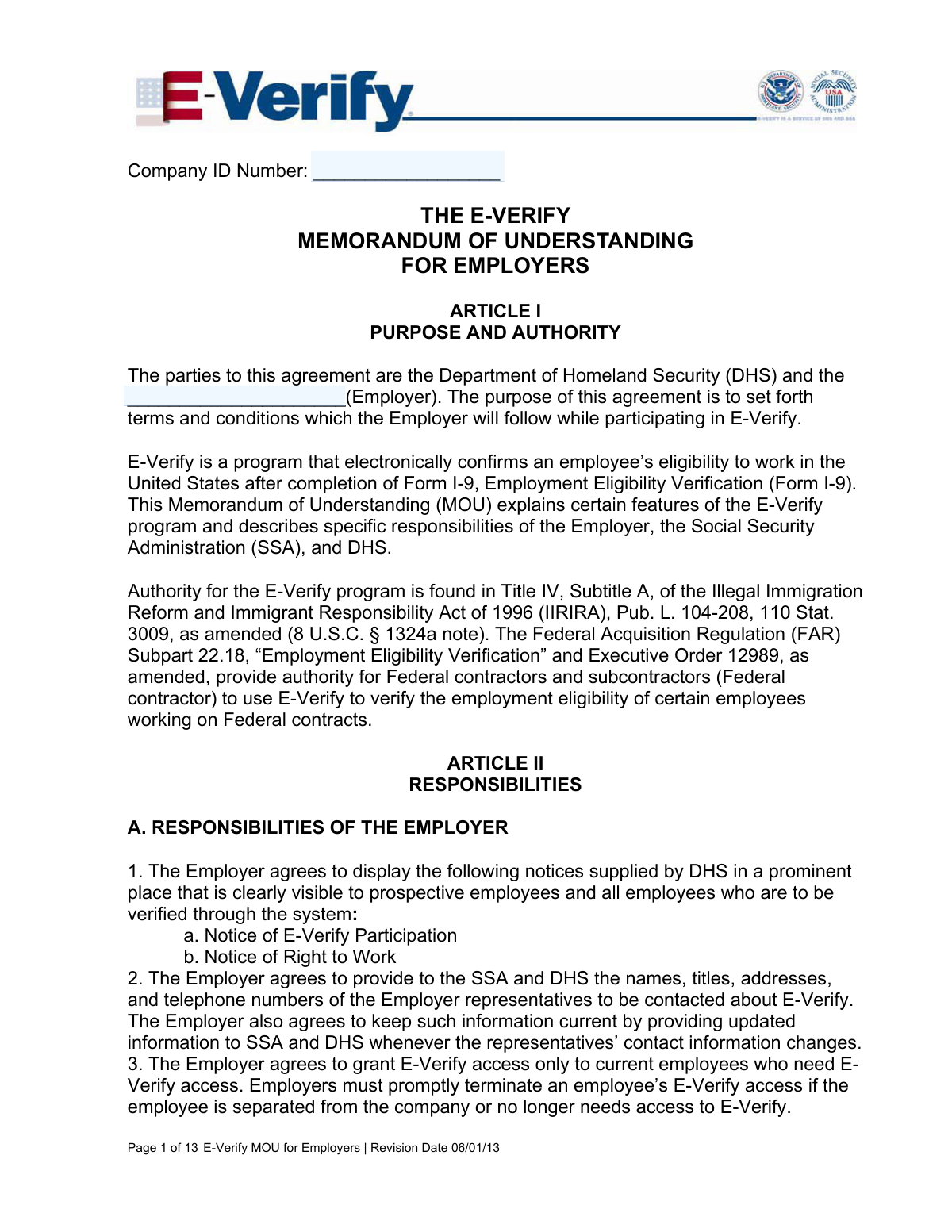
About E-Verify forms
Human resources professionals, business owners, and legal compliance officers typically handle E-Verify documentation during the onboarding process of new hires. The most significant document in this category is the Memorandum of Understanding (MOU), which establishes the formal agreement between the employer and the government. Completing these forms accurately is essential to avoid legal discrepancies or delays in the hiring process. Whether you are a small business owner hiring your first employee or a large corporation managing high-volume recruitment, staying current with E-Verify requirements is a fundamental part of modern workforce management.
Managing government documentation can be time-consuming, but tools like Instafill.ai use AI to fill these forms in under 30 seconds while ensuring data is handled accurately and securely. This allows employers to focus on their core operations rather than getting bogged down in repetitive paperwork.
Every form on this page can be completed without typing. Instafill is form filling software that reads a PDF and fills it for you — including flat and scanned documents that carry no fillable fields at all.
Forms in This Category
The forms in this category have a median Form Complexity Index of 55/100 (Moderate), measured across 1 forms by field count, input difficulty, length, conditional logic and structure. See how it is calculated.
| Form Name | Pages | FCI | |
|---|---|---|---|
| 1. | The E-Verify Memorandum of Understanding for Employers | 13 | Moderate 55 |
- Enterprise-grade security & data encryption
- 99%+ accuracy powered by AI
- 1,000+ forms from all industries
- Complete forms in under 60 seconds
How to Choose the Right Form
Understanding the E-Verify Process
The E-Verify system is a web-based service that allows employers to confirm the eligibility of their employees to work in the United States. While the system is largely automated, the foundation of your participation is the E-Verify Memorandum of Understanding (MOU) for Employers. This document serves as the legal contract between your organization and the federal government.
When to Use the E-Verify MOU
You should select and complete the E-Verify Memorandum of Understanding (MOU) for Employers if you fall into one of the following categories:
- New Program Participants: If your business is enrolling in E-Verify for the first time, this is the primary legal agreement required by the Department of Homeland Security (DHS). It must be signed by an authorized representative of your company.
- Federal Contractors: Many federal contracts include a clause requiring the use of E-Verify. Completing this MOU is a mandatory step to ensure your company meets those contractual compliance obligations.
- State-Level Compliance: Certain states require all or some employers to use E-Verify. This form establishes your legal standing within the program to satisfy state mandates.
Key Differences and Requirements
It is important to distinguish this agreement from individual employee paperwork. If you are looking for the document to verify a specific individual's identity and work authorization, you are likely looking for the Form I-9. The E-Verify Memorandum of Understanding (MOU) for Employers listed here is the *corporate-level* agreement that grants your company access to the E-Verify system so you can process those I-9s.
Streamlining Your Enrollment
Because the E-Verify Memorandum of Understanding (MOU) for Employers is a binding legal document, accuracy is paramount. Using Instafill.ai, you can quickly navigate the requirements of the MOU. Our AI-powered tools help ensure that all organizational details are accurately captured, reducing the risk of processing delays with the DHS and helping you get your verification program running smoothly.
Form Comparison
| Form | Primary Purpose | Parties Involved | Key Requirement |
|---|---|---|---|
| The E-Verify Memorandum of Understanding for Employers | Establishes terms for employer participation in the E-Verify electronic eligibility program. | Legal agreement between the employer and the Department of Homeland Security. | Mandates electronic verification of employment eligibility for all new hires. |
Tips for E-Verify forms
Ensure the individual signing the Memorandum of Understanding has the legal authority to bind the company to the agreement. Using an unauthorized signer can lead to processing delays or the requirement to re-submit the entire document later.
The MOU is a legally binding agreement with the Department of Homeland Security that outlines specific privacy and compliance duties. Take a moment to understand these responsibilities to ensure your business is prepared to manage the program correctly from the start.
AI-powered tools like Instafill.ai can complete these complex forms in under 30 seconds with high accuracy. Your sensitive company data stays secure during the process, providing a reliable and time-saving way to handle your E-Verify registration.
Have your EIN and primary company contact details ready before you begin filling out the form to prevent session timeouts. This is the primary identifier used in the E-Verify system and must be entered exactly as it appears on official tax documents.
Once the MOU is signed and accepted, store a digital version in a secure, centralized location. You may be required to produce this document during internal audits or when demonstrating eligibility for federal contracts.
If your business operates across multiple branches, clearly identify which specific hiring sites will be participating in E-Verify. Accurate site information ensures your account is structured correctly and that the program is applied to the right employees.
Frequently Asked Questions
The MOU is a formal agreement between an employer, the Department of Homeland Security (DHS), and the Social Security Administration (SSA). It outlines the responsibilities of each party and the rules the employer must follow to use the E-Verify system to confirm employee work authorization.
Any business or organization that chooses to participate in the E-Verify program must sign this agreement. While participation is voluntary for many, it is mandatory for federal contractors with the FAR E-Verify clause and employers in certain states with specific labor laws.
Yes, AI tools like Instafill.ai can process E-Verify forms by accurately extracting data from your company records and placing it into the correct fields. This technology ensures that the information is formatted correctly according to the Department of Homeland Security's requirements.
Using traditional manual entry can take significant time, but AI-powered services like Instafill.ai can complete these forms in under 30 seconds. By automating the data extraction and placement process, users can move from a blank document to a finalized form almost instantly.
The E-Verify program itself is a free service provided by the federal government. However, employers must ensure they have the administrative capacity to manage the verification process and maintain compliance with the terms set in the MOU.
You will typically need your company's legal name, doing business as (DBA) name, Employer Identification Number (EIN), and primary contact information. You should also know the estimated number of employees and the physical locations where the verification will take place.
Signing the MOU is the primary step in the enrollment process, but you must also complete the online registration on the official USCIS E-Verify website. Once the DHS electronically signs the agreement, your account is activated and you can begin verifying new hires.
Yes, federal contractors are often subject to specific rules under the Federal Acquisition Regulation (FAR). They may be required to verify both new hires and existing employees assigned to a federal contract, which is a broader requirement than that for standard commercial employers.
The MOU is generally submitted electronically through the E-Verify enrollment portal managed by United States Citizenship and Immigration Services (USCIS). Once you provide the necessary company details and agree to the terms, the system generates the document for electronic signature.
Employers can typically terminate their participation in E-Verify by providing 30 days' notice to the DHS. However, you must still comply with all E-Verify requirements for any pending cases and maintain records as specified in the original agreement.
Glossary
- Form Complexity Index
- Instafill’s 0–100 measure of how much effort a form takes to complete, calculated deterministically from the form’s own structure rather than estimated. It combines the number of fillable fields (the largest factor), how difficult those fields are to complete based on their type, the number of pages that contain fields, the amount of conditional “fill-only-if” logic, and how many sections the form is divided into, then adds modifiers for tables and repeating lists, bundled instruction pages, and dense page layouts. A higher score means the form is harder to fill out by hand. The forms in this category have a median Form Complexity Index of 55/100 (Moderate). See exactly how it is calculated.
- E-Verify
- A web-based system that allows enrolled employers to confirm the eligibility of their employees to work in the United States by comparing information from an employee's Form I-9 to government records.
- MOU (Memorandum of Understanding)
- A legally binding agreement between an employer, the Department of Homeland Security, and the Social Security Administration that sets the terms and conditions for participating in the E-Verify program.
- Form I-9
- The Employment Eligibility Verification document that all U.S. employers must complete for every new hire; E-Verify uses the data from this form to perform checks.
- TNC (Tentative Nonconfirmation)
- A result given when the information entered into E-Verify does not immediately match government records, requiring the employer and employee to take further action to resolve the issue.
- DHS (Department of Homeland Security)
- The federal agency that oversees the E-Verify program and manages the immigration records used to verify work authorization.
- SSA (Social Security Administration)
- The government agency responsible for managing Social Security numbers, which partners with DHS to verify employee identity and work eligibility.
- Program Administrator
- The individual designated by an employer to manage the organization's E-Verify account, including adding or deleting users and submitting verification cases.
- Employment Eligibility
- The legal right of a person to work in the United States based on their citizenship, permanent residency, or specific visa status.