Fill out electronic remittance forms
with AI.
Electronic remittance forms are essential for healthcare providers who want to streamline their financial operations and move away from paper-based billing. These documents, such as the 835 Authorization and Claims Enrollment forms, allow medical practices to receive electronic remittance advice (ERA) directly from payers like Medicaid or private insurance companies. By digitizing this process, providers can automate the reconciliation of claims, reduce manual data entry errors, and ensure that payment information is integrated directly into their practice management systems.
By continuing, you acknowledge Instafill's Privacy Policy and agree to get occasional product update and promotional emails.
About electronic remittance forms
Typically, these forms are required by office managers, billing specialists, and healthcare administrators when establishing a new provider relationship or updating existing electronic filing credentials. For example, forms like the Medicaid of Alaska Provider Electronic Remittance (835) Authorization are critical for ensuring that claims are processed and paid accurately through official electronic data systems. Completing these forms correctly is vital, as any errors in tax identification numbers or National Provider Identifiers (NPI) can lead to significant delays in reimbursement.
Managing the paperwork for electronic enrollment doesn't have to be a manual burden. Tools like Instafill.ai use AI to fill these forms in under 30 seconds, ensuring that sensitive provider data is handled accurately and securely. This allows healthcare professionals to focus more on patient care and less on the administrative complexities of insurance billing and enrollment.
Every form on this page can be completed without typing. Instafill is form filling software that reads a PDF and fills it for you — including flat and scanned documents that carry no fillable fields at all.
Forms in This Category
The forms in this category have a median Form Complexity Index of 35/100 (Basic), measured across 1 forms by field count, input difficulty, length, conditional logic and structure. See how it is calculated.
| Form Name | Pages | FCI | |
|---|---|---|---|
| 1. | Medicaid of Alaska Provider Electronic Remittance (835) Authorization and Claims Enrollment Form | 1 | Basic 35 |
- Enterprise-grade security & data encryption
- 99%+ accuracy powered by AI
- 1,000+ forms from all industries
- Complete forms in under 60 seconds
How to Choose the Right Form
If you are a healthcare provider operating in Alaska, streamlining your billing process is essential for maintaining a healthy cash flow. Electronic Remittance Advice (ERA) allows you to receive payment information digitally rather than waiting for paper statements.
Identifying the Correct Enrollment Form
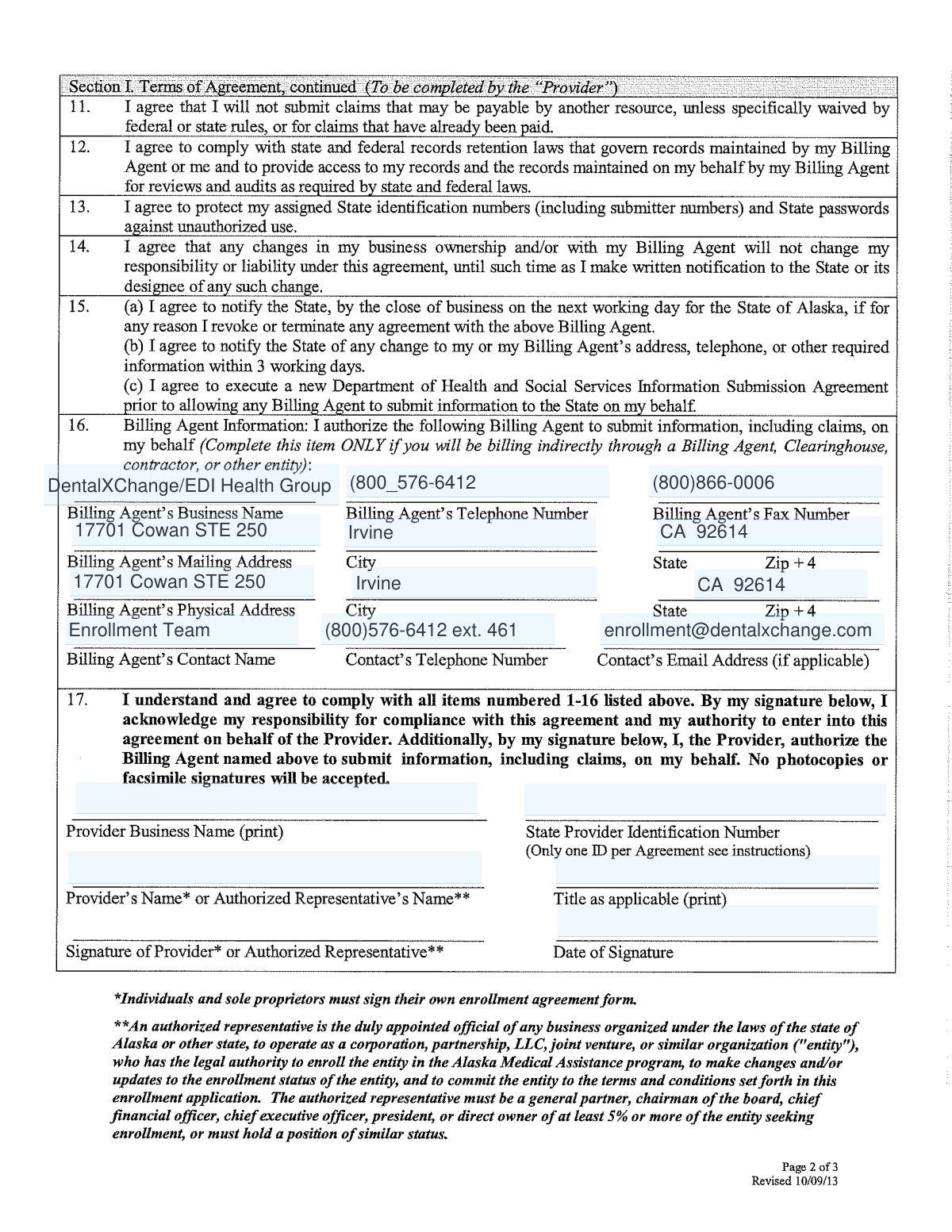
Currently, this category features the primary document required for providers working with the state’s medical assistance program: the Medicaid of Alaska Provider Electronic Remittance (835) Authorization and Claims Enrollment Form.
You should choose this form if you belong to one of the following groups:
- New Alaska Medicaid Providers: Those who need to establish a connection with Electronic Data Systems (EDS) to begin receiving 835 electronic transactions.
- Established Providers Changing Clearinghouses: If you are switching billing services or clearinghouses and need to update your authorization.
- Administrative Staff Updating Credentials: If you need to modify existing provider details, such as a change in your Tax ID or NPI associated with your electronic remittances.
Essential Information for Completion
To complete the Medicaid of Alaska Provider Electronic Remittance (835) Authorization and Claims Enrollment Form accurately, ensure you have the following data points ready before you begin:
- Provider Identification: Your legal name, National Provider Identifier (NPI), and Federal Tax Identification Number (TIN/EIN).
- Technical Details: Information regarding your software vendor or the clearinghouse that will be receiving the 835 files on your behalf.
- Authorization: The form requires a signature from an authorized representative of the healthcare entity to verify the enrollment or modification.
Using Instafill.ai to complete this form ensures that all technical fields are legible and correctly formatted, which is critical for preventing delays in your claims processing. Accurate submission helps automate your reconciliation process and reduces the administrative burden on your billing department.
Form Comparison
| Form | Purpose | Who Files It | Key Information Required |
|---|---|---|---|
| Medicaid of Alaska Provider Electronic Remittance (835) Authorization and Claims Enrollment Form | Authorizes electronic claim submission and receipt of 835 electronic remittance advice from Alaska Medicaid. | Healthcare providers or billing agents enrolling in electronic transactions with Alaska Medicaid services. | Requires legal provider name, Federal Tax ID (TIN/EIN), NPI, and authorized signature for setup. |
Tips for electronic remittance forms
Ensure your National Provider Identifier (NPI) and Federal Tax Identification Number (TIN) are entered correctly. Even a single digit error can delay the authorization process and prevent you from receiving electronic remittance advice for your claims.
Use the exact legal name associated with your medical practice as it appears on official tax documents. Inconsistencies between your enrollment form and Medicaid’s existing records can lead to an immediate rejection of the 835 authorization.
AI-powered tools like Instafill.ai can complete these complex enrollment forms in under 30 seconds with high accuracy. Your sensitive provider data stays secure during the process, making it an ideal solution for managing multiple billing authorizations efficiently.
Only an authorized representative or the provider themselves should sign the enrollment form to initiate or modify electronic services. Unauthorized signatures are a common reason for processing delays in healthcare claims enrollment.
When filling out the form, clearly mark whether you are initiating a new enrollment, modifying an existing one, or canceling services. Misidentifying the action type can cause confusion in your electronic billing workflow and disrupt your payment cycles.
Always save a completed copy of your 835 authorization form before submission. Having these records on hand simplifies future audits and helps resolve any discrepancies with Electronic Data Systems (EDS) or Medicaid more quickly.
Frequently Asked Questions
Electronic remittance forms are primarily used by healthcare providers to authorize and set up the electronic exchange of payment information with insurance payers. These forms allow providers to receive Electronic Remittance Advice (ERA), which explains the payment or denial of claims in a standardized digital format.
Healthcare providers, clinics, and medical billing entities need these forms to transition from paper-based payment notifications to digital ones. Completing these forms is a standard step for any provider looking to automate their billing cycle and reconcile payments more efficiently.
The 835 transaction is the HIPAA-mandated standard for Electronic Remittance Advice (ERA). When a form mentions an 835 authorization, it specifically refers to the provider's request to receive claim payment information via this electronic data interchange (EDI) standard.
Yes, you can use AI tools like Instafill.ai to complete electronic remittance forms quickly and accurately. These tools can extract data from your provider records and place it into the correct fields on the form, reducing the risk of manual entry errors.
Using AI-powered services, electronic remittance forms can often be filled out in under 30 seconds. The AI accurately identifies the required fields, such as NPI numbers and Tax IDs, and populates the document instantly from your source data.
Most electronic remittance forms require the provider's legal name, physical address, and National Provider Identifier (NPI). Additionally, you will likely need to provide your Federal Tax Identification Number (TIN) or Employer Identification Number (EIN) to verify your business identity.
The NPI is a unique 10-digit identification number used by healthcare providers in the United States. It is used on electronic remittance forms to ensure that the payment data is routed to the correct individual or organization within the healthcare system.
Completed forms are generally submitted to the specific state Medicaid agency or the designated Electronic Data Systems (EDS) partner. Submission instructions are usually provided on the form itself, often requiring delivery via a secure portal, fax, or mail.
Switching to electronic remittance helps streamline the billing process by reducing the need for manual data entry and paper storage. It allows for faster reconciliation of accounts and provides a more reliable audit trail for financial transactions between providers and payers.
Yes, the same authorization forms are typically used to initiate, modify, or cancel electronic remittance services. You will simply need to check the appropriate box on the form indicating whether you are updating your information or terminating the electronic agreement.
Yes, these forms almost always require an authorized signature to verify that the person requesting the electronic setup has the legal authority to do so. Some forms may accept digital signatures, while others might require a scanned copy of a physical signature.
Errors in information like your Tax ID or NPI can lead to delays in processing your enrollment or cause payment data to be misrouted. Using automated tools can help ensure that the data entered matches your official records exactly, minimizing the chance of rejection by the agency.
Glossary
- Form Complexity Index
- Instafill’s 0–100 measure of how much effort a form takes to complete, calculated deterministically from the form’s own structure rather than estimated. It combines the number of fillable fields (the largest factor), how difficult those fields are to complete based on their type, the number of pages that contain fields, the amount of conditional “fill-only-if” logic, and how many sections the form is divided into, then adds modifiers for tables and repeating lists, bundled instruction pages, and dense page layouts. A higher score means the form is harder to fill out by hand. The forms in this category have a median Form Complexity Index of 35/100 (Basic). See exactly how it is calculated.
- ERA (Electronic Remittance Advice)
- A digital version of a medical claim payment explanation that details how a payer processed a claim and the final payment amount.
- 835 Transaction
- The technical HIPAA-standard electronic file format used specifically for healthcare payment and remittance advice information.
- NPI (National Provider Identifier)
- A unique 10-digit identification number issued to healthcare providers in the United States by the Centers for Medicare & Medicaid Services.
- EDI (Electronic Data Interchange)
- The automated, computer-to-computer exchange of standardized business documents, such as claims and remittance forms, between different organizations.
- TIN/EIN
- The Federal Tax Identification Number or Employer Identification Number used by the IRS to identify a business entity for tax and billing purposes.
- Clearinghouse
- A service that acts as an intermediary between a healthcare provider and an insurance payer to validate and transmit electronic claims and remittances.
- EFT (Electronic Funds Transfer)
- The digital movement of money from the payer's bank account to the provider's account, which is usually paired with an electronic remittance advice.
- EDS (Electronic Data Systems)
- The specific technology system or contractor used to manage and process electronic data and claims for Medicaid programs.