Fill out employer reimbursement forms
with AI.
Employer reimbursement forms are essential administrative documents used by businesses to recover funds paid out on behalf of employees or as part of specific legal requirements. These forms often come into play during workers' compensation cases or when an employer provides voluntary payments to support a worker before official insurance benefits kick in. Ensuring these forms are filed accurately is critical for maintaining a company's financial records and ensuring that the business is properly compensated by insurance carriers or state agencies.
By continuing, you acknowledge Instafill's Privacy Policy and agree to get occasional product update and promotional emails.
About employer reimbursement forms
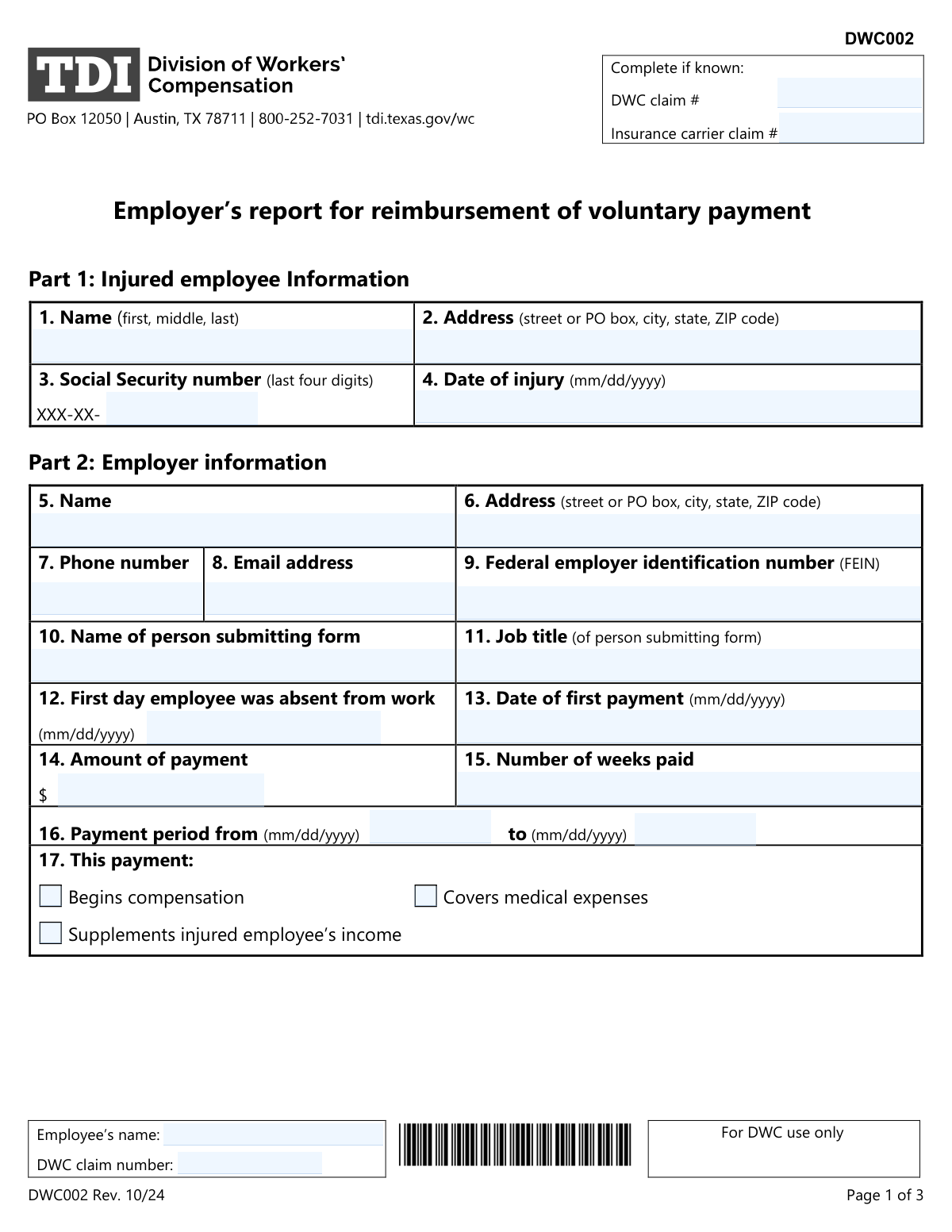
Typically, human resources professionals, business owners, and legal departments utilize these forms to document and claim expenses. For instance, forms like the DWC002 are frequently used by Texas employers who have made voluntary payments to injured workers and need to seek reimbursement from their insurance carrier. Whether it's covering initial medical costs or supplementing lost wages, these forms bridge the gap between immediate corporate action and official insurance processing, helping businesses manage their cash flow while supporting their workforce during recovery periods.
Navigating the complexities of these documents can be time-consuming, but tools like Instafill.ai use AI to fill these forms in under 30 seconds while ensuring data is handled accurately and securely. This automation allows employers to complete their reporting requirements with minimal effort, reducing the risk of manual entry errors and speeding up the reimbursement cycle.
Every form on this page can be completed without typing. Instafill is form filling software that reads a PDF and fills it for you — including flat and scanned documents that carry no fillable fields at all.
Forms in This Category
The forms in this category have a median Form Complexity Index of 39/100 (Basic), measured across 1 forms by field count, input difficulty, length, conditional logic and structure. See how it is calculated.
| Form Name | Pages | FCI | |
|---|---|---|---|
| 1. | DWC002, Employer’s report for reimbursement of voluntary payment | 2 | Basic 39 |
- Enterprise-grade security & data encryption
- 99%+ accuracy powered by AI
- 1,000+ forms from all industries
- Complete forms in under 60 seconds
How to Choose the Right Form
Navigating employer reimbursement can be straightforward if you are operating within the Texas workers' compensation system. Currently, the primary document available in this category is designed for a specific financial recovery process between an employer and their insurance carrier.
When to Use Form DWC002
The DWC002, Employer’s report for reimbursement of voluntary payment is the essential document for Texas-based employers who have proactively supported an injured worker before the formal claims process has concluded. You should select this form if:
- You made voluntary payments: You provided funds to an injured employee for medical expenses or as supplemental income before the official claim was processed.
- You seek recovery from your carrier: You are looking to be reimbursed by your workers' compensation insurance carrier for those specific out-of-pocket costs.
- The claim is in Texas: This is a state-specific form regulated by the Texas Department of Insurance, Division of Workers' Compensation (DWC).
Key Information Needed for Filing
To ensure your reimbursement request is processed without delays, you should have the following details ready before you begin filling out the form on Instafill.ai:
- Payment Records: Precise dates and dollar amounts of all voluntary payments made directly to the employee.
- Insurance Details: Your carrier’s name and the specific policy or claim number associated with the incident.
- Employee Documentation: Identifying information for the injured worker to ensure the DWC correctly matches the report to the existing case file.
Streamlining Your Reimbursement
Filing the DWC002 promptly is crucial for maintaining your company's cash flow after a workplace injury. Using Instafill.ai allows you to transform this often-tedious paperwork into a quick, AI-assisted task. Our tools help you avoid common clerical errors that lead to rejected claims, ensuring that your request for reimbursement from the insurance carrier is professional, accurate, and submitted on time.
Form Comparison
| Form | Purpose | Who Files It | When to Use |
|---|---|---|---|
| DWC002, Employer’s report for reimbursement of voluntary payment | Request reimbursement from insurance carriers for voluntary payments to injured employees. | Texas employers seeking recovery of costs paid before workers' compensation processing. | When an employer pays medical or income benefits directly to a claimant. |
Tips for employer reimbursement forms
Keep detailed receipts and proof of payment for any funds provided to employees before seeking reimbursement. This ensures that the amounts requested on the form match your internal accounting and helps avoid disputes with insurance carriers.
Incorrect claim numbers are a primary cause of reimbursement delays. Double-check that the insurance carrier's claim number and the employer's policy information are accurate to ensure the form is routed to the correct department.
Submitting reimbursement forms as soon as possible after making a voluntary payment helps maintain healthy business cash flow. Delaying the filing until the end of a claim period can lead to administrative backlogs or potential processing issues.
AI-powered tools like Instafill.ai can complete these reimbursement forms in under 30 seconds with high accuracy. Your sensitive business data stays secure during the process, making it a highly efficient solution for employers managing multiple workers' compensation filings.
Be clear about whether the reimbursement is for medical expenses or supplemental income provided to the employee. Categorizing these payments correctly on the form helps the insurance carrier process the request under the appropriate coverage category.
While the standard form covers the basics, some carriers may require additional attachments like copies of canceled checks or itemized billing statements. Review your specific insurance policy to see if extra evidence is needed to support the reimbursement claim.
Frequently Asked Questions
These forms are used by businesses to recover funds they have voluntarily paid to an employee for work-related injuries or medical expenses. They serve as a formal request to an insurance carrier to reimburse the employer for costs that would otherwise be covered under workers' compensation.
The employer or their designated human resources representative is typically responsible for completing and submitting these forms. It is the employer's duty to provide proof of the voluntary payments made to the injured worker to ensure the insurance carrier processes the refund correctly.
Yes, you can use AI tools to complete these forms quickly and accurately. Platforms like Instafill.ai can automatically extract data from your records and place it into the correct fields on the PDF, ensuring all information is consistent and legible.
It is best to file for reimbursement as soon as the voluntary payment is made or according to the timeline specified by your state's workers' compensation laws. Filing promptly helps maintain clear financial records and ensures the insurance carrier can reconcile the claim without delays.
Using AI-powered services like Instafill.ai, most employer reimbursement forms can be filled out in under 30 seconds. The AI accurately maps data from your source documents directly into the form, saving significant time compared to manual entry.
Generally, payments made for initial medical care or supplemental income provided before an official workers' compensation claim is finalized are eligible. These forms ensure that the employer is not financially penalized for supporting an employee immediately following a workplace incident.
Most forms are submitted directly to the company's workers' compensation insurance carrier for processing. Depending on your state's regulations, you may also be required to provide a copy to the state's labor or industrial accident board.
Employers should keep detailed records of all payments made, including receipts, check stubs, or electronic transfer confirmations. This supporting documentation may be requested by the insurance carrier to verify the amounts listed on the reimbursement form.
While the form is primarily between the employer and the insurance carrier, the employee may need to sign an acknowledgment that they received the voluntary payments. This prevents disputes regarding whether the funds were actually delivered to the worker.
Errors on the form can lead to processing delays or a full denial of the reimbursement request by the insurance carrier. Using digital tools to ensure accuracy is a common way to avoid these issues and ensure the business recovers its costs.
Glossary
- Form Complexity Index
- Instafill’s 0–100 measure of how much effort a form takes to complete, calculated deterministically from the form’s own structure rather than estimated. It combines the number of fillable fields (the largest factor), how difficult those fields are to complete based on their type, the number of pages that contain fields, the amount of conditional “fill-only-if” logic, and how many sections the form is divided into, then adds modifiers for tables and repeating lists, bundled instruction pages, and dense page layouts. A higher score means the form is harder to fill out by hand. The forms in this category have a median Form Complexity Index of 39/100 (Basic). See exactly how it is calculated.
- DWC (Division of Workers' Compensation)
- The state agency responsible for overseeing the workers' compensation system, ensuring that injured employees are treated and employers' claims are processed according to state law.
- Voluntary Payment
- A payment made by an employer to an injured worker for medical or income purposes before the insurance carrier has officially assumed liability for the claim.
- Insurance Carrier
- The insurance company that provides workers' compensation coverage to the employer and is responsible for reimbursing the employer for eligible voluntary payments.
- Indemnity Benefits
- Payments intended to replace a portion of the wages an employee loses due to a work-related injury or illness.
- Temporary Income Benefits (TIBs)
- Payments provided to an injured worker who loses all or part of their wages for more than seven days due to a work-related injury.
- Medical Benefits
- Payments for reasonable and necessary healthcare services related to a work injury, which an employer may pay upfront and later seek to recover from their insurer.
- Waiting Period
- The initial period of disability, typically seven days, during which an injured worker is not eligible for income benefits unless the disability lasts for a longer specified duration.
- Subrogation
- The legal process that allows an insurance carrier or employer to recover the cost of benefits paid to an employee from a third party who was responsible for the injury.