Fill out estate distribution forms
with AI.
Estate distribution forms are essential legal and financial documents used to facilitate the transfer of assets from a deceased individual's estate to their designated heirs or beneficiaries. These forms serve as the official request to financial institutions and probate courts to release funds, property, or securities according to the decedent's final wishes or established law. Properly executing these documents is a critical step in the estate settlement process, ensuring that the transition of wealth is documented for tax purposes and that all legal obligations are met without unnecessary delays.
By continuing, you acknowledge Instafill's Privacy Policy and agree to get occasional product update and promotional emails.
About estate distribution forms
Typically, these forms are required by surviving family members, executors, or legal representatives who are tasked with settling an estate. Common situations involve managing inherited retirement accounts, such as filing an IRA Beneficiary Distribution Form to claim assets from a Roth, SEP, or traditional IRA. Because these forms often require specific details regarding tax withholding and payout methods, accuracy is vital to avoid administrative errors that could stall the distribution of funds.
Navigating the paperwork of an estate can be a daunting task during a difficult time. Tools like Instafill.ai use AI to fill these forms in under 30 seconds, handling the data accurately and securely to simplify the administrative burden. By automating the data entry process, beneficiaries can ensure their information is correctly formatted, allowing them to focus on more important family matters while the financial transition is handled efficiently.
Every form on this page can be completed without typing. Instafill is form filling software that reads a PDF and fills it for you — including flat and scanned documents that carry no fillable fields at all.
Forms in This Category
The forms in this category have a median Form Complexity Index of 54/100 (Moderate), measured across 1 forms by field count, input difficulty, length, conditional logic and structure. See how it is calculated.
| Form Name | Pages | FCI | |
|---|---|---|---|
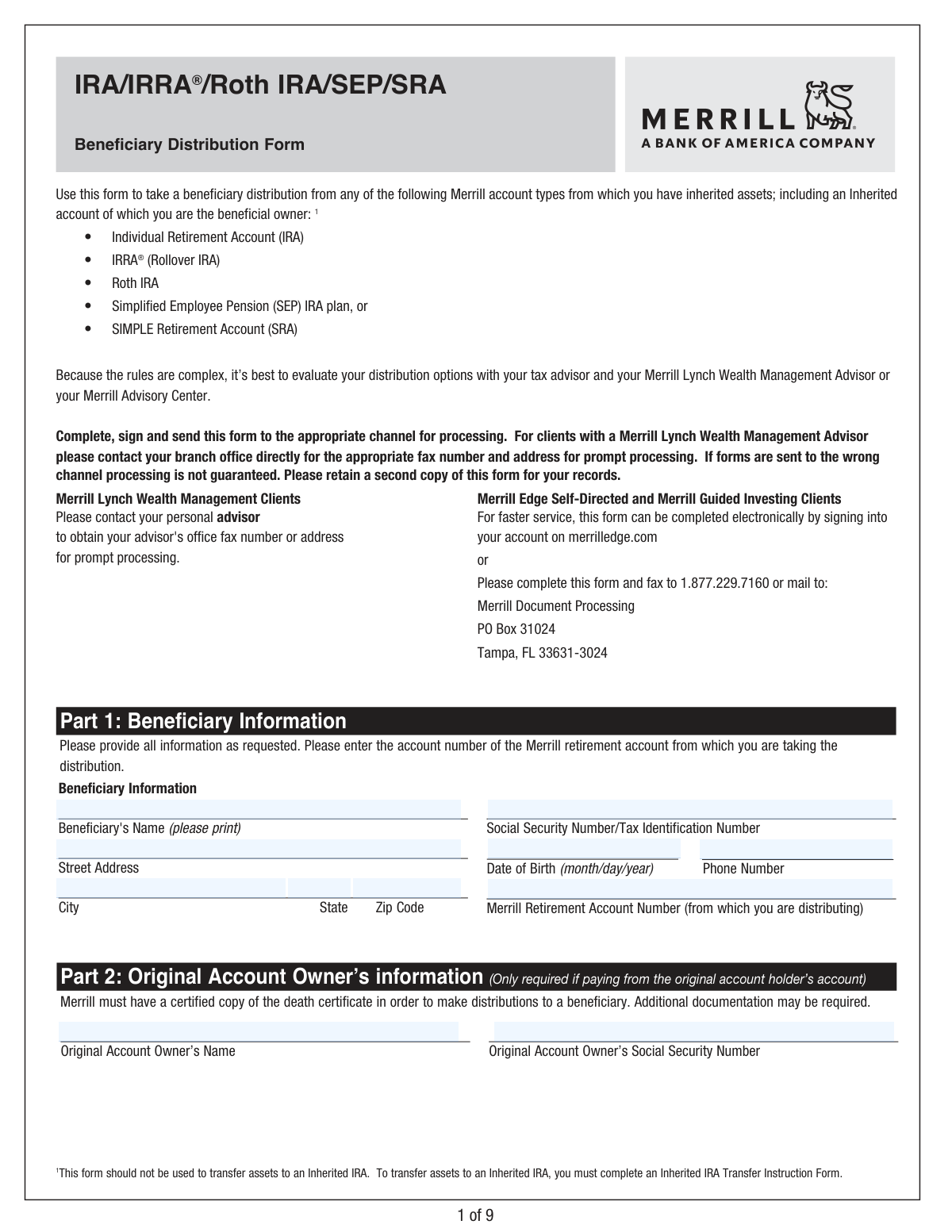
| 1. | IRA/IRRA®/ROTH IRA/SEP/SRA Beneficiary Distribution Form | 1 | Moderate 54 |
- Enterprise-grade security & data encryption
- 99%+ accuracy powered by AI
- 1,000+ forms from all industries
- Complete forms in under 60 seconds
How to Choose the Right Form
Navigating the distribution of an estate can be complex, especially when dealing with inherited retirement assets. If you are a beneficiary of a Merrill Lynch account, selecting the correct documentation is critical for ensuring funds are transferred correctly and tax obligations are met.
Determining the Account Type
The primary document in this category is the IRA/IRRA®/ROTH IRA/SEP/SRA Beneficiary Distribution Form. This is a versatile form designed to handle several types of inherited accounts. You should choose this form if you are the designated beneficiary of any of the following Merrill Lynch accounts:
- Traditional IRAs or Individual Retirement Rollover Accounts (IRRA)
- Roth IRAs
- Simplified Employee Pension (SEP) IRAs
- Savings Retirement Accounts (SRA)
When to Use This Form
This form is specifically for individuals who have inherited an account and are ready to initiate a payout. It is not intended for the original account holder to manage their own distributions. Use the IRA/IRRA®/ROTH IRA/SEP/SRA Beneficiary Distribution Form when you need to:
- Request a Distribution: Initiate a partial or total payout of the inherited assets.
- Define Payment Logistics: Specify exactly how the funds should be paid out, whether via check or transfer to a different account.
- Manage Tax Withholding: Explicitly state the amount of federal and state taxes you wish to have withheld from the distribution to simplify your year-end tax reporting.
Streamlining the Process with AI
Estate forms often involve complex financial data and sensitive personal identification. Using the IRA/IRRA®/ROTH IRA/SEP/SRA Beneficiary Distribution Form on Instafill.ai allows you to leverage AI to ensure every field—from account numbers to tax percentages—is filled accurately. If you have a static or non-interactive PDF version of this Merrill Lynch form, our platform can convert it into a fillable format to help you complete your inheritance process quickly and securely.
Tips for estate distribution forms
Ensure that the beneficiary's legal name, Social Security number, and the decedent's account number are entered exactly as they appear on official records. Even a minor typo can lead to significant delays in the distribution process or cause the financial institution to reject the request entirely.
These forms often allow you to choose how much federal and state tax to withhold from the distribution. Consult with a tax professional before filling this out to ensure you are meeting your tax obligations without over-withholding, as these decisions are usually difficult to reverse once the payment is processed.
AI-powered tools like Instafill.ai can complete these complex estate forms in under 30 seconds with high accuracy, even if the original PDF isn't interactive. Your sensitive financial and personal data stays secure during the process, making it an efficient way to handle multiple distribution requests simultaneously.
Most estate distribution forms require supplemental paperwork such as a certified copy of the death certificate or letters of testamentary. Having digital copies of these documents ready before you start filling out the forms will help you complete the submission in one sitting and avoid follow-up requests from the bank.
Be explicit about whether you want a total distribution, a specific dollar amount, or a partial percentage of the inherited account. Clearly indicating the payment method—whether via check, wire transfer, or a transfer to a new brokerage account—ensures the funds are moved according to your financial plan.
While federal withholding is standard, state tax rules for inherited IRAs vary significantly depending on your residency. Check your local state guidelines before selecting a withholding percentage to ensure you aren't hit with an unexpected tax bill at the end of the year.
Frequently Asked Questions
These forms are used to legally transfer assets from a deceased person's estate or retirement accounts to their designated beneficiaries. They provide the financial institution with clear instructions on how much to pay out, the payment method, and how to handle tax withholdings.
The individual named as a beneficiary on a retirement account, such as a traditional IRA or Roth IRA, must complete this form to claim their inheritance. If there are multiple beneficiaries, each person typically needs to submit their own form to receive their specific share.
You will generally need the account number of the inherited asset, the Social Security number of the deceased, and your own personal tax information. Most institutions also require a certified copy of the death certificate to be submitted alongside the distribution paperwork.
Yes, AI tools like Instafill.ai can fill out these forms in under 30 seconds by accurately extracting and placing data from your source documents into the PDF fields. This process minimizes manual entry errors and ensures that all required sections are addressed correctly.
While manually completing complex financial forms can be time-consuming, using an AI-powered service like Instafill.ai allows you to complete the process almost instantly. The AI automates the data mapping, significantly reducing the time spent on paperwork.
Often, a single multi-purpose form is used for various types of retirement accounts, including Traditional, Roth, SEP, and SRA accounts. You will simply indicate on the form which specific type of account you are requesting a distribution from so the institution can apply the correct tax rules.
The choice depends on your immediate financial needs and the tax implications of the withdrawal. Most distribution forms allow you to select a one-time full payout or a partial amount, though you should consult a tax professional regarding IRS rules for inherited account withdrawals.
Most forms provide an option for you to specify exactly how much federal and state income tax you want withheld from the payment. If you do not make a selection, the financial institution may apply a default withholding rate based on current tax regulations.
Once the forms are filled and signed, they should be submitted to the financial institution holding the assets, such as Merrill Lynch or a similar brokerage. Many firms now accept digital submissions through secure portals, though some may still require physical copies for certain transaction types.
Failing to file distribution forms in a timely manner can lead to missed Required Minimum Distributions (RMDs), which may result in significant IRS penalties. It is important to review the specific timeline requirements for the type of inherited account you are managing.
Glossary
- Form Complexity Index
- Instafill’s 0–100 measure of how much effort a form takes to complete, calculated deterministically from the form’s own structure rather than estimated. It combines the number of fillable fields (the largest factor), how difficult those fields are to complete based on their type, the number of pages that contain fields, the amount of conditional “fill-only-if” logic, and how many sections the form is divided into, then adds modifiers for tables and repeating lists, bundled instruction pages, and dense page layouts. A higher score means the form is harder to fill out by hand. The forms in this category have a median Form Complexity Index of 54/100 (Moderate). See exactly how it is calculated.