Fill out expense reimbursement forms
with AI.
Expense reimbursement forms are essential administrative tools designed to ensure that individuals are fairly compensated for out-of-pocket costs incurred during professional activities. These documents provide a structured way to report expenditures, maintaining financial transparency and accountability for both the claimant and the organization. Whether you are managing travel costs, office supplies, or specialized service expenses, having a standardized format is crucial for complying with internal policies and tax regulations.
By continuing, you acknowledge Instafill's Privacy Policy and agree to get occasional product update and promotional emails.
About expense reimbursement forms
This category of forms is typically used by employees, contractors, and specialized care providers who need to document specific outlays. For instance, those working within Financial Management Services (FMS) often utilize mileage reimbursement logs to track distances traveled while transporting individuals to appointments or activities. Similarly, travel expense forms are used to detail lodging, meals, and transportation during business trips. Accurate data entry is vital in these situations, as even small errors in odometer readings or date tracking can lead to payment delays or auditing complications.
Completing these documents manually can be a time-consuming task that is prone to human error. Tools like Instafill.ai use AI to fill these forms in under 30 seconds, handling your data accurately and securely to streamline the submission process. By automating the repetitive parts of data entry, you can ensure your reimbursement requests are professional, legible, and submitted on time without the usual administrative burden.
Every form on this page can be completed without typing. Instafill is form filling software that reads a PDF and fills it for you — including flat and scanned documents that carry no fillable fields at all.
Forms in This Category
The forms in this category have a median Form Complexity Index of 73/100 (Complex), measured across 2 forms by field count, input difficulty, length, conditional logic and structure. See how it is calculated.
| Form Name | Pages | FCI | |
|---|---|---|---|
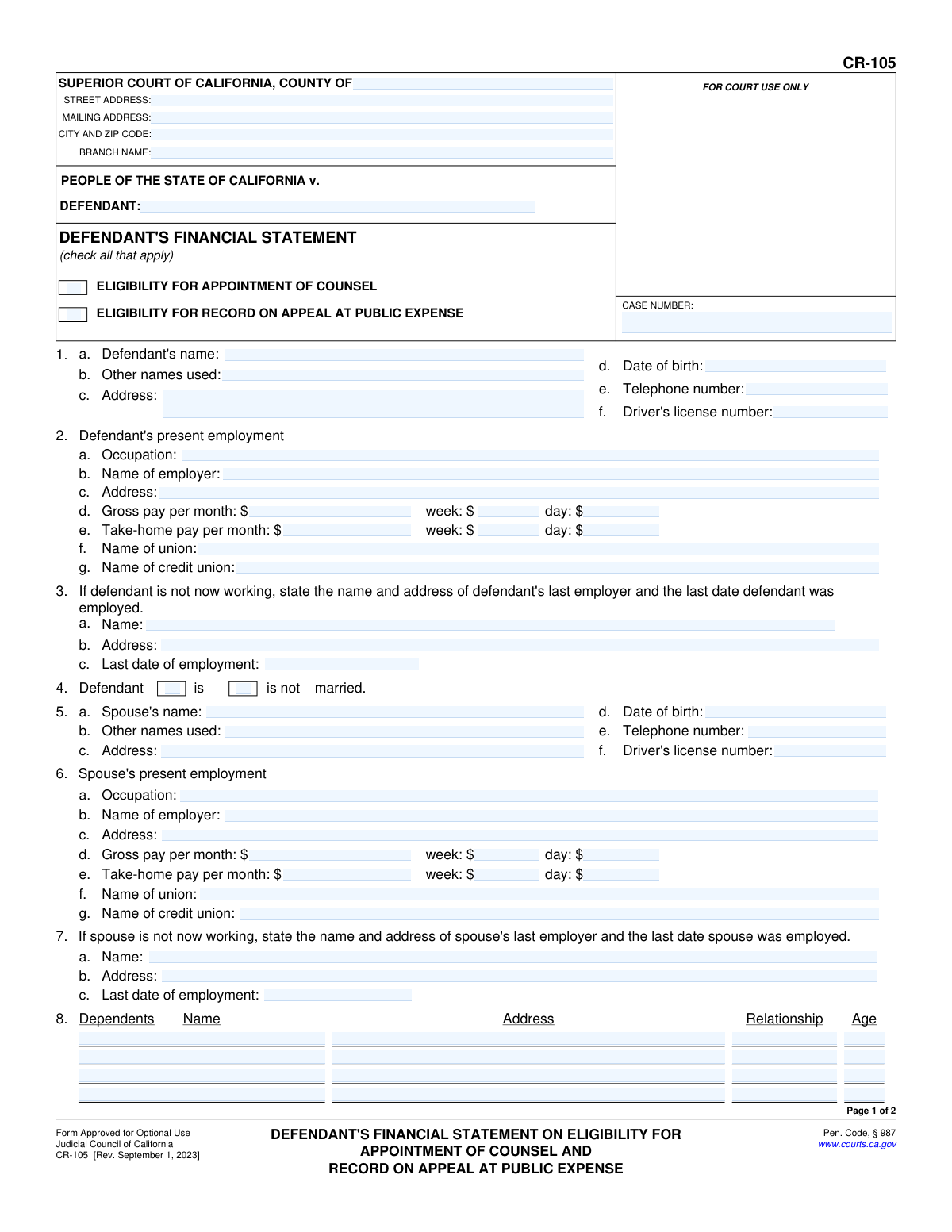
| 1. | Form CR-105, Defendant's Financial Statement on Eligibility for Appointment of Counsel and Reimbursement and Record on Appeal at Public Expense | 1 | Moderate 60 |
| 2. | Mileage Reimbursement Request for FMS | 1 | Complex 73 |
- Enterprise-grade security & data encryption
- 99%+ accuracy powered by AI
- 1,000+ forms from all industries
- Complete forms in under 60 seconds
How to Choose the Right Form
Navigating Expense Reimbursement Forms
When you need to get paid back for costs incurred during work, selecting the correct document is the first step toward a quick payout. While some organizations use general travel expense forms for meals and lodging, specialized industries like Financial Management Services (FMS) require specific documentation for mileage and service-related travel.
For FMS Employees and Drivers
If you are providing transportation for individuals receiving services, the Mileage Reimbursement Request for FMS is your primary document. This is not a general expense form; it is specifically designed for:
- Service-Related Travel: Specifically for transporting clients or individuals as part of an approved spending plan.
- Detailed Tracking: You will need this form if your reimbursement requires odometer readings (start and end) rather than just a flat rate or distance estimate.
- Audit Compliance: It ensures that every mile logged is tied to a specific destination and date, which is crucial for FMS record-keeping.
When to Use This Form
Choose the Mileage Reimbursement Request for FMS if your situation meets these criteria:
- You are an employee or driver operating under an FMS framework.
- Your primary expense is vehicle mileage rather than parking, tolls, or meals.
- You have precise records of your odometer readings for each trip.
Streamlining Your Request
Filling out mileage logs manually is prone to calculation errors. Using the Mileage Reimbursement Request for FMS on Instafill.ai allows you to use AI to ensure your totals are accurate and your entries are legible. If you have a static PDF version of this form, our tools can convert it into an interactive format, making it easier to submit your request on time and get reimbursed faster.
Form Comparison
| Form | Primary Purpose | Who Files It | Key Requirements |
|---|---|---|---|
| Mileage Reimbursement Request for FMS | Requesting reimbursement for mileage accrued while transporting individuals receiving services. | Employees and drivers providing transportation services under an approved FMS spending plan. | Detailed logs including dates, odometer readings, specific destinations, and total miles traveled. |
Tips for expense reimbursement forms
Ensure you record the exact purpose of each trip and keep digital copies of any associated toll or parking receipts. Providing clear context for every mile driven helps prevent your reimbursement request from being flagged or delayed during the approval process.
Always record your starting and ending odometer readings immediately upon completing a trip rather than estimating totals later. Small discrepancies can add up over time, and precise readings are often required for compliance with FMS spending plans.
Filling out mileage logs manually can be tedious, but AI-powered tools like Instafill.ai can complete these forms in under 30 seconds with high accuracy. Your data stays secure during the process, making it a reliable way to handle multiple reimbursement requests quickly.
Be careful not to include personal errands or commutes in your reimbursement request, as these are typically not covered. Maintaining a clear distinction between business-related travel and personal use ensures your form remains professional and honest.
Aim to submit your reimbursement forms weekly or monthly rather than waiting until the end of a quarter. Frequent submissions keep your records organized and ensure you receive your payments in a timely manner according to your organization’s fiscal schedule.
Before submitting an FMS form, verify that the mileage requested aligns with the services authorized in the participant's spending plan. Ensuring your request matches the approved budget prevents administrative back-and-forth and speeds up the reimbursement cycle.
Many reimbursement forms are rejected simply because a signature or date was missing from the driver or the supervisor. Always do a final sweep of the document to ensure every required field is populated before you hit the submit button.
Frequently Asked Questions
Expense reimbursement forms are documents used by employees, contractors, or service providers to claim back money spent on business-related activities. These forms ensure that individuals are paid back for out-of-pocket costs such as travel, supplies, or mileage incurred during the course of their work.
These forms are commonly used by staff, independent contractors, and caregivers who use their personal vehicles for work-related tasks or to transport clients. In the context of Financial Management Services (FMS), they are essential for drivers to get paid for transporting individuals receiving services according to an approved spending plan.
Most forms require the date of travel, starting and ending odometer readings, the specific destination, and the total miles driven for each trip. If the form is for general expenses, you will also need to list the vendor, the date of purchase, and the total amount spent.
While deadlines vary by organization, it is generally recommended to submit your forms as soon as the expense is incurred or at the end of each month. Many companies and service agencies require submissions within 30 to 60 days to ensure the funds are processed within the correct fiscal period.
Financial Management Services (FMS) forms are specialized documents used in self-directed care programs where individuals manage their own budgets. These forms, such as mileage logs, ensure that all spending is tracked accurately against the individual's authorized service plan and meets regulatory requirements.
Yes, most reimbursement processes require supporting documentation like itemized receipts for travel or supplies to verify the expense. For mileage-specific forms, a detailed log of odometer readings is often the primary requirement, though some organizations may also ask for parking or toll receipts.
You should choose a form based on the specific type of expense you are claiming, such as a mileage log for vehicle travel or a general travel expense form for hotels and meals. If you are working under a specific program like FMS, always use the version provided or approved by your program coordinator to avoid processing delays.
Yes, you can fill out these forms efficiently using AI tools like Instafill.ai. These tools can accurately extract data from your logs or receipts and place it into the correct PDF fields in under 30 seconds, significantly reducing the manual effort required for data entry.
Using an AI-powered service allows you to complete reimbursement forms in a fraction of the time it takes to do so manually. By automating the extraction of odometer readings or receipt totals, you can finish a complex mileage log or expense report in less than a minute.
Errors in odometer readings or total calculations can lead to your request being denied or delayed. If you discover a mistake after submission, you should notify your administrator and provide a corrected version immediately to ensure your payment is processed correctly.
Glossary
- Form Complexity Index
- Instafill’s 0–100 measure of how much effort a form takes to complete, calculated deterministically from the form’s own structure rather than estimated. It combines the number of fillable fields (the largest factor), how difficult those fields are to complete based on their type, the number of pages that contain fields, the amount of conditional “fill-only-if” logic, and how many sections the form is divided into, then adds modifiers for tables and repeating lists, bundled instruction pages, and dense page layouts. A higher score means the form is harder to fill out by hand. The forms in this category have a median Form Complexity Index of 73/100 (Complex). See exactly how it is calculated.
- FMS (Financial Management Services)
- An organization that helps individuals manage their self-directed care budgets, including processing payroll and verifying expense reimbursements for their support staff.
- IRS Standard Mileage Rate
- The fixed rate per mile set annually by the government used to calculate the tax-free reimbursement amount for business-related vehicle use.
- Spending Plan
- A pre-approved budget that outlines exactly how much money is allocated for specific services, like transportation, within a care program.
- Commuting Miles
- The distance traveled from an employee's home to their primary work site, which is typically not eligible for reimbursement under standard labor laws.
- Odometer Reading
- The specific numbers shown on a vehicle's dashboard at the start and end of a trip, required to calculate the exact distance traveled for a claim.
- Incidental Expenses
- Small, additional costs incurred during travel, such as bridge tolls or parking fees, that are often listed alongside mileage on reimbursement forms.
- Per Diem
- A fixed daily allowance provided to cover living expenses, such as meals and lodging, while traveling for work instead of reimbursing actual costs.
- Substantiation
- The process of providing evidence, such as receipts or detailed trip logs, to prove that a claimed expense was legitimately incurred for business purposes.