Fill out faculty review forms
with AI.
Faculty review forms are essential components of academic administration, particularly within higher education and research institutions. These documents facilitate the systematic evaluation of academic staff for appointments, tenure, and promotions. They ensure that every candidate is assessed against a standardized set of criteria, maintaining the integrity and quality of the institution's professoriate. By organizing peer reviews, trainee feedback, and comparative data, these forms provide review committees with a comprehensive view of a faculty member’s contributions to research, teaching, and clinical practice.
By continuing, you acknowledge Instafill's Privacy Policy and agree to get occasional product update and promotional emails.
About faculty review forms
Department administrators, deans, and academic affairs coordinators typically use these forms during annual reviews or when a faculty member is being considered for a change in rank. For example, checklists for referee and trainee grids are vital for tracking the submission of solicitation letters and evaluation grids. These documents help administrative staff manage the complex logistics of gathering external references and internal student feedback, ensuring that the candidate's dossier is complete and compliant with university policies before it reaches the review board.
Managing the volume of data required for these evaluations can be a significant administrative burden. Tools like Instafill.ai use AI to fill these forms in under 30 seconds, handling sensitive academic data accurately and securely. This allows administrative teams to focus on the qualitative aspects of faculty development rather than the manual entry of repetitive data points across various grids and checklists.
Every form on this page can be completed without typing. Instafill is form filling software that reads a PDF and fills it for you — including flat and scanned documents that carry no fillable fields at all.
Forms in This Category
The forms in this category have a median Form Complexity Index of 22/100 (Simple), measured across 1 forms by field count, input difficulty, length, conditional logic and structure. See how it is calculated.
| Form Name | Pages | FCI | |
|---|---|---|---|
| 1. | Professoriate Checklist for Referee Grid, Trainee Grid, and Comparison Peers | 1 | Simple 22 |
- Enterprise-grade security & data encryption
- 99%+ accuracy powered by AI
- 1,000+ forms from all industries
- Complete forms in under 60 seconds
How to Choose the Right Form
Navigating the complexities of academic appointments and promotions requires meticulous organization. While this category currently focuses on a specialized administrative tool, understanding its specific role will help you determine if it meets your departmental needs.
Internal Administrative Coordination
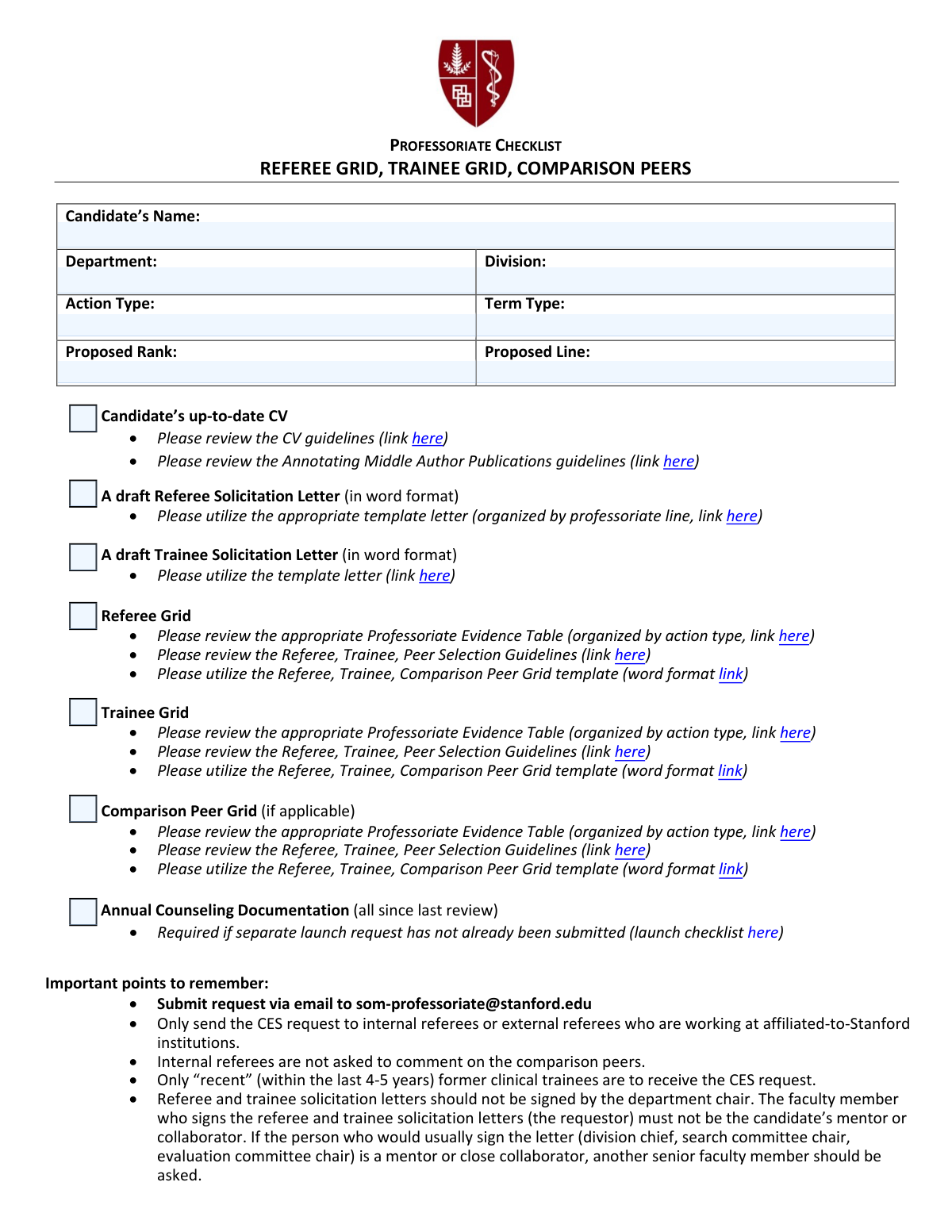
The Professoriate Checklist for Referee Grid, Trainee Grid, and Comparison Peers is designed specifically for academic departments (such as those within the Stanford School of Medicine) to manage the high volume of documentation required for faculty reviews.
Choose this form if you are responsible for:
- Compiling Candidate Portfolios: Ensuring that CVs and draft solicitation letters are prepared according to institutional standards.
- Organizing Evaluation Data: Managing the "Referee Grid" and "Trainee Grid" to track who has been contacted for letters of recommendation.
- Peer Comparison: Documenting "Comparison Peers" to provide context for a candidate's standing in their field.
Target Audience and Use Case
This form is not typically filled out by the faculty candidate themselves. Instead, it is an essential tool for:
- Departmental Administrators: To track the progress of a promotion or appointment file.
- Review Committees: To ensure all required evaluative components are present before a final decision is made.
- HR Coordinators: To maintain a standardized record of the appointment process and ensure compliance with university bylaws.
Streamlining the Review Process with AI
Faculty reviews often involve extracting data from multiple sources, such as long-form CVs and external evaluations. By using the Professoriate Checklist for Referee Grid, Trainee Grid, and Comparison Peers on Instafill.ai, you can leverage AI to quickly populate checklist fields from existing documents. If your department uses a legacy version of this checklist that isn't interactive, our platform can convert it into a fillable PDF, allowing your team to complete these critical administrative steps with greater speed and accuracy.
Form Comparison
| Form | Primary Purpose | Target Audience | Key Components |
|---|---|---|---|
| Professoriate Checklist for Referee Grid, Trainee Grid, and Comparison Peers | Ensures all documentation is compiled for faculty review, promotion, or appointment processes. | Department administrators and committee members managing academic faculty appointment files. | Candidate CV, solicitation letters, referee grids, and peer comparison evaluations. |
Tips for faculty review forms
Ensure all listed referees and comparison peers have their current academic titles and institutional affiliations correctly documented. Outdated information can lead to administrative rejections or delays in the solicitation process during the faculty review cycle.
Faculty review forms often require detailed trainee grids spanning several years of mentorship. Keeping a digital log of students, their roles, and their current positions allows you to populate these grids quickly without searching through old departmental records.
Consistency is essential for a smooth review process. Double-check that the dates, titles, and publication counts entered on the checklist and evaluation grids perfectly match the details provided in the candidate’s official curriculum vitae.
Using AI-powered tools like Instafill.ai can complete these complex faculty review forms in under 30 seconds with high accuracy. This is a significant time-saver for department administrators handling multiple candidates, and your data remains secure throughout the process.
When filling out referee grids, use a consistent format for contact information and brief biographies. This makes it easier for the review committee to scan the qualifications of chosen evaluators and speeds up the approval of the referee list.
Many checklists require draft solicitation letters to be submitted alongside the grids. Prepare these templates in advance, ensuring they follow departmental guidelines while highlighting the specific areas of the candidate's work that referees should address.
Missing a single checkbox or a required attachment in a faculty review packet can stall the entire promotion process. Use the checklist as a final audit tool to ensure every supporting document, from the CV to the peer grid, is attached and correctly labeled.
Frequently Asked Questions
Faculty review forms are used by academic institutions to standardize the evaluation process for hiring, promotion, and tenure. They help departments organize critical data, such as peer comparisons and trainee feedback, to ensure a comprehensive and fair review by the governing board.
These forms are generally managed by departmental administrators, faculty affairs coordinators, or search committee members. They use the checklists to verify that all necessary documentation, including CVs and solicitation letters, has been properly compiled before the candidate's file is reviewed.
These forms are required whenever a faculty member is being considered for a new appointment, a promotion to a higher rank, or a formal tenure review. While they are used throughout the year, they are most common during peak academic recruitment and promotion cycles.
To accurately fill out these forms, administrators typically need the candidate's current curriculum vitae, a list of potential external referees, and data regarding the candidate's trainees. The forms act as a guide to ensure all these disparate pieces of information are consolidated correctly.
A referee grid tracks the status and credentials of external experts who provide evaluations of the candidate's research and standing. A trainee grid focuses on the candidate's mentorship history, organizing feedback from students and researchers who have worked directly under their supervision.
Yes, AI tools like Instafill.ai can streamline the process by automatically extracting data from source documents like CVs and draft letters. The AI can then place this information into the appropriate sections of the faculty review form, ensuring accuracy and reducing manual data entry.
Using AI-powered services, you can fill out complex faculty review checklists and grids in under 30 seconds. These tools quickly scan your uploaded files and populate the PDF fields accurately, which is significantly faster than manual typing.
Completed faculty review forms are typically submitted to the Office of Faculty Affairs or the Dean's Office within the specific school or university. From there, the documentation is presented to the relevant committees or the university provost for final approval.
Yes, most faculty review checklists are designed to be versatile enough to cover various academic tracks, including clinical, research, and teaching lines. The specific grids for referees and peers ensure that the candidate is being compared to appropriate colleagues in their specific field.
Incomplete forms often result in the entire review package being returned to the department, which can delay appointments or promotions by several months. Using a structured checklist helps ensure that every administrative requirement is met before the file moves to the next stage of the approval process.
Glossary
- Form Complexity Index
- Instafill’s 0–100 measure of how much effort a form takes to complete, calculated deterministically from the form’s own structure rather than estimated. It combines the number of fillable fields (the largest factor), how difficult those fields are to complete based on their type, the number of pages that contain fields, the amount of conditional “fill-only-if” logic, and how many sections the form is divided into, then adds modifiers for tables and repeating lists, bundled instruction pages, and dense page layouts. A higher score means the form is harder to fill out by hand. The forms in this category have a median Form Complexity Index of 22/100 (Simple). See exactly how it is calculated.
- Professoriate
- The collective body of academic staff or professors within a university or a specific department, often referring to those in permanent or tenure-track positions.
- Referee Grid
- A structured table used to track and summarize the credentials, institutional affiliations, and responses of external experts who provide evaluations for a candidate.
- Comparison Peers
- A list of individuals at similar career stages in other institutions used to benchmark a faculty candidate's achievements and standing within their specific field.
- Trainee Grid
- A documentation tool used to list and describe the students, residents, or fellows a faculty member has mentored, including their current professional roles.
- Solicitation Letter
- A formal request sent by university leadership to external reviewers, asking them to provide a confidential assessment of a faculty member's work and suitability for promotion.
- Dossier
- The comprehensive collection of documents, including a CV, research statements, and teaching evaluations, compiled for a formal faculty review or appointment.
- Tenure
- A permanent academic appointment that provides job security and protects academic freedom, typically granted after a rigorous multi-year review process.
- Promotion
- The official advancement of a faculty member to a higher academic rank, such as moving from Assistant Professor to Associate Professor.