Fill out federal documents
with AI.
Federal documents represent the backbone of government transparency and administrative function in the United States. This category encompasses a wide range of official records, from legislative proceedings like the Congressional Record to administrative filings used by various executive agencies. These documents are essential for maintaining an accurate historical record of the nation’s lawmaking process and for ensuring that the interactions between the public and the federal government are documented with precision. Whether it is a transcript of a debate on the House floor or a standardized application for federal benefits, these records serve as the primary source of truth for government actions and individual obligations.
By continuing, you acknowledge Instafill's Privacy Policy and agree to get occasional product update and promotional emails.
About federal documents
Individuals from many walks of life find themselves needing to access or complete federal documents. Legal researchers and historians often rely on these records to trace the legislative intent behind specific laws, while business owners and private citizens encounter them during routine regulatory compliance or when applying for government programs. Navigating the complexity of federal paperwork can often be a time-consuming task, requiring careful attention to detail to ensure that all information is captured correctly and according to official standards.
Managing these documents is significantly easier with modern technology. Tools like Instafill.ai use AI to fill these forms in under 30 seconds, handling the data accurately and securely to streamline the submission process. This allows users to focus on the substance of their federal interactions rather than the manual effort of data entry, ensuring that even complex government records are completed efficiently.
Every form on this page can be completed without typing. Instafill is form filling software that reads a PDF and fills it for you — including flat and scanned documents that carry no fillable fields at all.
Forms in This Category
The forms in this category have a median Form Complexity Index of 24/100 (Simple), measured across 1 forms by field count, input difficulty, length, conditional logic and structure. See how it is calculated.
| Form Name | Pages | FCI | |
|---|---|---|---|
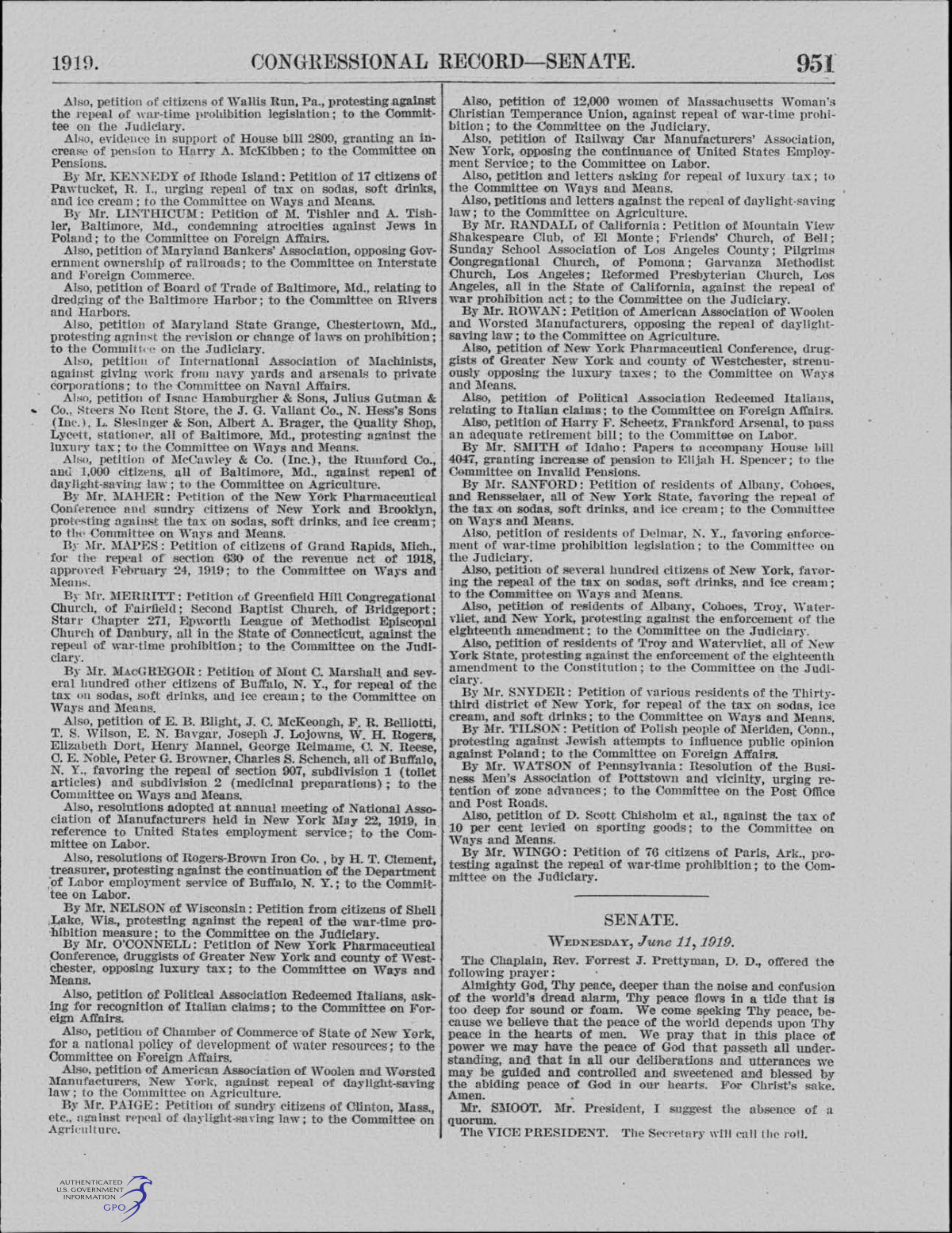
| 1. | Congressional Record - Proceedings and Debates of the Sixty-sixth Congress, First Session | 1 | Simple 24 |
- Enterprise-grade security & data encryption
- 99%+ accuracy powered by AI
- 1,000+ forms from all industries
- Complete forms in under 60 seconds
How to Choose the Right Form
Navigating Federal Records and Legislative History
Federal documents serve as the primary source of truth for government actions, historical precedents, and legislative intent. Choosing the right document depends largely on whether you are conducting historical research or seeking modern administrative records.
Legislative History and Debate
If you are researching the political climate, specific arguments, or the legislative process of the early 20th century, you will find the Congressional Record - Proceedings and Debates of the Sixty-sixth Congress, First Session to be an essential resource. This document is best for:
- Historians and Scholars: Tracking the specific language used during debates in the House and Senate during the 1919-1920 period.
- Legal Researchers: Establishing legislative intent for laws passed or debated during this specific session of Congress.
- Genealogists and Public Interest: Reviewing petitions, submitted materials, and speeches that shaped national policy following World War I.
Administrative vs. Historical Documents
When browsing government records, it is important to distinguish between "records of proceedings" and "fillable forms."
- Proceedings (like the Congressional Record): These are meant for reading, citation, and research. They provide a transparent, daily account of what occurred on the floor of Congress.
- Administrative Forms: While this category currently highlights historical debates, many federal documents are interactive. If you encounter a non-fillable PDF of a government record or a modern application, tools like Instafill.ai can be used to convert those static documents into fillable forms, making it easier to complete and submit paperwork accurately.
If your goal is to understand the roots of American lawmaking or the specific actions of the 66th Congress, the Congressional Record listed here is your primary resource for that era.
Form Comparison
| Form | Purpose | Content Included | Frequency | Primary Audience |
|---|---|---|---|---|
| Congressional Record - Proceedings and Debates of the Sixty-sixth Congress, First Session | Official daily record documenting the debates and proceedings of the United States Congress. | Includes legislative actions, floor speeches, petitions, and various materials submitted for the record. | Published daily while Congress is in session to ensure public legislative transparency. | Legislative researchers, historians, and citizens tracking the federal lawmaking process and history. |
Tips for federal documents
When filling out federal records, ensure your name, address, and social security number match your government-issued ID exactly. Discrepancies between your form and official records can lead to significant processing delays or rejections.
Always save a digital copy of your completed federal documents before submission. Having a personal archive allows you to quickly reference historical data for future filings and provides proof of your documented legislative or administrative actions.
Federal agencies often update forms to comply with new legislation. Check for the OMB control number and expiration date on the document to ensure you are using the current version accepted by the government agency.
AI-powered tools like Instafill.ai can complete complex federal forms in under 30 seconds with high accuracy. This technology streamlines the data entry process while ensuring your sensitive information stays secure throughout the entire workflow.
Many federal filings require attached evidence or supporting records to be valid. Gather digital scans of necessary certificates or identification before you begin the filling process to avoid session timeouts on official portals.
Ensure that any electronic signatures used on federal documents meet the agency's specific security standards. Using a platform that supports valid digital signatures helps ensure your document is legally binding and recognized by government entities.
Frequently Asked Questions
Federal documents include a wide range of official records, forms, and publications produced by the United States government agencies and branches. This category covers everything from legislative transcripts like the Congressional Record to administrative forms used for taxes, immigration, and social services.
Identifying the correct form depends on the specific agency you are dealing with and the nature of your request. You should review the descriptions provided for each form or visit the official website of the relevant federal department to ensure the document meets current regulatory requirements.
Yes, many federal documents can be completed using AI-powered tools like Instafill.ai. These tools can fill out complex government forms in under 30 seconds by accurately extracting data from your source documents and placing it directly into the required fields.
The Congressional Record serves as the official transcript of the proceedings and debates of the U.S. Congress. It is a vital historical and legal resource that documents legislative history, speeches, and the official actions taken by the House and Senate.
While manual entry can take significant time depending on the length of the document, using an automated service can streamline the process. AI tools can complete these forms in less than a minute, ensuring that all data is mapped correctly and legibly.
In most cases, digital versions of federal records are accepted as long as they meet the specific submission guidelines of the receiving agency. Many departments now prefer electronic filings, though some may still require a physical signature or a printed copy for certain legal processes.
Yes, if a government record is provided as a static PDF, you can use online platforms to transform it. AI services like Instafill.ai are capable of converting non-fillable versions into interactive forms, making it easier to type, edit, and save your information.
Submission methods vary by document type and agency; common options include online portals, mailing them to specific processing centers, or hand-delivering them to local federal offices. Always check the instructions included with the form for the most current submission address or digital link.
Most federal forms require standard identifying information such as your full legal name, address, and Social Security Number or Taxpayer Identification Number. Depending on the form, you may also need to provide specific evidence, dates of birth, or financial records to support your filing.
The majority of federal documents, such as legislative records and general government reports, are public records accessible to anyone. However, forms containing sensitive personal information are protected by privacy laws and are only accessible to the individual involved or authorized representatives.
Glossary
- Form Complexity Index
- Instafill’s 0–100 measure of how much effort a form takes to complete, calculated deterministically from the form’s own structure rather than estimated. It combines the number of fillable fields (the largest factor), how difficult those fields are to complete based on their type, the number of pages that contain fields, the amount of conditional “fill-only-if” logic, and how many sections the form is divided into, then adds modifiers for tables and repeating lists, bundled instruction pages, and dense page layouts. A higher score means the form is harder to fill out by hand. The forms in this category have a median Form Complexity Index of 24/100 (Simple). See exactly how it is calculated.
- Congressional Record
- The official daily transcript of the proceedings and debates of the United States Congress, documenting every word spoken on the floor.
- Legislative Intent
- The underlying purpose or objective of a law, often determined by researchers by reviewing transcripts and debates within federal documents.
- Extension of Remarks
- A specific section of the Congressional Record where members of Congress can include additional statements or materials that were not spoken aloud during a session.
- Daily Digest
- A summary section found at the end of the Congressional Record that provides a quick overview of the day's legislative actions and committee meetings.
- Public Law (P.L.)
- A bill that has been approved by both the House and Senate and signed by the President, becoming a permanent part of federal law.
- United States Code (U.S.C.)
- The official compilation of all general and permanent federal laws, organized by subject matter into 54 titles.
- Federal Register
- The official daily publication for executive branch documents, including proposed rules, final regulations, and public notices from federal agencies.
- Statutes at Large
- A chronological collection of all laws enacted during a specific session of Congress, published in the order they were signed.