Yes! You can use AI to fill out Congressional Record - Proceedings and Debates of the Sixty-sixth Congress, First Session
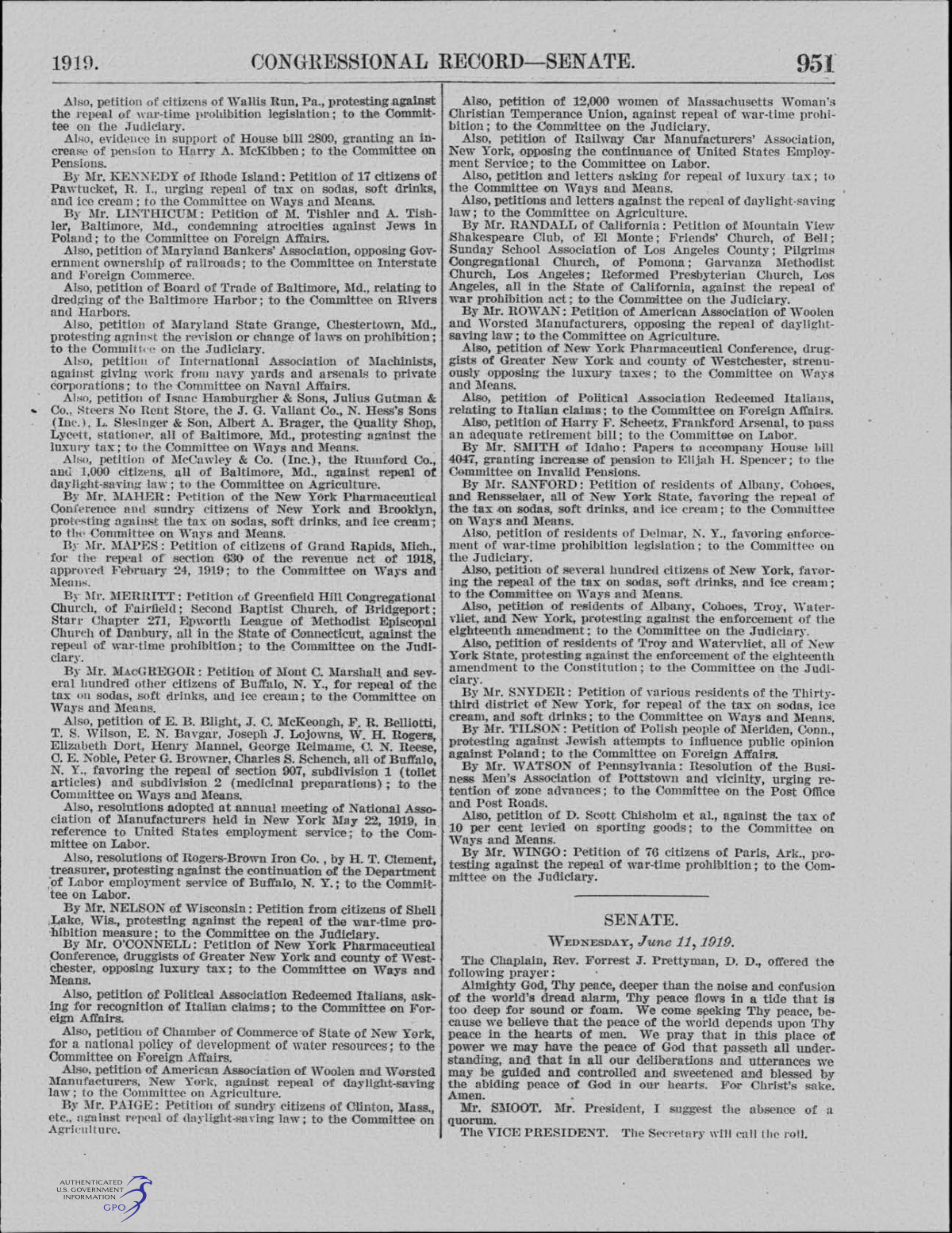
The Congressional Record is the official daily record of the debates and proceedings of the U.S. Congress, documenting legislative actions, speeches, petitions, and submitted materials. It is a crucial document for legislative history and public information, providing a transparent account of the nation's lawmaking process. While this historical document is for informational purposes, many contemporary government forms can be filled out quickly and accurately using AI-powered services like Instafill.ai, which can also convert non-fillable PDF versions into interactive fillable forms.
Our AI automatically handles information lookup, data retrieval, formatting, and form filling.
It takes less than a minute to fill out Congressional Record using our AI form filling.
Securely upload your data. Information is encrypted in transit and deleted immediately after the form is filled out.
Form specifications
| Form name: | Congressional Record - Proceedings and Debates of the Sixty-sixth Congress, First Session |
| Number of pages: | 1 |
| Language: | English |
| Categories: | IRS forms |
Instafill Demo: How to fill out PDF forms in seconds with AI
How to Fill Out Congressional Record Online for Free in 2026
Are you looking to fill out a CONGRESSIONAL RECORD form online quickly and accurately? Instafill.ai offers the #1 AI-powered PDF filling software of 2026, allowing you to complete your CONGRESSIONAL RECORD form in just 37 seconds or less.
Follow these steps to fill out your CONGRESSIONAL RECORD form online using Instafill.ai:
- 1 Navigate to Instafill.ai and upload or select the Congressional Record document you need to reference or annotate.
- 2 Use the AI-powered tools to identify key sections, petitions, or legislative actions within the record, such as those related to railroad rates or war-time prohibition.
- 3 If using this document as a template for a modern petition or official correspondence, let the AI assist in drafting the necessary text based on the historical format and language.
- 4 Review all AI-generated annotations or drafted content for accuracy, ensuring all names, dates, and committees are correctly cited from the source text.
- 5 Securely save, print, or share your annotated document directly from the platform for your records or for submission.
Our AI-powered system ensures each field is filled out correctly, reducing errors and saving you time.
Why Choose Instafill.ai for Your Fillable Congressional Record Form?
Speed
Complete your Congressional Record in as little as 37 seconds.
Up-to-Date
Always use the latest 2026 Congressional Record form version.
Cost-effective
No need to hire expensive lawyers.
Accuracy
Our AI performs 10 compliance checks to ensure your form is error-free.
Security
Your personal information is protected with bank-level encryption.
Frequently Asked Questions About Form Congressional Record
This document is a selection from the Congressional Record, which is the official daily record of the proceedings and debates of the United States Congress. Its purpose is to provide a public and transparent account of legislative activities, including speeches, votes, and petitions presented.
The Congressional Record is intended for anyone interested in the legislative process, including citizens, researchers, historians, lawyers, and lobbyists. It provides a detailed account of how laws are made and what issues are being discussed by the nation's lawmakers.
This section is where members of Congress formally present petitions, resolutions, and memorials from their constituents or organizations on various public issues. These items are then officially referred to the appropriate congressional committee for consideration.
To have a petition included, you must submit it to your Senator or Representative. They can then choose to present it on the floor of the House or Senate, at which point it becomes part of the official record.
The debate centered on a bill to amend the act for Federal control of railroads, specifically to restore the power to regulate interstate rates to the Interstate Commerce Commission. This power had been temporarily given to the President during World War I.
This is a procedural tactic used by a member to request a roll call to determine if a sufficient number of members are present to conduct business. It can be used to delay proceedings or to gather more members for an important debate or vote.
These are specialized committees within Congress that handle specific subject areas. They review proposed legislation and petitions, hold hearings, and make recommendations before a bill is considered by the full House or Senate.
No, the Congressional Record is a publication for informational purposes and not a form to be filled out. It documents the proceedings of Congress rather than collecting information from the public.
Since this is a publication and not a form, it is not meant to be fillable. For non-interactive PDFs, services like Instafill.ai can convert them into searchable and interactive documents, making it much easier to find specific information.
Yes, AI-powered services like Instafill.ai can be very helpful for navigating dense documents like this. They can quickly locate specific names, topics, or bill numbers, and help you analyze the contents more efficiently than manual reading.
You can upload the PDF to a platform like Instafill.ai to make the entire text searchable. This allows you to instantly find mentions of specific topics, such as 'daylight-saving law' or 'luxury tax,' saving you the time of reading through every page.
Citizens were concerned with a wide range of issues, including the repeal of war-time prohibition, taxes on items like soda and ice cream (luxury taxes), the daylight-saving law, and labor issues related to government-owned facilities.
The debate concerns the balance of power between state governments and the federal government in regulating railroad commerce. The core issue was whether the federal government, during its temporary control of railroads, should have the authority to set rates for traffic that occurs entirely within a single state.
The Congressional Record is published each day that Congress is in session. The document shown here is for a single day's proceedings on June 11, 1919.
Compliance Congressional Record
Validation Checks by Instafill.ai
1
Validates Bill Number Format
This check ensures that any legislative bill number follows the standard congressional format, such as 'H. R. 5312' or 'S. 641'. It verifies the presence of the correct prefix for the chamber (House or Senate) followed by a numerical identifier. This validation is critical for accurate legislative tracking and database indexing; a malformed number would prevent the system from linking the record to the correct bill.
2
Verifies Committee Name against Official Roster
This validation confirms that the committee name to which a petition or bill is referred, such as 'Committee on Ways and Means', exists in an official roster for that session of Congress. Referring a matter to a non-existent or misspelled committee would result in a processing dead-end. If validation fails, the submission should be flagged for manual correction to ensure it reaches the proper legislative body.
3
Ensures Date is in a Valid Format and Chronologically Sound
This check verifies that all dates, like 'June 11, 1919', are in a standard, parseable format and represent a valid calendar date. It also performs a logical check to ensure the date is not in the future or otherwise anachronistic for a historical record. Maintaining accurate date records is fundamental for archival integrity and searchability; an invalid date would corrupt the timeline of events.
4
Checks for Clear Identification of Petitioner
This validation ensures that the petitioner field is not empty and contains a clearly identifiable name, whether of an organization ('International Association of Machinists') or individuals ('M. Tishler and A. Tishler'). An anonymous or vague petition lacks official standing and cannot be properly recorded. Submissions with unclear petitioner information must be flagged for review to establish provenance.
5
Validates Location Format (City, State Abbreviation)
This check ensures that geographic locations are consistently formatted, typically as 'City, ST' (e.g., 'Pawtucket, R. I.'). It validates the state abbreviation against a standard list. This standardization is crucial for accurate data aggregation, mapping, and geographic reporting; inconsistent formats would lead to fragmented and unreliable location data.
6
Logical Consistency between Petition Subject and Committee Referral
This validation cross-references the subject matter of a petition with the known jurisdiction of the committee it is referred to. For instance, a petition on a 'luxury tax' should logically go to the 'Committee on Ways and Means,' not the 'Committee on Naval Affairs.' A mismatch indicates a potential clerical error that would delay or prevent the petition from receiving appropriate consideration, requiring the submission to be rerouted.
7
Verifies Legislator's Name and State
This check confirms that the name of the legislator presenting a petition or bill (e.g., 'Mr. KENNEDY of Rhode Island') matches an official roster of members for that specific Congress and that the associated state is correct. Accurate attribution is essential for the integrity of the legislative record. A mismatch would be a significant error and must be flagged for immediate correction.
8
Ensures Document Page Numbers are Sequential
This validation examines the page numbers within the document (e.g., 951, 952, 953) to confirm they are in a correct, unbroken sequence. A gap or duplication in page numbers suggests that the document may be incomplete or improperly assembled. This check is vital for verifying the integrity and completeness of the official record before it is archived.
9
Completeness Check for Petition Submissions
This validation ensures that every recorded petition includes the three essential components: a petitioner, a subject or purpose, and a committee referral. A record lacking any of these core elements is incomplete and cannot be processed correctly. The system should reject or flag any petition entry that fails this fundamental completeness check for manual data entry correction.
10
Validates Resolution Number and Type Format
This check ensures that resolutions are identified with the correct prefix (e.g., 'H. J. Res.', 'H. R.') followed by a number, as seen with 'H. R. 5312'. Correctly identifying the resolution type is critical as it determines the legislative path and legal weight of the measure. An error in the prefix or number would lead to misclassification and incorrect processing.
11
Plausibility Check for Appropriation Amounts
This validation flags monetary values, such as the '$2,417,186.95' appropriation, that fall outside a predefined, reasonable range for a given context. This serves as a crucial defense against data entry errors like misplaced decimals or extra digits. An implausible amount would trigger a requirement for manual verification before the financial data is accepted into the system.
12
Verifies Bill Prefix Corresponds to Chamber of Origin
This check ensures the prefix of a bill number ('S.' for Senate, 'H. R.' for House of Representatives) aligns with the chamber in which the action is taking place. For example, a bill being introduced in the Senate, as shown in the document, should have an 'S.' prefix. This validation prevents clerical errors and ensures accurate tracking of legislation as it moves through the legislative process.
Common Mistakes in Completing Congressional Record
Many submissions fail to clearly identify the petitioners, using vague terms like 'concerned citizens.' The record shows effective petitions specify the group, such as '17 citizens of Pawtucket, R.I.' or 'Maryland Bankers' Association.' Omitting specific names, organizational affiliations, or geographic locations weakens the petition's credibility and makes it difficult for legislators to assess the scope of support. To avoid this, always provide complete and precise information for all petitioning parties.
A petition's request must be clear, concise, and actionable. A common error is stating a goal that is too broad, such as 'for better government,' which provides no clear direction for legislators. Effective petitions, like those in the record urging the 'repeal of tax on sodas,' target a specific outcome. Failing to do so can result in the petition being misunderstood or ignored because its objective is not apparent.
The document shows that each petition was referred to a specific committee with relevant jurisdiction, such as the Committee on Ways and Means for tax issues or the Committee on Naval Affairs for navy-related work. A frequent mistake is sending a petition to the wrong committee, which causes significant delays or leads to the petition being lost in the legislative process. Petitioners must research and identify the correct committee to ensure their concerns are addressed by the appropriate body. AI-powered tools like Instafill.ai can help identify the correct committee based on the form's content.
The impact of a petition is significantly enhanced by demonstrating broad support. The record highlights petitions from '12,000 women' and 'several hundred other citizens,' giving legislators a clear measure of public interest. A common mistake is to simply state that a group of 'citizens' is petitioning without providing a specific number of signatories. This vagueness can cause the petition's importance to be underestimated, so it is crucial to tally and prominently feature the total number of supporters.
Petitions that address a general problem without connecting it to a specific legislative vehicle are often ineffective. The most successful petitions cited in the record reference a particular bill, like 'House bill 2809,' or a specific law, such as 'section 630 of the revenue act of 1918.' This provides a clear, actionable focus for legislators. Failing to do so leaves the petition's desired outcome open to interpretation and reduces the likelihood of concrete legislative action.
An effective petition focuses on a single, well-defined issue. A critical error is to create an omnibus petition that addresses several unrelated topics, such as foreign affairs, agricultural policy, and military pensions, all at once. This approach makes it impossible to refer the petition to a single, appropriate committee and dilutes the overall message. To ensure each issue receives proper consideration, a separate petition should be prepared for each distinct request.
Many official documents are only available as flat, non-fillable PDFs, leading to submissions that are handwritten, illegible, and unprofessional. This makes it difficult to process the information and reflects poorly on the petitioner. To avoid this, tools like Instafill.ai can convert non-fillable PDFs into clean, typeable forms, ensuring the final document is clear, professional, and easy for congressional staff to read and process.
A petition does not formally enter the legislative process until it is presented by a Member of Congress. The record shows every petition was introduced 'By Mr. [Senator's Name].' A common procedural mistake is to mail a petition directly to a committee or to Congress in general, without first securing a sponsor. This can result in the petition never being officially recorded or considered. Petitioners should always work with their local Representative or Senator to ensure their petition is properly introduced on the floor.
Saved over 80 hours a year
“I was never sure if my IRS forms like W-9 were filled correctly. Now, I can complete the forms accurately without any external help.”
Kevin Martin Green
Your data stays secure with advanced protection from Instafill and our subprocessors

Robust compliance program
Transparent business model
You’re not the product. You always know where your data is and what it is processed for.
ISO 27001, HIPAA, and GDPR
Our subprocesses adhere to multiple compliance standards, including but not limited to ISO 27001, HIPAA, and GDPR.
Security & privacy by design
We consider security and privacy from the initial design phase of any new service or functionality. It’s not an afterthought, it’s built-in, including support for two-factor authentication (2FA) to further protect your account.
Fill out Congressional Record with Instafill.ai
Worried about filling PDFs wrong? Instafill securely fills congressional-record-proceedings-and-debates-of-the-sixty-sixth-congress-first-session forms, ensuring each field is accurate.