Fill out government records
with AI.
Government records and federal documents are the backbone of public transparency and historical preservation. They serve as the official account of legislative activities, administrative decisions, and the legal framework of the nation. These records are essential for maintaining an informed citizenry and ensuring that the actions of elected officials and government agencies are documented for posterity. Whether it is a transcript of a historic debate or a contemporary administrative filing, these documents provide the context necessary to understand how laws are shaped and implemented.
By continuing, you acknowledge Instafill's Privacy Policy and agree to get occasional product update and promotional emails.
About government records
Typically, researchers, legal professionals, and historians rely on these records to trace the evolution of specific statutes or to gather evidence for legal proceedings. However, everyday citizens also interact with federal documents when requesting official information, participating in public hearings, or fulfilling reporting requirements. For instance, reviewing the Congressional Record can be vital for understanding the intent behind a piece of legislation. Navigating these dense documents often requires significant time and attention to detail to ensure that any associated paperwork is handled correctly.
Managing the paperwork associated with government records can be a complex task, but modern tools are simplifying the process. Instafill.ai uses AI to fill these forms in under 30 seconds, ensuring that data is handled accurately and securely while saving users from tedious manual entry. This technology makes it easier to manage federal documents by converting static files into interactive, fillable forms that can be completed with minimal effort.
Every form on this page can be completed without typing. Instafill is form filling software that reads a PDF and fills it for you — including flat and scanned documents that carry no fillable fields at all.
Forms in This Category
The forms in this category have a median Form Complexity Index of 24/100 (Simple), measured across 1 forms by field count, input difficulty, length, conditional logic and structure. See how it is calculated.
| Form Name | Pages | FCI | |
|---|---|---|---|
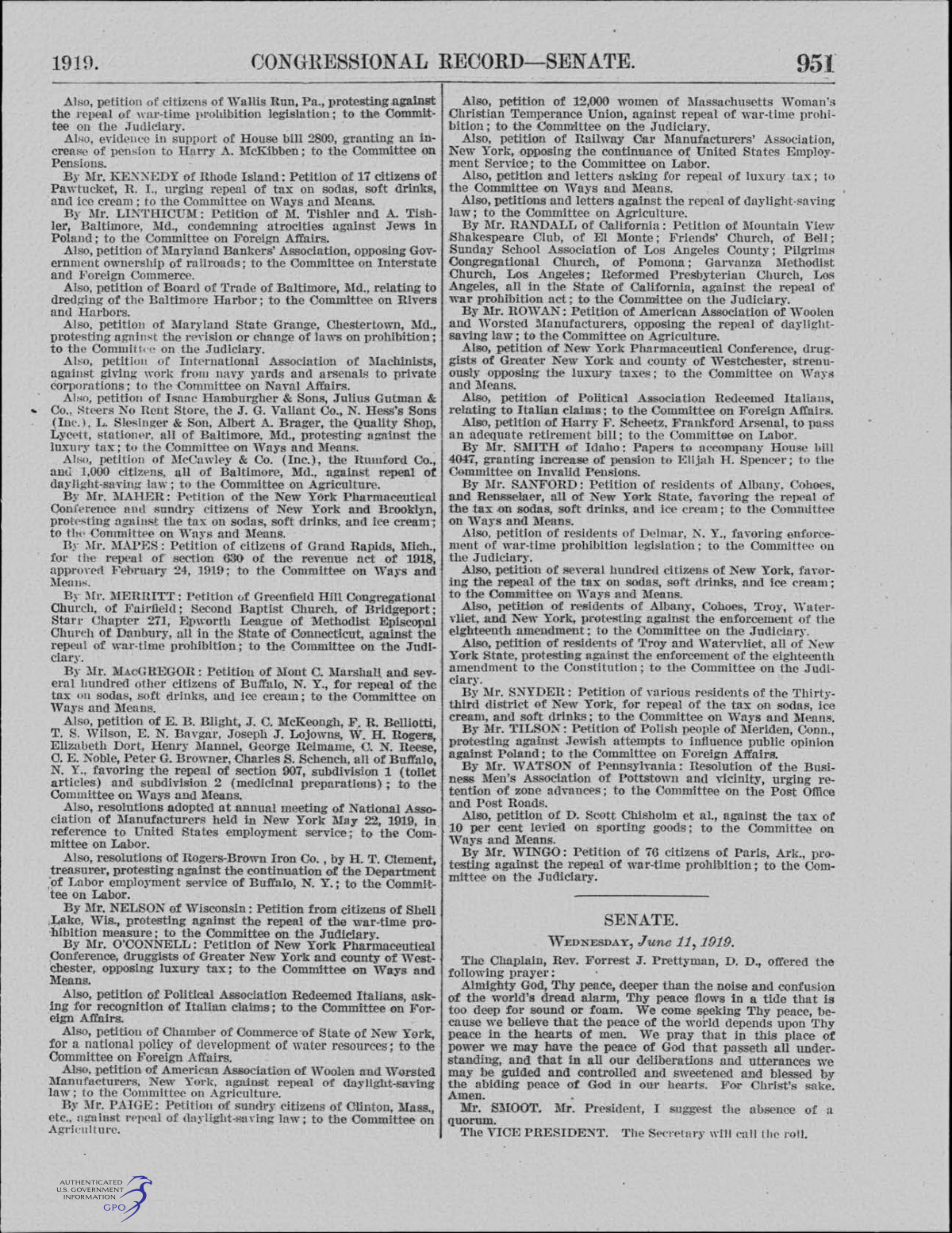
| 1. | Congressional Record - Proceedings and Debates of the Sixty-sixth Congress, First Session | 1 | Simple 24 |
- Enterprise-grade security & data encryption
- 99%+ accuracy powered by AI
- 1,000+ forms from all industries
- Complete forms in under 60 seconds
How to Choose the Right Form
Navigating the vast landscape of government records and federal documents requires an understanding of whether you are looking for historical archives or actionable forms. While this category currently highlights specific historical proceedings, it serves as a gateway to understanding the legislative process.
Historical and Legislative Research
If your goal is to research American history, legal precedents, or the evolution of federal policy, you will primarily interact with archival documents.
- Congressional Record - Proceedings and Debates of the Sixty-sixth Congress, First Session: Choose this document if you are looking for a verbatim account of the speeches, debates, and petitions that shaped the 66th Congress. It is an essential resource for historians and legal professionals seeking to understand legislative intent during that era.
Identifying the Right Federal Document
When browsing government records, consider the following use cases to ensure you have the correct file:
- For Academic or Legal Reference: Look for official records like the Congressional Record. These are used to cite specific floor statements or to track the progression of a particular bill through the House and Senate.
- For Modern Administrative Tasks: If you are looking for contemporary federal forms (such as those from the IRS, SSA, or USCIS), you should look for fillable PDF versions. While historical records are for reading, modern forms are for active submission.
Streamlining Government Filings
Many government records and federal documents are provided in static formats that are difficult to edit. Whether you are referencing the Congressional Record - Proceedings and Debates of the Sixty-sixth Congress, First Session for a report or trying to complete a modern government application, Instafill.ai can help. Our AI-powered tools allow you to convert non-fillable PDF government documents into interactive, fillable forms, ensuring that your federal submissions are accurate, professional, and completed quickly.
Form Comparison
| Form | Primary Purpose | Content Type | Historical Significance |
|---|---|---|---|
| Congressional Record - Proceedings and Debates of the Sixty-sixth Congress, First Session | Documents the official daily debates and proceedings of the U.S. Congress. | Includes legislative actions, floor speeches, petitions, and submitted materials. | Provides a transparent account of legislative history and the lawmaking process. |
Tips for government records
When working with federal documents, precision is paramount as these records often serve as legal or historical evidence. Always verify names, dates, and citations against official sources before finalizing your submission or archive to maintain the integrity of the record.
To easily retrieve specific debates or proceedings, organize your files by Congress number and session date. This systematic approach saves significant time when cross-referencing legislative history or tracking the evolution of a specific bill over several years.
Many historical government records are stored as image-based PDFs that are not naturally searchable. Converting these into searchable text formats allows you to find specific keywords or legislative actions instantly without scrolling through hundreds of pages.
When submitting or sharing government records, be sure to redact any sensitive personal identifiers that are not strictly required for the public record. Maintaining privacy is critical when handling federal documents that may be subject to public disclosure or archival access.
Modern government forms can be complex, but AI-powered tools like Instafill.ai can complete these documents in under 30 seconds with high accuracy. This technology ensures your data stays secure throughout the process, providing a massive time-saving advantage for those managing multiple federal filings.
Federal agencies frequently update their documentation and filing requirements to reflect new laws. Before filling out a record, verify that you are using the most current version of the form to avoid rejection or administrative delays.
Adopt a standard naming format for your digital government records, such as including the date and agency name in the file title. This practice prevents version control issues and ensures that you can locate specific federal documents within seconds during an audit.
Frequently Asked Questions
Federal government records include all documentary materials, such as papers, maps, and electronic files, made or received by an agency of the United States. These records serve as the official account of the organization, functions, policies, and decisions of the federal government.
The Congressional Record is the official transcript of the proceedings and debates of the United States Congress. It provides a primary source for understanding legislative intent, tracking the history of specific bills, and reviewing the speeches and petitions submitted during a particular session.
Historical records are typically archived by the National Archives and Records Administration (NARA) or the Government Publishing Office (GPO). Many of these documents, including those from the Sixty-sixth Congress, are digitized and can be searched by session number, date, or specific legislative topic.
Yes, many contemporary government forms and records can be completed using AI-powered tools. Services like Instafill.ai can process these documents in under 30 seconds by accurately extracting data from your source files and placing it into the correct fields.
While manual entry can be time-consuming, using an AI tool significantly speeds up the process. Automated systems can analyze the requirements of a federal document and populate the necessary information almost instantly, often in less than 30 seconds.
Most federal records are accessible to the public under the Freedom of Information Act (FOIA), though some may be restricted for reasons of national security or privacy. Historical legislative records like the Congressional Record are generally open and available for public inspection.
A government record is a finished document that preserves historical or administrative information, whereas a government form is a template used to collect data. Once a form is submitted to and processed by a federal agency, it often becomes part of the official government record.
While complex legal filings may benefit from professional advice, many standard federal documents can be prepared by individuals using official instructions. AI tools further simplify this by helping users navigate fields and ensuring that the data provided matches the requirements of the specific record.
Submission methods vary by agency, but most can be filed electronically through official portals, via mail, or in person at regional offices. It is important to check the specific filing instructions provided on the document or the agency's official website.
Yes, many historical or static government PDFs are not natively interactive. AI platforms like Instafill.ai can automatically detect fields in these documents and convert them into fillable forms, making it easier to add information or complete required sections digitally.
Glossary
- Form Complexity Index
- Instafill’s 0–100 measure of how much effort a form takes to complete, calculated deterministically from the form’s own structure rather than estimated. It combines the number of fillable fields (the largest factor), how difficult those fields are to complete based on their type, the number of pages that contain fields, the amount of conditional “fill-only-if” logic, and how many sections the form is divided into, then adds modifiers for tables and repeating lists, bundled instruction pages, and dense page layouts. A higher score means the form is harder to fill out by hand. The forms in this category have a median Form Complexity Index of 24/100 (Simple). See exactly how it is calculated.
- Congressional Record
- The official daily transcript of the proceedings and debates of the U.S. Congress, documenting speeches, legislative actions, and votes.
- Legislative History
- The collection of documents, such as committee reports and floor debates, that are produced during the process of a bill becoming a law.
- FOIA (Freedom of Information Act)
- A federal law that grants the public the right to request and access records from any federal agency, subject to certain exemptions.
- Federal Register
- The official daily journal of the federal government that contains agency rules, proposed regulations, and public notices.
- NARA (National Archives and Records Administration)
- The independent federal agency charged with the preservation and management of all historical and government records of the United States.
- Extension of Remarks
- A section of the Congressional Record where members of Congress can include additional statements or materials that were not spoken on the floor during a session.
- Public Law
- A bill that has been passed by both the House and Senate and signed by the President, making it a permanent part of the nation's legal code.
- Statutes at Large
- A chronological collection of all laws and resolutions passed by Congress during a specific session, serving as the permanent record of legislation.