Fill out financial account application forms
with AI.
Financial account application forms serve as the essential bridge between individuals or legal entities and the financial institutions they trust to manage their assets. These documents are designed to collect critical information ranging from tax identification numbers and legal structures to the personal details of authorized signers. Because these forms are used to establish brokerage accounts, investment portfolios, and corporate banking relationships, they are vital for maintaining regulatory compliance and ensuring that all financial activities are properly documented and secure.
By continuing, you acknowledge Instafill's Privacy Policy and agree to get occasional product update and promotional emails.
About financial account application forms
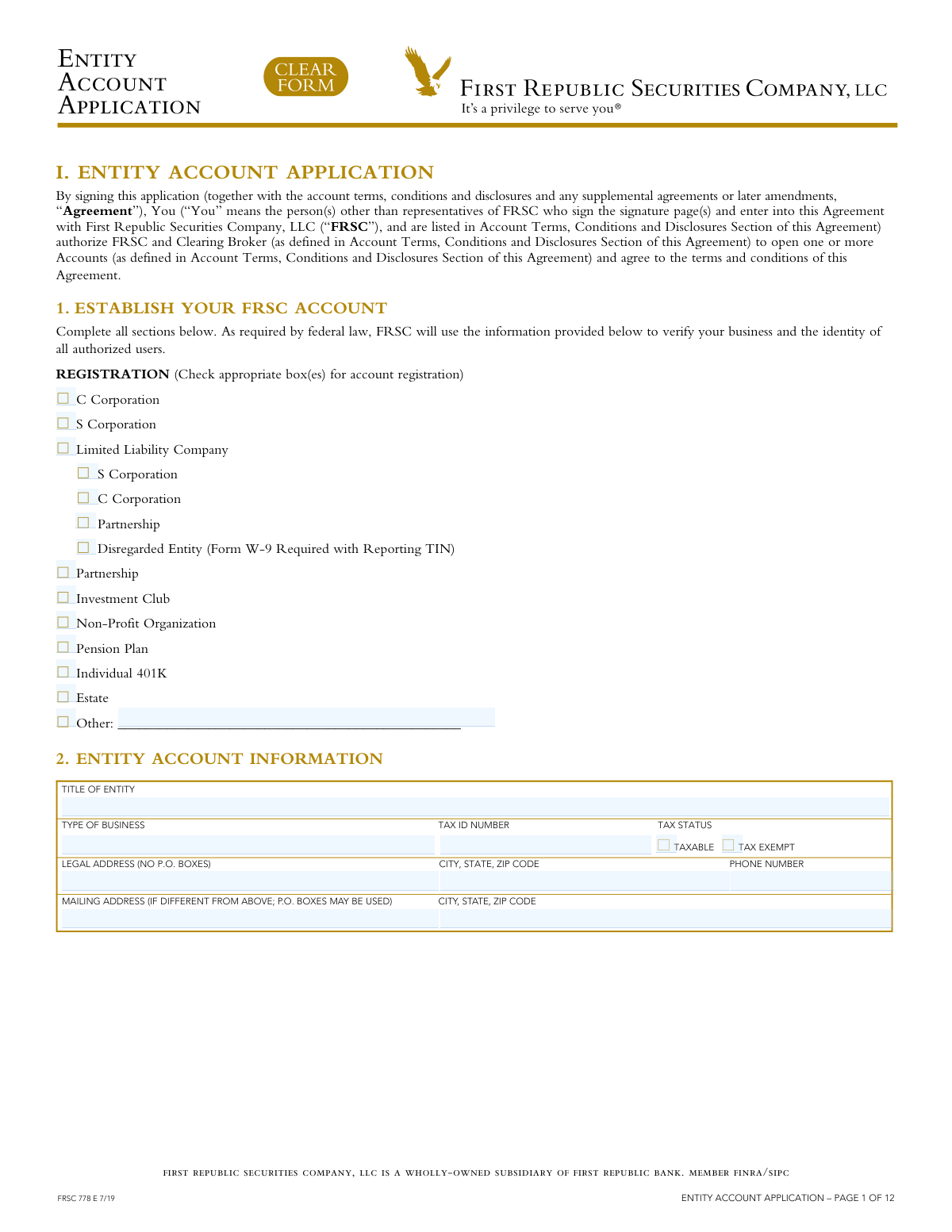
Business owners, corporate officers, and legal representatives typically need these forms when expanding their organization's financial footprint or transitioning to new investment platforms. For instance, entities like LLCs, corporations, and partnerships must often complete detailed applications, such as the Entity Account Application, to satisfy 'Know Your Customer' requirements. Accuracy is paramount in these situations, as even a minor clerical error can lead to significant delays in account approval or issues with tax reporting.
Completing these complex PDFs manually is often a time-consuming administrative burden. Tools like Instafill.ai use AI to fill these forms in under 30 seconds, handling the data accurately and securely to ensure your applications are professional and error-free. By automating the data entry process, you can focus on managing your investments rather than navigating the intricacies of paperwork.
Every form on this page can be completed without typing. Instafill is form filling software that reads a PDF and fills it for you — including flat and scanned documents that carry no fillable fields at all.
Forms in This Category
The forms in this category have a median Form Complexity Index of 63/100 (Complex), measured across 1 forms by field count, input difficulty, length, conditional logic and structure. See how it is calculated.
| Form Name | Pages | FCI | |
|---|---|---|---|
| 1. | First Republic Securities Company, LLC Entity Account Application (FRSC 778 E 7/19) | 1 | Complex 63 |
- Enterprise-grade security & data encryption
- 99%+ accuracy powered by AI
- 1,000+ forms from all industries
- Complete forms in under 60 seconds
How to Choose the Right Form
Navigating financial account applications requires matching your specific business structure with the correct regulatory document. While this category currently focuses on a primary option for institutional investors, it is essential to verify that your entity meets the criteria for this specific application before beginning the process.
For Legal Entities and Organizations
If you are representing a business or a non-natural person rather than an individual, the First Republic Securities Company, LLC Entity Account Application (FRSC 778 E 7/19) is the required document. This form is specifically tailored for legal structures that need to establish a presence in the financial markets. It is the correct choice for:
- Corporations: Including both C-Corp and S-Corp structures.
- Limited Liability Companies (LLCs): Both member-managed and manager-managed entities.
- Partnerships: General partnerships, limited partnerships (LPs), and limited liability partnerships (LLPs).
- Other Entities: Such as trusts, estates, or unincorporated associations.
Identifying the Account Purpose
The FRSC 778 E is specifically designed for opening a brokerage account. If your goal is to manage market investments, trade securities, or hold investment assets under a legal entity name, this is the correct form. If you are instead looking for a standard business checking or savings account, you should verify if your institution requires a different retail banking application.
Preparation for Filing
To complete the First Republic Securities Company, LLC Entity Account Application efficiently using Instafill.ai, ensure you have the following information ready:
- Entity Tax Status: You will need your Employer Identification Number (EIN) and tax classification.
- Authorized Signers: The form requires detailed personal information for all individuals authorized to transact on behalf of the entity.
- Control Persons: Information regarding individuals with significant responsibility to control or manage the legal entity.
By utilizing AI-powered tools, you can quickly convert the standard PDF version of the FRSC 778 E into an interactive format, ensuring that all entity details and signer information are captured accurately and professionally.
Form Comparison
| Form | Eligible Entities | Primary Purpose | Key Requirements |
|---|---|---|---|
| First Republic Securities Company, LLC Entity Account Application (FRSC 778 E 7/19) | Corporations, LLCs, partnerships, and other legal entities seeking brokerage accounts. | To establish a new brokerage account with First Republic Securities Company. | Requires entity tax status and personal details for all authorized signers. |
Tips for financial account application forms
Before starting the application, ensure you have your Articles of Incorporation, Operating Agreement, or Partnership Agreement readily available. These documents are essential for verifying your legal structure and identifying the authorized individuals required to sign the form.
Mistyping your Employer Identification Number (EIN) or Taxpayer Identification Number (TIN) is a common error that leads to significant processing delays. Always cross-reference the digits on the form with your official IRS documentation to ensure an exact match.
AI-powered tools like Instafill.ai can complete these financial forms in under 30 seconds with high accuracy, saving you from repetitive manual typing. Your sensitive data stays secure during the process, providing a practical and fast solution for managing multiple entity applications.
Entity account applications require detailed personal information for every authorized signer, including Social Security numbers and residential addresses. Ensure every individual listed has reviewed their specific section to prevent discrepancies that could trigger additional compliance reviews.
If you are opening several accounts for the same entity, ensure the legal name and business address are identical across all applications. Inconsistent information between different forms can raise red flags with security departments and slow down the approval of your brokerage accounts.
Some financial institutions have strict requirements regarding digital signatures versus 'wet' ink signatures for corporate entities. Check the specific submission instructions for the form to confirm if you can submit electronically or if a physical copy must be mailed.
Frequently Asked Questions
Financial account application forms are used by individuals and legal entities to establish new relationships with banks, brokerages, or investment firms. These documents collect essential identity, tax, and regulatory information required to open and maintain a secure financial account.
Entity account applications are required for legal organizations such as corporations, Limited Liability Companies (LLCs), partnerships, and trusts. Unlike individual accounts, these forms focus on the legal structure of the business and the individuals authorized to manage its assets.
You will typically need to provide the legal name of the entity, its Tax Identification Number (TIN) or Employer Identification Number (EIN), and its primary business address. Additionally, the form will require details about the nature of the business and the personal information of all beneficial owners and authorized signers.
Yes, AI tools like Instafill.ai can be used to complete financial account application forms efficiently. These systems accurately extract data from your existing business documents and place it into the correct fields on the PDF form, ensuring high accuracy and consistency.
Using AI-powered services, you can fill out complex financial forms in under 30 seconds. The technology automates the data entry process by identifying relevant information from your source documents, which significantly reduces the time spent on manual typing.
Most financial institutions require copies of the entity's formation documents, such as Articles of Incorporation or an Operating Agreement. You may also need to provide government-issued identification for all authorized signers to comply with 'Know Your Customer' (KYC) regulations.
An authorized signer is an individual who has been granted the legal power by the entity to perform transactions and sign documents on its behalf. These individuals are usually officers, managers, or partners who are officially designated in the company’s corporate resolution.
Financial institutions are required to report certain types of income and transactions to tax authorities. Knowing whether an entity is a C-Corporation, S-Corporation, or Partnership allows the institution to apply the correct tax withholding and reporting standards to the account.
Once the forms are filled and signed, they are generally submitted to the specific financial institution's onboarding or compliance department. Submission methods vary by firm and may include secure digital uploads, physical mail, or in-person delivery at a branch office.
If the account will be owned by a person or two people jointly, an individual or joint application is appropriate. If the account is being opened in the name of a business, non-profit, or trust, you must use the specific entity account application designed for legal organizations.
Glossary
- Form Complexity Index
- Instafill’s 0–100 measure of how much effort a form takes to complete, calculated deterministically from the form’s own structure rather than estimated. It combines the number of fillable fields (the largest factor), how difficult those fields are to complete based on their type, the number of pages that contain fields, the amount of conditional “fill-only-if” logic, and how many sections the form is divided into, then adds modifiers for tables and repeating lists, bundled instruction pages, and dense page layouts. A higher score means the form is harder to fill out by hand. The forms in this category have a median Form Complexity Index of 63/100 (Complex). See exactly how it is calculated.
- Authorized Signer
- An individual who has been granted the legal authority to conduct transactions, sign documents, and manage a financial account on behalf of a business or organization.
- Tax Identification Number (TIN)
- A unique nine-digit number, such as an Employer Identification Number (EIN), used by the IRS to identify a legal entity for tax reporting and account verification purposes.
- Beneficial Owner
- Any individual who owns 25% or more of a legal entity, or who exercises significant control over the entity, often required to be disclosed for anti-money laundering compliance.
- Brokerage Account
- A type of financial account held at a licensed firm that allows an entity to buy and sell securities, such as stocks, bonds, and mutual funds.
- Legal Entity
- A business or organization, such as a Corporation, LLC, or Partnership, that is legally recognized as separate from its individual owners or members.
- KYC (Know Your Customer)
- A standard regulatory process used by financial institutions to verify the identity of their clients and assess potential risks of illegal intentions.
- Controlling Person
- An individual with significant managerial responsibility within an entity, such as a CEO, CFO, or Managing Member, who directs the organization's operations.
- FINRA (Financial Industry Regulatory Authority)
- The private corporation that acts as a self-regulatory organization for brokerage firms and exchange markets in the United States.