Fill out financial account update forms
with AI.
Financial account update forms are essential documents used to maintain the accuracy and compliance of investment and banking records. As life circumstances change or regulatory requirements evolve, financial institutions require updated information to ensure that accounts remain in good standing. These forms cover a range of details, from changing basic contact information to providing complex structural data for entities like unregulated trusts. Keeping this information current is vital for tax reporting, adhering to international regulations like FATCA and CRS, and ensuring that all beneficiaries and controlling persons are correctly identified within the financial system.
By continuing, you acknowledge Instafill's Privacy Policy and agree to get occasional product update and promotional emails.
About financial account update forms
These forms are typically required by individual investors, trustees, and corporate officers who manage assets within established financial institutions. You might encounter them when there is a change in the management of a trust, a shift in beneficial ownership, or simply as part of a periodic review initiated by a firm like Vanguard. For example, updating trust details ensures that the institution has the most recent data regarding the trust’s structure and tax residency. Failing to provide these updates promptly can lead to account restrictions, processing delays, or complications during tax season.
Manually entering data into these complex documents can be tedious and prone to errors, especially when dealing with legal terminology and tax classifications. Tools like Instafill.ai use AI to fill these forms in under 30 seconds, handling the data accurately and securely to save you time. This technology streamlines the process, allowing you to complete your financial administrative tasks with precision and minimal effort.
Every form on this page can be completed without typing. Instafill is form filling software that reads a PDF and fills it for you — including flat and scanned documents that carry no fillable fields at all.
Forms in This Category
The forms in this category have a median Form Complexity Index of 64/100 (Complex), measured across 1 forms by field count, input difficulty, length, conditional logic and structure. See how it is calculated.
| Form Name | Pages | FCI | |
|---|---|---|---|
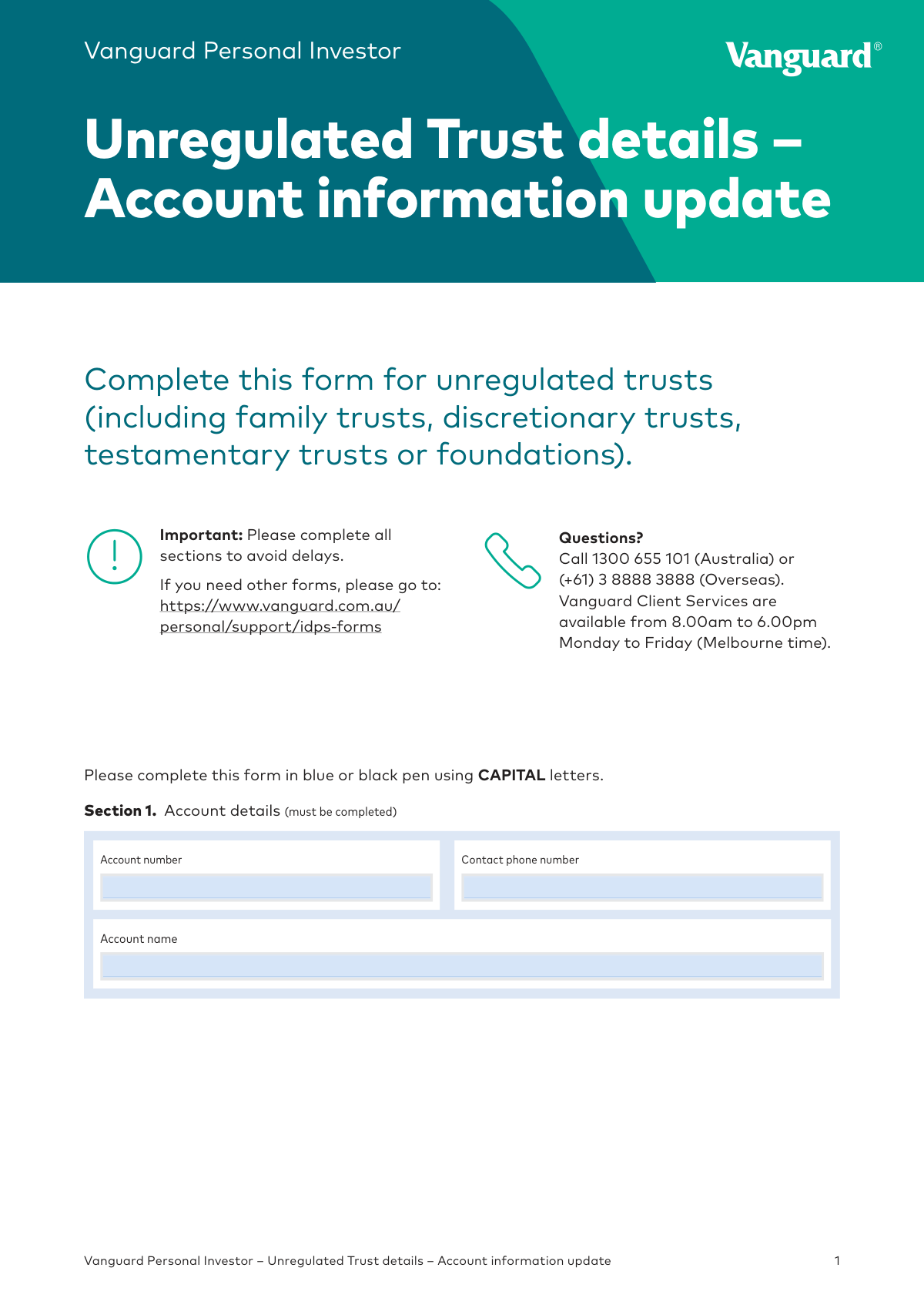
| 1. | Vanguard Personal Investor – Unregulated Trust details – Account information update | 1 | Complex 64 |
- Enterprise-grade security & data encryption
- 99%+ accuracy powered by AI
- 1,000+ forms from all industries
- Complete forms in under 60 seconds
How to Choose the Right Form
Updating your financial accounts ensures that your investments remain compliant with current regulations and that your records accurately reflect your current legal structure. In this category, the focus is on specialized trust documentation for investment platforms.
Managing Unregulated Trust Accounts
If you manage an investment portfolio through a trust that is not registered with a specific regulatory body (an unregulated trust), you must keep the financial institution informed of any changes to the trust's structure.
- Vanguard Personal Investor – Unregulated Trust details – Account information update: Use this form specifically if you hold a Vanguard Personal Investor account under an unregulated trust. It is the correct choice when you need to:
- Update the list of beneficiaries.
- Provide details on new or existing controlling persons.
- Report changes to the trust’s structure to satisfy FATCA (Foreign Account Tax Compliance Act) or CRS (Common Reporting Standard) requirements.
- Ensure the trust's tax residency information is up to date.
When to Use This Form
You should select this form if your trust has undergone a significant change, such as a change in trustees or a modification in how the trust is governed. Because financial institutions are required by law to maintain "Know Your Customer" (KYC) standards, failing to provide these updates can lead to account restrictions or compliance issues.
Tips for Accuracy
Before you begin filling out the Vanguard Personal Investor – Unregulated Trust details – Account information update form, ensure you have the trust deed and the identification details of all relevant parties (beneficiaries and controllers) ready. Using Instafill.ai to complete this document allows you to accurately map out complex trust hierarchies and ensures that all mandatory fields for tax reporting are addressed without manual errors. This is particularly helpful for trustees who need to ensure every detail matches their legal documentation exactly.
Form Comparison
| Form | Purpose | Who Files It | Key Requirements |
|---|---|---|---|
| Vanguard Personal Investor – Unregulated Trust details – Account information update | Updates trust structure, beneficiaries, and controlling person details for Vanguard accounts. | Trustees of unregulated trusts managing a Vanguard Personal Investor account. | Trust structure details, beneficiary information, and FATCA/CRS reporting data. |
Tips for financial account update forms
Double-check that all beneficiary names and tax identification numbers exactly match your trust deed and legal documents. Discrepancies between the form and official records can lead to significant delays or the rejection of your update request.
For unregulated trusts, it is essential to clearly identify anyone with significant control or influence over the trust's assets. This information is a mandatory requirement for FATCA and CRS compliance, so ensure you have their full legal details ready.
AI-powered tools like Instafill.ai can complete complex financial update forms in under 30 seconds with high accuracy. Your sensitive financial data stays secure during the process, making it a highly efficient way to manage multiple trust updates.
Gathering your trust deed, tax file numbers, and identification documents before you start will save you from interruptions. Having these details at your fingertips ensures a smoother, more organized filing experience.
Since these forms often involve FATCA and CRS reporting, you must provide accurate information regarding the trust's tax residency. Failing to update this correctly can result in incorrect tax withholding or non-compliance with international regulations.
Review the entire form to ensure that the information provided matches previous filings with the same institution. Maintaining consistency across all financial account updates helps prevent confusion and simplifies your overall portfolio management.
Frequently Asked Questions
Financial account update forms are used to notify investment firms or banks about changes in your legal or personal status. They ensure that your account details remain accurate for tax reporting, regulatory compliance, and secure communication.
This form is typically completed by the trustees of an unregulated trust that holds an investment account. It is used to provide updated details regarding the trust's structure, its beneficiaries, and the individuals who exercise control over the trust's assets.
Financial institutions are required by law to identify the ultimate beneficial owners of an account to prevent financial crimes. This information is also essential for meeting international tax transparency standards, such as FATCA (Foreign Account Tax Compliance Act) and CRS (Common Reporting Standard).
You should submit an update whenever there is a significant change to the trust, such as the appointment of a new trustee, a change in beneficiaries, or a shift in the trust’s underlying structure. Regular updates may also be requested by the financial institution to ensure their records remain current.
Yes, you can use AI tools like Instafill.ai to complete these forms efficiently. The AI can accurately extract data from your source documents and place it into the correct fields, ensuring that complex trust information is captured without manual entry errors.
Using AI-powered services, you can fill out financial account update forms in under 30 seconds. The technology processes the document instantly, allowing you to review and submit your information much faster than traditional manual typing.
Failure to provide updated information can lead to account restrictions or difficulties in processing transactions. In some cases, financial institutions may be legally required to report the account as non-compliant to tax authorities if the necessary documentation is missing.
Once the form is filled out and signed, it should typically be submitted directly to the financial institution managing the account, such as Vanguard. Most institutions allow for digital submission through their secure portals, though some may require physical mail for certain original trust documents.
Yes, financial institutions often require supporting documents to verify the changes, such as a certified copy of the Trust Deed or identification for newly appointed trustees. It is best to check the specific requirements of the investment firm to ensure all necessary attachments are included.
A regulated trust is usually one that is registered with a government body or subject to specific oversight, such as a self-managed super fund. An unregulated trust, which this specific form covers, typically includes family trusts or private testamentary trusts that do not fall under those specific regulatory categories.
Glossary
- Form Complexity Index
- Instafill’s 0–100 measure of how much effort a form takes to complete, calculated deterministically from the form’s own structure rather than estimated. It combines the number of fillable fields (the largest factor), how difficult those fields are to complete based on their type, the number of pages that contain fields, the amount of conditional “fill-only-if” logic, and how many sections the form is divided into, then adds modifiers for tables and repeating lists, bundled instruction pages, and dense page layouts. A higher score means the form is harder to fill out by hand. The forms in this category have a median Form Complexity Index of 64/100 (Complex). See exactly how it is calculated.
- Trustee
- An individual or organization legally appointed to manage and hold assets within a trust for the benefit of designated beneficiaries.
- Unregulated Trust
- A trust that is not subject to specific government oversight or registration, commonly used for private family or individual investment purposes rather than public or charitable ones.
- Beneficiary
- A person or entity designated to receive assets, income, or other benefits from a trust, either immediately or at a future date.
- FATCA (Foreign Account Tax Compliance Act)
- A United States federal law requiring financial institutions to report information about accounts held by U.S. taxpayers to the Internal Revenue Service (IRS).
- CRS (Common Reporting Standard)
- An international framework for the automatic exchange of financial account information between countries to help prevent global tax evasion.
- Controlling Person
- Any individual who exercises ultimate effective control over a trust, which typically includes the settlor, trustees, protectors, and identifiable beneficiaries.
- TIN (Taxpayer Identification Number)
- A unique identification number used by tax authorities to track tax obligations; for trusts, this is often an Employer Identification Number (EIN).
- Entity Classification
- The categorization of a trust or organization under specific tax laws, which determines how its income is reported and which regulations apply to the account.