Fill out financial conversion forms
with AI.
Financial conversion forms are essential tools for managing the tax structure of retirement savings and investment accounts. These documents facilitate the transition of assets between different types of account structures, most notably when moving funds from a Traditional IRA to a Roth IRA. This process, often referred to as a Roth conversion, allows account holders to pay taxes on their contributions now in exchange for tax-free growth and withdrawals in the future. Because these transitions involve complex IRS regulations and specific insurance company requirements, ensuring the data is captured correctly is vital for maintaining compliance and securing your long-term financial health.
By continuing, you acknowledge Instafill's Privacy Policy and agree to get occasional product update and promotional emails.
About financial conversion forms
Typically, these forms are used by individual policyholders and financial advisors who are looking to optimize a portfolio’s tax strategy. Whether you are adjusting your retirement plan based on current market conditions or preparing for a change in tax brackets, these forms serve as the formal legal request to your financial institution. For example, converting a Traditional IRA requires certifying eligibility and making specific tax withholding elections to avoid unexpected liabilities during tax season. Managing these administrative requirements can be time-consuming, but tools like Instafill.ai use AI to fill these forms in under 30 seconds while ensuring data is handled accurately and securely, streamlining the entire conversion process.
Every form on this page can be completed without typing. Instafill is form filling software that reads a PDF and fills it for you — including flat and scanned documents that carry no fillable fields at all.
Forms in This Category
The forms in this category have a median Form Complexity Index of 31/100 (Basic), measured across 1 forms by field count, input difficulty, length, conditional logic and structure. See how it is calculated.
| Form Name | Pages | FCI | |
|---|---|---|---|
| 1. | Conversion Request Form – Traditional IRA to Roth IRA | 1 | Basic 31 |
- Enterprise-grade security & data encryption
- 99%+ accuracy powered by AI
- 1,000+ forms from all industries
- Complete forms in under 60 seconds
How to Choose the Right Form
Choosing the right financial conversion form depends entirely on your current retirement strategy and the specific institution holding your assets. In this category, the primary focus is on transitioning retirement funds from a tax-deferred status to a tax-free growth status through a process commonly known as a Roth conversion.
Determining if Form ADMIN5576 is Right for You
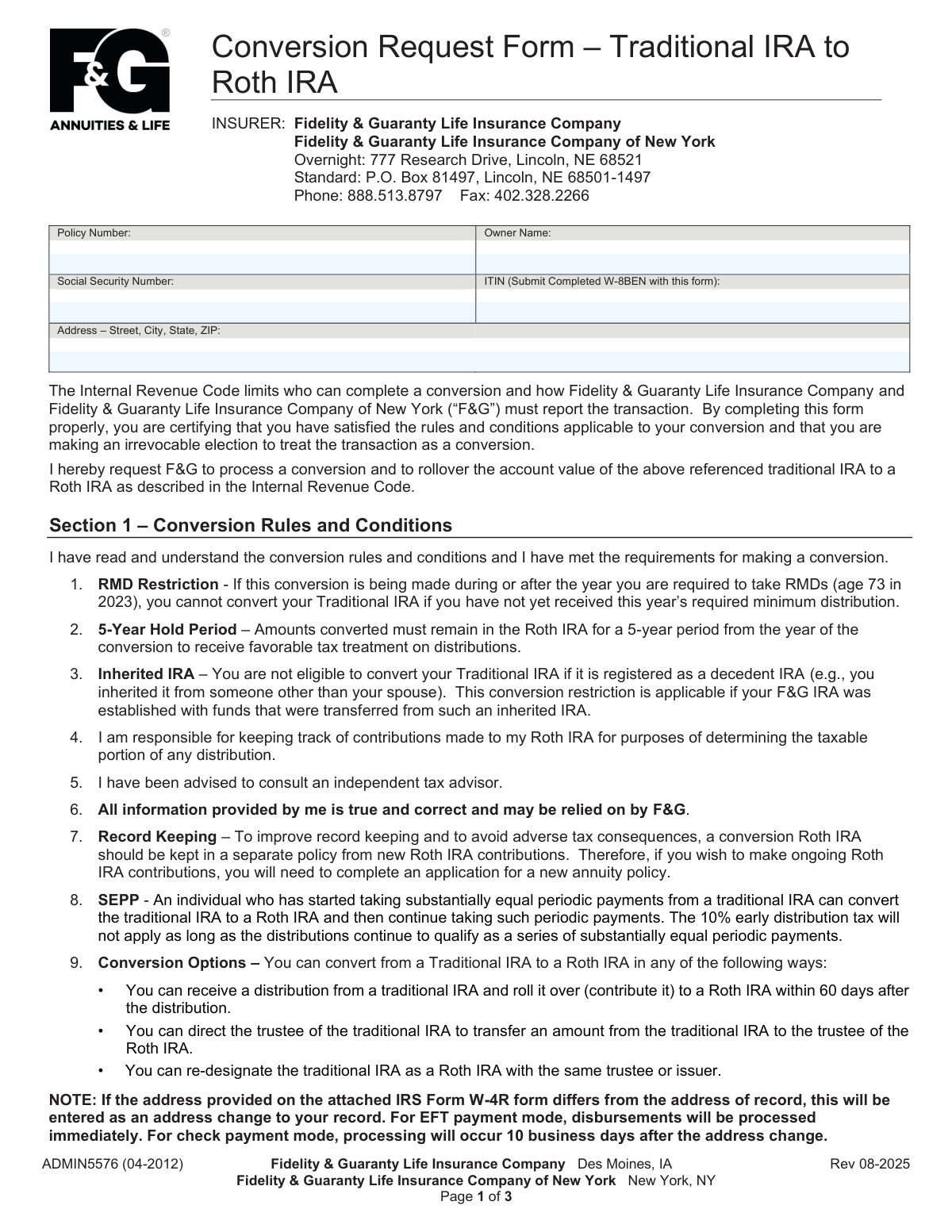
The Conversion Request Form – Traditional IRA to Roth IRA (Form ADMIN5576) is a specialized document designed for policyholders of Fidelity & Guaranty Life Insurance Company (F&G). You should select this form if:
- You hold an F&G Life Insurance Company policy: This form is specific to their administrative requirements and cannot be used for IRAs held at other brokerages or financial institutions.
- You are performing a Roth Conversion: You intend to move funds from a Traditional IRA (where contributions were likely tax-deductible) into a Roth IRA (where qualified future withdrawals are tax-free).
- You are ready to manage the tax impact: Converting to a Roth IRA is a taxable event. This form requires you to certify your eligibility and make specific tax withholding elections.
Key Considerations Before Filling
Before you use Instafill’s AI tools to complete the Conversion Request Form – Traditional IRA to Roth IRA, ensure you have the following details ready to ensure accuracy:
- Policy Information: You will need your specific Fidelity & Guaranty policy number to ensure the funds are identified and moved correctly.
- Tax Withholding Strategy: The form requires you to decide whether you want federal and state income taxes withheld from the conversion amount. Because this choice affects your total tax liability, many users consult a tax professional before finalizing this section.
- Certification of Eligibility: You must be prepared to certify that you meet all IRS requirements for the conversion, including understanding how the conversion affects your specific tax bracket for the current year.
By using Instafill.ai, you can quickly navigate the complex fields of Form ADMIN5576, ensuring that your certification and tax elections are clear and accurately captured for faster processing by the insurance company.
Form Comparison
| Form | Purpose | Primary User | Key Requirements |
|---|---|---|---|
| Conversion Request Form – Traditional IRA to Roth IRA | Converts existing Traditional IRA funds into a Roth IRA account structure. | Policyholders of Fidelity & Guaranty Life Insurance Company with Traditional IRAs. | Requires certification of eligibility and specific tax withholding election choices. |
Tips for financial conversion forms
Ensure that the account and policy numbers for both the source Traditional IRA and the target Roth IRA are exactly correct. A single digit error can lead to a rejected conversion request or funds being misallocated to the wrong account.
Converting to a Roth IRA is a taxable event. While you can often choose to have taxes withheld directly from the conversion amount, many filers prefer to pay taxes from outside funds to maximize the amount growing tax-free in the new Roth account.
Maintain a copy of your most recent tax records showing your non-deductible contributions. This helps ensure you only pay taxes on the pre-tax portion of the conversion and simplifies your future reporting to the IRS.
AI-powered tools like Instafill.ai can complete these complex financial forms in under 30 seconds with high accuracy. Your sensitive data stays secure during the process, providing a practical and fast solution for managing multiple financial documents.
Submit your conversion forms well before year-end deadlines to account for internal processing times at financial institutions. Submitting a perfectly filled form the first time prevents back-and-forth delays that could push the transaction into the next tax year.
Financial conversion forms often require signatures from all account owners or authorized representatives. Missing a signature is a common reason for processing delays, so double-check the authorization section before you finalize your submission.
Frequently Asked Questions
Financial conversion forms are used to transition funds from one type of account or tax status to another, such as moving assets from a Traditional IRA to a Roth IRA. These documents ensure the financial institution has the correct authorization to recharacterize the funds and report the transaction correctly to regulatory bodies.
These forms are required by policyholders or account owners who wish to change the tax treatment of their retirement savings. For example, if you have a traditional account and want to move it to a Roth account to benefit from tax-free future withdrawals, you must complete this specific paperwork for your financial provider.
Yes, converting from a pre-tax account to an after-tax account usually creates a taxable event for the year the conversion occurs. The forms often include sections for tax withholding elections, allowing you to choose whether to pay the taxes from other sources or have them withheld directly from the converted amount.
Yes, AI tools like Instafill.ai can process financial conversion forms in under 30 seconds. These tools accurately extract data from your source documents and place it into the correct fields on the form, significantly reducing the risk of manual entry errors.
While you can often submit these forms at any time, many taxpayers choose to complete conversions by December 31st to ensure the transaction is recorded for the current tax year. It is important to check with your specific financial institution regarding their internal processing deadlines to ensure the conversion is finalized before year-end.
You will generally need your account or policy number, current contact information, and Social Security number. Additionally, you should be prepared to make decisions regarding federal and state tax withholding and verify your eligibility for the conversion based on current IRS guidelines.
Manually filling out these forms can take 15 to 20 minutes, but using AI-powered services can significantly speed up the process. With Instafill.ai, the data extraction and form completion are handled automatically, allowing you to review and sign the document in a fraction of the time.
Once the form is filled out and signed, it must be submitted to the financial institution or insurance company that holds the account. Most companies allow for submission via a secure online portal, mail, or fax, depending on their specific security protocols and administrative requirements.
No, while they are similar, a conversion specifically refers to changing the tax status of funds within an IRA framework, such as moving from Traditional to Roth. A rollover usually involves moving funds between different types of employer-sponsored plans or moving assets from a 401(k) into an IRA.
Under current tax laws, most Roth IRA conversions are permanent and cannot be reversed or 'recharacterized' once they are completed. It is essential to review the terms on the conversion form carefully and consult with a tax professional before submitting the final request.
Glossary
- Form Complexity Index
- Instafill’s 0–100 measure of how much effort a form takes to complete, calculated deterministically from the form’s own structure rather than estimated. It combines the number of fillable fields (the largest factor), how difficult those fields are to complete based on their type, the number of pages that contain fields, the amount of conditional “fill-only-if” logic, and how many sections the form is divided into, then adds modifiers for tables and repeating lists, bundled instruction pages, and dense page layouts. A higher score means the form is harder to fill out by hand. The forms in this category have a median Form Complexity Index of 31/100 (Basic). See exactly how it is calculated.
- Roth Conversion
- The process of moving assets from a Traditional, SEP, or SIMPLE IRA into a Roth IRA, which typically requires paying income tax on the converted amount in exchange for future tax-free growth.
- Traditional IRA
- A retirement account where contributions are often tax-deductible, but withdrawals in retirement are taxed as ordinary income.
- Tax Withholding Election
- A decision made by the account owner to have a percentage of the converted funds sent directly to the IRS to cover potential taxes, rather than moving the full balance to the new account.
- MAGI (Modified Adjusted Gross Income)
- A specific calculation of your income used by the IRS to determine your eligibility for certain tax deductions and the ability to contribute to specific retirement accounts.
- Qualified Distribution
- A withdrawal from a Roth IRA that is tax-free and penalty-free, generally occurring after the account has been open for five years and the owner is at least 59½ years old.
- Direct Rollover
- A transfer of retirement assets directly from one financial institution to another, ensuring the account holder never takes possession of the funds and avoids immediate tax penalties.
- Cost Basis
- The total amount of after-tax contributions made to an IRA, which is not taxed again when converted to a Roth IRA.
- Early Withdrawal Penalty
- A 10% additional tax imposed by the IRS for taking money out of a retirement account before age 59½, unless a specific exception applies.