Fill out financial investment forms
with AI.
Financial investment forms are the essential bridge between capital and opportunity, serving as the official record for wealth management and portfolio growth. These documents are vital for ensuring that every transaction complies with strict financial regulations and anti-money laundering standards. Whether you are allocating funds to a new venture or increasing your stake in an existing portfolio, accurate documentation provides the necessary transparency and legal protection for both the investor and the financial institution.
By continuing, you acknowledge Instafill's Privacy Policy and agree to get occasional product update and promotional emails.
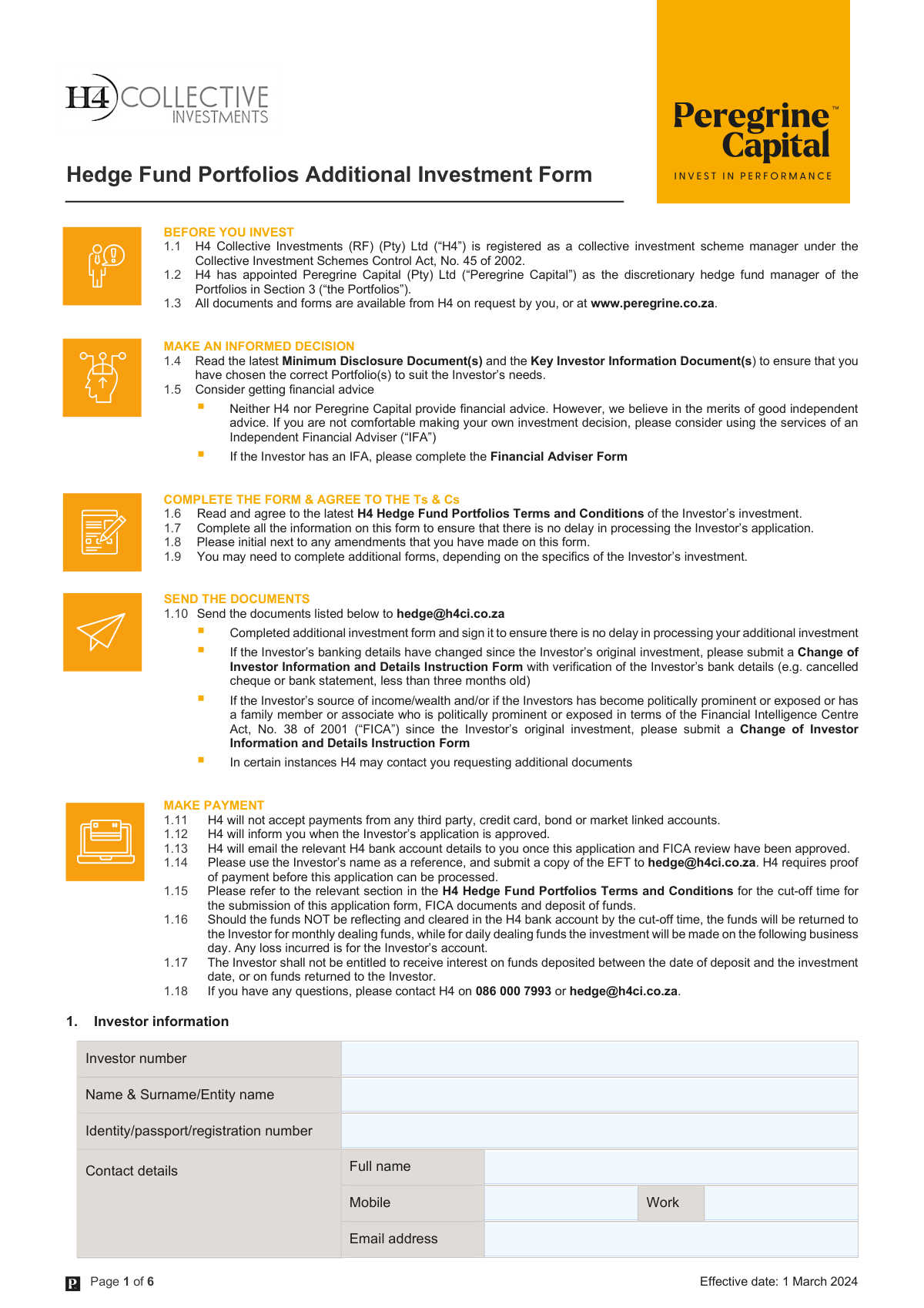
About financial investment forms
This category is primarily used by individual investors, institutional entities, and financial advisors who need to facilitate capital movements or update account details. For example, an investor might use a Hedge Fund Portfolios Additional Investment Form to commit a lump sum or establish a recurring debit order for their account. These situations require precise data entry to ensure that funds are allocated to the correct sub-funds and that regulatory requirements, such as FICA updates, are consistently met.
Managing these complex documents manually can be a significant administrative burden, often leading to delays in fund deployment. Tools like Instafill.ai use AI to fill these forms in under 30 seconds, handling the data accurately and securely to streamline the investment process. This allows you to focus on your market strategy while ensuring your paperwork is handled with professional precision.
Every form on this page can be completed without typing. Instafill is form filling software that reads a PDF and fills it for you — including flat and scanned documents that carry no fillable fields at all.
Forms in This Category
The forms in this category have a median Form Complexity Index of 51/100 (Moderate), measured across 1 forms by field count, input difficulty, length, conditional logic and structure. See how it is calculated.
| Form Name | Pages | FCI | |
|---|---|---|---|
| 1. | Hedge Fund Portfolios Additional Investment Form | 1 | Moderate 51 |
- Enterprise-grade security & data encryption
- 99%+ accuracy powered by AI
- 1,000+ forms from all industries
- Complete forms in under 60 seconds
How to Choose the Right Form
Choosing the right financial investment form depends on your current status with the fund manager and the specific transaction you wish to perform. While this category currently features specialized documentation for hedge fund management, understanding its specific application will help you avoid administrative delays and ensure your capital is deployed correctly.
For Current H4 Hedge Fund Investors
The Hedge Fund Portfolios Additional Investment Form is designed specifically for individuals or entities who already hold an account with H4 Hedge Fund Portfolios. You should select this form if:
- Increasing Your Stake: You want to make a one-time lump sum contribution to your existing portfolio to capitalize on market movements.
- Setting Up Recurring Investments: You wish to establish or modify a monthly debit order to automate your investment growth over time.
- Allocating New Capital: You are looking to distribute new funds across various retail or qualified investor hedge funds within the H4 suite.
Compliance and FICA Updates
A critical component of the Hedge Fund Portfolios Additional Investment Form is the FICA (Financial Intelligence Centre Act) update section. Choose this form if you need to ensure your investment remains compliant while adding capital. It allows you to provide current verification details alongside your financial contribution, streamlining two essential processes into one document.
When This Form is Not the Right Choice
To ensure you are using the correct paperwork, note that this form is generally not suitable for the following scenarios:
- New Account Openings: If you are not yet an investor in H4 Hedge Fund Portfolios, you will likely need a "New Individual Investor" or "Legal Entity Application" form rather than an "Additional Investment" form.
- Full Redemptions: This form focuses on inflows; for liquidating your position or withdrawing capital, you should search for a "Redemption Request" or "Withdrawal" form.
By using Instafill.ai, you can quickly complete the Hedge Fund Portfolios Additional Investment Form by letting AI handle the repetitive data entry. This ensures your FICA details and investment amounts are captured accurately without the frustration of manual PDF editing.
Form Comparison
| Form | Purpose | Who Files It | Key Requirements |
|---|---|---|---|
| Hedge Fund Portfolios Additional Investment Form | Facilitates additional lump sum or recurring investments into existing hedge fund accounts. | Current investors in retail or qualified H4 Hedge Fund Portfolios. | Requires investment amount details, debit order instructions, and updated FICA documentation. |
Tips for financial investment forms
When submitting additional investment forms, ensure your account name and number match your previous statements perfectly. Minor discrepancies in naming conventions can cause administrative delays or result in the fund manager rejecting the transaction for security reasons.
If you are setting up a monthly investment, double-check your bank account number and branch code to prevent failed transactions. Ensuring these details are accurate ensures you don't miss investment cycles due to simple data entry errors.
Investment forms often require updated proof of residence or identification to satisfy FICA and KYC regulations. Prepare digital copies of these documents in advance to ensure they are within the required three-month validity period before you begin filling out the form.
Hedge fund portfolios often have various tiers or classes based on the investment amount or investor type. Carefully review the fund selection section to ensure your capital is allocated to the correct strategy and that you meet the minimum investment threshold for that specific class.
AI-powered tools like Instafill.ai can complete these complex financial forms in under 30 seconds with high accuracy. This is a significant time-saver for investors handling multiple portfolios, and you can rest assured that your sensitive financial data stays secure throughout the process.
Always save a copy of the completed and signed form for your own financial records. Having a time-stamped copy of your investment instructions provides essential proof of your intent should there be any discrepancies in your subsequent quarterly statements.
If the investment account is held in the name of a trust or a joint partnership, ensure all authorized signatories provide their signatures. Missing a single required signature is one of the most common reasons investment forms are returned for correction.
Frequently Asked Questions
Financial investment forms are legal documents used by investors to open accounts, authorize trades, or add capital to existing portfolios. They ensure that the investment manager has the correct regulatory information and clear instructions on how to allocate funds.
These forms are used by existing investors who already have an account with a specific hedge fund manager and wish to increase their stake. Both retail investors and qualified investors use these documents to specify the amount and frequency of their new contributions.
You should submit this form whenever you want to make a one-time lump sum payment or establish a recurring debit order. Many funds have specific cut-off dates each month for processing new investments, so it is best to file the form several days before your intended investment date.
FICA requirements generally involve providing updated identification, proof of residence, and source of funds to comply with anti-money laundering regulations. The form typically includes sections to confirm if your previously submitted documentation is still valid or if new details are needed.
A lump sum investment is a single, one-time payment made via electronic transfer, whereas a debit order sets up an automated, recurring deduction from your bank account. The form allows you to choose either option or a combination of both to suit your investment strategy.
Completed forms are usually submitted directly to the fund administrator or the management company via email, secure portal, or post. Always check the specific submission instructions provided by the financial institution to ensure your investment is processed without delay.
Yes, AI tools like Instafill.ai can be used to fill out financial investment forms by accurately extracting data from your source documents and placing it into the correct fields. This technology can even convert static, non-fillable PDFs into interactive forms, making the process much more efficient for investors.
Using automated tools, it often takes under 30 seconds to fill out complex financial forms that would otherwise take much longer to complete manually. AI-powered platforms streamline the data entry process, reducing the risk of errors while saving significant time for the user.
Yes, most additional investment forms are designed to accommodate different classes of investors, including retail and qualified (sophisticated) investors. The form will usually have specific sections or checkboxes to indicate which fund category your investment should be directed toward.
If your FICA information is not current, the fund manager may be legally required to freeze your account or reject any additional investments. Keeping this information updated on your investment forms ensures continued compliance with financial regulations and prevents delays in fund processing.
Generally, for lump sum investments, you must provide a proof of payment or a transfer confirmation alongside the form. For recurring debit orders, you typically provide bank account details and authorization for the fund to pull the specified amount automatically.
While the primary purpose is for adding funds, many additional investment forms include sections for updating your address, email, or bank account for future distributions. If the form does not include these sections, you may need to file a separate change of details form alongside your investment request.
Glossary
- Form Complexity Index
- Instafill’s 0–100 measure of how much effort a form takes to complete, calculated deterministically from the form’s own structure rather than estimated. It combines the number of fillable fields (the largest factor), how difficult those fields are to complete based on their type, the number of pages that contain fields, the amount of conditional “fill-only-if” logic, and how many sections the form is divided into, then adds modifiers for tables and repeating lists, bundled instruction pages, and dense page layouts. A higher score means the form is harder to fill out by hand. The forms in this category have a median Form Complexity Index of 51/100 (Moderate). See exactly how it is calculated.
- FICA (Financial Intelligence Centre Act)
- A regulatory framework that requires financial institutions to verify the identity of their clients and the source of their funds to prevent money laundering and financial crimes.
- Qualified Investor
- An individual or entity that meets specific financial criteria, such as a high net worth or specialized knowledge, allowing them to invest in complex or restricted financial products.
- Retail Investor
- A non-professional investor who buys and sells securities or funds for their personal account rather than for an organization.
- Hedge Fund
- A pooled investment fund that employs diverse and often aggressive strategies, such as leveraging or short-selling, to achieve high returns for its investors.
- Debit Order
- An authorization given by a bank account holder to a third party to withdraw a specified amount of money from their account on a recurring basis for ongoing investments.
- Lump Sum
- A single, one-time payment made into an investment account as opposed to multiple smaller payments made over a period of time.
- Portfolio
- The total collection of financial assets, such as stocks, bonds, and hedge funds, held by an individual investor or managed by a financial firm.
- KYC (Know Your Customer)
- A mandatory due diligence process used by financial institutions to verify the identity of their clients and assess the risk of illegal activities.