Fill out financial registration forms
with AI.
Financial registration forms serve as the essential gateway for organizations and trusts looking to establish a formal presence within the U.S. financial system. These documents are critical for verifying the legal identity of an entity, ensuring that all accounts comply with rigorous federal regulations such as the Bank Secrecy Act and "Know Your Customer" (KYC) requirements. By collecting detailed information on tax identification, legal structure, and beneficial ownership, these forms help maintain the integrity of financial markets and prevent unauthorized or fraudulent activity.
By continuing, you acknowledge Instafill's Privacy Policy and agree to get occasional product update and promotional emails.
About financial registration forms
Typically, these forms are completed by corporate officers, legal counsel, or financial intermediaries who are tasked with opening new institutional accounts or managing investment vehicles. For instance, an Institutional Account Registration Form is often required when a corporation or partnership seeks to establish a relationship with a major brokerage or investment firm. Because these documents require specific details regarding authorized signatories and complex organizational structures, they can be cumbersome to navigate manually. Accuracy is paramount, as errors in registration can lead to significant delays in account activation or compliance audits.
Modern tools like Instafill.ai use AI to fill these financial registration forms in under 30 seconds, ensuring data is handled accurately and securely. This automated approach allows professionals to bypass the tedious manual entry process, transforming static documents into completed filings with minimal effort and high precision.
Every form on this page can be completed without typing. Instafill is form filling software that reads a PDF and fills it for you — including flat and scanned documents that carry no fillable fields at all.
Forms in This Category
The forms in this category have a median Form Complexity Index of 63/100 (Complex), measured across 1 forms by field count, input difficulty, length, conditional logic and structure. See how it is calculated.
| Form Name | Pages | FCI | |
|---|---|---|---|
| 1. | Form IIGAREG, Institutional Account Registration Form | 1 | Complex 63 |
- Enterprise-grade security & data encryption
- 99%+ accuracy powered by AI
- 1,000+ forms from all industries
- Complete forms in under 60 seconds
How to Choose the Right Form
Navigating financial registration can be complex, especially when dealing with institutional assets. While this category currently features a specific specialized document, understanding its application is key to ensuring your organization’s compliance and account setup.
When to Use Form IIGAREG
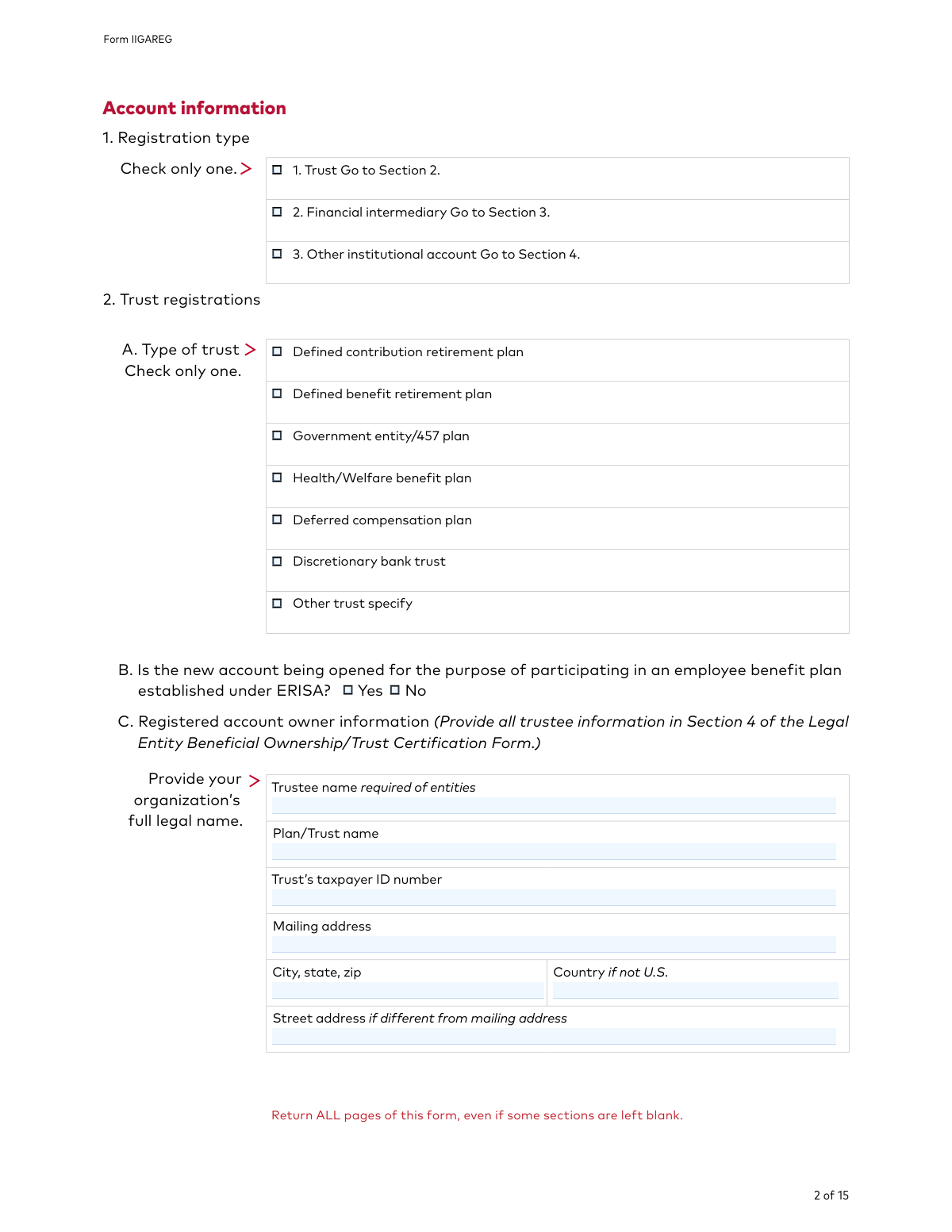
The Form IIGAREG (Institutional Account Registration Form) is the primary document required for establishing new institutional accounts with Vanguard. You should select this form if you are acting on behalf of a U.S.-based entity rather than an individual investor. It is the correct choice for:
- Corporations and Partnerships: Entities looking to manage corporate treasury or investment funds.
- Trusts and Estates: Legal arrangements requiring a formal institutional structure for asset management.
- Financial Intermediaries: Firms managing assets on behalf of third-party clients.
- Non-Profit Organizations: 501(c)(3) entities or other charitable foundations requiring institutional-grade accounts.
Key Information You Will Need
Before you begin filling out Form IIGAREG via Instafill.ai, ensure you have the following details ready to streamline the process and avoid errors:
- Legal Structure and Tax ID: You must provide the official legal name of the entity as registered with the IRS and its Employer Identification Number (EIN).
- Beneficial Ownership Details: Due to federal "Know Your Customer" (KYC) regulations, you will need to identify individuals who own or control 25% or more of the legal entity.
- Authorized Signatories: A list of individuals empowered to transact on the account, including their personal identification information and roles within the organization.
Why This Form Matters
Choosing the Institutional Account Registration Form over a standard individual application is crucial for proper tax reporting and establishing legal liability. Using AI-powered tools to complete this form ensures that complex sections—such as the certification of beneficial owners and the designation of signing authority—are filled accurately. If you are a sole proprietor or an individual investor, this institutional form is likely not the correct document for your needs.
Form Comparison
| Form | Purpose | Eligible Entities | Key Requirements |
|---|---|---|---|
| Form IIGAREG, Institutional Account Registration Form | To establish new institutional investment accounts for U.S.-based entities with Vanguard. | U.S. entities including trusts, corporations, partnerships, and financial intermediaries. | Requires tax identification, legal structure details, and beneficial owner identification. |
Tips for financial registration forms
Ensure the legal name and Taxpayer Identification Number (TIN) match your IRS records or articles of incorporation exactly. Even minor discrepancies in the entity name can lead to immediate rejection by financial institutions during the identity verification process.
Federal regulations often require details for all individuals with significant control or a 25% or greater ownership stake. Have their full legal names, residential addresses, and social security numbers ready before starting the form to avoid session timeouts or delays.
Only include individuals who have the legal authority to execute trades or manage the account as defined by your organization's bylaws. Ensure that the signatures provided match the names listed in the authorization section to prevent verification failures.
Reference your organization's trust agreement, corporate bylaws, or partnership agreement while filling out the form. You will often need to cite specific sections of these documents to prove the entity's legal standing and the authority of the signatories.
Automating the data entry process is a significant time-saver when managing complex institutional registrations. AI-powered tools like Instafill.ai can complete these forms in under 30 seconds with high accuracy, and your sensitive financial data stays secure during the process.
Financial registration forms typically require a physical street address for the entity to comply with anti-money laundering laws. If your organization uses a P.O. Box for correspondence, ensure it is only listed in the mailing address section and not as the primary legal location.
Frequently Asked Questions
Financial registration forms are used to establish a legal relationship between an entity and a financial institution. These documents ensure that the institution collects necessary data for tax reporting, regulatory compliance, and identity verification before opening an account.
These forms are generally required by U.S.-based entities such as corporations, trusts, partnerships, and non-profit organizations. They are necessary when an organization wants to manage assets or open brokerage accounts in the entity's name rather than under an individual's social security number.
You will usually need to provide the entity's legal name, Tax Identification Number (TIN), and physical business address. Additionally, institutions require details regarding beneficial owners and authorized signatories who are permitted to trade or move funds on behalf of the organization.
Federal regulations require institutions to verify the identities of natural persons who own or control a legal entity to prevent financial crimes like money laundering. Providing this information helps the institution comply with 'Know Your Customer' (KYC) standards.
Yes, AI tools like Instafill.ai can automate the process of completing complex financial documents. These tools accurately extract data from your existing source documents and place it into the correct fields, allowing you to complete forms in under 30 seconds.
While manual entry can take an hour or more due to the technical nature of the fields, using an AI-powered service like Instafill.ai can reduce that time to less than 30 seconds. The AI ensures that data is mapped correctly from your records to the PDF, minimizing the risk of manual errors.
Completed forms are typically submitted directly to the financial service provider, such as Vanguard or a specific bank. Most institutions offer a secure online upload portal, though some may still require physical mailing or faxing for documents involving wet-ink signatures.
Most institutions require supplemental proof of the entity's existence, such as Articles of Incorporation, trust agreements, or partnership documents. You may also need to provide copies of government-issued IDs for any authorized individuals listed on the registration form.
To avoid delays, ensure that all information matches your official tax records exactly and that all required signatures are present. Using digital tools to fill the form can help ensure legibility and accuracy, which are common reasons for application rejection.
Yes, if there is a change in the entity's structure, beneficial ownership, or authorized signers, a new registration or an amendment form is usually required. Financial institutions may also reach out periodically to verify that the information they have on file remains current.
Glossary
- Form Complexity Index
- Instafill’s 0–100 measure of how much effort a form takes to complete, calculated deterministically from the form’s own structure rather than estimated. It combines the number of fillable fields (the largest factor), how difficult those fields are to complete based on their type, the number of pages that contain fields, the amount of conditional “fill-only-if” logic, and how many sections the form is divided into, then adds modifiers for tables and repeating lists, bundled instruction pages, and dense page layouts. A higher score means the form is harder to fill out by hand. The forms in this category have a median Form Complexity Index of 63/100 (Complex). See exactly how it is calculated.
- Taxpayer Identification Number (TIN)
- A unique nine-digit number used by the IRS to identify businesses and individuals for tax reporting purposes, commonly required on all registration forms.
- Authorized Signatory
- An individual who has been granted legal authority by an organization to sign documents and make financial decisions on behalf of the entity.
- Beneficial Owner
- A person who directly or indirectly owns a significant portion of a legal entity or exercises significant control over its management and operations.
- Institutional Account
- A financial account established for a legal entity, such as a corporation, partnership, or trust, rather than for a private individual.
- Legal Entity
- An association, corporation, partnership, or trust that has legal standing in the eyes of the law and can enter into contracts or own property.
- Financial Intermediary
- An entity that acts as a middleman between a financial institution and an investor, such as a broker-dealer, bank, or investment advisor.
- Customer Identification Program (CIP)
- A federal requirement that mandates financial institutions to verify the identity of any person or entity seeking to open a new account to prevent money laundering.
- Trustee
- An individual or organization appointed to manage and hold assets on behalf of a trust for the benefit of its named beneficiaries.