Fill out financial regulatory forms
with AI.
Financial regulatory forms are essential tools used by government bodies, financial institutions, and international organizations to maintain transparency and security within the global economy. They serve as a primary defense against illegal activities such as money laundering, tax evasion, and terrorism financing. By requiring detailed disclosures from businesses and individuals, these forms ensure that all parties involved in significant financial transactions meet strict compliance standards and ethical guidelines.
By continuing, you acknowledge Instafill's Privacy Policy and agree to get occasional product update and promotional emails.
About financial regulatory forms
These documents are typically required by corporate entities, financial counterparties, and beneficiaries entering into high-stakes contractual relationships. For instance, organizations working with major development banks or national investment institutions, such as Cassa Depositi e Prestiti (CDP), must complete comprehensive Anti-Money Laundering (AML) and due diligence questionnaires. Navigating these requirements is a standard part of onboarding for investment projects, public funding, or international partnerships where verifying the integrity of a counterparty is mandatory.
Completing these complex questionnaires manually can be a slow, error-prone process that delays critical business operations. Tools like Instafill.ai use AI to fill these regulatory forms in under 30 seconds, ensuring data accuracy and maintaining high security standards for sensitive financial information. By automating the data entry process, professionals can focus on their core compliance duties rather than the logistics of document preparation.
Every form on this page can be completed without typing. Instafill is form filling software that reads a PDF and fills it for you — including flat and scanned documents that carry no fillable fields at all.
Forms in This Category
The forms in this category have a median Form Complexity Index of 62/100 (Moderate), measured across 1 forms by field count, input difficulty, length, conditional logic and structure. See how it is calculated.
| Form Name | Pages | FCI | |
|---|---|---|---|
| 1. | Compliance & AML Due Diligence Form | 1 | Moderate 62 |
- Enterprise-grade security & data encryption
- 99%+ accuracy powered by AI
- 1,000+ forms from all industries
- Complete forms in under 60 seconds
How to Choose the Right Form
Navigating the landscape of financial regulatory forms requires a clear understanding of the specific institution you are engaging with and the level of scrutiny required for compliance. In this category, the focus is on rigorous due diligence designed to prevent financial crimes and ensure institutional integrity.
The Primary Compliance Document
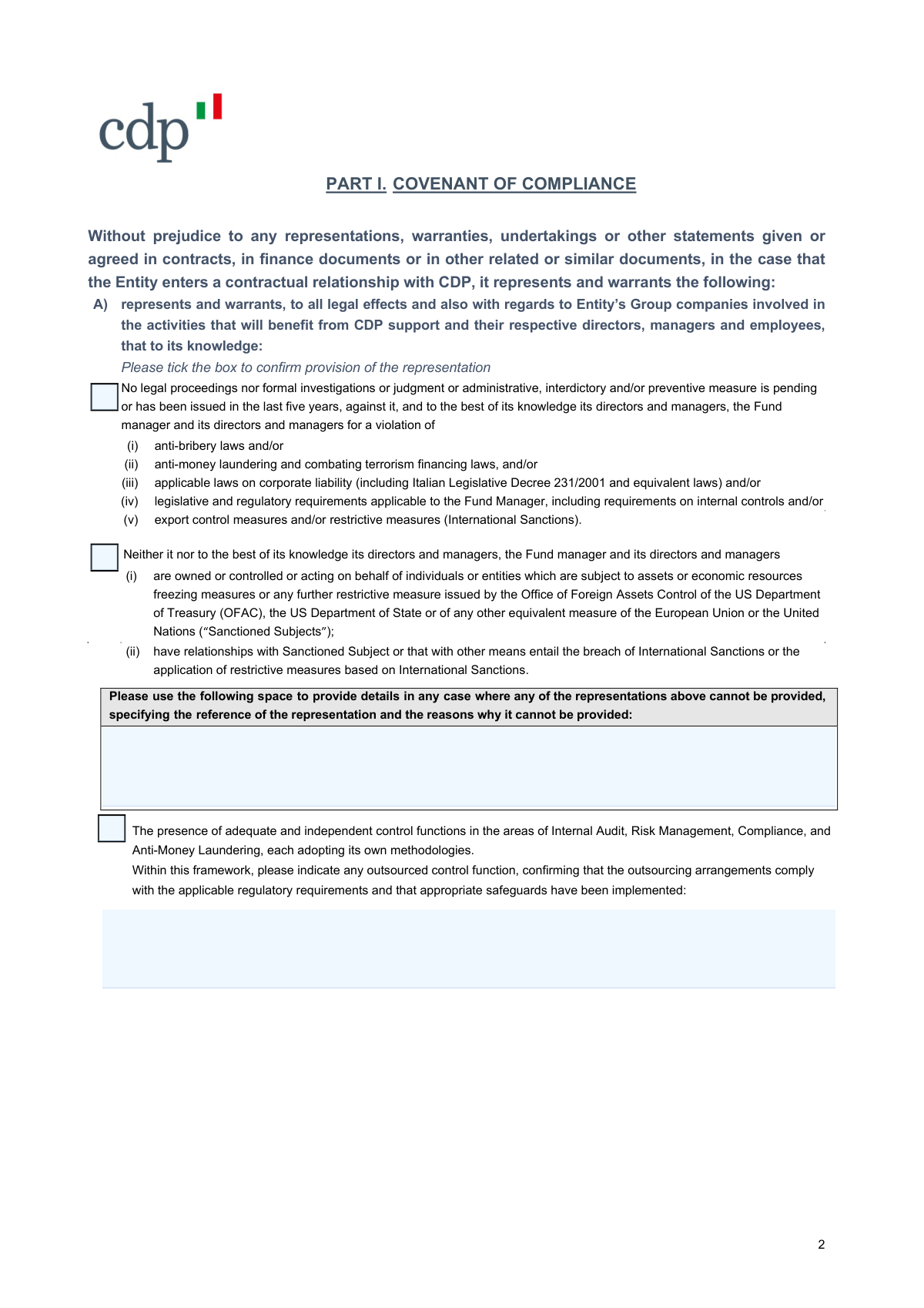
The COMPLIANCE & AML DUE DILIGENCE FORM - CDP is the central document for entities looking to establish a formal relationship with Cassa Depositi e Prestiti (CDP). Unlike general financial statements, this form is a targeted questionnaire designed to vet the integrity of counterparties and beneficiaries before any funds are disbursed or contracts are signed.
Determining if This Form is Right for You
You should select the COMPLIANCE & AML DUE DILIGENCE FORM - CDP if you fall into one of the following categories:
- CDP Counterparties: You are entering into a direct contract, partnership, or agreement with Cassa Depositi e Prestiti.
- Beneficiaries of Funds: You are an entity or organization slated to receive funding, grants, or investment directly from CDP.
- Compliance Officers: You are responsible for ensuring your organization meets the specific Anti-Money Laundering (AML) and Counter-Terrorism Financing (CFT) standards required by Italian and international financial regulations.
Key Compliance Areas Covered
When preparing to fill out this form, ensure you have the necessary data regarding your organization's internal controls. The COMPLIANCE & AML DUE DILIGENCE FORM - CDP focuses on:
- Anti-Money Laundering (AML): Detailed procedures and transparency measures your organization has implemented.
- Counter-Terrorism Financing (CFT): Verification that funds are not being diverted to prohibited or sanctioned activities.
- Tax Avoidance & Bribery: Declarations regarding ethical tax practices and robust anti-corruption policies.
Completing this document accurately is essential for demonstrating compliance with international standards. Using Instafill.ai can help you quickly navigate the complex fields of the COMPLIANCE & AML DUE DILIGENCE FORM - CDP, turning a standard PDF into an interactive, AI-assisted experience to speed up your approval process.
Form Comparison
| Form | Primary Purpose | Required By | Key Compliance Areas |
|---|---|---|---|
| COMPLIANCE & AML DUE DILIGENCE FORM - CDP | Ensures counterparties adhere to anti-money laundering and anti-bribery standards. | Entities establishing a contractual relationship or receiving funds from CDP. | Prevention of terrorism financing, tax avoidance, and international regulatory compliance. |
Tips for financial regulatory forms
When completing financial regulatory forms, always use the exact legal name of your organization as it appears on official registration documents. Even minor discrepancies in tax IDs or registration numbers can trigger manual reviews and significantly delay your compliance approval process.
AML forms require detailed information on individuals who own or control the entity, typically at a 25% threshold. Gather full names, birth dates, and residential addresses for all beneficial owners beforehand to prevent stopping mid-form to search for missing data.
Regulatory bodies often cross-reference new submissions with existing records or public registries. Ensure that the financial data and corporate structures you report are consistent with your latest annual reports or previous AML disclosures to avoid unnecessary red flags.
Avoid using overly broad terms like 'consulting' or 'services' when describing your business activities. Providing a clear, detailed explanation of your revenue streams and the nature of your transactions helps compliance officers assess risk levels more accurately and quickly.
AI-powered tools like Instafill.ai can complete these complex financial forms in under 30 seconds with high accuracy. This is a major time-saver for businesses managing multiple regulatory requirements, and your sensitive data stays secure during the automated filing process.
Financial regulatory forms often ask if any key stakeholders are Politically Exposed Persons. Conduct a preliminary internal check to identify if any directors or owners hold prominent public positions, as this requires specific disclosure and may necessitate additional supporting documentation.
Many compliance forms are rejected simply because mandatory fields were left blank or marked 'N/A' without explanation. Ensure every section is addressed; if a section truly does not apply, provide a brief sentence explaining why to demonstrate that the requirement wasn't overlooked.
Frequently Asked Questions
These forms are designed to ensure that financial institutions and their partners comply with international standards regarding anti-money laundering (AML) and countering the financing of terrorism (CFT). They help organizations like Cassa Depositi e Prestiti (CDP) verify the integrity of their counterparties and prevent illegal activities such as tax avoidance or bribery.
Typically, any entity or beneficiary seeking to establish a contractual relationship or receive funding from a major financial institution like CDP must complete this form. This includes corporate entities, financial intermediaries, and other organizations that undergo a rigorous vetting process before funds are disbursed.
You will likely need to provide details regarding your organization's legal structure, beneficial ownership, and internal AML/CFT policies. The form also frequently asks for information about your tax residency and the specific measures your organization takes to prevent corruption and bribery.
Identifying beneficial owners is a core requirement of global financial regulations to ensure transparency and prevent money laundering. Accurate reporting allows regulatory bodies to ensure that funds are not being diverted to sanctioned individuals or used for illicit purposes through shell companies.
Yes, AI tools like Instafill.ai can significantly streamline the process by extracting data from your existing corporate documents and populating the form fields automatically. These tools can accurately fill out complex regulatory forms in under 30 seconds by mapping data directly from your source documentation.
While manual entry for complex compliance forms can take hours of research and typing, using an AI-powered service can reduce the time to less than a minute. This technology allows you to upload your supporting documentation and have the relevant sections of the PDF completed instantly and accurately.
It is helpful to have your company's articles of incorporation, tax identification numbers, and a list of directors or major shareholders on hand. Additionally, having your internal compliance manuals or AML policy documents ready will make it easier to answer specific procedural questions regarding your firm's standards.
Most financial institutions require due diligence forms to be updated periodically or whenever there is a significant change in your organization's structure or ownership. Keeping a digital record of your previous submissions can make these updates much faster and ensure consistency across different reporting periods.
Completed forms are usually submitted directly to the compliance department or the specific project manager at Cassa Depositi e Prestiti (CDP) who is handling your application. Always verify the submission instructions provided in your contract or the official portal to ensure the document reaches the correct office for processing.
Inaccurate or misleading information can lead to the rejection of your funding application or the termination of your contractual relationship with the financial institution. In some cases, providing false information on regulatory documents may also trigger further investigation by authorities or lead to legal penalties.
Yes, by signing and submitting a compliance and due diligence form, you are legally certifying that the information provided is true and complete to the best of your knowledge. These declarations form a critical part of the legal and risk-management agreement between your organization and the financial entity.
Glossary
- Form Complexity Index
- Instafill’s 0–100 measure of how much effort a form takes to complete, calculated deterministically from the form’s own structure rather than estimated. It combines the number of fillable fields (the largest factor), how difficult those fields are to complete based on their type, the number of pages that contain fields, the amount of conditional “fill-only-if” logic, and how many sections the form is divided into, then adds modifiers for tables and repeating lists, bundled instruction pages, and dense page layouts. A higher score means the form is harder to fill out by hand. The forms in this category have a median Form Complexity Index of 62/100 (Moderate). See exactly how it is calculated.
- AML (Anti-Money Laundering)
- A set of laws and regulations designed to prevent criminals from disguising illegally obtained funds as legitimate income.
- Due Diligence
- The process of investigating and verifying a person or business to ensure they meet regulatory standards before entering into a legal or financial agreement.
- CFT (Combating the Financing of Terrorism)
- Government regulations and procedures intended to track and stop the movement of funds to individuals or groups involved in terrorist activities.
- Beneficial Owner
- The individual who ultimately owns or controls a company, even if the legal title or ownership is held in the name of another entity.
- KYC (Know Your Customer)
- A mandatory process used by financial institutions to verify the identity, suitability, and potential risks of a client or business partner.
- CDP (Cassa Depositi e Prestiti)
- The Italian National Promotional Institution that manages postal savings and funds public investments, requiring strict compliance from its partners.
- PEP (Politically Exposed Person)
- An individual who holds a prominent public position and is considered a higher risk for involvement in bribery or corruption due to their influence.
- Counterparty
- The legal entity or person on the other side of a financial transaction or contract that must be vetted for regulatory compliance.