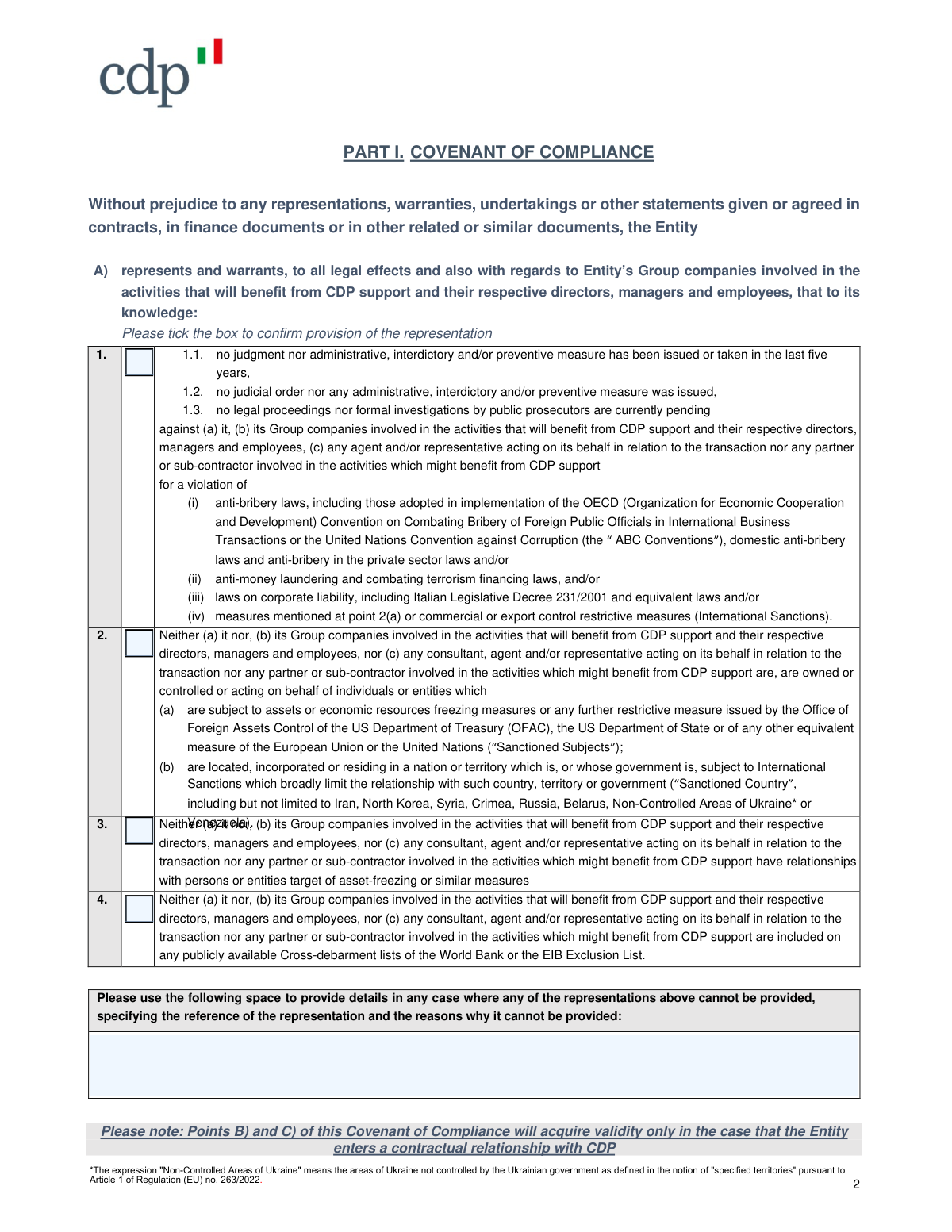
Yes! You can use AI to fill out COMPLIANCE & AML DUE DILIGENCE FORM - CDP

This form is a comprehensive due diligence questionnaire required by Cassa Depositi e Prestiti (CDP) for its counterparties and beneficiaries. Its purpose is to ensure that entities receiving CDP funds adhere to principles and standards for preventing money laundering (AML), terrorism financing (CFT), tax avoidance, and bribery. Completing this form is crucial for establishing a contractual relationship with CDP and demonstrating compliance with international regulations. Today, this form can be filled out quickly and accurately using AI-powered services like Instafill.ai, which can also convert non-fillable PDF versions into interactive fillable forms.
Our AI automatically handles information lookup, data retrieval, formatting, and form filling.
It takes less than a minute to fill out CDP Compliance & AML Form using our AI form filling.
Securely upload your data. Information is encrypted in transit and deleted immediately after the form is filled out.

Form specifications

Form name: COMPLIANCE & AML DUE DILIGENCE FORM - CDP
Number of pages: 1
Language: English
Categories: due diligence forms, compliance forms
main-image

Instafill Demo: How to fill out PDF forms in seconds with AI

How to Fill Out CDP Compliance & AML Form Online for Free in 2026

Are you looking to fill out a CDP COMPLIANCE & AML FORM form online quickly and accurately? Instafill.ai offers the #1 AI-powered PDF filling software of 2026, allowing you to complete your CDP COMPLIANCE & AML FORM form in just 37 seconds or less.
Follow these steps to fill out your CDP COMPLIANCE & AML FORM form online using Instafill.ai:
  1. 1 Navigate to Instafill.ai and upload the CDP Compliance & AML Due Diligence Form.
  2. 2 Complete Part I, the Covenant of Compliance, by reviewing and ticking the boxes to confirm representations and warranties regarding legal history and sanctions.
  3. 3 Provide detailed information in Part II, Section 1 (Entity Profile), including your legal name, address, ownership structure, and list of current directors.
  4. 4 Fill out the specific sections in Part II (Operation Details) and Part III (Compliance Policies) that apply to your entity's operation, such as Project Details for procurement or M&A, or specific compliance frameworks for financial institutions.
  5. 5 Answer the detailed questions about your internal policies and procedures for Anti-Money Laundering (AML), Tax Transparency, International Sanctions, and Anti-Bribery and Corruption in Part III.
  6. 6 Carefully review all the information entered or pre-filled by the AI across all sections to ensure accuracy and completeness.
  7. 7 Provide the signatory's name, role, and date, then electronically sign the document to finalize your submission.

Our AI-powered system ensures each field is filled out correctly, reducing errors and saving you time.

Why Choose Instafill.ai for Your Fillable CDP Compliance & AML Form Form?

Speed

Complete your CDP Compliance & AML Form in as little as 37 seconds.

Up-to-Date

Always use the latest 2026 CDP Compliance & AML Form form version.

Cost-effective

No need to hire expensive lawyers.

Accuracy

Our AI performs 10 compliance checks to ensure your form is error-free.

Security

Your personal information is protected with bank-level encryption.

Frequently Asked Questions About Form CDP Compliance & AML Form

This form is used by CDP to conduct due diligence on its counterparties and beneficiaries. It ensures that entities receiving CDP funds adhere to principles against money laundering (AML), terrorism financing (CFT), tax avoidance, international sanctions, and corruption.

Any entity (counterparty or beneficiary) that will use funds originating from operations with CDP, where CDP acts as a lender, co-lender, guarantor, investor, or in a similar capacity, must complete this form.

No, some sections are conditional. For example, Part II (Project Details) has specific subsections for procurement projects, M&A, or funds, while Part III has sections that only apply to Financial Institutions or companies with specific international exposure.

You must provide details for any direct or indirect owner holding 20% or more of the company. This includes their full name, percentage of ownership, and country of residence.

If you cannot tick a box to confirm a representation, you must use the provided space to specify which representation it is and clearly explain the reasons why it cannot be provided.

Part III, Section 1, which covers the AML/CTF framework, is only required to be filled out by entities that are classified as Financial Institutions.

Part III, Section 3 on International Sanctions must be completed by Financial Institutions and any company that has declared an aggregate exposure of 5% or more to Major Sanctioned Countries (MSC).

If your entity fails to comply, CDP may require remedial actions, deem you ineligible for future contracts and funding, or seek any other remedy available under applicable law.

The form must be signed by an individual who is duly authorized to make declarations and commitments in the name and on behalf of the entity.

Yes, the form explicitly states that the information contained within it, once completed, is to be considered confidential. CDP also provides a detailed privacy notice regarding data processing.

Yes, services like Instafill.ai use AI to help you accurately auto-fill form fields from your saved profile information, which can save significant time and reduce the risk of errors on complex forms like this one.

You can use a platform like Instafill.ai to upload the PDF. The service will make it an interactive, fillable form that you can complete, sign, and download or share directly from your browser.

If you have a non-fillable or 'flat' PDF, you can use a service like Instafill.ai. It can convert the document into an interactive, fillable form that you can easily complete online.

Compliance CDP Compliance & AML Form
Validation Checks by Instafill.ai

1
LEI Code Format Validation
This check verifies that the Legal Entity Identifier (LEI) in Part II, Section 1 follows the correct ISO 17442 standard format, which is a 20-character alphanumeric string. This is crucial for uniquely and unambiguously identifying the legal entity in financial transactions and regulatory reporting. If the format is incorrect, the submission should be rejected as it prevents proper automated identification and compliance screening.
2
Conditional 'Other Legal Form' Description
In Part II, Section 1, if the 'Legal form' checkbox selected is 'Other', this validation ensures that the adjacent text field describing the legal form is not empty. This information is necessary for CDP to understand the entity's legal structure, which impacts risk assessment and due diligence requirements. Failure to provide a description when 'Other' is selected will result in an incomplete profile and halt the process.
3
Director's Date of Birth Validity
This validation checks that the 'Date of birth' for each director listed in Part II, Section 1.C is a valid date and is logically plausible (e.g., not in the future, and the individual is over 18 years of age). Accurate age data is essential for identity verification, background checks, and ensuring the individual has the legal capacity to act as a director. An invalid or implausible date would trigger an error and require correction.
4
Ownership Percentage Sanity Check
For the ownership table in Part II, Section 1.B, this check ensures two things: each listed owner's 'Percentage of ownership' is 20% or greater, and the sum of all listed percentages does not exceed 100%. This prevents data entry errors and ensures the ownership structure is logically sound. A submission with a total ownership over 100% is a critical error and must be rejected.
5
Covenant of Compliance Exception Explanation
In Part I, if any of the checkboxes for representations 1 through 4 are left unticked, this validation mandates that the subsequent text area for providing details must be filled. This is critical because an unticked box signifies a potential compliance issue or risk that must be explicitly declared and explained to CDP. Failure to provide an explanation for a negative representation will render the covenant incomplete and invalid.
6
Conditional Project Award Regulation Reference
In the 'PROCUREMENT PROJECT INFORMATION' (Part II, Section 2, A.1), if the 'Project award process' is marked as 'Direct Award' or 'Other', this validation ensures the text field for 'reference to the applicable regulation' is completed. This justification is vital for transparency and to confirm the legality of a non-competitive award process. Without this reference, the project's legitimacy is questionable and the form cannot be accepted.
7
Conditional Public Official Details Requirement
In 'PROJECT COMPLIANCE' (Part II, Section 2, B), if the answer to question 1 (regarding involvement of a Public Official) is 'Yes', this check ensures the corresponding details table (Name, Public role, etc.) is filled out. This information is fundamental for assessing corruption and conflict of interest risks associated with Politically Exposed Persons (PEPs). An affirmative answer without details is a major red flag and must be blocked.
8
Project Compliance Negative Confirmation Explanation
This validation applies to the 'PROJECT COMPLIANCE' section (Part II, Section 2, B), question 3. If the answer to any of the confirmations (3.a through 3.e) is 'No', the final text box explaining the reason and remedial actions must be filled. A 'No' answer indicates a potential irregularity, investigation, or adverse finding that CDP must be made aware of. The submission is incomplete without this mandatory explanation.
9
Conditional AML/CTF Section Requirement for Financial Institutions
This is a cross-sectional logic check. If the 'Legal form' in Part II, Section 1 is identified as a 'Financial Institution' or 'Financial Intermediary', this validation ensures that Part III, Section 1 ('ANTI-MONEY LAUNDERING AND COUNTER TERRORISM FINANCING') is filled out as required. This ensures that entities subject to higher AML/CTF scrutiny provide the necessary details about their compliance framework. If the section is skipped, the submission is non-compliant.
10
Mandatory Explanation for Unapplied Tax Standards
In Part III, Section 2.B ('TAX TRANSPARENCY STANDARDS'), if any of the checkboxes confirming the application of principles 1 through 5 are left unticked, this validation requires an entry in the explanation text box. This forces the entity to declare why it is not compliant with a specific tax transparency standard and what actions it will take. This is essential for CDP's assessment of tax avoidance risks.
11
Joint Venture Leader Mandate
In Part II, Section 2, A.2, if the answer to question 16 (project awarded to a joint venture) is 'Yes', this validation ensures that the 'JV leader' field is populated. Identifying the lead member of the consortium is crucial for establishing a primary point of contact and responsibility within the JV structure. An empty 'JV leader' field when a JV is declared would make the submission incomplete.
12
Final Signatory Authorization Completeness
This check verifies that the final signature block on page 21 ('Signatory name', 'Role held', 'Place and Date') is fully completed. This block legally binds the entity to the truthfulness and accuracy of the information provided in the entire form. An incomplete or missing signature block invalidates the entire submission, as there is no authorized declaration.

Common Mistakes in Completing CDP Compliance & AML Form

Misinterpreting Conditional Section Instructions

This form contains numerous conditional sections with instructions like 'To be filled by Financial Institutions only' or based on project type. Applicants frequently overlook these footnotes, leading them to either skip required sections or fill out irrelevant ones. This error requires the form to be returned for correction, significantly delaying the application process. To avoid this, carefully review the instructions on pages 1, 6, 12, 15, and 17 before filling out each part.

Leaving Explanatory Fields Blank or Vague

Throughout the form, there are text boxes for providing details when a standard representation cannot be confirmed (e.g., Part I Covenant of Compliance, Part II Project Compliance). A common mistake is to leave these fields blank or provide a non-specific answer like 'N/A'. This is a major red flag for reviewers, as it suggests either an oversight or an attempt to hide information, and can lead to rejection. Always provide a clear, detailed explanation and outline any remedial actions undertaken.

Using a Trading Name Instead of the Registered Legal Name

In Part II, Section 1, the form asks for the 'Registered legal name' of the entity. Applicants sometimes enter their common brand name or a trading name, which does not match official corporate registries. This discrepancy creates validation failures and halts the due diligence process until the correct legal name is provided. Always use the exact entity name as it appears on official incorporation documents.

Incomplete Disclosure of Ownership and Directors

Part II, Sections B and C, require a full breakdown of owners holding 20% or more and a list of current directors. People often fail to account for indirect ownership through holding companies or forget to attach a complete ownership chart for complex structures as suggested. This incomplete disclosure is a critical compliance failure. It is essential to meticulously map out the entire ownership structure to identify all ultimate beneficial owners before completing this section.

Incorrectly Screening for Politically Exposed Persons (PEPs)

Part II, Section B on 'Project Compliance' asks if any individual involved is a Public Official (or a family member/close associate). Many entities lack a robust screening process and incorrectly answer 'No' without performing adequate checks. A false negative on PEP screening is a serious compliance breach that can have severe consequences. Entities must use reliable screening tools to check all involved parties against global PEP databases.

Having an Unauthorized Person Sign the Form

The signature blocks on pages 3 and 21 require a 'duly authorized person' to sign on behalf of the entity. A frequent error is having a junior employee or someone without the legal authority to bind the company sign the document. This invalidates the entire submission and forces a time-consuming resubmission process. Ensure the signatory holds a senior role, such as a C-level executive or Director, with the explicit authority to make such declarations.

Inconsistent Data Formatting and Legibility Issues

Since the form is a flat, non-fillable PDF, it is often printed and filled out by hand, leading to illegible handwriting and inconsistent formats for dates, percentages, and names. This slows down data processing and increases the risk of critical transcription errors by the receiving party. To prevent this, use a tool that can convert the document into a digitally fillable form. AI-powered tools like Instafill.ai can make the PDF fillable and help validate data formats as you type, ensuring clarity and accuracy.

Failing to Distinguish Between Different Project Types

Part II, Section 2 has entirely different subsections for 'PROCUREMENT PROJECT', 'M&A PROJECT', and 'Funds managed by the Entity'. A common error is filling out the wrong subsection or mixing information between them. This confusion demonstrates a lack of attention to detail and requires significant rework. Before starting Part II, clearly identify which project type applies and only complete the corresponding sections (A.1/A.2, A.3, or C).

Incomplete Listing of Third Parties

In Part II, Section A.2, the form asks for a comprehensive list of all third parties involved in a project, including agents, consultants, JV members, and sub-contractors. Applicants often provide an incomplete list, omitting key intermediaries or local partners. This omission can be interpreted as an attempt to obscure relationships and will trigger further scrutiny. It is crucial to map the entire project ecosystem and disclose every relevant third party.

Incorrectly Answering Policy and Procedure Questions

Part III requires detailed 'Yes/No' answers about the entity's internal compliance policies (AML, Tax, Sanctions, ABC). Applicants may answer 'Yes' to having a policy without verifying that it meets the specific standards described in the form. This can be considered a misrepresentation if an audit reveals the policy is inadequate or not implemented. Before answering, carefully compare your internal written policies against the specific requirements listed in each section.
Saved over 80 hours a year

“I was never sure if my IRS forms like W-9 were filled correctly. Now, I can complete the forms accurately without any external help.”

Kevin Martin Green

Your data stays secure with advanced protection from Instafill and our subprocessors

Robust compliance program

Transparent business model

You’re not the product. You always know where your data is and what it is processed for.

ISO 27001, HIPAA, and GDPR

Our subprocesses adhere to multiple compliance standards, including but not limited to ISO 27001, HIPAA, and GDPR.

Security & privacy by design

We consider security and privacy from the initial design phase of any new service or functionality. It’s not an afterthought, it’s built-in, including support for two-factor authentication (2FA) to further protect your account.

Fill out CDP Compliance & AML Form with Instafill.ai

Worried about filling PDFs wrong? Instafill securely fills compliance-aml-due-diligence-form-cdp forms, ensuring each field is accurate.