Fill out AML forms
with AI.
Anti-Money Laundering (AML) and Know Your Customer (KYC) forms are essential components of global financial security and regulatory compliance. These documents are designed to prevent illegal activities such as money laundering, terrorism financing, and tax evasion by verifying the identity and financial background of individuals and entities. By collecting detailed information through instruments like the AML/CTF Investor Identification Form or the IsDB Group AML & KYC Questionnaire, institutions can ensure transparency and maintain the integrity of the international financial system.
By continuing, you acknowledge Instafill's Privacy Policy and agree to get occasional product update and promotional emails.
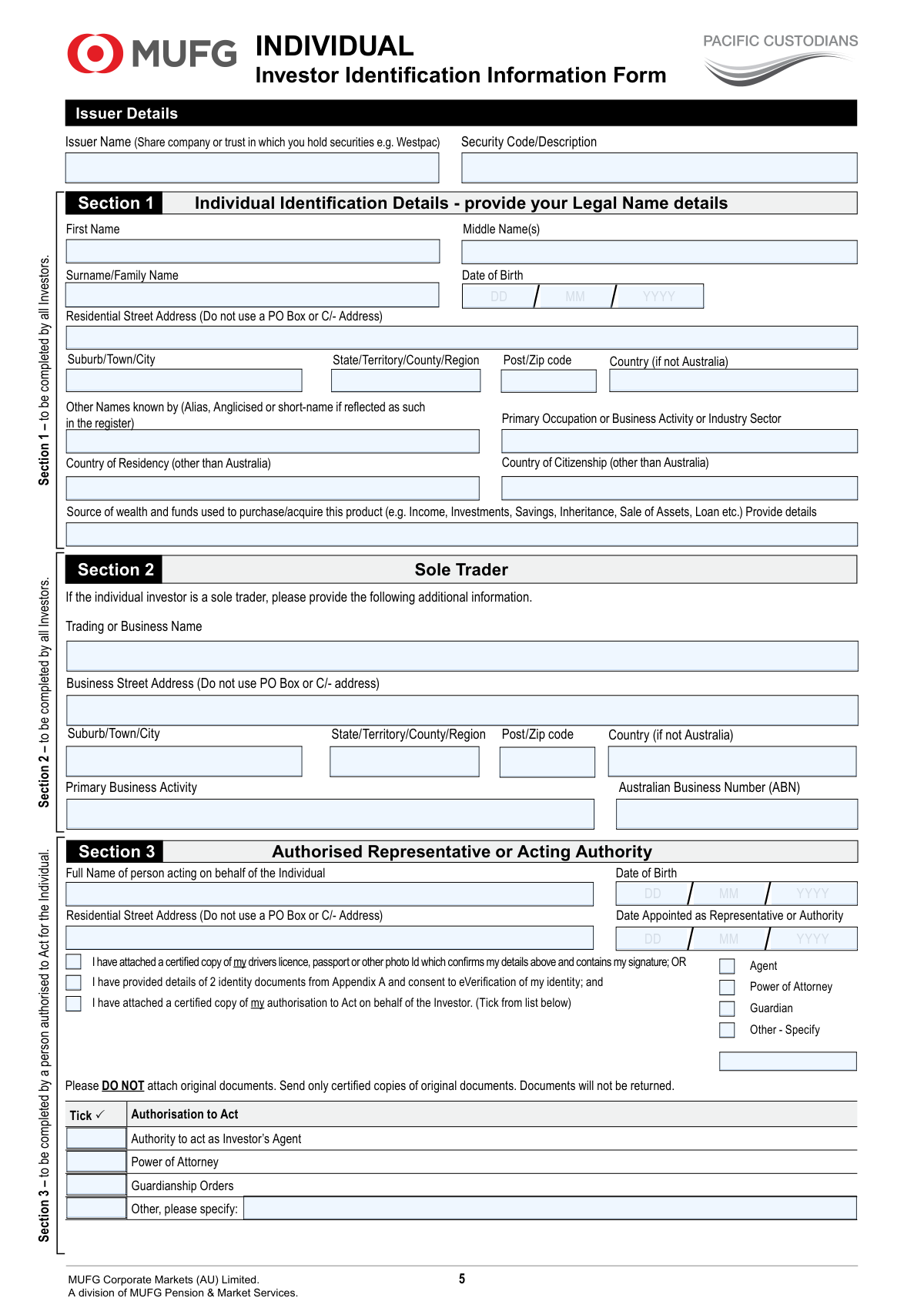
About AML forms
These forms are typically required for investors, corporate entities, and financial institutions during the onboarding process or when establishing new business relationships. Whether you are opening a corporate account at a bank, applying for funding through organizations like Cassa Depositi e Prestiti (CDP), or managing international asset portfolios, completing these due diligence questionnaires is a mandatory step. Accurate documentation is vital for compliance officers and legal teams to satisfy jurisdictional requirements and avoid significant delays in account activation or asset transfers. Tools like Instafill.ai use AI to fill these forms in under 30 seconds, ensuring that sensitive data is handled accurately and securely to save you time during the compliance process.
Every form on this page can be completed without typing. Instafill is form filling software that reads a PDF and fills it for you — including flat and scanned documents that carry no fillable fields at all.
Forms in This Category
The forms in this category have a median Form Complexity Index of 61/100 (Moderate), measured across 8 forms by field count, input difficulty, length, conditional logic and structure. See how it is calculated.
| Form Name | Pages | FCI | |
|---|---|---|---|
| 1. | AML/CTF Investor Identification Information Form | 1 | – |
| 2. | Arbejdernes Landsbank – Virksomhedsoplysninger og KYC/AML (kundekendskab) for erhvervskunder | 9 | Complex 67 |
| 3. | Compliance & AML Due Diligence Form | 1 | Moderate 62 |
| 4. | IsDB Group AML & KYC Questionnaire (Financial Institutions) | 1 | Moderate 54 |
| 5. | IsDB Group AML & KYC Questionnaire (Non-Financial Institutions) | 1 | Moderate 50 |
| 6. | Know Your Client - Foreign Company | 1 | – |
| 7. | Macquarie Asset Management AML/KYC Form | 1 | Moderate 61 |
| 8. | Streamlined Hardship Withdrawal Service Letter of Instruction | 1 | Moderate 59 |
- Enterprise-grade security & data encryption
- 99%+ accuracy powered by AI
- 1,000+ forms from all industries
- Complete forms in under 60 seconds
How to Choose the Right Form
Navigating Anti-Money Laundering (AML) and Know Your Customer (KYC) requirements can be complex. To choose the right form, first identify whether you are an individual investor, a corporate entity, or a financial institution, and check if your form is tied to a specific bank or regulatory body.
Banking and Institutional Compliance
If you are conducting business with a specific international financial group, you must use their proprietary questionnaires to ensure compliance with their internal risk assessments:
- Islamic Development Bank (IsDB): Choose the IsDB Group AML & KYC Questionnaire (Financial Institutions) if you represent a bank. For all other business types, use the IsDB Group AML & KYC Questionnaire (Non-Financial Institutions).
- Arbejdernes Landsbank: Danish business customers should use the Arbejdernes Landsbank – Virksomhedsoplysninger og KYC/AML to provide identity and risk data.
- Cassa Depositi e Prestiti (CDP): Entities seeking funding or contracts with CDP should use the Compliance & AML Due Diligence Form - CDP to verify tax transparency and anti-bribery standards.
Investment and Asset Management
These forms are specifically designed for investors and plan participants to verify the legitimacy of funds and identity:
- General Australian Investing: Use the AML/CTF Investor Identification Information Form to meet Australian KYC requirements for individuals, companies, or trusts.
- Macquarie Clients: Investors working with Macquarie should select the Macquarie Asset Management AML/KYC Form.
- Retirement Funds: If you are a plan participant requesting an emergency distribution, use the Streamlined Hardship Withdrawal Service Letter of Instruction.
Corporate and Foreign Due Diligence
For broader corporate compliance and international reporting:
- Foreign Entities: The Know Your Client - Foreign Company form is essential for international businesses to report ownership structures and tax status under FATCA or CRS regulations.
- General Due Diligence: The Compliance & AML Due Diligence Form is used to gather comprehensive information on counterparties regarding international sanctions and anti-corruption principles.
Tips for AML forms
Ensure all individuals owning or controlling 25% or more of the entity are accurately listed with their full legal names. Discrepancies in ownership structures are a leading cause of compliance delays and additional information requests from financial institutions.
Most AML forms require accompanying proof such as government-issued IDs, certificates of incorporation, or trust deeds. Having these scanned and ready allows you to cross-reference the exact details on the form, ensuring your entries match your official documentation perfectly.
Be thorough when identifying if any directors, owners, or their close associates are Politically Exposed Persons. Omitting this information, even accidentally, can trigger significant red flags during the manual review process and may lead to account restrictions.
When asked for anticipated monthly or annual transaction amounts, provide realistic estimates based on historical data or business projections. Providing consistent figures across different banking applications helps the institution build a clear and accurate risk profile for your account.
AI-powered tools like Instafill.ai can complete these complex AML and KYC forms in under 30 seconds with high accuracy. Your sensitive data stays secure during the process, providing a massive time-saving advantage for professionals managing multiple compliance filings.
Distinguish clearly between where your total net worth comes from and the specific origin of the money for a particular transaction. Providing specific details such as 'inheritance,' 'business profits,' or 'sale of assets' prevents repetitive follow-up inquiries from compliance officers.
Many due diligence forms include sections for international tax reporting standards like FATCA and CRS. Double-check your Tax Identification Numbers (TINs) to ensure they match official government records for all relevant jurisdictions to avoid tax-related compliance holds.
Frequently Asked Questions
AML (Anti-Money Laundering) and KYC (Know Your Customer) forms are regulatory documents used by financial institutions to verify the identity of their clients. They help prevent illegal activities such as money laundering, terrorism financing, and tax evasion by ensuring the institution understands who their customers are and the nature of their financial transactions.
These forms are required for a wide range of entities, including individual investors, corporate entities, trusts, and other financial institutions. Whether you are opening a new bank account, making a significant investment, or establishing a business partnership, the institution is legally obligated to perform due diligence to comply with local and international law.
The correct form depends on your legal structure and the specific institution you are dealing with. For example, a foreign company would use a 'Know Your Client - Foreign Company' form, while a financial institution working with the Islamic Development Bank would need to fill out the specialized IsDB Group AML & KYC Questionnaire for Financial Institutions.
Most forms will ask for basic identification like names and addresses, but many also require details on 'Ultimate Beneficial Owners' (UBOs), source of wealth, and expected transaction patterns. For corporate clients, you may need to provide registration numbers, tax residency information, and details about your company’s internal compliance policies.
Yes, you can use AI tools like Instafill.ai to complete these complex compliance forms in under 30 seconds. The AI accurately extracts data from your existing source documents and places it directly into the required fields, significantly reducing the risk of manual entry errors.
Institutions ask about PEP status because individuals in prominent public positions may pose a higher risk for potential involvement in bribery or corruption due to their influence. Disclosing this status does not necessarily prevent you from using financial services, but it does require the institution to apply enhanced due diligence measures.
Many official AML forms are provided as static PDFs that are difficult to edit without specialized software. Using AI-powered services like Instafill.ai, you can convert these non-fillable versions into interactive, fillable forms that can be completed digitally and signed electronically.
Providing incomplete information can lead to significant delays in onboarding, account freezes, or the rejection of your application. Since these are legal compliance documents, ensuring accuracy is vital for maintaining your relationship with the financial institution and avoiding regulatory scrutiny.
No, AML regulations apply globally, and many forms are specifically designed for international entities. Forms like the 'Know Your Client - Foreign Company' or the 'IsDB Group AML & KYC Questionnaire' are specifically tailored to capture data from entities operating across different jurisdictions and tax systems.
Processing times vary by institution and the complexity of the entity being verified. While filling out the form with AI tools takes less than a minute, the institution's internal compliance team may take anywhere from a few days to several weeks to verify the information and complete their risk assessment.
Almost always. You will typically need to provide 'Know Your Customer' evidence such as passports, utility bills for address verification, certificates of incorporation, or trust deeds. These documents serve as the necessary proof for the information you have entered into the AML or KYC form.
Financial institutions are often subject to more rigorous oversight and have their own internal AML programs, so their questionnaires focus on their internal policies and controls. Non-financial institutions are evaluated more on their ownership structure and the specific nature of their business operations to ensure they are not being used as a front for illicit funds.
Glossary
- Form Complexity Index
- Instafill’s 0–100 measure of how much effort a form takes to complete, calculated deterministically from the form’s own structure rather than estimated. It combines the number of fillable fields (the largest factor), how difficult those fields are to complete based on their type, the number of pages that contain fields, the amount of conditional “fill-only-if” logic, and how many sections the form is divided into, then adds modifiers for tables and repeating lists, bundled instruction pages, and dense page layouts. A higher score means the form is harder to fill out by hand. The forms in this category have a median Form Complexity Index of 61/100 (Moderate). See exactly how it is calculated.
- KYC (Know Your Customer)
- A mandatory process where financial institutions verify the identity, suitability, and risks involved with maintaining a business relationship with a client.
- AML (Anti-Money Laundering)
- A set of laws, regulations, and procedures intended to prevent criminals from disguising illegally obtained funds as legitimate income.
- UBO (Ultimate Beneficial Owner)
- The natural person who ultimately owns or controls a legal entity, such as a company or trust, or the person on whose behalf a transaction is being conducted.
- PEP (Politically Exposed Person)
- An individual who holds a prominent public position, such as a senior politician or government official, and is considered higher risk for potential involvement in bribery or corruption.
- CFT (Counter-Financing of Terrorism)
- Regulations and practices designed to stop the movement of funds intended for use by terrorist organizations or for terrorist acts.
- Customer Due Diligence (CDD)
- The process of collecting and evaluating information about a customer to understand their financial dealings and assess the risk of money laundering.
- FATCA (Foreign Account Tax Compliance Act)
- A U.S. law requiring foreign financial institutions to report information about financial accounts held by U.S. taxpayers to the IRS.
- CRS (Common Reporting Standard)
- An international standard for the automatic exchange of financial account information between countries to help fight global tax evasion.