Yes! You can use AI to fill out Know Your Client - Foreign Company
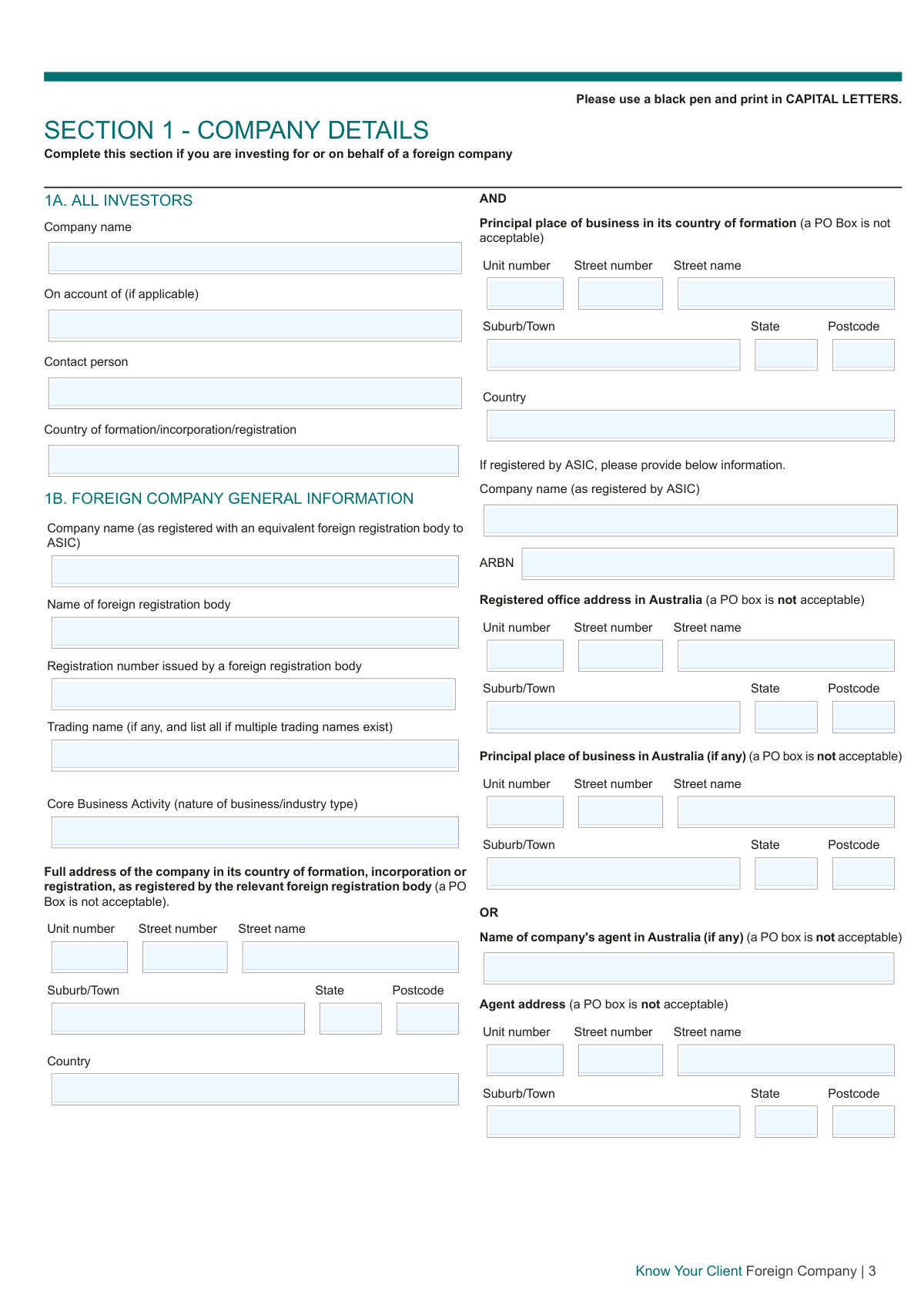
This form is a 'Know Your Client' (KYC) document required for foreign companies to provide detailed information about their identity, ownership structure, and tax status. It is essential for financial institutions to meet their legal obligations under regulations such as the Anti-Money Laundering and Counter-Terrorism Financing Act 2006, FATCA, and the Common Reporting Standard (CRS). Today, this form can be filled out quickly and accurately using AI-powered services like Instafill.ai, which can also convert non-fillable PDF versions into interactive fillable forms.
KYC - Foreign Company is part of the
compliance forms, company forms, KYC forms, AML forms, foreign company forms and client onboarding forms categories on Instafill.
Rather not fill this in by hand? Instafill is an online form filler that completes PDF forms automatically — upload the blank form, answer a few questions, and the AI fills every field.
Form specifications
| Form name: | Know Your Client - Foreign Company |
| Number of pages: | 1 |
| Language: | English |
Our AI automatically handles information lookup, data retrieval, formatting, and form filling.
It takes less than a minute to fill out KYC - Foreign Company using our AI form filling.
Securely upload your data. Information is encrypted in transit and deleted immediately after the form is filled out.
Instafill Demo: How to fill out PDF forms in seconds with AI
How to Fill Out KYC - Foreign Company Online for Free in 2026
Are you looking to fill out a KYC - FOREIGN COMPANY form online quickly and accurately? Instafill.ai offers the #1 AI-powered PDF filling software of 2026, allowing you to complete your KYC - FOREIGN COMPANY form in just 37 seconds or less.
Follow these steps to fill out your KYC - FOREIGN COMPANY form online using Instafill.ai:
- 1 Navigate to Instafill.ai and upload or select the 'Know Your Client - Foreign Company' form.
- 2 Use the AI assistant to automatically populate Section 1 with the company's details, including its registered name, address, business activity, and source of funds.
- 3 Specify the company type and provide the full names of all company directors.
- 4 Enter the personal and residential details for all Beneficial Owners (individuals owning 25% or more) or, if none, the Controlling Persons of the company.
- 5 Complete Section 2 by declaring the company's tax status for FATCA and CRS purposes, providing a GIIN if applicable, and listing all countries of tax residency.
- 6 Carefully read the declaration in Section 3, then have the authorized signatories sign and date the form.
- 7 Download the completed form and compile it with all required original certified copies of identification documents for the company and individuals listed.
Our AI-powered system ensures each field is filled out correctly, reducing errors and saving you time.
Why Choose Instafill.ai for Your Fillable KYC - Foreign Company Form?
Speed
Complete your KYC - Foreign Company in as little as 37 seconds.
Up-to-Date
Always use the latest 2026 KYC - Foreign Company form version.
Cost-effective
No need to hire expensive lawyers.
Accuracy
Our AI performs 10 compliance checks to ensure your form is error-free.
Security
Your personal information is protected with bank-level encryption.
Frequently Asked Questions About KYC - Foreign Company
This form is used to collect information to verify a foreign company's identity when investing with Dexus. It is required to meet legal obligations under Australian Anti-Money Laundering, Counter-Terrorism Financing, and tax laws like FATCA and CRS.
This form must be completed by or on behalf of any foreign company that is applying to make an investment with Dexus.
A beneficial owner is any individual who ultimately owns 25% or more of the company's capital, either directly or indirectly. You must provide the personal details and identification documents for every individual who meets this definition in Section 1D.
If there are no individuals who meet the 25% ownership threshold, you must complete Section 1E instead. You will need to provide details for the company's 'Controlling Persons,' such as the senior managing directors.
You must provide original certified copies of documents such as the company's certificate of registration and company registers describing ownership. If the ownership structure is complex, a certified ownership chart may also be required.
A certified copy is a photocopy of an original document that has been signed and verified as a true copy by an authorized person. The form lists eligible certifiers, which include notaries public, justices of the peace, and certain police or bank officers.
No, do not send your original documents. You must obtain and send original certified copies of your identification documents, which have been verified and signed by an authorized person.
'Source of funds' refers to the origin of the specific money being used for this investment, such as business income. 'Source of wealth' describes how the company's overall net worth was accumulated over time, for example, through long-term investment income.
In Section 2C, you must list every country where the company is a tax resident. You also need to provide the Tax Identification Number (TIN) issued by each of those countries.
Send the completed and signed form, along with all required original certified documents, to Dexus Fund Operations at the postal address listed in the 'Contact Details' section.
Failing to provide the necessary information may result in delays, refusal of your investment, or restrictions on your account. It is essential to complete the form fully to comply with legal requirements.
Yes, services like Instafill.ai use AI to accurately auto-fill form fields from your saved information. This can save you significant time and help reduce errors when completing the form.
You can use a service like Instafill.ai to complete this form on your computer. Simply upload the PDF, and the platform will allow you to fill in the fields, add signatures, and download the completed document for submission.
If you have a flat, non-fillable PDF, you can upload it to a platform like Instafill.ai. Its technology can convert the document into an interactive, fillable form that you can easily complete online.
Compliance KYC - Foreign Company
Validation Checks by Instafill.ai
1
Prohibits PO Box in Address Fields
This validation checks that any address field where a physical location is required (e.g., registered office, principal place of business, residential address) does not contain 'PO Box' or similar variants. This is crucial for Anti-Money Laundering (AML) regulations which require a verifiable physical location for the entity and its key individuals. A submission with a PO Box in a restricted field will be rejected and require correction.
2
Validates Date of Birth and Signature Date Format
Ensures that all date fields, specifically the 'Date of birth' for individuals and the 'Date' in the signature section, adhere strictly to the dd/mm/yyyy format. This standardization is essential for accurate record-keeping, identity verification, and compliance checks. An invalid format would prevent the form from being processed and require the user to correct the entry.
3
Ensures Either Beneficial Owner or Controlling Person Details are Provided
This validation enforces the logic that if a company is not a type exempt from providing ownership details (e.g., a listed company on an approved market), it must provide information for either Beneficial Owners (Section 1D) or Controlling Persons (Section 1E). If the user indicates 'No' to having beneficial owners, they must complete the details for at least one Controlling Person. This is a critical AML requirement to identify the individuals with ultimate control, and failure to provide either will result in an incomplete and rejected form.
4
Verifies Skip Logic for Publicly Listed Companies
This check validates that if a company is identified as a 'Foreign public listed' or a 'Majority owned subsidiary' and confirms it is listed on a Dexus-approved market, then the Beneficial Owner/Controlling Person sections (1D, 1E) are correctly skipped as instructed. This logic streamlines the process for lower-risk entities. If these sections are filled out despite the company type, it may indicate a data entry error or misclassification, triggering a review.
5
Confirms Selection of Source of Funds and Wealth
Validates that the user has selected exactly one option for both 'Source of funds' and 'Source of wealth'. These selections are mandatory for assessing the money laundering and terrorism financing risk associated with the investment. An omission or multiple selections in either section would render the KYC profile incomplete and require the user to provide the missing information before the application can proceed.
6
Enforces Single Selection for Tax Status
This validation ensures that exactly one tax status category is selected in Section 2A. The company's classification under FATCA and CRS rules is fundamental to determining Dexus's reporting obligations. Selecting zero or multiple statuses creates ambiguity and makes compliance impossible, thus the form would be rejected until a single, clear status is declared.
7
Validates GIIN Provision for Financial Institutions
Checks that if the company's tax status is declared as a 'Financial Institution', the Global Intermediary Identification Number (GIIN) field is either filled or a valid FATCA status is selected from the sub-list. The GIIN is a key identifier for FATCA compliance. A Financial Institution failing to provide a GIIN or a valid reason for its absence cannot be properly onboarded, leading to form rejection.
8
Validates Tax Identification Number (TIN) for Foreign Tax Residents
This check ensures that if a company confirms it is a tax resident of a country other than Australia (Section 2C), it must provide a Tax Identification Number (TIN) for each country listed. If a TIN is not provided, a valid reason (A, B, or C) must be selected from the provided options. This information is mandatory for Common Reporting Standard (CRS) obligations, and its absence would halt the application process pending correction.
9
Ensures Declaration Section is Signed and Dated
Verifies that at least one signatory has completed the 'Signature(s)' portion of Section 3, including their name, title, a selected role, a signature, and a validly formatted date. The signature legally binds the company to the declarations made in the form, which is a critical legal and compliance requirement. An unsigned or incomplete declaration section is legally non-binding and will be immediately rejected.
10
Ensures Foreign Company Registration Details are Complete
This check validates that the 'Company name', 'Name of foreign registration body', and 'Registration number' fields in Section 1B are all filled out. These details are essential for verifying the legal existence and good standing of the foreign company through official channels. Missing registration information prevents basic due diligence and would cause the form to be returned for completion.
11
Requires Role of Controlling Person to be Specified
This validation ensures that if the 'Controlling Persons' section (1E) is completed, the 'Role of controlling person' field is filled for each individual listed. Understanding the person's role (e.g., Managing Director, Senior Official) provides context for their control and is a required data point for AML/CTF reporting. An empty role field would make the submission incomplete and require clarification.
12
Verifies Completeness of Individual's Full Name
This check ensures that for every Beneficial Owner or Controlling Person listed, both the 'Surname' and 'Given name(s)' fields are completed. A full legal name is the primary identifier for an individual and is essential for conducting sanctions screening and identity verification. An incomplete name would immediately fail validation and require correction.
13
Validates Conditional Logic for Financial Institution Investment Entities
In Section 2A, if a company is a 'Financial Institution', this check validates that the question 'Is the Financial Institution an Investment Entity located in a Non-Participating CRS Jurisdiction...' is answered with 'Yes' or 'No'. The answer determines the next required step (proceeding to 2B or Section 3). An unanswered question breaks the compliance workflow and will cause the form to be flagged as incomplete.
Common Mistakes in Completing KYC - Foreign Company
Applicants often submit simple photocopies, send original documents against instructions, or use a certifier not on the approved list. This error occurs due to not reading the detailed instructions on who can certify and the exact wording required. Submissions with improper certifications are immediately rejected, causing significant processing delays. To avoid this, use only the certifiers listed on page one and ensure they use the specified certification text.
A critical error is failing to identify all individuals who ultimately own 25% or more of the company, especially in complex, multi-layered corporate structures. This happens when applicants misunderstand the concept of 'ultimate' ownership or neglect to trace ownership through intermediate entities. Omitting this information violates AML/CTF regulations and will halt the application pending further investigation. Always map out the full ownership structure to the final individual owners before completing Section 1D.
If a company has no individual beneficial owners meeting the 25% ownership threshold, the form requires details of 'Controlling Persons' (e.g., senior managing officials) in Section 1E. A common mistake is to answer 'No' to beneficial owners and then incorrectly skip this section, leaving the form incomplete. This will result in a rejection, as the institution must identify the individuals exercising control. If no beneficial owners exist, you must provide details for the company's senior management.
In Section 2A, companies frequently misclassify their tax status, such as selecting 'Active Non-Financial Entity (NFE)' when they are a 'Passive NFE' (e.g., an investment holding company). This is a technical distinction based on income and asset types that is easily misunderstood. An incorrect classification leads to non-compliance with tax reporting standards and requires resubmission of the form. If there is any uncertainty, consult a tax advisor to ensure the correct entity type is selected.
The form explicitly prohibits using a PO Box for the company's registered address or principal place of business, yet applicants often enter one out of habit. This is a data entry error that leads to automatic rejection, as a physical address is a legal requirement for verification. To prevent this, always provide a full street address. AI-powered form filling tools like Instafill.ai can help prevent this by validating address fields and flagging the use of PO Boxes where they are not permitted.
When completing Section 2C, applicants who are tax residents of another country may leave the Tax Identification Number (TIN) field blank without providing a reason. The form requires that if a TIN is not provided, one of the three specific reasons (A, B, or C) must be selected. This omission makes the tax declaration incomplete and non-compliant, requiring clarification and delaying the process. Always provide the TIN or select the appropriate reason for its absence.
For companies with complex ownership, the instructions require a certified chart detailing the structure up to the ultimate beneficial owners. Applicants often forget to attach this chart, or provide one that is uncertified or does not clearly show ownership percentages. This prevents the verification of the beneficial owners listed in the form and will result in a request for more information. Since this form is a non-fillable PDF, tools like Instafill.ai can convert it into an interactive version, making it easier to manage checklists and ensure all required attachments are included.
The declaration in Section 3 is often filled out incorrectly, with an unauthorized person signing, the signatory's role not being ticked, or the signature itself being missing. This invalidates the entire application from a legal standpoint. Ensure the form is signed only by an authorized director or attorney as specified, and that their capacity is clearly marked in the checkbox. This simple oversight can cause the entire package to be returned.
The form provides two options for verifying an individual's identity, and applicants often mix them up. A common error with Option B is providing two documents like a birth and marriage certificate, while forgetting the mandatory second document must be a recent proof of address (e.g., a utility bill). This fails the identity verification check and requires the applicant to find and resubmit correctly certified documents. Carefully read the 'Plus' instruction in Option B to ensure you provide one document from each list.
In Section 1C, the form provides space for six directors and instructs applicants to attach a separate page if there are more. It is common for applicants with more than six directors to either forget to attach the additional list or assume listing the main directors is sufficient. This is considered an incomplete submission, as information on all directors is required for due diligence. Always double-check the number of directors and attach a supplementary sheet if necessary.
Saved over 80 hours a year
“I was never sure if my IRS forms like W-9 were filled correctly. Now, I can complete the forms accurately without any external help.”
Kevin Martin Green
Your data stays secure with advanced protection from Instafill and our subprocessors




Robust compliance program
Transparent business model
You’re not the product. You always know where your data is and what it is processed for.
ISO 27001, HIPAA, and GDPR
Our subprocesses adhere to multiple compliance standards, including but not limited to ISO 27001, HIPAA, and GDPR.
Security & privacy by design
We consider security and privacy from the initial design phase of any new service or functionality. It’s not an afterthought, it’s built-in, including support for two-factor authentication (2FA) to further protect your account.
Fill out KYC - Foreign Company with Instafill.ai
Worried about filling PDFs wrong? Instafill securely fills know-your-client-foreign-company forms, ensuring each field is accurate.
