Fill out client onboarding forms
with AI.
Client onboarding forms are the foundational documents used by businesses and financial institutions to establish a formal relationship with new customers. These forms are critical for ensuring that organizations understand exactly who they are doing business with, particularly when dealing with complex corporate structures or international entities. Beyond just gathering basic contact information, these documents serve as a primary tool for risk management and regulatory adherence, helping firms navigate the intricacies of modern financial standards and reporting requirements.
By continuing, you acknowledge Instafill's Privacy Policy and agree to get occasional product update and promotional emails.
About client onboarding forms
Professionals in the legal, financial, and corporate services sectors frequently rely on these forms to meet stringent legal obligations. For instance, Know Your Client (KYC) and Anti-Money Laundering (AML) forms are essential for complying with regulations like the Common Reporting Standard (CRS) or FATCA. Whether you are verifying the ownership structure of a foreign company or performing due diligence on a new investor, these forms ensure that all necessary data is captured accurately to prevent fraud and maintain transparency. Tools like Instafill.ai use AI to fill these forms in under 30 seconds while ensuring data is handled accurately and securely, significantly reducing the administrative burden of the onboarding process.
Every form on this page can be completed without typing. Instafill is form filling software that reads a PDF and fills it for you — including flat and scanned documents that carry no fillable fields at all.
Forms in This Category
| Form Name | Pages | FCI | |
|---|---|---|---|
| 1. | Know Your Client - Foreign Company | 1 | – |
- Enterprise-grade security & data encryption
- 99%+ accuracy powered by AI
- 1,000+ forms from all industries
- Complete forms in under 60 seconds
How to Choose the Right Form
Navigating international regulations is a critical step in any corporate onboarding process. Choosing the right documentation ensures that your business remains compliant with global financial standards while providing a seamless experience for your new clients.
Identifying Your Onboarding Needs
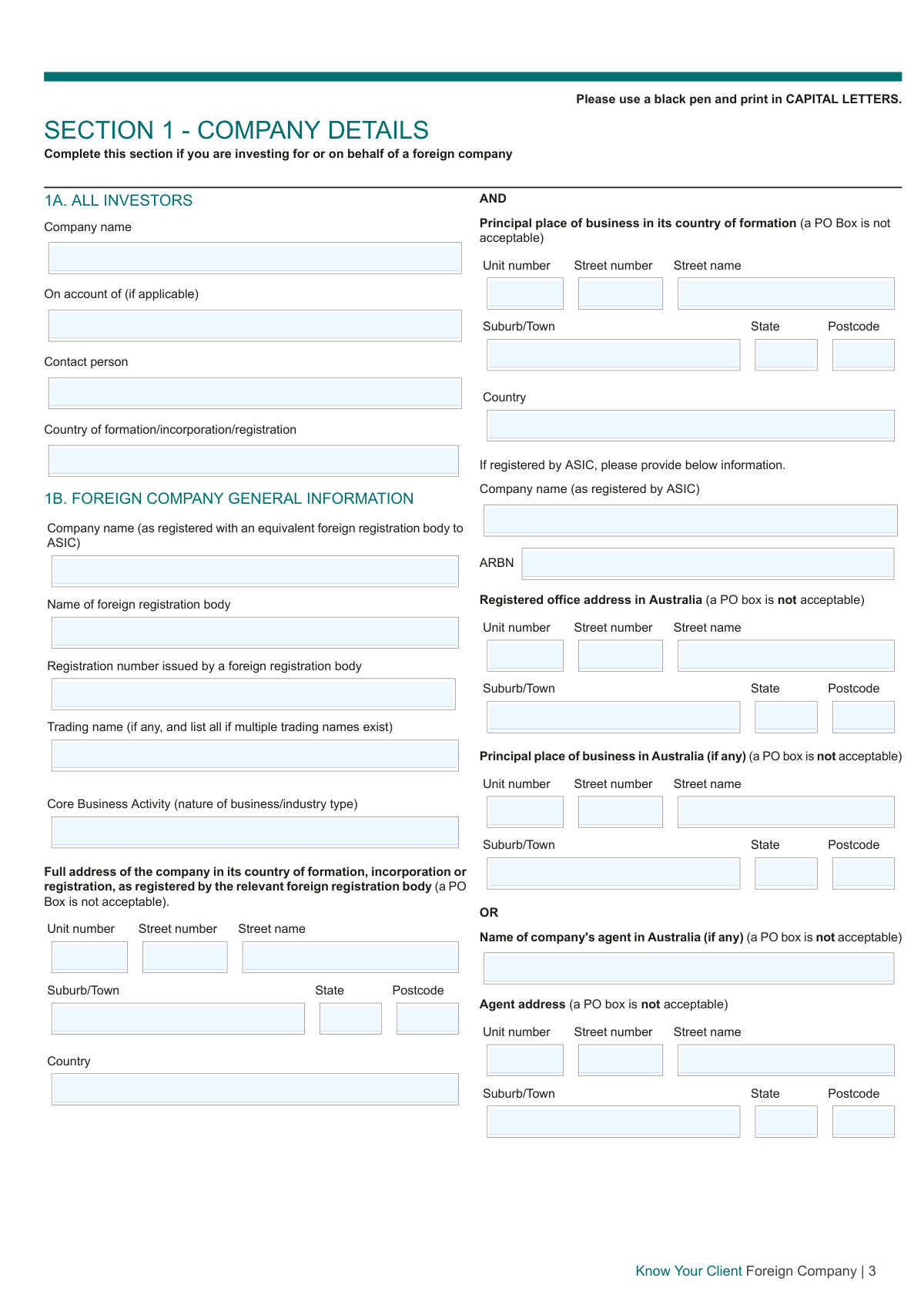
When dealing with international entities, standard domestic forms are often insufficient. You need a specialized document that captures the nuances of foreign corporate structures and cross-border tax obligations. On this page, we currently feature the primary document required for these scenarios:
- Know Your Client - Foreign Company: This is the essential form for onboarding non-domestic corporate entities. It is specifically designed to satisfy strict regulatory frameworks, including the Anti-Money Laundering and Counter-Terrorism Financing Act 2006 (AML/CTF), FATCA, and the Common Reporting Standard (CRS).
When to Use This Form
You should select the Know Your Client - Foreign Company form if your prospective client meets any of the following criteria:
- Foreign Incorporation: The company is incorporated, registered, or headquartered outside of your primary operating jurisdiction.
- Complex Ownership: The entity has a multi-layered ownership structure that involves foreign parent companies or international beneficial owners.
- Regulatory Reporting: You are a financial institution, legal firm, or real estate agency required to perform enhanced due diligence (EDD) on foreign investors to meet tax transparency requirements.
Why Accuracy Matters
Incomplete or inaccurate KYC forms can lead to significant delays in account opening or even legal penalties for non-compliance. By using the Know Your Client - Foreign Company form, you ensure that you are collecting all necessary data points regarding the entity’s identity, beneficial ownership, and tax residency status from the start.
Using Instafill.ai, you can streamline this high-stakes process. Our AI tools help you fill out this form accurately or convert static, non-fillable PDF versions into interactive documents, reducing the administrative burden on both your team and your international clients.
Form Comparison
| Form | Primary Purpose | Target Entity | Regulatory Compliance | Key Information |
|---|---|---|---|---|
| Know Your Client - Foreign Company | Identify ownership structure and tax status for international corporate entities. | Foreign companies and offshore business structures seeking financial services. | Adheres to AML/CTF Act 2006, FATCA, and Common Reporting Standards (CRS). | Details on beneficial owners, tax residency, and company registration. |
Tips for client onboarding forms
Identifying Ultimate Beneficial Owners (UBOs) is often the most complex part of foreign company onboarding. Ensure you have a clear organizational chart showing any individual who owns 25% or more of the entity to avoid delays during the compliance review.
Compliance forms often require proof of existence, such as a Certificate of Incorporation or an Articles of Association. Having these digital copies ready to reference ensures that the legal names and registration numbers you enter on the form exactly match your official records.
Onboarding forms for foreign entities require specific tax residency information and classifications. Verify your Global Intermediary Identification Number (GIIN) if applicable, as incorrect tax status declarations are a common reason for form rejection.
Managing multiple compliance documents for different jurisdictions can be overwhelming. AI-powered tools like Instafill.ai can complete these forms in under 30 seconds with high accuracy, ensuring your data stays secure while significantly reducing manual data entry.
Financial institutions compare the information on your KYC forms against your submitted identification documents. Any discrepancy in addresses, spelling of names, or registration dates can trigger a manual review and slow down the onboarding process.
For foreign company forms, supporting documents in non-English languages usually require certified translations. Check if the institution requires these to be notarized or apostilled before you begin filling out the forms to save time on revisions.
Frequently Asked Questions
Client onboarding forms are used by businesses, particularly financial institutions, to collect essential information about new clients before establishing a professional relationship. These documents help establish the client's identity, assess potential risk levels, and ensure the company remains compliant with local and international regulatory standards.
These forms are generally required for any entity or individual opening accounts with banks, investment firms, or insurance companies. They are especially critical for foreign companies or high-net-worth individuals to satisfy anti-money laundering (AML) and tax transparency regulations like FATCA and the Common Reporting Standard (CRS).
Foreign companies are often subject to stricter scrutiny to prevent cross-border financial crimes and tax evasion. These forms help institutions understand the company's complex ownership structure, identify the ultimate beneficial owners, and determine the correct tax residency status.
Completion usually requires supporting evidence such as a certificate of incorporation, proof of a registered business address, and government-issued identification for directors or major shareholders. You may also be asked to provide tax identification numbers and financial statements to verify the legal source of funds.
Yes, you can fill out complex client onboarding forms using AI-powered tools like Instafill.ai. These platforms can accurately extract relevant data from your source documents and place it into the correct PDF fields in under 30 seconds, significantly reducing manual entry errors.
While filling out these technical forms manually can take a significant amount of time, using AI services allows you to complete the process in less than a minute. This technology streamlines the onboarding process by automating the data extraction and form-filling steps for KYC and AML documents.
If a company fails to provide the required onboarding or KYC documentation, the institution will likely be unable to open an account or provide any services. In some jurisdictions, failing to meet these compliance requirements can lead to regulatory delays or the freezing of existing assets until the information is provided.
While many institutions use standardized templates based on global regulations like FATCA or CRS, individual banks often have their own specific variations. It is important to use the exact form provided by the specific institution you are dealing with to ensure all their unique compliance requirements are met.
KYC (Know Your Client) is the specific process of verifying a client's identity and understanding their financial activities. AML (Anti-Money Laundering) refers to the broader set of laws and regulations designed to prevent the generation of income through illegal actions; KYC is a core component of an effective AML program.
Completed forms are typically submitted directly to the compliance or onboarding department of the requesting institution via their secure online portal, encrypted email, or physical mail. Always ensure you are using a secure transmission method, as these forms contain sensitive corporate and personal data.
Glossary
- KYC (Know Your Client)
- A mandatory process used by businesses to verify the identity, suitability, and risks involved with maintaining a business relationship with a client.
- AML (Anti-Money Laundering)
- A set of laws and regulations designed to prevent the practice of generating income through illegal actions and disguising it as legitimate funds.
- UBO (Ultimate Beneficial Owner)
- The natural person who ultimately owns or controls a legal entity, typically identified by holding a certain percentage of shares or voting rights.
- FATCA (Foreign Account Tax Compliance Act)
- A United States federal law requiring foreign financial institutions to report on the assets and identities of US persons holding accounts abroad.
- CRS (Common Reporting Standard)
- An international standard for the automatic exchange of financial account information between countries to combat global tax evasion.
- Controlling Person
- An individual who exercises significant influence or control over a legal entity, often used in tax reporting when no single owner meets the UBO threshold.
- Tax Residency
- The jurisdiction or country where a person or company is legally obligated to pay taxes based on their physical presence or registered headquarters.
- Certificate of Incorporation
- A legal document relating to the formation of a company or corporation, often required as supporting evidence in foreign company onboarding.