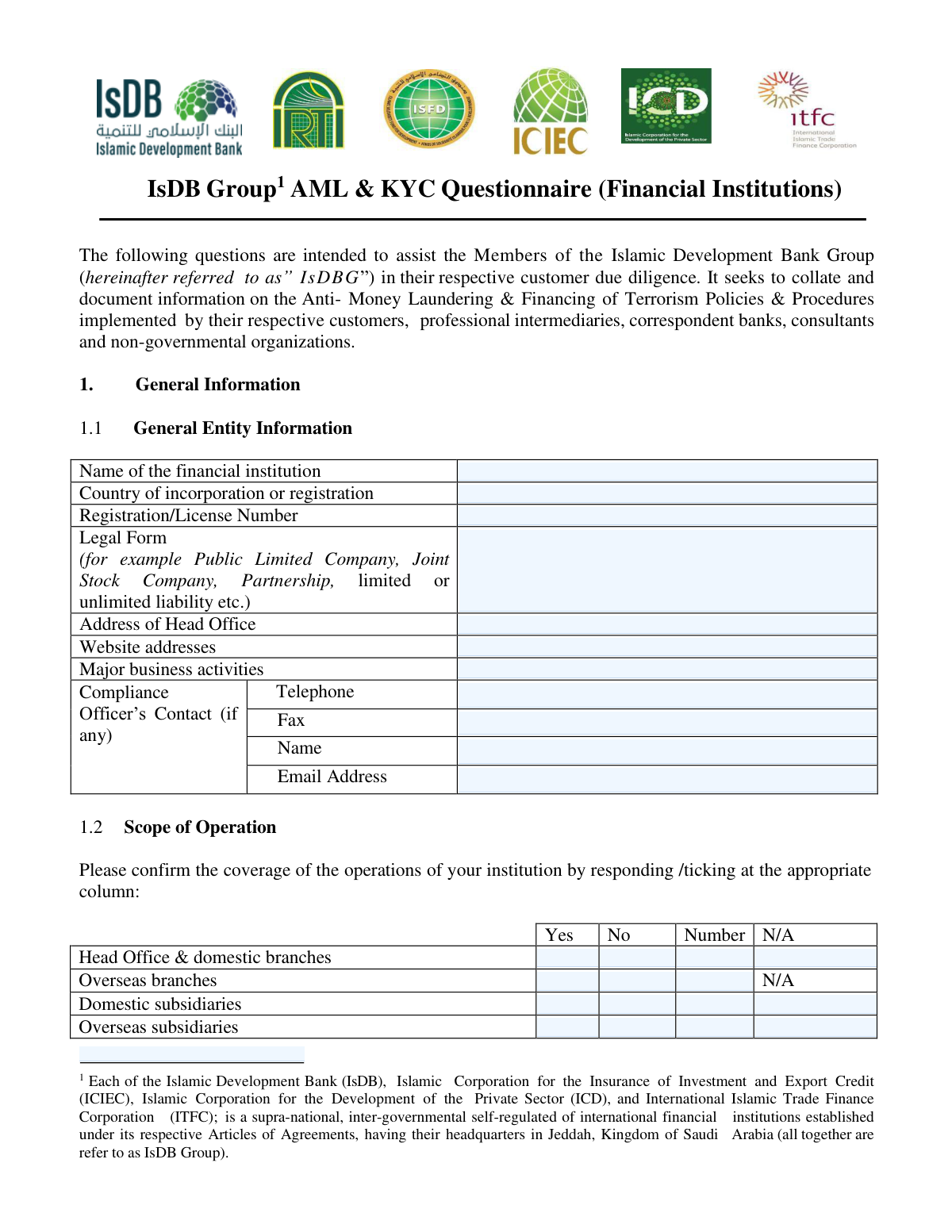
Yes! You can use AI to fill out IsDB Group AML & KYC Questionnaire (Financial Institutions)
This questionnaire is a crucial document used by the Islamic Development Bank (IsDB) Group to conduct customer due diligence on financial institutions it works with. It collects detailed information regarding the institution's Anti-Money Laundering (AML) and Counter-Financing of Terrorism (CFT) controls, policies, and procedures to ensure compliance with international standards. Today, this form can be filled out quickly and accurately using AI-powered services like Instafill.ai, which can also convert non-fillable PDF versions into interactive fillable forms.
Our AI automatically handles information lookup, data retrieval, formatting, and form filling.
It takes less than a minute to fill out IsDB AML & KYC Questionnaire using our AI form filling.
Securely upload your data. Information is encrypted in transit and deleted immediately after the form is filled out.
Form specifications
| Form name: | IsDB Group AML & KYC Questionnaire (Financial Institutions) |
| Number of pages: | 1 |
| Language: | English |
| Categories: | financial forms, compliance forms |
Instafill Demo: How to fill out PDF forms in seconds with AI
How to Fill Out IsDB AML & KYC Questionnaire Online for Free in 2026
Are you looking to fill out a ISDB AML & KYC QUESTIONNAIRE form online quickly and accurately? Instafill.ai offers the #1 AI-powered PDF filling software of 2026, allowing you to complete your ISDB AML & KYC QUESTIONNAIRE form in just 37 seconds or less.
Follow these steps to fill out your ISDB AML & KYC QUESTIONNAIRE form online using Instafill.ai:
- 1 Navigate to Instafill.ai and upload or select the IsDB Group AML & KYC Questionnaire.
- 2 Use the AI assistant to automatically populate general information about your financial institution, such as its name, address, legal form, and registration details.
- 3 Answer the series of yes/no questions regarding your institution's AML/CFT policies, risk assessment, customer due diligence, and training programs.
- 4 Provide specific details where required, such as listing compliance officers, regulatory authorities, and the names of relevant AML/CFT laws.
- 5 Gather and prepare the required attachments, including your AML/CFT policy, articles of association, list of shareholders, and annual financial statements.
- 6 Review all the information entered for accuracy, then have an authorized representative sign, date, and apply the official seal to finalize the questionnaire before submission.
Our AI-powered system ensures each field is filled out correctly, reducing errors and saving you time.
Why Choose Instafill.ai for Your Fillable IsDB AML & KYC Questionnaire Form?
Speed
Complete your IsDB AML & KYC Questionnaire in as little as 37 seconds.
Up-to-Date
Always use the latest 2026 IsDB AML & KYC Questionnaire form version.
Cost-effective
No need to hire expensive lawyers.
Accuracy
Our AI performs 10 compliance checks to ensure your form is error-free.
Security
Your personal information is protected with bank-level encryption.
Frequently Asked Questions About Form IsDB AML & KYC Questionnaire
This form is used by the Islamic Development Bank Group (IsDB G) to conduct customer due diligence. It gathers essential information on the Anti-Money Laundering (AML) and Counter-Financing of Terrorism (CFT) policies and procedures of the financial institutions it works with.
This form must be completed by financial institutions that are customers, professional intermediaries, correspondent banks, consultants, or non-governmental organizations engaging with any member of the IsDB Group.
You are required to attach several key documents, including your License/Certificate of Registration, Articles of Association, AML/CFT Policy, lists of shareholders and directors, a management team list, and your most recent Annual Report & Financial Statement.
The form states that it cannot be processed if it is not duly filled, signed, and stamped, or if information is missing. Submitting an incomplete form will lead to delays and prevent the IsDB Group from proceeding with your case.
If your institution does not have an officially designated Compliance Officer, you should provide the contact details of the senior manager or individual responsible for overseeing AML and CFT compliance.
The form defines a shell bank as a bank that is incorporated in a jurisdiction where it has no physical presence and is not affiliated with a regulated financial group. You must confirm whether your institution has policies that prohibit relationships with such banks.
A Politically Exposed Person (PEP) is an individual entrusted with a prominent public function, such as a senior government official, judicial officer, or military leader. The form asks about your policies for these individuals because they may present a higher risk for potential involvement in bribery and corruption.
The form must be signed by a representative who is authorized to complete the document on behalf of your institution. Their name and title must be clearly printed, and the form must be stamped with your institution's official seal.
In this section, you must provide your institution's authorized and issued share capital, specify if there are different classes of shares, and state whether the company is publicly traded. If it is public, you must list the stock exchange and symbol.
While the form asks if you provide training, it also asks for the frequency. You should state how often the training occurs (e.g., annually, upon hiring) as this demonstrates an ongoing commitment to AML compliance.
Yes, services like Instafill.ai use AI to accurately auto-fill form fields with your institution's information, which can save significant time and reduce errors. This is particularly helpful for lengthy and detailed questionnaires like this one.
To fill this form online, you can use a platform like Instafill.ai. Simply upload the PDF, and the service will make it an interactive form where you can type your answers, check boxes, and add a digital signature.
If you have a non-fillable or 'flat' PDF, you can use a service like Instafill.ai to convert it into an interactive, fillable form. This allows you to easily complete the questionnaire on your computer without needing to print it.
Compliance IsDB AML & KYC Questionnaire
Validation Checks by Instafill.ai
1
Ensures General Entity Information is Complete
This check verifies that all mandatory fields in the 'General Entity Information' section (1.1) are filled out, including the institution's name, country of incorporation, registration number, legal form, head office address, and major business activities. This basic information is fundamental for identifying the entity and initiating the due diligence process. A failure to provide this complete information will prevent the form from being submitted and will prompt the user to fill in the missing fields.
2
Validates Website Address Format
This validation ensures that the entry in the 'Website addresses' field is a properly formatted URL (e.g., starts with http:// or https:// and contains a valid domain). A correct website address is crucial for verification and for gathering further public information about the institution. If the format is invalid, the system will display an error message requesting a valid URL.
3
Validates Compliance Officer's Email Address Format
This check confirms that the email address provided for the Compliance Officer follows the standard '[email protected]' format. A valid email is essential for future communication regarding compliance and KYC matters. If an invalid format is entered, the form will reject the entry and require the user to correct it before proceeding.
4
Conditional Requirement for Publicly Traded Information
This validation enforces a logical rule on question 1.3.3. If the user answers 'Yes' to 'Is your institution publicly traded?', the subsequent 'Exchange & Symbol' field becomes mandatory. This information is vital for verifying the institution's status and ownership through public records. If 'Yes' is selected but the exchange and symbol are left blank, an error will be triggered, halting submission until the information is provided.
5
Conditional Requirement for AML/CFT Laws
This check is linked to question 1 in the AML/CFT section. If the user selects 'Yes' to confirm the existence of money laundering laws, the text field to 'list the names of the relevant laws' must be filled. This provides specific context to the affirmative answer and is a key part of the due diligence. If the field is left empty after selecting 'Yes', the user will be notified that this information is required.
6
Conditional Requirement for Designated Compliance Officer Details
This validation applies to question 7 in the AML/CFT section. If the user answers 'Yes' to having a designated compliance officer, the associated contact detail fields (Name/Title, Email, Phone) become mandatory. Having direct contact information for the responsible officer is critical for AML oversight and communication. Failure to provide these details after answering 'Yes' will result in a validation error.
7
Conditional Requirement for Supervisory Authority Name
This check is tied to question 8 in the AML/CFT section. If the user responds 'Yes' to 'Is your institution subject to the supervision of any regulatory authority?', the field for the authority's name must be completed. This information allows for independent verification of the institution's regulatory status. The form will not be accepted if 'Yes' is checked but the authority's name is omitted.
8
Conditional Requirement for Record Retention Period
This validation is linked to question 15. If the user answers 'Yes' to having 'appropriate record retention procedures', the field asking for the 'period of time for which records are kept' must be filled. This quantifies the institution's policy and demonstrates compliance with legal standards. An empty period field after a 'Yes' answer will trigger an error.
9
Validates Numeric Input for Scope of Operation
This check ensures that for each row in the 'Scope of Operation' table (1.2), if a value is entered in the 'Number' column, it must be a valid integer. This data provides a quantitative measure of the institution's operational scale. Any non-numeric characters in these fields will cause a validation failure, prompting the user to enter a valid number.
10
Prohibition Check for Anonymous Accounts
This is a critical business rule validation for question 14, 'Does your institution offer anonymous accounts?'. An answer of 'Yes' is a major red flag for AML/CFT controls, as anonymous accounts are a high-risk product. The system should flag this response for immediate and enhanced review, or potentially prevent submission altogether, as it may indicate non-compliance with global standards.
11
Prohibition Check for Shell Bank Relationships
This validation assesses the response to question 11 regarding policies on shell banks. An answer of 'No' to having policies that 'prohibit any accounts/relationships with shell banks' is a significant compliance risk. This response should trigger a high-priority alert for the reviewer, as dealing with shell banks is strongly discouraged by international standards like FATF. The system should highlight this response for mandatory follow-up.
12
Verification of Required Document Attachments
This check ensures that all documents listed in the 'Additional Information' section (e.g., License, Articles of Association, AML Policy) have been uploaded. These documents are essential evidence supporting the answers provided in the questionnaire. The system should prevent final submission if any of the required files are missing and display a checklist of the missing documents to the user.
13
Ensures Final Confirmation Section is Complete
This validation verifies that the 'Name', 'Title', 'Date', and 'Signature' fields at the end of the form are all completed, as explicitly required by the postscript note. The signature and title confirm the authority of the individual completing the form, making the submission legally binding and accountable. An incomplete confirmation section will block submission and prompt the user to fill all required signature fields.
14
Validates Format and Plausibility of Confirmation Date
This check ensures the 'Date' in the final confirmation section is in a valid format (e.g., DD/MM/YYYY) and is a plausible date (i.e., not in the future or a distant past date). A correct and current date is essential for establishing when the information was certified as accurate. An invalid date format or an illogical date will result in an error, requiring the user to correct it.
Common Mistakes in Completing IsDB AML & KYC Questionnaire
The form's final section lists seven categories of required attachments, including the AML/CFT Policy, Articles of Association, and Annual Report. A very common mistake is overlooking this list and submitting the questionnaire without some or all of these crucial documents. This guarantees an incomplete submission, leading to significant processing delays and back-and-forth communication. To prevent this, create a checklist from the 'Additional Information' section and gather all required files before starting the form.
Many questions (e.g., Q1, Q7, Q8, Q15, Q28) require specific details if the answer is 'Yes,' such as listing laws or providing contact information. Applicants frequently check 'Yes' but forget to fill in the corresponding text box. This makes the affirmative answer useless for due diligence and forces the reviewer to request the missing information. Always double-check that any 'Yes' response is accompanied by the requested supplementary data.
The final page requires a signature, name, title, date, and an 'Official Seal'. The postscript explicitly warns that the form will not be processed if it is not duly filled, signed, and stamped. This crucial step is often missed in a rush, especially when dealing with digital documents. An unsigned or unstamped form is considered invalid and will be immediately rejected, restarting the submission process.
Users often confuse 'N/A' (Not Applicable) with 'No'. For instance, if an institution does not have overseas subsidiaries (Section 1.2), the correct answer is 'No,' not 'N/A.' The form also requires a separate explanation for any 'N/A' answers in the Scope of Operation section, a detail that is almost always forgotten. Misusing 'N/A' can misrepresent the institution's structure and compliance posture, leading to unnecessary scrutiny.
In the 'Major business activities' field, applicants often provide overly broad terms like 'financial services' or 'investment.' For a KYC review, specific details are essential (e.g., 'Retail Banking,' 'Trade Finance,' 'Asset Management for Institutional Clients'). Vague descriptions are a red flag that can trigger further, more detailed inquiries and slow down the approval process. Be specific and clearly list all primary lines of business.
The form requests contact information for a Compliance Officer in Section 1.1 and again for the designated AML/CFT officer in Question 7. It's common for users to enter conflicting information in these two sections or to only complete one. This creates confusion about who the correct point of contact is. Ensure the details are identical and complete in both sections if the role is held by the same person.
When filling out the 'Authorised Capital' and 'Issued Share Capital' in Section 1.3.1, applicants frequently enter only the numerical value. For a financial institution, this information is incomplete without a currency indicator (e.g., USD, EUR, SAR). This ambiguity requires clarification and delays the review. Always include the standard three-letter currency code next to the capital amounts.
This form is often a flat, non-fillable PDF, forcing users to print, handwrite, and scan it. This frequently results in illegible handwriting, poor scan quality, and data entry errors that make the form difficult to process. To ensure clarity and professionalism, it is better to use a tool that can convert the document into a fillable version. AI-powered form-filling tools like Instafill.ai can perform this conversion and help populate fields accurately.
Question 1 asks for the names of relevant AML/CFT laws, and a common error is to provide a generic answer like 'National AML Legislation.' Reviewers expect the official titles of the specific acts, codes, or regulations (e.g., 'The Bank Secrecy Act,' 'Proceeds of Crime Act 2002'). A non-specific answer suggests a lack of detailed knowledge and may lead to a finding of a weak compliance culture. Research and provide the full, formal names of the governing legislation.
Section 1.2 contains a table with four rows (Head Office, Overseas branches, etc.) and multiple columns (Yes, No, Number, N/A). It is very easy to miss a checkmark or forget to enter the number of branches or subsidiaries for a specific row. Any blank row creates ambiguity and requires the reviewer to follow up for clarification. Systematically review each row to ensure all applicable columns are filled out correctly.
Saved over 80 hours a year
“I was never sure if my IRS forms like W-9 were filled correctly. Now, I can complete the forms accurately without any external help.”
Kevin Martin Green
Your data stays secure with advanced protection from Instafill and our subprocessors

Robust compliance program
Transparent business model
You’re not the product. You always know where your data is and what it is processed for.
ISO 27001, HIPAA, and GDPR
Our subprocesses adhere to multiple compliance standards, including but not limited to ISO 27001, HIPAA, and GDPR.
Security & privacy by design
We consider security and privacy from the initial design phase of any new service or functionality. It’s not an afterthought, it’s built-in, including support for two-factor authentication (2FA) to further protect your account.
Fill out IsDB AML & KYC Questionnaire with Instafill.ai
Worried about filling PDFs wrong? Instafill securely fills isdb-group-aml-kyc-questionnaire-financial-institutions forms, ensuring each field is accurate.