Fill out AML KYC forms
with AI.
Anti-Money Laundering (AML) and Know Your Customer (KYC) forms are critical compliance documents used by financial institutions to verify the identity of their clients and assess potential risks. These forms serve as a safeguard against financial crimes such as money laundering, fraud, and terrorism financing by ensuring that the source of funds and the identity of the account holders are legitimate. For organizations and individuals, accurately completing these documents is a mandatory requirement for maintaining legal standing and fostering trust within the global financial ecosystem.
By continuing, you acknowledge Instafill's Privacy Policy and agree to get occasional product update and promotional emails.
About AML KYC forms
These forms are typically required during the onboarding process or during periodic compliance reviews by banks, asset managers, and international development groups. Whether you are a corporate entity opening a business account at Arbejdernes Landsbank, a financial institution partnering with the IsDB Group, or an investor with Macquarie Asset Management, you will likely encounter detailed questionnaires regarding ownership structures, beneficial owners, and transaction patterns. Providing precise information is essential to avoid delays in account activation or interruptions in financial services.
Navigating these complex requirements can be time-consuming, especially when dealing with lengthy questionnaires and non-interactive PDF files. Tools like Instafill.ai use AI to fill these forms in under 30 seconds, ensuring that your data is handled accurately and securely while streamlining the entire compliance process. This allows businesses and investors to focus on their core activities rather than administrative paperwork.
Every form on this page can be completed without typing. Instafill is form filling software that reads a PDF and fills it for you — including flat and scanned documents that carry no fillable fields at all.
Forms in This Category
The forms in this category have a median Form Complexity Index of 61/100 (Moderate), measured across 4 forms by field count, input difficulty, length, conditional logic and structure. See how it is calculated.
| Form Name | Pages | FCI | |
|---|---|---|---|
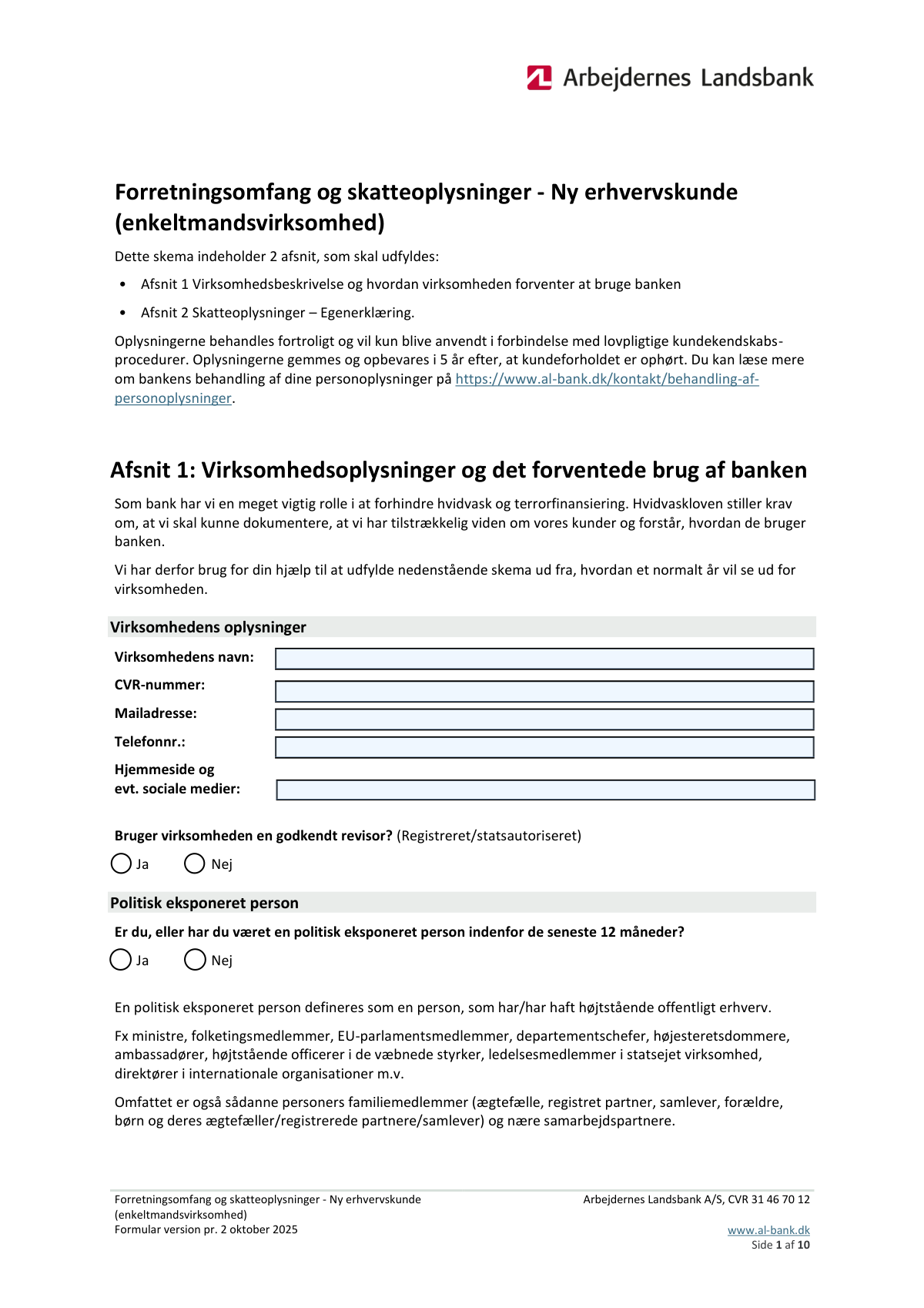
| 1. | Arbejdernes Landsbank – Virksomhedsoplysninger og KYC/AML (kundekendskab) for erhvervskunder | 9 | Complex 67 |
| 2. | IsDB Group AML & KYC Questionnaire (Financial Institutions) | 1 | Moderate 54 |
| 3. | IsDB Group AML & KYC Questionnaire (Non-Financial Institutions) | 1 | Moderate 50 |
| 4. | Macquarie Asset Management AML/KYC Form | 1 | Moderate 61 |
- Enterprise-grade security & data encryption
- 99%+ accuracy powered by AI
- 1,000+ forms from all industries
- Complete forms in under 60 seconds
How to Choose the Right Form
Choosing the Right AML/KYC Form for Your Compliance Needs
Anti-Money Laundering (AML) and Know Your Customer (KYC) documentation is a mandatory part of onboarding with financial institutions. To ensure you select the correct form and avoid delays in your application, consider your specific institution and entity type.
Banking with Arbejdernes Landsbank
If your business is based in Denmark or you are opening a commercial account with this specific bank, you must use the Arbejdernes Landsbank – Virksomhedsoplysninger og KYC/AML (kundekendskab) for erhvervskunder. This form is tailored for Danish corporate compliance, requiring details such as your CVR number, ownership structure, and expected international transfer volumes.
Partnering with the IsDB Group
For entities establishing a relationship with the Islamic Development Bank, the choice depends on your organization's regulatory status:
- Financial Institutions: Select the IsDB Group AML & KYC Questionnaire (Financial Institutions) if you represent a bank, credit union, or insurance company. It focuses on your internal AML/CFT controls and policies.
- Non-Financial Entities: Use the IsDB Group AML & KYC Questionnaire (Non-Financial Institutions) for corporations, trade businesses, or other non-bank entities. This version prioritizes legal structure and beneficial ownership.
Asset Management and Investment
If you are a new investor looking to manage funds through Macquarie Asset Management, the standard Macquarie Asset Management AML/KYC Form is required. This document is specifically designed to meet the requirements of the Australian Anti-Money Laundering and Counter-Terrorism Financing Act 2006, focusing on the legitimacy of investment funds.
Quick Selection Tips
- By Geography: Use the Arbejdernes Landsbank form for Danish domestic business.
- By Industry: Use the IsDB Financial Institutions form if you are a regulated bank.
- By Activity: Use the Macquarie form specifically for asset management and investment onboarding.
Using Instafill.ai, you can quickly complete these complex questionnaires by letting AI handle the repetitive data entry, ensuring all fields are accurately addressed for faster compliance approval.
Form Comparison
| Form | Target Entity | Primary Focus | Regulatory Scope |
|---|---|---|---|
| Arbejdernes Landsbank – Virksomhedsoplysninger og KYC/AML (kundekendskab) for erhvervskunder | Danish business customers and corporate entities | Identity, ownership, risk assessment, and expected transaction patterns | Danish anti-money laundering legislation and local compliance standards |
| IsDB Group AML & KYC Questionnaire (Financial Institutions) | Banks and other regulated financial institutions | Institutional AML/CFT controls, compliance policies, and internal procedures | International banking standards and IsDB Group due diligence requirements |
| IsDB Group AML & KYC Questionnaire (Non-Financial Institutions) | Non-financial corporate customers and various legal entities | Legal structure, beneficial ownership, and general AML/CFT policies | International regulatory standards for non-financial business relationships |
| Macquarie Asset Management AML/KYC Form | New individual or corporate investment clients | Identity verification and ensuring the legitimate source of investment funds | Australian Anti-Money Laundering and Counter-Terrorism Financing Act 2006 |
Tips for AML KYC forms
One of the most common reasons for KYC rejection is incomplete ownership information. Always list all individuals who hold a significant stake in the company, typically 25% or more, and provide their full legal names as they appear on government identification.
Discrepancies between your KYC form and your company's articles of incorporation can cause significant delays. Ensure that the business name, registered address, and registration numbers are identical to those found on your official legal filings.
AI-powered tools like Instafill.ai can complete these complex forms in under 30 seconds with high accuracy, ensuring no fields are missed. Your sensitive financial data remains secure throughout the process, making it an ideal solution for managing multiple compliance documents.
Banks use your projected transaction data to establish a baseline for your account activity. Provide realistic estimates for monthly volumes and international transfers to prevent automated systems from flagging legitimate business activity as suspicious later on.
AML and KYC forms almost always require supplemental files, such as proof of address or director IDs. Organize these documents in a dedicated digital folder beforehand so you can quickly reference details and upload them without interrupting your workflow.
Failing to disclose if an owner or director is a Politically Exposed Person can lead to severe compliance issues. Double-check the PEP status of all key stakeholders to ensure your submission is transparent and meets regulatory standards.
Many AML forms are provided as non-fillable scans, which typically require printing and manual entry. Use a digital conversion tool to make these PDFs interactive, allowing you to type directly into the fields and maintain a professional, legible appearance.
Frequently Asked Questions
AML (Anti-Money Laundering) and KYC (Know Your Customer) forms are regulatory requirements designed to prevent financial crimes like money laundering, fraud, and terrorism financing. These documents allow financial institutions to verify the identity of their clients, understand their business activities, and assess the risk levels associated with a business relationship.
These forms are generally required for any entity or individual opening a bank account, making a large investment, or establishing a relationship with a high-stakes financial organization. This includes corporate entities, financial institutions, and sometimes non-financial businesses that handle significant capital.
The choice depends on your organization's legal status: banks, credit unions, and other regulated entities should use the Financial Institutions questionnaire. Other entities, such as corporations or NGOs, should use the Non-Financial Institutions version to report their legal structure and AML policies.
Most forms, such as those for Arbejdernes Landsbank, require details on the company's CVR or registration number, ownership structure, and the identity of Ultimate Beneficial Owners (UBOs). You will also likely need to provide information on expected transaction volumes, international transfers, and whether any stakeholders are Politically Exposed Persons (PEPs).
Yes, AI tools like Instafill.ai can fill out complex AML and KYC forms in under 30 seconds. The AI accurately extracts data from your source documents, such as registration certificates or IDs, and places it directly into the form fields to ensure consistency and speed.
While manual entry can take an hour or more due to the level of detail required, using an AI-powered service can reduce this to less than a minute. These tools automate the data entry process, which is particularly helpful for lengthy questionnaires like the IsDB Group or Macquarie Asset Management forms.
If you have a static PDF that doesn't allow typing, you can use services like Instafill.ai to convert it into an interactive, fillable form. This allows you to complete the document digitally without the need for printing, manual handwriting, or scanning.
This form is required to comply with the Anti-Money Laundering and Counter-Terrorism Financing Act 2006. It ensures that Macquarie can verify the legitimacy of the investor's identity and the source of their funds before any investment activity begins.
Incomplete or inaccurate forms often lead to significant delays in onboarding or the rejection of your application. Financial institutions are legally barred from providing services if they cannot satisfy their due diligence requirements, so ensuring every field is filled correctly is essential.
Yes, KYC is an ongoing process. Most institutions require you to update your information whenever there is a major change in ownership or business activity, and many conduct routine reviews every 1 to 3 years to ensure their records remain current.
Glossary
- Form Complexity Index
- Instafill’s 0–100 measure of how much effort a form takes to complete, calculated deterministically from the form’s own structure rather than estimated. It combines the number of fillable fields (the largest factor), how difficult those fields are to complete based on their type, the number of pages that contain fields, the amount of conditional “fill-only-if” logic, and how many sections the form is divided into, then adds modifiers for tables and repeating lists, bundled instruction pages, and dense page layouts. A higher score means the form is harder to fill out by hand. The forms in this category have a median Form Complexity Index of 61/100 (Moderate). See exactly how it is calculated.
- KYC (Know Your Customer)
- The mandatory process of identifying and verifying a client's identity when opening an account and periodically over time.
- AML (Anti-Money Laundering)
- A set of laws and regulations designed to prevent criminals from disguising illegally obtained funds as legitimate income.
- UBO (Ultimate Beneficial Owner)
- The natural person who ultimately owns or controls a business, typically identified as anyone holding 25% or more of the shares or voting rights.
- PEP (Politically Exposed Person)
- An individual who holds a prominent public position, such as a senior politician or government official, who is considered a higher risk for potential involvement in bribery or corruption.
- CFT (Counter-Financing of Terrorism)
- Regulations and procedures specifically aimed at preventing the movement of funds intended for use by terrorist organizations.
- CDD (Customer Due Diligence)
- The process of gathering information about a customer to evaluate the level of risk they pose to the financial institution.
- Source of Funds (SoF)
- A requirement to explain the origin of the specific money being used for a transaction, such as salary, inheritance, or business profits.
- Sanctions Screening
- The process of checking a person or entity against government lists of individuals and countries that are prohibited from certain financial activities.