Yes! You can use AI to fill out IsDB Group AML & KYC Questionnaire (Non-Financial Institutions)
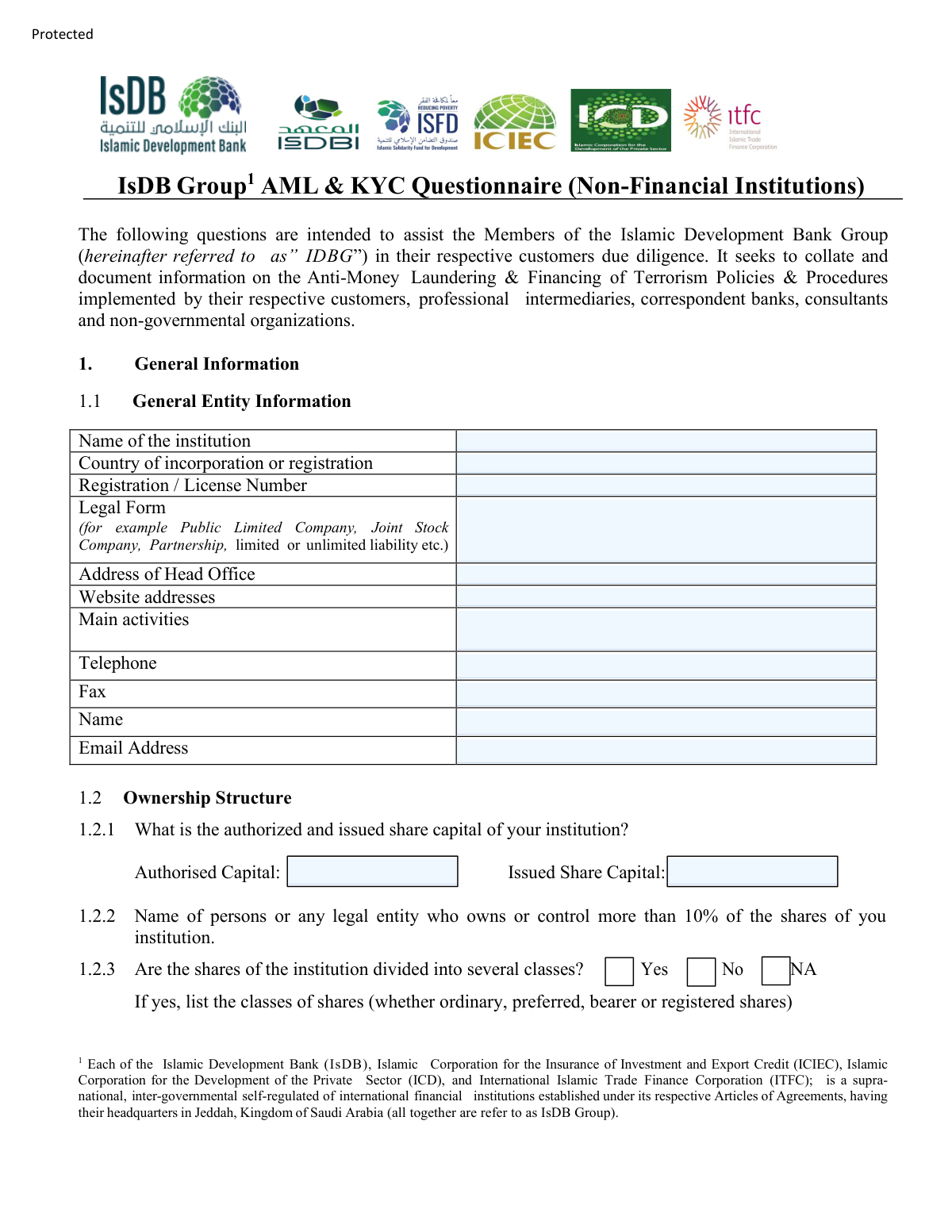
This questionnaire is a crucial document used by the Islamic Development Bank (IsDB) Group to conduct due diligence on its non-financial institution customers. It gathers detailed information about an entity's legal structure, ownership, and its policies and procedures related to Anti-Money Laundering and Counter-Financing of Terrorism (AML/CFT). Completing this form is essential for establishing or maintaining a business relationship with the IsDB Group, ensuring compliance with international financial regulations. Today, this form can be filled out quickly and accurately using AI-powered services like Instafill.ai, which can also convert non-fillable PDF versions into interactive fillable forms.
Our AI automatically handles information lookup, data retrieval, formatting, and form filling.
It takes less than a minute to fill out IsDB AML & KYC Questionnaire using our AI form filling.
Securely upload your data. Information is encrypted in transit and deleted immediately after the form is filled out.
Form specifications
| Form name: | IsDB Group AML & KYC Questionnaire (Non-Financial Institutions) |
| Number of pages: | 1 |
| Language: | English |
| Categories: | financial forms, due diligence forms, compliance forms |
Instafill Demo: How to fill out PDF forms in seconds with AI
How to Fill Out IsDB AML & KYC Questionnaire Online for Free in 2026
Are you looking to fill out a ISDB AML & KYC QUESTIONNAIRE form online quickly and accurately? Instafill.ai offers the #1 AI-powered PDF filling software of 2026, allowing you to complete your ISDB AML & KYC QUESTIONNAIRE form in just 37 seconds or less.
Follow these steps to fill out your ISDB AML & KYC QUESTIONNAIRE form online using Instafill.ai:
- 1 Navigate to Instafill.ai and upload or select the IsDB Group AML & KYC Questionnaire.
- 2 Use the AI assistant to accurately fill in the 'General Information' section, including your institution's name, legal form, address, and primary activities.
- 3 Provide detailed information about the 'Ownership Structure,' such as authorized capital, major shareholders, and public trading status.
- 4 Complete the comprehensive 'Anti-Money Laundering & Financing Terrorism Controls' section by answering yes/no questions about your institution's policies, risk assessment, and KYC procedures.
- 5 Gather and prepare the required supporting documents listed in the 'Additional Information/Documents' section, such as your Certificate of Registration, AML/CFT Policy, and Annual Report.
- 6 Review all entered information for accuracy, then have an authorized representative provide their name, title, signature, and the date, and affix the official seal.
- 7 Securely download and submit the completed questionnaire along with all attached documents as instructed by the IsDB Group.
Our AI-powered system ensures each field is filled out correctly, reducing errors and saving you time.
Why Choose Instafill.ai for Your Fillable IsDB AML & KYC Questionnaire Form?
Speed
Complete your IsDB AML & KYC Questionnaire in as little as 37 seconds.
Up-to-Date
Always use the latest 2026 IsDB AML & KYC Questionnaire form version.
Cost-effective
No need to hire expensive lawyers.
Accuracy
Our AI performs 10 compliance checks to ensure your form is error-free.
Security
Your personal information is protected with bank-level encryption.
Frequently Asked Questions About Form IsDB AML & KYC Questionnaire
This form is used by the Islamic Development Bank (IsDB) Group to conduct customer due diligence. It collects information on the Anti-Money Laundering (AML) and Counter-Financing of Terrorism (CFT) policies of its non-financial institution partners.
This questionnaire is intended for non-financial institutions that are customers or partners of the IsDB Group. This includes professional intermediaries, consultants, and non-governmental organizations.
You must provide details on your institution's share capital and list the names of any person or legal entity that owns or controls more than 10% of the shares.
You must attach several documents, including your Certificate of Registration, Articles of Association, AML/CFT Policy, lists of shareholders and directors, and your most recent Annual Report & Financial Statement.
This refers to having specific procedures for identifying and conducting enhanced due diligence on customers who are, or have been, in prominent public positions, as they may pose a higher risk for corruption.
You should answer question 8 in the AML/CFT section honestly. The form is designed to gather a complete picture of your institution's compliance framework, including whether it is self-regulated.
To complete the onboarding process, you must ensure the form is fully filled out, signed by an authorized representative, and stamped with your institution's official seal before submission.
For any questions that do not apply to your institution's structure or operations, you should select the 'N/A' (Not Applicable) option where provided to ensure the form is completed fully.
FATF is the Financial Action Task Force, an intergovernmental body that sets international standards to combat money laundering and terrorist financing. The form checks if your policies align with these global standards.
Yes, you can use services like Instafill.ai, which leverage AI to accurately auto-fill form fields from your saved data, helping you complete complex questionnaires like this one quickly and efficiently.
You can use a platform like Instafill.ai, which can convert flat, non-fillable PDFs into interactive forms. This allows you to type your answers directly into the fields and sign the document digitally.
Simply upload the IsDB Group questionnaire PDF to the Instafill.ai platform. You can then fill in the fields online, use AI to auto-complete information from your profile, and securely download the completed document.
You need to confirm if you provide AML/CFT training to relevant employees, state the frequency of the training, and confirm whether you maintain records of attendance and training materials.
A shell company is typically an entity without active business operations or significant assets. The form asks if your local laws prohibit dealing with such companies, as they can be used for illicit financial activities.
Compliance IsDB AML & KYC Questionnaire
Validation Checks by Instafill.ai
1
Validates Email Address Format
This check ensures that the value entered in the 'Email Address' field follows the standard email format (e.g., [email protected]). It is crucial for ensuring that the primary contact information is valid and can be used for official communication regarding the application. A failed validation would prevent form submission and prompt the user to correct the email address.
2
Validates Website Address URL Format
This check verifies that any entry in the 'Website addresses' field is a valid URL, including 'http://' or 'https://'. While not always mandatory, a valid URL is essential for the due diligence process, allowing reviewers to easily access the institution's official online presence. If a value is entered, it must be a functional URL format, otherwise, an error is shown.
3
Ensures International Phone Number Format
This validation checks that the 'Telephone' and 'Fax' numbers are entered in a recognizable international format, including a country code (e.g., +1-555-123-4567). This standardization is important for ensuring that the contact numbers are accurate and usable for international communication. An invalid format would trigger an error, requiring the user to re-enter the number correctly.
4
Verifies Completion of Mandatory General Information
This check confirms that all critical fields in the 'General Entity Information' section, such as 'Name of the institution', 'Country of incorporation', and 'Registration / License Number', are not left blank. These fields are the minimum required data to identify and begin processing the entity's application. Submission is blocked until all these mandatory fields are completed.
5
Logical Check for Issued vs. Authorized Capital
This validation ensures that the 'Issued Share Capital' amount is less than or equal to the 'Authorised Capital' amount. It is a logical impossibility for an institution to issue more capital than it is legally authorized to. This check prevents significant financial data entry errors and ensures the integrity of the ownership structure information.
6
Conditional Requirement for Publicly Traded Details
This check enforces a conditional logic rule: if the user answers 'Yes' to the question 'Is your institution publicly traded?', then the 'Exchange & Symbol' field becomes mandatory. This ensures that essential verification information for publicly traded companies is captured. Failure to provide the exchange and symbol after selecting 'Yes' will prevent the user from proceeding.
7
Conditional Requirement for AML Law Details
This validation is tied to Question 1 in the AML/CFT section. If the user selects 'Yes' to confirm the existence of AML/CFT laws in their country, the associated text field to 'list the names of the relevant laws' must be filled out. This verifies the user's claim and provides specific data needed for the due diligence review.
8
Conditional Requirement for Supervisory Authority Name
This check is linked to Question 8. If the user answers 'Yes' to being 'subject to the supervision of any regulatory authority', the field for the 'name of the supervisory/regulatory authority' must be completed. This information is critical for understanding the institution's regulatory environment and for potential verification with that authority.
9
Conditional Requirement for Record Retention Period
This validation rule applies to Question 13. If the user answers 'Yes' to having 'appropriate record retention procedures', the subsequent field to 'state the period of time' becomes mandatory. This ensures that a simple 'Yes' answer is substantiated with a specific, verifiable detail about the policy, which is a key aspect of AML compliance.
10
Validates Date Format and Prevents Future Dates
This check ensures the 'Date' field in the final signature block is entered in a valid format (e.g., YYYY-MM-DD) and is not a date in the future. This is important for establishing an accurate and legally sound record of when the document was attested to. An invalid format or a future date would result in an error, requiring correction before submission.
11
Ensures All Required Documents are Attached
This validation verifies that all files listed in 'Section VII. Additional Information/Documents' (e.g., License, Articles of Association, AML Policy) have been uploaded. These documents are critical evidence supporting the answers in the questionnaire and are non-negotiable for completing the onboarding process. The form cannot be submitted until all required attachments are present.
12
Verifies Completion of Final Confirmation Section
This check ensures that the 'Name', 'Signature', 'Title', and 'Official Seal' fields in the final confirmation block are all filled out. This section provides the legal attestation for the entire document, confirming the authority of the signatory and the authenticity of the information provided. An incomplete confirmation section would render the entire submission invalid.
13
Conditional Requirement for AML Training Frequency
This rule is linked to Question 23 regarding AML training. If the user selects 'Yes' to indicate that the institution provides training, the field asking 'how frequent are these trainings?' must be filled. This moves beyond a simple checkbox compliance to gather specific, actionable data on the implementation of the training program.
14
Numeric Validation for Capital Fields
This check ensures that the 'Authorised Capital' and 'Issued Share Capital' fields only accept numeric data, potentially allowing for common currency formatting like commas and decimal points. This prevents the entry of non-numeric text, which would corrupt financial data and impede analysis. The validation maintains data quality for key financial indicators.
Common Mistakes in Completing IsDB AML & KYC Questionnaire
Applicants often use abbreviations or trade names instead of the full, official legal name of the institution as it appears on registration documents. Similarly, fields like 'Legal Form' or 'Main activities' are filled with overly simplistic terms. This ambiguity forces reviewers to seek clarification, delaying the due diligence process and potentially raising red flags about transparency.
In section 1.2.1, a frequent error is transposing or misunderstanding the difference between 'Authorized Capital' and 'Issued Share Capital'. This financial misrepresentation can lead to questions about the applicant's financial literacy and internal controls. To avoid this, consult the company's articles of association or latest financial statements to ensure the correct figures are entered in the appropriate fields.
When asked for owners of more than 10% (section 1.2.2), applicants may only list direct corporate shareholders, failing to identify the ultimate beneficial owners (i.e., the natural persons). This is a critical failure in KYC compliance and can lead to immediate rejection of the form. It is essential to trace ownership through any corporate layers to identify and list all individuals who meet the control threshold.
Throughout the form, many 'Yes' answers trigger a requirement for more information in a subsequent field (e.g., Q1, Q8, Q13, Q23). A very common mistake is checking 'Yes' but leaving the corresponding text box for details blank. This renders the submission incomplete and guarantees follow-up queries, significantly slowing down the onboarding process.
Section VII clearly lists numerous required attachments, such as the Certificate of Registration, AML Policy, and shareholder lists. Submitting the questionnaire without one or more of these documents is a frequent and significant error. This results in an incomplete application and certain delays until all required documentation is provided.
The final declaration requires a signature from an authorized person, their title, the date, and an official company seal. Omitting any of these elements, especially the signature and official seal, invalidates the entire submission. This simple administrative oversight forces the form to be returned for proper completion, wasting valuable time.
When asked to list relevant AML laws (Q1) or the name of the supervisory authority (Q8), applicants often provide vague answers like 'AML regulations' or 'the financial authority'. This is insufficient for due diligence purposes. Applicants must provide the specific, full names of statutes and regulatory bodies to demonstrate compliance and awareness.
Applicants sometimes provide answers that contradict each other, such as stating they have no written AML policy (Q2: No) but then confirming it is approved by the board (Q5: Yes). Such inconsistencies raise serious doubts about the institution's control environment and the accuracy of the entire questionnaire. It is crucial to review all answers for logical consistency before submission.
As this form is a PDF, some users may print, handwrite, and scan it, often resulting in illegible text and a poor-quality submission. This makes the review process difficult and can lead to data entry errors or rejection. To ensure clarity, the form should be filled digitally; AI-powered tools like Instafill.ai can convert such non-fillable PDFs into easily fillable versions, preventing legibility issues.
Applicants may incorrectly mark a question as 'Not Applicable' (N/A) when the correct answer is 'No', often due to a misunderstanding of the question. For example, a private company should answer 'No' to being publicly traded (Q1.2.4), not 'N/A'. Using 'N/A' incorrectly creates ambiguity and requires clarification, whereas a definitive 'No' provides a clear statement of fact.
Saved over 80 hours a year
“I was never sure if my IRS forms like W-9 were filled correctly. Now, I can complete the forms accurately without any external help.”
Kevin Martin Green
Your data stays secure with advanced protection from Instafill and our subprocessors

Robust compliance program
Transparent business model
You’re not the product. You always know where your data is and what it is processed for.
ISO 27001, HIPAA, and GDPR
Our subprocesses adhere to multiple compliance standards, including but not limited to ISO 27001, HIPAA, and GDPR.
Security & privacy by design
We consider security and privacy from the initial design phase of any new service or functionality. It’s not an afterthought, it’s built-in, including support for two-factor authentication (2FA) to further protect your account.
Fill out IsDB AML & KYC Questionnaire with Instafill.ai
Worried about filling PDFs wrong? Instafill securely fills isdb-group-aml-kyc-questionnaire-non-financial-institutions forms, ensuring each field is accurate.