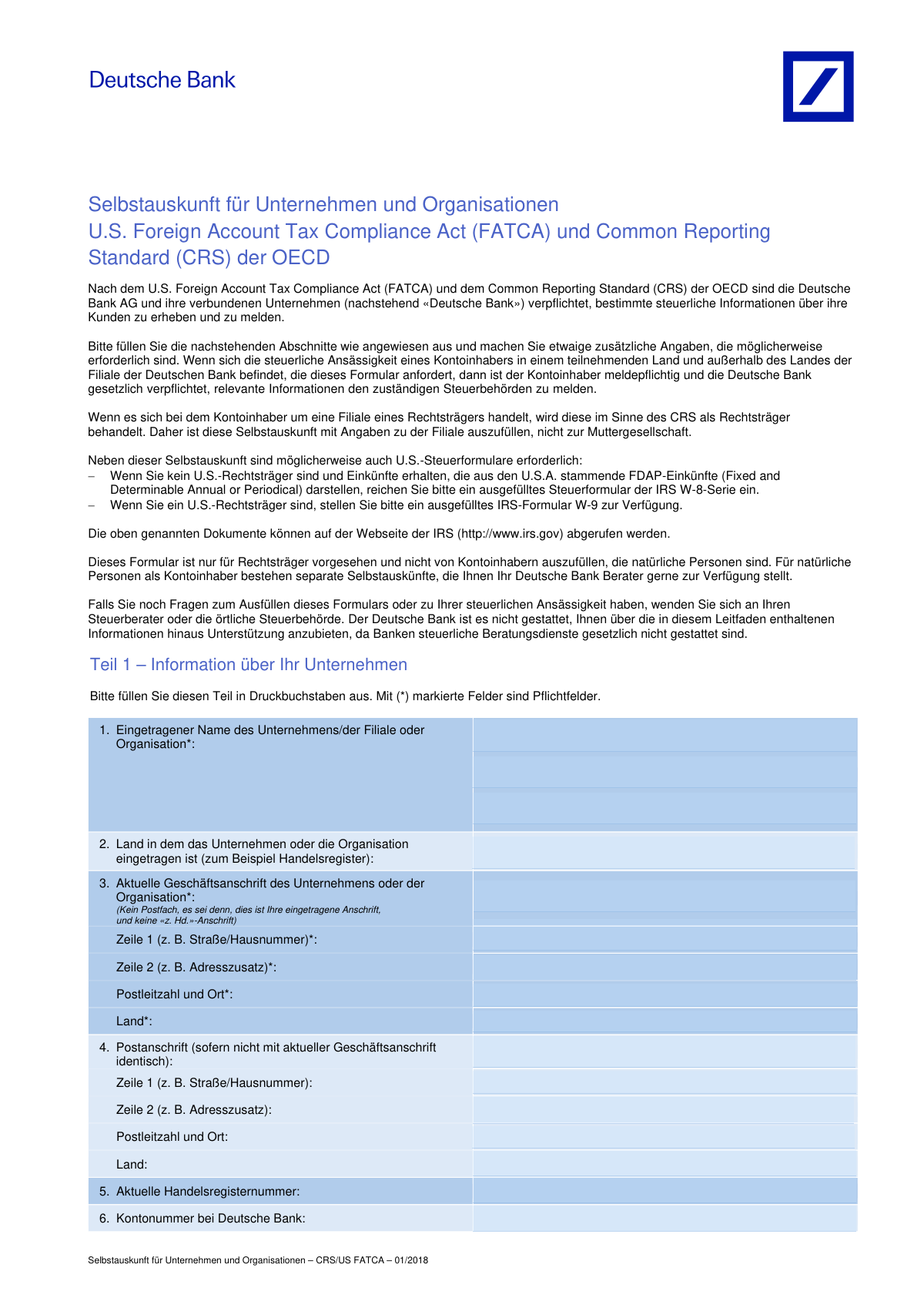
Yes! You can use AI to fill out Selbstauskunft für Unternehmen und Organisationen U.S. Foreign Account Tax Compliance Act (FATCA) und Common Reporting Standard (CRS) der OECD

This form, known as the Self-Certification for Entities, is required by financial institutions like Deutsche Bank to determine an entity's tax residency status under the U.S. Foreign Account Tax Compliance Act (FATCA) and the OECD's Common Reporting Standard (CRS). It helps identify and report financial accounts held by foreign tax residents to prevent offshore tax evasion. Today, this form can be filled out quickly and accurately using AI-powered services like Instafill.ai, which can also convert non-fillable PDF versions into interactive fillable forms.
Our AI automatically handles information lookup, data retrieval, formatting, and form filling.
It takes less than a minute to fill out CRS/US FATCA – 01/2018 using our AI form filling.
Securely upload your data. Information is encrypted in transit and deleted immediately after the form is filled out.

Form specifications

Form name: Selbstauskunft für Unternehmen und Organisationen U.S. Foreign Account Tax Compliance Act (FATCA) und Common Reporting Standard (CRS) der OECD
Number of pages: 5
Filled form examples: Form CRS/US FATCA – 01/2018 Examples
Language: English
Categories: tax forms, compliance forms
main-image

Instafill Demo: How to fill out PDF forms in seconds with AI

How to Fill Out CRS/US FATCA – 01/2018 Online for Free in 2026

Are you looking to fill out a CRS/US FATCA – 01/2018 form online quickly and accurately? Instafill.ai offers the #1 AI-powered PDF filling software of 2026, allowing you to complete your CRS/US FATCA – 01/2018 form in just 37 seconds or less.
Follow these steps to fill out your CRS/US FATCA – 01/2018 form online using Instafill.ai:
  1. 1 Navigate to Instafill.ai and upload or select the 'Selbstauskunft für Unternehmen und Organisationen' form.
  2. 2 Use the AI assistant to accurately fill in Part 1 with your company's identification details, including registered name, address, and country of registration.
  3. 3 In Part 2, classify your entity as either a Financial Institution (FI) or a Non-Financial Entity (NFE) and select the appropriate FATCA and CRS status.
  4. 4 Complete Part 3 by listing all countries of tax residency and providing the corresponding Tax Identification Number (TIN) for each.
  5. 5 If your entity is classified as a Passive NFE or a specific type of Investment Entity, complete Annex 1 with the required details of all controlling persons.
  6. 6 Carefully review all the information auto-filled by the AI for accuracy and completeness.
  7. 7 Electronically sign and date the declaration in Part 4 to certify that the information provided is correct and complete.

Our AI-powered system ensures each field is filled out correctly, reducing errors and saving you time.

Why Choose Instafill.ai for Your Fillable CRS/US FATCA – 01/2018 Form?

Speed

Complete your CRS/US FATCA – 01/2018 in as little as 37 seconds.

Up-to-Date

Always use the latest 2026 CRS/US FATCA – 01/2018 form version.

Cost-effective

No need to hire expensive lawyers.

Accuracy

Our AI performs 10 compliance checks to ensure your form is error-free.

Security

Your personal information is protected with bank-level encryption.

Frequently Asked Questions About Form CRS/US FATCA – 01/2018

This form is used by Deutsche Bank to collect tax information from companies and organizations to comply with the U.S. Foreign Account Tax Compliance Act (FATCA) and the OECD's Common Reporting Standard (CRS).

This form must be completed by all legal entities, such as companies and organizations, that are account holders with Deutsche Bank. It is not intended for individuals, who have a separate form.

Part 2(a) is for entities classified as Financial Institutions (FIs), like banks or investment firms. All other businesses, classified as Non-Financial Entities (NFEs), must complete Part 2(b).

In this section, you must list all countries where your entity is a tax resident and provide the corresponding Tax Identification Number (TIN) for each country.

If you cannot provide a TIN, you must select a reason from the options in field 15. The form provides specific reasons, such as the country not issuing TINs or other circumstances preventing you from obtaining one.

You must complete Annex 1 if your entity is classified as a 'Passive Non-Financial Entity (Passive NFE)' or a specific type of 'Investment Entity'. This section requires identifying the natural persons who ultimately control the entity.

Yes, U.S. entities must also provide an IRS Form W-9. Non-U.S. entities receiving certain U.S.-sourced income may need to submit an IRS W-8 series form.

The form is valid indefinitely until there is a change in your circumstances. You must notify Deutsche Bank of any changes within 30 days and submit a new, updated form.

If a valid form is not provided, your entity may be treated as reportable to tax authorities. Furthermore, a 30% U.S. withholding tax could be applied to certain U.S.-sourced payments under FATCA regulations.

No, the form should be filled out with the information pertaining to the branch itself, not the parent company.

No, Deutsche Bank is legally prohibited from providing tax advice. For assistance with determining your tax status or filling out the form, please consult a professional tax advisor.

Yes, services like Instafill.ai use AI to accurately auto-fill form fields, which can save you time and help prevent errors. These tools can extract information from your documents and place it in the correct fields.

To fill this form online, you can upload the PDF to Instafill.ai. The platform will make the document interactive, allowing you to type your information directly into the fields and save or print the completed form.

If you have a non-fillable or 'flat' PDF, you can use a service like Instafill.ai to instantly convert it into an interactive, fillable form. This allows you to complete it digitally without needing to print it.

Compliance CRS/US FATCA – 01/2018
Validation Checks by Instafill.ai

1
Mandatory Field Completion
This validation ensures that all fields marked with an asterisk (*) are filled out, including the company name, business address, country of tax residency, and the signatory's details. These fields represent the minimum information required under FATCA and CRS regulations for proper identification and reporting. If any of these fields are left blank, the form is considered incomplete and must be rejected, requiring the client to resubmit a fully completed version.
2
Exclusive Entity Classification
Verifies that the user has selected a classification in either Part 2(a) for Financial Institutions (FI) or Part 2(b) for Non-Financial Entities (NFE), but not both. This choice is fundamental as it dictates all subsequent reporting obligations under both FATCA and CRS. An invalid submission with both or neither section completed would make it impossible to process and would be rejected for ambiguity.
3
Conditional GIIN Requirement
This check confirms that a Global Intermediary Identification Number (GIIN) is provided if the entity identifies as a Participating FFI, Registered Deemed-Compliant FFI, Reporting Model II FFI, or Direct Reporting NFFE. The GIIN is the official IRS identifier for these statuses. Failure to provide a GIIN for these classifications prevents the bank from verifying the entity's FATCA status, which could force the bank to treat the entity as non-compliant and apply withholding tax.
4
Justification for Missing GIIN
Ensures that if an entity is classified as a Foreign Financial Institution (FFI) in Part 2(a) but does not provide a GIIN, a reason must be selected from the options in field 9. This justification is a mandatory part of the FATCA due diligence process. Without a selected reason, the absence of a GIIN is unexplained, rendering the FATCA classification invalid and potentially leading to the entity being flagged as a Non-Participating FFI.
5
Controlling Persons Annex Requirement
Validates that Annex 1 ('Beherrschende Personen') is completed if the entity is classified as a 'Passive NFE' (Part 2b, option iv) or an 'Investment Entity in a non-participating jurisdiction' (Part 2a, option ii). Regulations require the financial institution to identify and report the controlling persons of such entities. A submission without the required Annex 1 data is non-compliant and will be rejected.
6
Tax Identification Number (TIN) or Reason
For each country of tax residency listed in Part 3, this check verifies that either a Tax Identification Number (TIN) is provided in field 13 or a reason (A, B, or C) is selected in field 15. The TIN is the primary identifier for tax authorities under CRS. Submitting a residency without a TIN or a valid reason for its absence will halt processing, as it prevents correct reporting to tax authorities.
7
Mandatory Explanation for TIN Unavailability (Reason B)
If 'Reason B' (unable to obtain a TIN for other reasons) is selected in Part 3 for any tax residency, this validation ensures the corresponding free-text explanation field is filled out. 'Reason B' is an exceptional circumstance that requires explicit justification for audit purposes. An empty explanation field makes the reason invalid and the form incomplete, necessitating rejection.
8
Signature Date Format and Validity
This check verifies that the signature date in Part 4 is present, follows the 'tt.mm.jjjj' format, and represents a valid, logical date (i.e., not a future date). The date establishes the timeliness of the self-certification and is crucial for legal and audit trail purposes. An invalid, incorrectly formatted, or missing date invalidates the declaration and the entire form.
9
Confirmation of Signatory Authority
Ensures the checkbox in Part 4, confirming the signatory is authorized to act on behalf of the entity, is ticked. This is a critical legal attestation. Without this explicit confirmation, the bank has no proof that the form was completed by an authorized individual, rendering the entire self-certification legally void and unacceptable.
10
Stock Exchange Details for Publicly Traded NFE
If an entity checks the box for 'Active NFE – a publicly traded company' (Part 2b, option i), this validation confirms that the name of the stock exchange is provided in the corresponding text field. This information is essential for the bank to verify the entity's claim of being a low-risk, publicly traded entity. Missing this detail prevents verification and may require re-classification of the entity.
11
Business Address Physical Location Check
Validates that the 'Aktuelle Geschäftsanschrift' (Current Business Address) in Part 1 does not contain prohibited terms like 'Postfach' (P.O. Box) or 'z. Hd.' (c/o), as a physical address is required to help establish tax residency. A non-physical address can be a red flag for obscuring the true place of effective management. If such an address is used, the form should be flagged for manual review or rejected.
12
Controlling Person Data Completeness
When Annex 1 is required, this check ensures that for each controlling person listed, essential identifying information such as full name, address, and date and place of birth are provided. This data is fundamental for AML (Anti-Money Laundering) and CRS reporting on individuals. Incomplete records for any controlling person make the annex non-compliant and will cause the form to be rejected.
13
Controlling Person TIN or Justification
For each controlling person listed in Annex 1, this check ensures that for each of their tax residencies, either a TIN is provided or a reason for its absence is given. This requirement mirrors the rule for the entity itself and is critical for accurate reporting to tax authorities. Missing this information for any controlling person renders the Annex 1 data incomplete and unacceptable.
14
Country of Registration and Tax Residency Consistency
This validation cross-references the 'Country of Registration' from Part 1 with the list of tax residency countries in Part 3. While they can differ, the country of registration is typically expected to be one of the countries of tax residency. If it is not listed, the form may be flagged for a plausibility review to ensure the entity's structure and tax status are understood correctly.

Common Mistakes in Completing CRS/US FATCA – 01/2018

Incorrect Entity Classification in Part 2

Users often misunderstand the complex definitions of Financial Institution (FI), Active Non-Financial Entity (NFE), and Passive NFE, leading them to select the wrong category. This is a critical error as it dictates all subsequent reporting obligations and can lead to incorrect information being sent to tax authorities or the application of withholding taxes. To avoid this, carefully review the definitions in Annex 2 or consult a tax advisor. If the form is a non-fillable PDF, tools like Instafill.ai can convert it into an interactive version and guide users to the correct classification.

Failure to Complete 'Controlling Persons' Annex

This mistake occurs when an entity is classified as a 'Passive NFE' or a specific 'Investment Entity' but the user fails to complete the mandatory 'Anhang 1 – Beherrschende Personen' (Annex 1 - Controlling Persons). This is often due to overlooking the instruction linked to the checkbox in Part 2. The consequence is an incomplete form that will be rejected, delaying account services and requiring resubmission. Always check if your selection in Part 2 requires you to fill out Annex 1.

Incomplete or Incorrect Tax Identification Number (TIN) Information

In Part 3, users frequently omit the Tax Identification Number (TIN) for a country of tax residency or provide an invalid one. A common error is selecting 'Reason C - Not required' when the jurisdiction does require a TIN, or selecting 'Reason B' without providing the mandatory written explanation. Missing or incorrect TINs will cause the form to be flagged, leading to processing delays. To prevent this, verify the correct TIN and its format for each country and only select a reason for omission if genuinely applicable.

Providing an Invalid Business Address

The form explicitly states in Part 1, Zeile 3, that the business address cannot be a P.O. Box or a 'c/o' (in care of) address. People often provide a more convenient mailing address here out of habit, which will result in the form being rejected. The physical business address is crucial for determining tax residency and due diligence. Always provide the full physical address where the entity conducts its business to ensure compliance.

Missing or Incorrect Global Intermediary Identification Number (GIIN)

Financial Institutions or Direct Reporting NFFEs often forget to enter their Global Intermediary Identification Number (GIIN) in Part 2 (fields 8 or 11) or enter it with typos. This number is essential for FATCA compliance. Submitting the form without a required GIIN can lead to the entity being treated as non-compliant, potentially subjecting its U.S. source income to a 30% withholding tax. AI-powered tools like Instafill.ai can help validate the format of such identification numbers.

Filling Out Conflicting Sections

The form is divided into mutually exclusive sections, such as Part 2(a) for Financial Institutions and Part 2(b) for Non-Financial Entities. A common error is for users to fill out fields in both sections out of confusion. This creates ambiguity and invalidates the submission, requiring the bank to return the form for correction. To avoid this, read the instructions carefully and only complete the single section—either 2(a) or 2(b)—that applies to your entity.

Forgetting the Signatory Authority Confirmation

In Part 4, right before the signature line, there is a mandatory checkbox to confirm that the signatory is authorized to sign on behalf of the entity. This checkbox is frequently missed, which invalidates the entire declaration and requires the form to be returned. Always ensure this box is ticked before signing to affirm your authority and prevent unnecessary delays.

Incorrectly Identifying the Account Holder (Branch vs. Parent)

The instructions specify that if the account is held by a branch, the self-certification should be completed with the details of the branch, not the parent company. Users often mistakenly provide the parent company's information, leading to incorrect data collection and reporting. This can cause significant compliance issues and mismatches. Ensure the information in Part 1 pertains specifically to the entity or branch that is the legal owner of the account.

Incomplete Information for Controlling Persons in Annex 1

When Annex 1 is required, users often provide incomplete data, such as missing a full date and place of birth, omitting a TIN without a valid reason, or failing to specify the 'Art der beherrschenden Person' (Type of controlling person). Each field is critical for the bank's due diligence and reporting obligations. An incomplete annex will render the entire form invalid, so it is crucial to gather and enter all required details for each controlling person accurately.

Using Abbreviations for Country Names

In Annex 1, the field for the controlling person's address explicitly states 'Land (nicht abkürzen)' which means 'Country (do not abbreviate)'. Despite this clear instruction, users often use common abbreviations like 'USA' or 'DE'. This can cause data processing errors in automated systems that expect full country names for compliance reporting. To avoid rejection, always write out the full, official name of the country as instructed.
Saved over 80 hours a year

“I was never sure if my IRS forms like W-9 were filled correctly. Now, I can complete the forms accurately without any external help.”

Kevin Martin Green

Your data stays secure with advanced protection from Instafill and our subprocessors

Robust compliance program

Transparent business model

You’re not the product. You always know where your data is and what it is processed for.

ISO 27001, HIPAA, and GDPR

Our subprocesses adhere to multiple compliance standards, including but not limited to ISO 27001, HIPAA, and GDPR.

Security & privacy by design

We consider security and privacy from the initial design phase of any new service or functionality. It’s not an afterthought, it’s built-in, including support for two-factor authentication (2FA) to further protect your account.

Fill out CRS/US FATCA – 01/2018 with Instafill.ai

Worried about filling PDFs wrong? Instafill securely fills selbstauskunft-fr-unternehmen-und-organisationen-us-foreign-account-tax-compliance-act-fatca-und-common-reporting forms, ensuring each field is accurate.