Yes! You can use AI to fill out Compliance & AML Due Diligence Form
This form is a comprehensive questionnaire required by Cassa Depositi e Prestiti (CDP) for its counterparties and beneficiaries. Its purpose is to gather detailed information to perform due diligence regarding Anti-Money Laundering (AML), Counter-Terrorism Financing (CFT), tax transparency, international sanctions, and anti-bribery and corruption (ABC) principles. Completing this form is crucial for entities to demonstrate their adherence to international standards and to be eligible for CDP funding. Today, this form can be filled out quickly and accurately using AI-powered services like Instafill.ai, which can also convert non-fillable PDF versions into interactive fillable forms.
Our AI automatically handles information lookup, data retrieval, formatting, and form filling.
It takes less than a minute to fill out AML Due Diligence Form using our AI form filling.
Securely upload your data. Information is encrypted in transit and deleted immediately after the form is filled out.
Form specifications
| Form name: | Compliance & AML Due Diligence Form |
| Number of pages: | 1 |
| Language: | English |
| Categories: | due diligence forms, compliance forms |
Instafill Demo: How to fill out PDF forms in seconds with AI
How to Fill Out AML Due Diligence Form Online for Free in 2026
Are you looking to fill out a AML DUE DILIGENCE FORM form online quickly and accurately? Instafill.ai offers the #1 AI-powered PDF filling software of 2026, allowing you to complete your AML DUE DILIGENCE FORM form in just 37 seconds or less.
Follow these steps to fill out your AML DUE DILIGENCE FORM form online using Instafill.ai:
- 1 Navigate to Instafill.ai and upload or select the Compliance & AML Due Diligence Form.
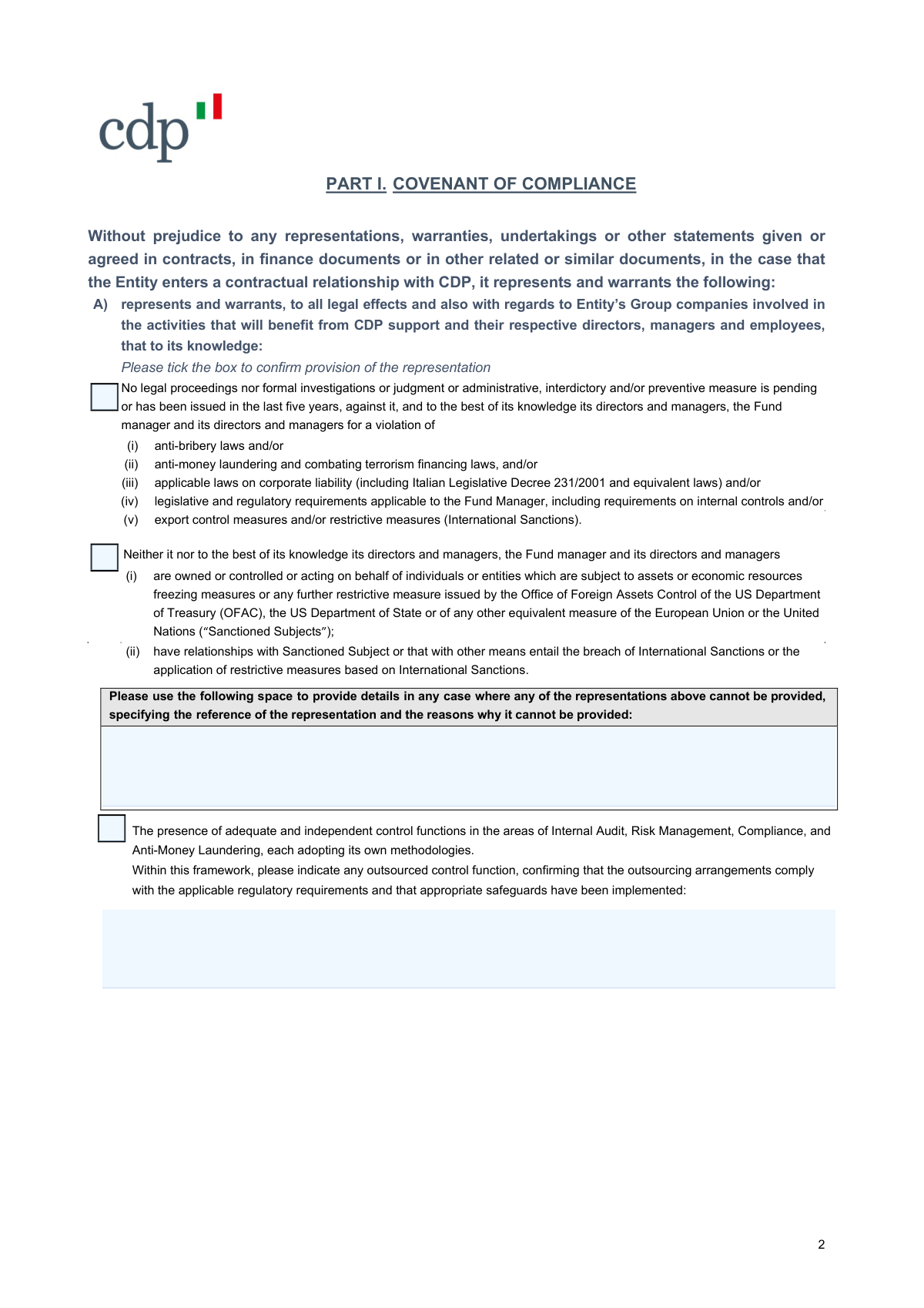
- 2 Complete Part I, the Covenant of Compliance, by carefully reviewing and ticking the boxes to confirm your entity's representations and warranties.
- 3 Fill in Part II with detailed information about the Fund Manager Profile, Beneficial Ownership, and the Fund Profile, including attaching a diagram of the ownership structure.
- 4 Address the detailed questionnaires in Part III concerning your entity's policies and standards for Anti-Money Laundering, Tax Transparency, International Sanctions, and Anti-Bribery.
- 5 Use the AI assistant to clarify complex requirements, such as the criteria for determining beneficial owners or identifying Politically Exposed Persons (PEPs).
- 6 Thoroughly review all sections, including declarations and annexes, to ensure all information is accurate and complete.
- 7 Electronically sign the form in the designated signature fields and download the completed document for submission to CDP.
Our AI-powered system ensures each field is filled out correctly, reducing errors and saving you time.
Why Choose Instafill.ai for Your Fillable AML Due Diligence Form Form?
Speed
Complete your AML Due Diligence Form in as little as 37 seconds.
Up-to-Date
Always use the latest 2026 AML Due Diligence Form form version.
Cost-effective
No need to hire expensive lawyers.
Accuracy
Our AI performs 10 compliance checks to ensure your form is error-free.
Security
Your personal information is protected with bank-level encryption.
Frequently Asked Questions About Form AML Due Diligence Form
This form is used by Cassa Depositi e Prestiti (CDP) to conduct due diligence on entities receiving its funds. It ensures that counterparties and beneficiaries comply with CDP's principles against money laundering (AML), terrorism financing (CFT), tax avoidance, and corruption.
Any entity, including counterparties and beneficiaries like Fund Managers, that will use or benefit from funds originating from CDP is required to complete and submit this form.
The Covenant of Compliance is a binding declaration where your entity warrants its adherence to key legal and ethical standards. By signing it, you commit to complying with principles against bribery, money laundering, and sanctions when using CDP funds.
You must provide identification data for each beneficial owner, including name, date of birth, and tax code. You also need to state the criteria used to determine their status (as per Annex 1) and declare if they are a Politically Exposed Person (PEP).
You are required to attach a representative diagram of the Fund Manager's entire ownership structure. If trusts or similar vehicles are involved, you may also need to provide documents like trust deeds.
If you cannot tick a box to confirm a representation in the Covenant of Compliance, you must use the provided space to explain why. Clearly specify which representation it is and the reasons for the non-confirmation.
A PEP is a person with a prominent public function, as defined in Annex 2. If a beneficial owner is a PEP, you must indicate this and provide details on their public role or relationship to a PEP.
These are countries identified as having unsatisfactory tax transparency and anti-money laundering standards, as listed in a footnote on the form. You must declare if your entity or its owners have legal residence in these countries and provide additional details if so.
Non-compliance may lead CDP to request remedial actions, consider your entity ineligible for future funding, or seek other legal remedies. CDP reserves the right not to enter a contract with an entity that has not signed the Covenant.
The form notes that you may not need to re-submit information already provided to CDP. In such cases, you should provide details in your response indicating where and when the information was previously submitted.
The completed form must be signed by a person duly authorized to issue the declaration on behalf of the entity. It should then be submitted to CDP for their review and records.
Yes, services like Instafill.ai use AI to help fill out complex forms like this one. These tools can auto-fill fields accurately from your data, saving you time and helping to prevent errors.
You can upload the form to Instafill.ai, which will make it fillable online. The platform helps you complete the fields, add signatures, and then download the finished document for submission.
If you have a non-fillable or 'flat' PDF, you can use a service like Instafill.ai. It can convert the document into an interactive, fillable form that you can easily complete on your computer.
Compliance AML Due Diligence Form
Validation Checks by Instafill.ai
1
Covenant of Compliance Conditional Explanation
This check ensures that if the entity cannot provide one of the representations and warranties in Part I, Section A (by leaving a checkbox unticked), they must provide a detailed explanation in the subsequent text box. This is critical for the compliance team to understand the specific legal or operational risks associated with the entity. A failure to provide this explanation would render the covenant incomplete and prevent a proper risk assessment.
2
Signature Block Completeness
Validates that the 'Signatory name', 'Role held', and 'Place and Date' fields are filled in for every signature block on the form. This is essential to confirm that the form was signed by a duly authorized person and to establish the legal validity of the declarations made. An incomplete signature block would invalidate the submission, requiring the form to be returned for correction.
3
Valid and Logical Date of Signature
This check verifies that the 'Place and Date' field contains a date in a valid format (e.g., YYYY-MM-DD) and that the date is not in the future. This ensures the accuracy and integrity of the document's execution timeline. An invalid or future date would be rejected, as it calls into question when the declaration was actually made.
4
Fund Manager Tax Code Validation
Ensures the 'Tax Code' field in the Fund Manager Profile is not empty. It must either contain a value that matches the format of an Italian Tax Code or the specific string 'N.A.' as instructed on the form. This validation enforces the specific data entry rule and ensures a key identifier is captured correctly or explicitly marked as not applicable.
5
Beneficial Owner Minimum Data Requirement
For each Beneficial Owner section that is filled out, this check mandates the completion of the 'Name', 'Surname', 'Date of Birth', and 'Country of Birth' fields. This information is the absolute minimum required for Know Your Customer (KYC) and identity verification procedures. Missing data would halt the due diligence process until the complete information is provided.
6
Beneficial Owner Age Verification
This validation calculates the age of the beneficial owner based on the 'Date of Birth' provided to ensure they are 18 years of age or older. This is a standard check to confirm the individual is of legal age to be considered a beneficial owner or hold a senior management position. A date indicating a minor would trigger an error and require clarification or correction.
7
Politically Exposed Person (PEP) Declaration
This is a conditional check that requires the 'public role held' text field to be filled if a beneficial owner is identified as a Politically Exposed Person (PEP) by selecting 'YES'. This information is crucial for applying enhanced due diligence measures as required by AML regulations. Failure to provide the specific role prevents the risk assessment team from understanding the nature and level of the political exposure.
8
Senior Managing Official Justification
If the 'Senior managing official(s)' criterion is selected to identify a beneficial owner, this validation ensures the corresponding text box explaining why no owner could be identified via ownership or control is completed. This justification is a regulatory requirement to demonstrate that all other avenues for identifying the UBO were exhausted. An empty justification would be a critical compliance failure.
9
Asset Interposition Vehicle Documentation Requirement
If the user answers 'YES' to the question about the ownership structure including asset interposition vehicles (like trusts), this validation flags that supporting documentation must be attached. While not a direct field validation, it ensures a critical process step is not missed. The system should prevent final submission or create a high-priority task for the compliance officer to follow up on the missing documents.
10
Conditional KYC Responsibility Clarification
In the Fund Profile section, if the answer to question 1.d or 1.e (regarding the performance of KYC checks) is 'NO', this validation makes the subsequent text field mandatory. This ensures that if the entity itself does not perform these crucial checks, it must declare who is responsible. This is vital for understanding the complete AML/CFT process chain and identifying potential gaps.
11
Conditional Reporting Details Completeness
In the CDP Investment Standards section, if the entity confirms it will provide reporting on target entities (2.c) or use of proceeds (2.d), this check ensures that both a 'reporting basis' and a 'reporting frequency' are selected. This prevents ambiguity and ensures the reporting commitment is clearly and fully defined from the outset. An incomplete selection would require clarification before the agreement can be finalized.
12
Rejection Explanation for CDP Standards
This validation requires the explanation text box to be filled if the entity answers 'NO' to the question about its availability to include CDP's investment standards in subscription documents. This is critical for understanding the entity's position and identifying points for negotiation or potential deal-breaking issues. Without this explanation, CDP cannot assess the feasibility of the partnership.
13
Supervisory Authority Identification
In the AML/CTF Supervisory System section, if the entity answers 'YES' to question 3 ('Is there a supervisory authority appointed...'), this check mandates that the 'full name of the supervisory authority' field must be filled. This provides a specific, verifiable detail about the regulatory environment the entity operates in. An empty field would indicate incomplete data and hinder verification efforts.
14
At Least One Beneficial Owner
This validation ensures that details for at least one beneficial owner have been provided in the 'Fund Manager Beneficial Ownership' section. Under AML regulations, every legal entity must have an ultimate beneficial owner, even if it is a senior managing official by default. A form submitted with no beneficial owners is fundamentally incomplete and must be rejected.
Common Mistakes in Completing AML Due Diligence Form
Applicants often fail to correctly identify all Ultimate Beneficial Owners (UBOs) as defined in Annex 1, especially those with indirect ownership or control through other means. This can happen due to misunderstanding the complex criteria or failing to trace ownership through multiple corporate layers. Incomplete UBO information is a critical AML failure and will lead to form rejection and significant delays. To avoid this, carefully map out the entire ownership structure and consult Annex 1 for each potential UBO, ensuring you also attach the required ownership diagram.
A frequent error is narrowly defining a PEP as only the individual holding a public function, while ignoring the form's broader definition in Annex 2 which includes immediate family members and close associates. This oversight leads to an incorrect 'No' declaration, which is a serious compliance breach. Always review Annex 2 thoroughly and consider the relationships of all beneficial owners and senior managers to determine if any qualify as a PEP or are linked to one.
In sections covering AML, Tax, Sanctions, and Anti-Corruption, applicants may tick 'Yes' to confirm they have policies and procedures without having formally documented, approved, and implemented them. This is often done to expedite the form but constitutes a false declaration, which can have severe legal and contractual consequences if discovered during an audit. Before ticking 'Yes', ensure a written policy exists, is actively used, and can be produced upon request.
Throughout the form, text boxes are provided to explain negative answers, non-compliance, or other specific circumstances (e.g., why a representation cannot be provided in Part I). Many filers skip these fields, leaving critical gaps in the due diligence information. This will prompt follow-up questions and delay the review process. Always provide clear, concise details in the designated spaces whenever you cannot provide a standard confirmation.
The form explicitly requires attaching a representative diagram of the entire ownership structure (Part II, Section 2) and relevant documentation for any asset interposition vehicles like trusts. Forgetting to include these attachments is a common oversight that renders the submission incomplete. Create a checklist of all required documents before submission to ensure nothing is missed. AI-powered tools like Instafill.ai can help by flagging fields that reference required attachments.
This complex form contains multiple signature blocks (e.g., two on page 3 for the Covenant of Compliance, and another on page 18). It is very common for an applicant to miss one or more signatures, or to leave the 'Signatory name' and 'Role held' fields blank. An unsigned or incompletely signed form is invalid and will be immediately returned. Carefully review every page for signature lines before finalizing the document.
In the Tax Transparency section, applicants are asked about links to 'Countries of Barrage' but may fail to read the footnote that provides the specific, short list of countries (e.g., British Virgin Islands, Vietnam). Instead, they may guess based on general knowledge of tax havens, leading to inaccurate declarations. Always refer to the specific definitions and lists provided in footnotes to ensure your answers are correct and avoid compliance issues.
In the 'Fund Manager Profile' section, applicants sometimes enter the common trading name or an abbreviation of their company instead of the full, official registered legal name. This creates a mismatch with official records and can cause validation failures and processing delays. Ensure the name provided exactly matches the one on the entity's official registration documents. AI form-filling tools like Instafill.ai can help prevent this by pulling data directly from official business registries.
In Part I, the form asks filers to indicate any outsourced control functions (e.g., Internal Audit, Risk Management) and confirm their compliance with regulatory requirements. This detail is often overlooked or left blank, even when such arrangements are in place. Failing to disclose this information provides an incomplete picture of the entity's compliance framework. Be sure to accurately describe any outsourced functions and the safeguards implemented.
This document is a complex, multi-page PDF that may not be offered as a fillable version, forcing users to print, handwrite, and scan it. This often results in illegible handwriting, misaligned answers, and poor scan quality, making the form difficult to process and leading to data entry errors on the recipient's end. To avoid this, use a tool like Instafill.ai that can convert flat PDFs into easily fillable digital forms, ensuring all entries are clean, legible, and correctly placed.
Saved over 80 hours a year
“I was never sure if my IRS forms like W-9 were filled correctly. Now, I can complete the forms accurately without any external help.”
Kevin Martin Green
Your data stays secure with advanced protection from Instafill and our subprocessors

Robust compliance program
Transparent business model
You’re not the product. You always know where your data is and what it is processed for.
ISO 27001, HIPAA, and GDPR
Our subprocesses adhere to multiple compliance standards, including but not limited to ISO 27001, HIPAA, and GDPR.
Security & privacy by design
We consider security and privacy from the initial design phase of any new service or functionality. It’s not an afterthought, it’s built-in, including support for two-factor authentication (2FA) to further protect your account.
Fill out AML Due Diligence Form with Instafill.ai
Worried about filling PDFs wrong? Instafill securely fills compliance-aml-due-diligence-form forms, ensuring each field is accurate.