Yes! You can use AI to fill out AML/CTF Investor Identification Information Form
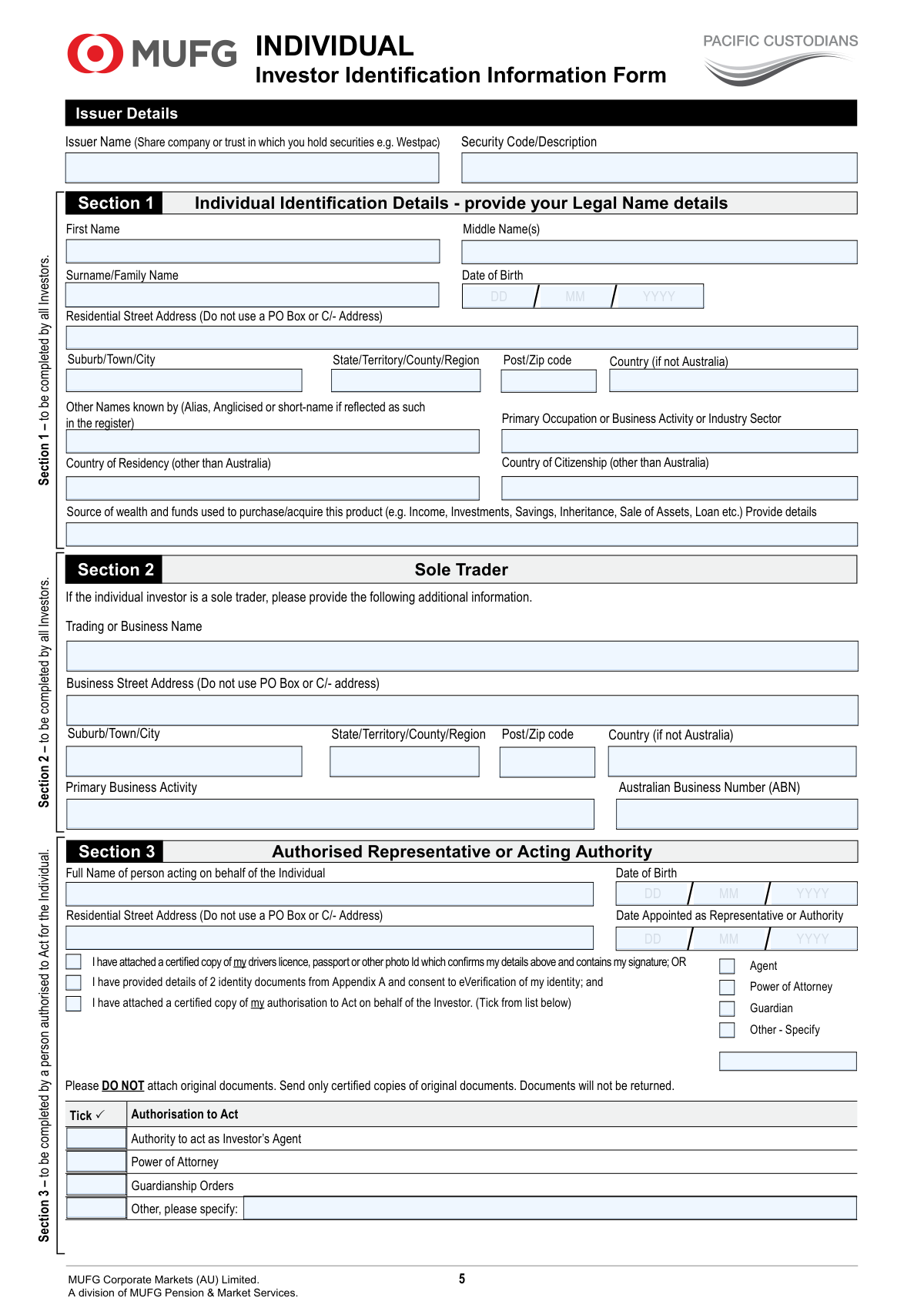
The AML/CTF Investor Identification Information Form is a mandatory document for investors in Australia, used by financial institutions to comply with the 'Know Your Customer' (KYC) requirements of the Anti-Money Laundering and Counter-Terrorism Financing Act. It serves to verify the identity of individuals, companies, and trusts to prevent illegal financial activities. Today, this form can be filled out quickly and accurately using AI-powered services like Instafill.ai, which can also convert non-fillable PDF versions into interactive fillable forms.
PCPL AML 0524 is part of the
identification forms, AML compliance forms, investor identification forms, financial compliance forms, KYC forms, anti-money laundering forms, investor forms and AML forms categories on Instafill.
Rather not fill this in by hand? Instafill is an online form filler that completes PDF forms automatically — upload the blank form, answer a few questions, and the AI fills every field.
Form specifications
| Form name: | AML/CTF Investor Identification Information Form |
| Number of pages: | 1 |
| Language: | English |
Our AI automatically handles information lookup, data retrieval, formatting, and form filling.
It takes less than a minute to fill out PCPL AML 0524 using our AI form filling.
Securely upload your data. Information is encrypted in transit and deleted immediately after the form is filled out.
Instafill Demo: How to fill out PDF forms in seconds with AI
How to Fill Out PCPL AML 0524 Online for Free in 2026
Are you looking to fill out a PCPL AML 0524 form online quickly and accurately? Instafill.ai offers the #1 AI-powered PDF filling software of 2026, allowing you to complete your PCPL AML 0524 form in just 37 seconds or less.
Follow these steps to fill out your PCPL AML 0524 form online using Instafill.ai:
- 1 Navigate to Instafill.ai and upload or select the AML/CTF Investor Identification Information Form.
- 2 Let the AI identify the correct sections for your investor type (e.g., Individual, Company, Trust) and confirm the selection.
- 3 Provide your personal, company, or trust details as prompted. The AI will guide you through required fields like name, address, and source of wealth.
- 4 Choose your identification method (eVerification or certified copies) and follow the prompts to enter document details or upload scans of certified documents.
- 5 If applicable, provide details for any authorized representatives, beneficial owners, or controlling persons, and upload the required supporting documents.
- 6 Review all the information automatically populated by the AI across the form for accuracy, make any necessary edits, and then apply your digital signature.
- 7 Download the completed, signed form and attach it to your transfer, transmission, or application documents for submission.
Our AI-powered system ensures each field is filled out correctly, reducing errors and saving you time.
Why Choose Instafill.ai for Your Fillable PCPL AML 0524 Form?
Speed
Complete your PCPL AML 0524 in as little as 37 seconds.
Up-to-Date
Always use the latest 2026 PCPL AML 0524 form version.
Cost-effective
No need to hire expensive lawyers.
Accuracy
Our AI performs 10 compliance checks to ensure your form is error-free.
Security
Your personal information is protected with bank-level encryption.
Frequently Asked Questions About PCPL AML 0524
This form is used to verify your identity in compliance with Australia's Anti-Money Laundering and Counter-Terrorism Financing (AML/CTF) Act. It is a mandatory 'Know Your Customer' (KYC) procedure for organisations providing financial services.
Any investor requesting a designated financial service must complete this form. This includes individuals, minors, companies, trusts (like super funds or family trusts), and representatives of deceased estates.
You need to complete the 'INDIVIDUAL Investor Identification Information Form'. If you are part of a joint holding, each individual must complete a separate form.
You can either consent to eVerification by providing document details in Appendix A, or submit certified copies of your ID. Options include one primary photographic ID (like a passport or driver's licence) or a combination of primary and secondary non-photographic documents.
A certified copy is a photocopy of an original document that has been signed and verified as a true copy by an authorized person. The form provides a long list of authorized certifiers, including legal practitioners, police officers, accountants, and Justices of the Peace.
You can have your documents certified by a person in your country who is authorized by law to administer oaths or authenticate documents. This typically includes a Notary Public or an equivalent role.
eVerification is an electronic method to confirm your identity using details from your government-issued documents. By completing Appendix A and providing consent, you allow MUFG to check your details against official records without needing certified paper copies.
You must complete the 'TRUST Investor Identification Information Form' for the trust itself. If the trust has a corporate trustee, you must also complete the 'COMPANY Investor Identification Information Form' for the trustee company.
You must mail the completed form(s) along with any required certified document copies to: MUFG Corporate Markets (AU) Limited, Registry Operations – AML/CTF Processing, Locked Bag A14, SYDNEY SOUTH NSW 1235, AUSTRALIA.
No, you cannot use correction fluid, tape, or pencil. You must complete the form by typing or handwriting in blue or black ink, and any corrections must be initialed.
You must complete the 'Authorised Representative or Acting Authority' section on the relevant form, provide your own identification, and attach a certified copy of the Power of Attorney document.
Yes, services like Instafill.ai use AI to accurately auto-fill form fields, which can save you time and help reduce errors when completing complex forms.
To fill this form online, upload the PDF to the Instafill.ai platform. The AI will make the document interactive, allowing you to type your information directly into the fields, sign electronically, and download the completed form.
If the PDF is not interactive, you can use a service like Instafill.ai to convert it into a fillable format. This allows you to easily complete and sign the document on your computer without needing to print it.
Compliance PCPL AML 0524
Validation Checks by Instafill.ai
1
Date of Birth is a Valid Past Date
This check verifies that any 'Date of Birth' field is populated with a valid calendar date in DD/MM/YYYY format and that the date is in the past. This is crucial for establishing the identity and legal age of an individual. A submission will be rejected if the date is invalid, in the future, or missing, as it prevents accurate age-related assessments, such as distinguishing a minor from an adult.
2
Minor Age Verification and Representative Requirement
For the 'Individual Minor' form, this validation confirms the investor's Date of Birth corresponds to an age under 18. It also ensures that Section 2, 'Authorised Representative or Acting Authority', is fully completed, as a minor cannot act on their own behalf. If the investor is not a minor or if the representative details are missing, the form is considered invalid for this investor type.
3
Deceased Date Logical Consistency
On the 'Deceased Individual' form, this check ensures the 'Date of Death' is a valid date that occurs on or after the individual's 'Date of Birth'. This logical validation prevents data entry errors for critical life event dates. A failure would indicate a data inconsistency that makes the record unreliable for legal and administrative processes concerning the estate.
4
Residential Address Excludes PO Box
This validation scans all 'Residential Street Address' fields to ensure they do not contain prohibited terms like 'PO Box' or 'C/-'. AML/CTF regulations require a physical residential address to properly identify and locate the individual, making non-physical addresses unacceptable. Forms containing a PO Box in this field will be flagged for correction to meet KYC requirements.
5
Exclusive Identification Method Selection
In the 'Identification Documents' sections (e.g., Section 4 on the Individual form), this check ensures that exactly one primary identification option (e.g., Option 1, 2, or 3) is selected. This is important for defining a clear and unambiguous path for identity verification. If zero or multiple options are chosen, the submission is ambiguous and must be rejected until a single, clear choice is made.
6
Conditional Document Attachment Check
Following the selection of an identification method (e.g., Option 2 or 3), this validation verifies that the required number of sub-selections for document types have been ticked. For example, if Option 3 is chosen, it checks for either two primary non-photographic documents or one primary and one secondary document. This ensures the applicant provides the correct combination of evidence to support their chosen verification method, and failure to do so results in an incomplete application.
7
eVerification Appendix A Trigger
If an investor selects 'Option 1 – eVerification' for identity verification, this rule validates that the corresponding 'Appendix A' section has been fully and correctly completed for that individual. Appendix A is essential for the electronic verification process to proceed. A submission with Option 1 selected but a missing or incomplete Appendix A will be halted pending completion of the required details.
8
Australian Business Number (ABN) Format and Checksum
For fields requiring an Australian Business Number (ABN), such as on the Sole Trader or Company forms, this check validates that the entry is an 11-digit number and passes the official weighting and checksum algorithm. This ensures the validity of the business identifier, which is crucial for correctly identifying Australian entities for regulatory and tax purposes. An invalid ABN would be rejected, preventing misidentification of a business.
9
Corporate Trustee Requires Company Form
On the 'Trust' form, if a trustee is identified with the 'Company' type checkbox, this validation flags that a separate 'Company' investor identification form must also be submitted for that corporate trustee. This is a critical cross-form dependency check to ensure full KYC is performed on all entities in a complex structure. The absence of the required Company form would render the Trust's application incomplete.
10
Unregulated Trust Controlling Person Requirement
When the 'Other unregulated trust' type is selected on the Trust form, this validation ensures that the details of all controlling persons (settlor, trustee, appointer) are provided in Section 4. Unregulated trusts pose a higher AML risk, making the identification of all controlling individuals mandatory. A form lacking these details would fail the due diligence check and be rejected.
11
Document Expiry Date Rules
This check validates the expiry dates of identification documents against the specific rules mentioned on the form. For instance, it verifies that a 'Drivers Licence' is not expired, while an 'Australian Passport' is either current or expired within the last 2 years. This ensures the provided identification is considered recent and valid enough for verification purposes, and documents failing these rules cannot be accepted.
12
Source of Wealth Field is Mandatory
This validation ensures that the 'Source of wealth and funds' text field is not empty on all investor forms. This information is a cornerstone of Anti-Money Laundering (AML) checks, helping to establish the legitimacy of the funds being invested. A blank or nonsensical entry would be a major compliance failure, leading to the rejection of the application until a plausible explanation is provided.
13
Beneficial Owner Details for Private Companies
For an investor identified as a 'Proprietary or Private Company', this check mandates the completion of Section 3, which captures the details of all ultimate beneficial owners holding 25% or more. Identifying the individuals behind a company is a fundamental KYC requirement to prevent the use of shell companies for illicit purposes. An application for a private company without this information would be incomplete and rejected.
Common Mistakes in Completing PCPL AML 0524
Applicants often submit documents certified by a person not on the approved list, such as a colleague or a foreign Justice of the Peace not authorized by law in their jurisdiction. This leads to immediate rejection of the documents, as the certification is invalid under Australian AML/CTF Rules. To avoid this, carefully review the list of authorized certifiers on the form and ensure the person certifying your documents meets the specified criteria, such as having '2 or more years of continuous service' where required.
When filling out the Company or Trust forms, applicants frequently list another company or trust as a shareholder or beneficiary instead of tracing ownership to the individual people who ultimately own or control 25% or more. This is a critical error as the purpose of the form is to identify the natural persons behind the entity. To prevent this, you must follow the chain of ownership through all legal entities until you identify the individual UBOs and provide their full details as requested in Section 3 of the Company form or Section 5 of the Trust form.
Despite explicit instructions to send only 'originally certified copies', some applicants mail their original passports, birth certificates, or trust deeds. This creates a significant risk of permanent loss, as the documents will not be returned. Always obtain a certified copy from an authorized person and send that copy, keeping your original documents safe. AI-powered tools like Instafill.ai can help manage digital copies and track submission requirements to prevent such errors.
The 'Source of wealth and funds' field is often filled with vague, one-word answers like 'Savings' or 'Investment'. Regulators require more specific information to understand the origin of the funds used for the investment. A proper response should provide more context, such as 'Savings from employment as an engineer' or 'Inheritance from deceased estate'. Failing to provide sufficient detail will result in follow-up questions and delay the processing of your application.
The instructions specify that certain investor types require multiple forms, which is often missed. For example, a trust with a corporate trustee must submit both the 'Trust' form for the trust itself and the 'Company' form for the corporate trustee. Submitting only one of the required forms results in an incomplete application and significant processing delays. Carefully read the 'Which type of investor are you?' section to ensure you complete and submit all necessary forms for your specific structure.
When opting for eVerification, applicants make minor data entry mistakes that cause the automated check to fail, such as entering a name that doesn't exactly match the document or mistyping a document number. The rules for birth certificates are particularly complex and state-specific, often requiring a registration year or district, which is easily missed. To avoid this, double-check that all details in Appendix A are entered exactly as they appear on your ID documents, paying close attention to the detailed notes. Using a tool like Instafill.ai can help by auto-filling and validating data formats to reduce typos.
When a person is acting on behalf of an investor (e.g., as a Power of Attorney or Guardian), they often complete the investor's details but forget to provide their own. The form requires the representative to complete Section 3 (or Section 2 on other versions), provide their own certified ID, and attach a certified copy of the document that grants them authority to act (e.g., the Power of Attorney document). Forgetting any of these three components will halt the application until all required information is received.
The form explicitly states 'Do not use a PO Box or C/- Address' for all residential and business street address fields. This is a standard KYC requirement to establish a physical location for the individual or entity. Applicants sometimes enter a PO Box out of habit, which invalidates the section and requires correction. Always provide a full physical street address to ensure compliance and avoid delays.
International investors often submit certified copies of identity documents, like a driver's license or birth certificate, that are in a language other than English without the required translation. The form clearly states that 'All foreign language documents must be accompanied by an English translation prepared by an accredited translator.' Submitting a document without this translation will result in it being rejected. Always ensure any non-English document is translated and submitted alongside the certified copy of the original.
Applicants sometimes provide a certified copy of a primary photographic ID, such as a driver's licence or foreign passport, that has expired. The form specifies that these documents must be current and 'Not expired' (with the exception of an Australian passport, which can be expired within the last 2 years). Submitting an expired ID will lead to rejection of the verification attempt. Always check the expiry date on your documents before submitting them.
Saved over 80 hours a year
“I was never sure if my IRS forms like W-9 were filled correctly. Now, I can complete the forms accurately without any external help.”
Kevin Martin Green
Your data stays secure with advanced protection from Instafill and our subprocessors




Robust compliance program
Transparent business model
You’re not the product. You always know where your data is and what it is processed for.
ISO 27001, HIPAA, and GDPR
Our subprocesses adhere to multiple compliance standards, including but not limited to ISO 27001, HIPAA, and GDPR.
Security & privacy by design
We consider security and privacy from the initial design phase of any new service or functionality. It’s not an afterthought, it’s built-in, including support for two-factor authentication (2FA) to further protect your account.
Fill out PCPL AML 0524 with Instafill.ai
Worried about filling PDFs wrong? Instafill securely fills amlctf-investor-identification-information-form forms, ensuring each field is accurate.
