Fill out investor identification forms
with AI.
Investor identification forms are essential regulatory tools used by financial institutions and investment firms to verify the identity of their clients. These documents serve as a cornerstone for "Know Your Customer" (KYC) protocols and are designed to prevent financial crimes such as money laundering and terrorism financing. By collecting specific data regarding an investor’s legal status, background, and source of funds, these forms ensure that all investment activities remain transparent and compliant with both national and international financial regulations.
By continuing, you acknowledge Instafill's Privacy Policy and agree to get occasional product update and promotional emails.
About investor identification forms
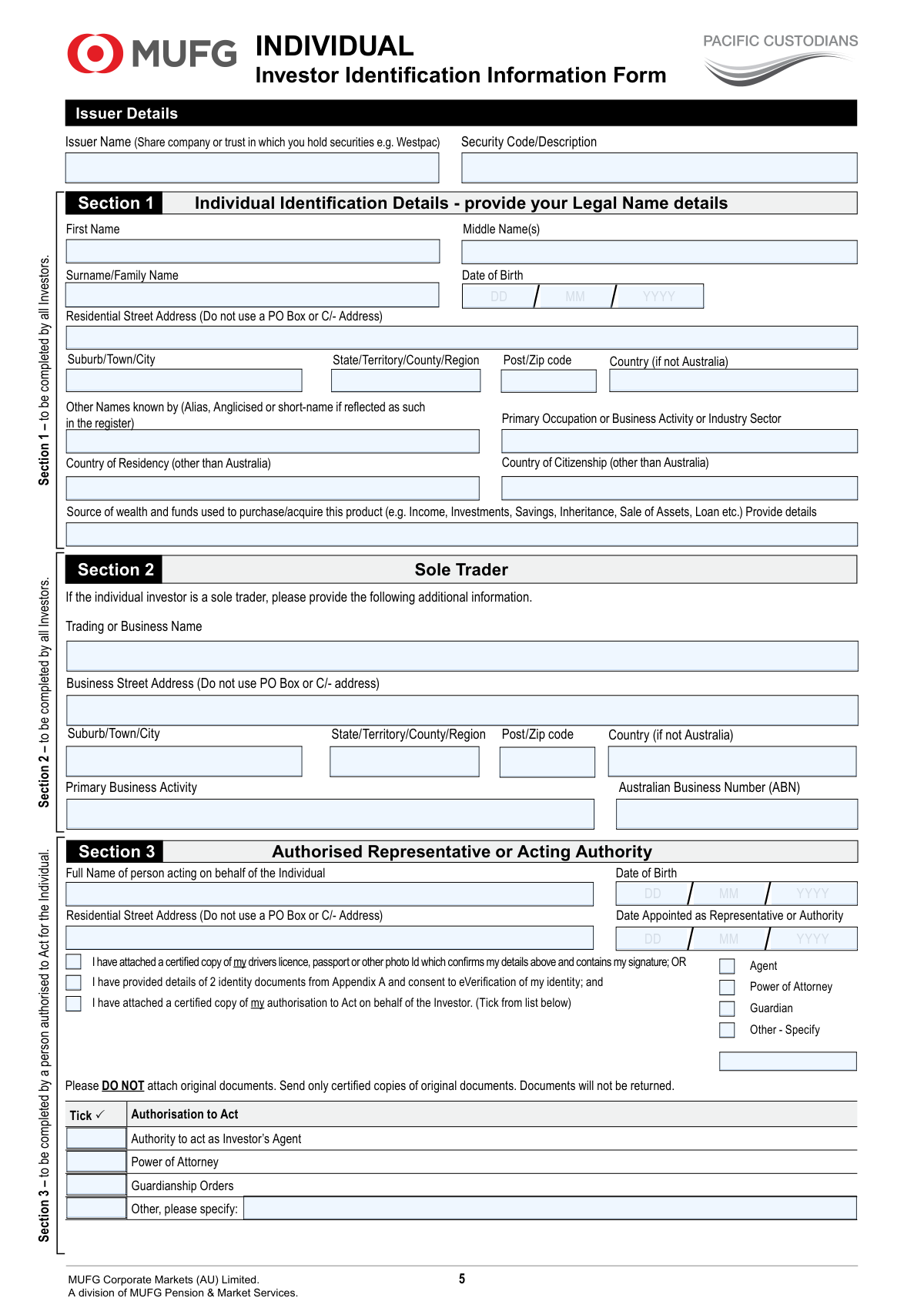
These forms are typically required for individuals, corporate entities, and trusts whenever they seek to open new investment accounts, purchase securities, or enter into managed fund agreements. For instance, the AML/CTF Investor Identification Information Form is a standard requirement in Australia for anyone entering the financial market. Completing these documents is a mandatory step in the onboarding process, usually occurring before any capital can be deployed or assets can be managed by a third party.
While the information requested is often detailed and sensitive, tools like Instafill.ai use AI to fill these forms in under 30 seconds while ensuring data is handled accurately and securely. This technology simplifies the administrative burden, allowing investors and compliance officers to move through the verification process more efficiently without compromising on precision.
Every form on this page can be completed without typing. Instafill is form filling software that reads a PDF and fills it for you — including flat and scanned documents that carry no fillable fields at all.
Forms in This Category
| Form Name | Pages | FCI | |
|---|---|---|---|
| 1. | AML/CTF Investor Identification Information Form | 1 | – |
- Enterprise-grade security & data encryption
- 99%+ accuracy powered by AI
- 1,000+ forms from all industries
- Complete forms in under 60 seconds
How to Choose the Right Form
Navigating the regulatory landscape for Australian investments requires strict adherence to 'Know Your Customer' (KYC) protocols. If you have landed on this page, you are likely looking to satisfy legal requirements under the Anti-Money Laundering and Counter-Terrorism Financing Act.
When to Use the AML/CTF Investor Identification Information Form
Currently, the primary document in this category is the AML/CTF Investor Identification Information Form. You should select and complete this form if you are an investor based in Australia or investing in Australian financial products through a local institution.
This form is mandatory for:
- Individual Investors: Verifying personal identity through government-issued documentation.
- Corporate Entities: Identifying beneficial owners and company registration details.
- Trusts and Trustees: Clarifying the structure of the trust and the identity of the beneficiaries.
Why This Specific Form is Necessary
The AML/CTF Investor Identification Information Form is the standard tool used by financial institutions to prevent illegal financial activities. Choosing this form ensures that you are providing the specific data points required by law to verify your identity and the source of your funds. Without a completed version of this document, most Australian financial services providers will be unable to process your investment application or manage your account.
Streamlining Your Compliance with Instafill.ai
Investor identification forms are often lengthy and require precise data entry. If you have a static or non-fillable PDF version of the AML/CTF Investor Identification Information Form, you can use Instafill.ai to quickly convert it into an interactive document. Our AI-powered tools help you fill out these complex fields accurately, ensuring your compliance paperwork is professional, legible, and submitted without delay.
Form Comparison
| Form | Primary Purpose | Target Entity | Regulatory Basis | Common Usage |
|---|---|---|---|---|
| AML/CTF Investor Identification Information Form | Verifies investor identity to prevent money laundering and terrorism financing. | Individual investors, companies, and trusts opening Australian financial accounts. | Complies with Australia's Anti-Money Laundering and Counter-Terrorism Financing Act. | Required when establishing new investment accounts or updating KYC details. |
Tips for investor identification forms
Ensure the name provided on the form matches your government-issued identification exactly, including any middle names. Even minor discrepancies between the form and your supporting ID documents can lead to processing delays or rejection by financial institutions.
Investor forms often differ based on whether you are investing as an individual, a company, or through a trust. Double-check that you are filling out the sections relevant to your specific legal structure to ensure compliance with mandatory KYC regulations.
Most identification forms require accompanying documents like passports, driver's licenses, or utility bills to verify your identity. Having these documents scanned and ready to upload will streamline the submission process and prevent last-minute hurdles.
AI-powered tools like Instafill.ai can complete these complex identification forms in under 30 seconds with high accuracy. Your sensitive data stays secure during the process, making it a reliable and practical time-saver for those dealing with multiple investor forms.
For corporate or trust-based investments, you must often disclose all individuals who own or control the entity. Providing complete details for all beneficial owners upfront prevents the need for repeated follow-up requests from compliance officers.
If you are submitting identification forms to several different institutions, ensure your address and contact details are identical across all of them. Inconsistent data can trigger red flags in automated anti-money laundering screening systems and slow down your approval.
Many investor forms are rejected simply because a signature or date was missed in a secondary section. Always perform a final scan to ensure every required field is populated, especially in sections involving legal declarations or consent.
Frequently Asked Questions
These forms are used by financial institutions to verify the identity of their clients, ensuring they comply with legal regulations like Anti-Money Laundering (AML) and Counter-Terrorism Financing (CTF) laws. They help prevent illegal activities such as money laundering and fraud by establishing a clear link between the investor and their source of funds.
Any individual, company, or trust looking to open an investment account or conduct significant financial transactions in jurisdictions like Australia must complete these forms. This includes retail investors, corporate entities, and trustees who are acting on behalf of a beneficiary.
You will generally need to provide full legal names, dates of birth, residential or business addresses, and tax residency information. For companies or trusts, the form may also require details about beneficial owners or directors to ensure full transparency of the entity's structure.
Most institutions require primary identification such as a passport or driver’s license, and sometimes secondary documents like utility bills or bank statements to verify your address. Requirements vary depending on whether you are applying as an individual, a company, or a trust.
The specific form you need depends on your legal status as an investor and the requirements of the financial institution. Most organizations provide a specific version for individuals, another for companies, and another for trusts or partnerships to ensure the correct regulatory data is captured.
Yes, AI tools like Instafill.ai can fill these forms in under 30 seconds by accurately extracting and placing data from your source documents. This technology helps ensure that complex fields are filled correctly without the need for manual data entry.
When using automated tools, the process is very fast and can often be completed in less than a minute. AI-powered services can even convert non-fillable PDFs into interactive forms, making the entire submission process much more efficient.
Financial institutions are legally barred from providing services to clients who have not met 'Know Your Customer' (KYC) requirements. Failure to submit the form or provide the necessary supporting documentation will likely result in your application being rejected or your account being restricted.
While the goal of identity verification is the same, the forms for corporate investors or trusts are usually more detailed than those for individuals. They require additional information regarding the legal structure of the entity and the identities of the individuals who ultimately control it.
Once completed, the form is typically submitted directly to the fund manager, bank, or financial advisor through whom you are making the investment. Many providers now accept digital submissions through secure portals or encrypted email to speed up the verification process.
Glossary
- KYC (Know Your Customer)
- A mandatory process used by financial institutions to verify the identity of their clients to prevent identity theft, fraud, and money laundering.
- AML/CTF
- Stands for Anti-Money Laundering and Counter-Terrorism Financing, referring to the legal framework that requires businesses to monitor and report suspicious financial activities.
- Beneficial Owner
- An individual who ultimately owns or controls an entity, typically defined as someone holding 25% or more of the shares or voting rights.
- AUSTRAC
- The Australian Transaction Reports and Analysis Centre, the government agency responsible for overseeing compliance with financial crime regulations.
- PEP (Politically Exposed Person)
- An individual who holds a high-profile public position, or their close associates, who are subject to enhanced scrutiny due to potential risks of corruption.
- Certified Document
- A copy of an original identification document, such as a passport or driver's license, that has been verified and signed by an authorized person like a Justice of the Peace.
- Ultimate Holding Company
- The top-level parent company in a corporate group structure that is not a subsidiary of any other company.
- Settlor
- The person or entity that establishes a trust by transferring assets to a trustee; their identity is often required when registering a trust for investment.