Fill out KYC forms
with AI.
KYC forms, or "Know Your Customer" documents, are essential tools used by financial institutions and global businesses to verify the identity of their clients. These forms play a critical role in international efforts to prevent financial crimes, such as money laundering and terrorism financing. By collecting detailed information on beneficial ownership, legal structures, and sources of funds, these documents ensure that companies comply with strict regulatory frameworks like the Anti-Money Laundering and Counter-Terrorism Financing Act.
By continuing, you acknowledge Instafill's Privacy Policy and agree to get occasional product update and promotional emails.
About KYC forms
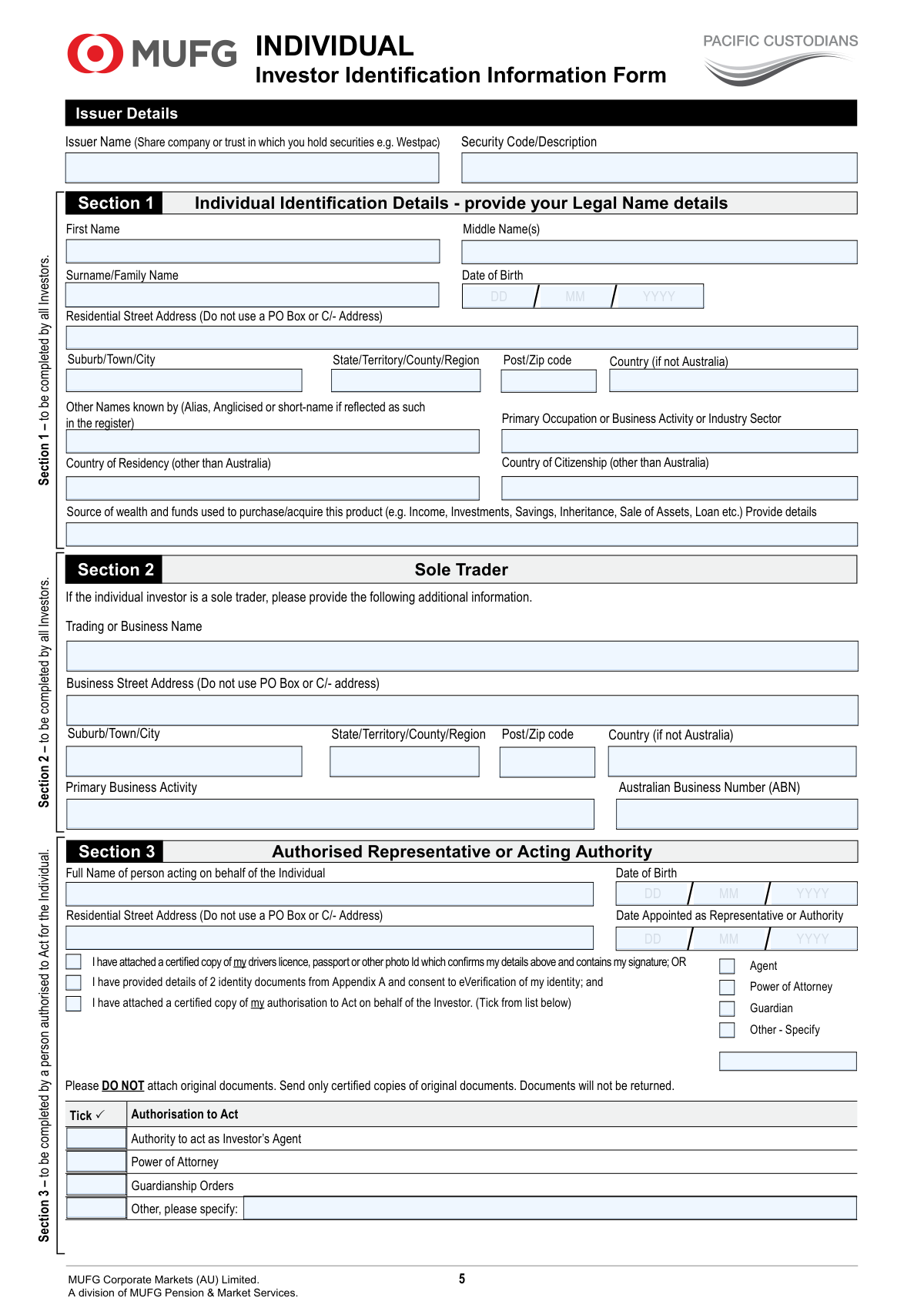
A wide range of entities require these forms, from individual investors and trusts to large corporations and non-financial institutions. You will typically encounter these documents when opening a new bank account, applying for institutional funding, or participating in investment funds. For instance, documents like the AML/CTF Investor Identification Information Form or the IsDB Group AML & KYC Questionnaire are common requirements during the onboarding process or during periodic compliance refreshes to ensure all records remain up to date and accurate.
Completing these detailed questionnaires can be a time-consuming administrative task, often involving complex questions about ownership and risk profiles. Tools like Instafill.ai use AI to fill these forms in under 30 seconds, handling sensitive data accurately and securely to streamline the compliance process. This allows businesses and individuals to focus on their core activities while ensuring their regulatory obligations are met without unnecessary delay.
Every form on this page can be completed without typing. Instafill is form filling software that reads a PDF and fills it for you — including flat and scanned documents that carry no fillable fields at all.
Forms in This Category
The forms in this category have a median Form Complexity Index of 62/100 (Moderate), measured across 10 forms by field count, input difficulty, length, conditional logic and structure. See how it is calculated.
| Form Name | Pages | FCI | |
|---|---|---|---|
| 1. | AML/CTF Investor Identification Information Form | 1 | – |
| 2. | Arbejdernes Landsbank – Virksomhedsoplysninger og KYC/AML (kundekendskab) for erhvervskunder | 9 | Complex 67 |
| 3. | Compliance & AML Due Diligence Form | 1 | Moderate 62 |
| 4. | IsDB Group AML & KYC Questionnaire (Financial Institutions) | 1 | Moderate 54 |
| 5. | IsDB Group AML & KYC Questionnaire (Non-Financial Institutions) | 1 | Moderate 50 |
| 6. | Know Your Client - Foreign Company | 1 | – |
| 7. | Legal Entity Beneficial Ownership/Trust Certification Form | 1 | Moderate 58 |
| 8. | Macquarie Asset Management AML/KYC Form | 1 | Moderate 61 |
| 9. | Vanguard Wholesale Funds – Know Your Customer (KYC) Refresh Form – Company | 1 | Complex 65 |
| 10. | Vanguard Wholesale Funds – Know Your Customer (KYC) Refresh Form – Trusts | 1 | Complex 65 |
- Enterprise-grade security & data encryption
- 99%+ accuracy powered by AI
- 1,000+ forms from all industries
- Complete forms in under 60 seconds
How to Choose the Right Form
For Investors and Asset Management
If you are an investor based in or dealing with Australian financial markets, your form choice depends on the specific institution and your current status. New investors typically require the AML/CTF Investor Identification Information Form or the Macquarie Asset Management AML/KYC Form to establish their identity. If you are an existing client updating your information, choose the Vanguard Wholesale Funds – Know Your Customer (KYC) Refresh Form – Company or the Trusts version, depending on how your assets are held.
For Institutional and Development Finance
Entities engaging with international development banks or government-backed funding bodies must provide high-level compliance data. Financial institutions partnering with the Islamic Development Bank should use the IsDB Group AML & KYC Questionnaire (Financial Institutions), while corporate entities should select the Non-Financial Institutions version. If you are establishing a contractual relationship with Cassa Depositi e Prestiti, you will specifically need the Compliance & AML Due Diligence Form - CDP to satisfy their anti-bribery and tax transparency requirements.
For Corporate Entities and Foreign Companies
Choosing the right form often depends on where your business is registered and which bank you are onboarding with.
- Foreign Entities: Use the Know Your Client - Foreign Company form to provide identity, ownership, and tax status (FATCA/CRS) data.
- Beneficial Ownership: If you need to certify the individuals who ultimately own or control a legal entity to prevent illicit financial activity, the Legal Entity Beneficial Ownership/Trust Certification Form is the standard document.
- Region-Specific Banking: Businesses operating in Denmark with Arbejdernes Landsbank should select the Virksomhedsoplysninger og KYC/AML form to provide mandatory transaction patterns and ownership data.
By selecting the form that matches both your entity type and the requesting institution, you can ensure a smoother compliance process and avoid delays in account opening or funding.
Tips for KYC forms
When filling out KYC forms, ensure that all names, addresses, and identification numbers match your government-issued ID or corporate registry exactly. Even small discrepancies, such as omitting a middle name or using an abbreviation for a business suffix, can trigger manual reviews and delay your account approval.
For corporate or trust forms, you must disclose every individual who owns or controls a significant percentage of the entity, typically 25% or more. Failing to provide complete details for these Ultimate Beneficial Owners (UBOs) is a frequent cause of form rejection during the due diligence process.
Gather digital copies of your passport, recent utility bills, and articles of incorporation before you begin. Having these files organized in a dedicated folder allows you to quickly cross-reference data and upload required evidence without interrupting your workflow.
AI-powered tools like Instafill.ai can complete these complex forms in under 30 seconds with high accuracy, significantly reducing the manual effort required for compliance. This technology ensures that your data is mapped correctly to the right fields while keeping your sensitive information secure throughout the entire process.
If you are submitting AML forms to different entities like Vanguard or Macquarie, ensure your reported financial activities and risk profiles are consistent. Discrepancies between different filings can flag your profile for additional compliance scrutiny or lead to requests for further clarification.
Be specific when describing your expected monthly transaction volumes and the countries you intend to transfer funds to. Providing vague descriptions instead of listing specific regions or estimated amounts can lead to follow-up questionnaires regarding your anti-money laundering risk profile.
Frequently Asked Questions
KYC (Know Your Customer) and AML (Anti-Money Laundering) forms are used by financial institutions to verify the identity of their clients and assess potential risks. These documents are essential for preventing financial crimes such as money laundering, terrorism financing, and fraud by ensuring that the source of funds is legitimate.
Requirement depends on the entity type and the transaction involved, but generally, individual investors, corporate officers, and trustees must complete these forms. Financial institutions, such as banks and investment firms, are legally obligated to collect this information before opening accounts or processing significant transactions.
You should select a form based on your legal structure—such as an individual, a company, or a trust—and the specific organization you are dealing with. For example, a foreign company would use a different form than a local trust, and institutions like Vanguard or Macquarie have their own specific versions of these documents.
Most forms require basic identification like legal names and addresses, but they also ask for more detailed data including beneficial ownership, tax residency status (FATCA/CRS), and the intended nature of the business relationship. You may also need to disclose if any associated individuals are 'Politically Exposed Persons' (PEPs).
Yes, AI tools like Instafill.ai can fill out these complex forms in under 30 seconds by accurately extracting data from your source documents and placing it in the correct fields. This technology helps ensure that long, technical forms are completed with high accuracy while reducing manual effort.
While manually completing detailed AML questionnaires can take 20 minutes or more, using an AI-powered service can finish the task in less than 30 seconds. These tools can also convert non-fillable PDF versions into interactive, fillable forms to streamline the submission process.
Forms for financial institutions often focus on the entity's internal compliance controls and regulatory oversight. In contrast, forms for non-financial institutions focus more on the legal structure, ownership, and the specific business activities that generate their funds.
Regulations require financial institutions to look through legal entities to identify the actual humans who own or control 25% or more of the business. This transparency prevents individuals from using shell companies to hide assets or conduct illegal financial activities.
A KYC Refresh is a periodic update required by law to ensure that a financial institution’s records remain current. Even if you have submitted forms in the past, you may be asked to complete a refresh form to confirm that your ownership structure, address, or business activities haven't changed.
Completed and signed forms should be submitted directly to the compliance department or account manager of the institution requesting them. Most organizations provide a secure portal, email address, or physical mailing address for these documents, as they contain sensitive personal and financial data.
Incomplete forms will likely lead to delays in account onboarding, the rejection of investment applications, or the temporary freezing of existing accounts. Financial institutions are legally barred from maintaining relationships with entities that do not meet their due diligence requirements.
Glossary
- Form Complexity Index
- Instafill’s 0–100 measure of how much effort a form takes to complete, calculated deterministically from the form’s own structure rather than estimated. It combines the number of fillable fields (the largest factor), how difficult those fields are to complete based on their type, the number of pages that contain fields, the amount of conditional “fill-only-if” logic, and how many sections the form is divided into, then adds modifiers for tables and repeating lists, bundled instruction pages, and dense page layouts. A higher score means the form is harder to fill out by hand. The forms in this category have a median Form Complexity Index of 62/100 (Moderate). See exactly how it is calculated.
- KYC (Know Your Customer)
- The mandatory process used by financial institutions to verify the identity, suitability, and risks involved with maintaining a business relationship with a client.
- AML (Anti-Money Laundering)
- A set of laws, regulations, and procedures intended to prevent criminals from disguising illegally obtained funds as legitimate income.
- Beneficial Owner
- An individual who ultimately owns or controls a legal entity, such as a company or trust, typically through a specific percentage of ownership or voting rights.
- PEP (Politically Exposed Person)
- An individual who holds a prominent public position, or their close associates, who may be at higher risk for potential involvement in bribery or corruption.
- CTF (Counter-Terrorism Financing)
- Specific measures and regulations designed to prevent the movement of funds intended to support terrorist activities or organizations.
- Customer Due Diligence (CDD)
- The process of collecting and evaluating information about a customer to assess the risk of money laundering or other financial crimes before a transaction occurs.
- FATCA (Foreign Account Tax Compliance Act)
- A United States federal law requiring foreign financial institutions to report the assets and identities of U.S. persons to the IRS to prevent tax evasion.
- CRS (Common Reporting Standard)
- An information-gathering and reporting standard for the automatic exchange of financial account information between participating countries to combat global tax evasion.
- KYC Refresh
- A periodic update of a client's information and documentation to ensure that a financial institution's records remain accurate and up to date.