Fill out investor forms
with AI.
Investor forms are the essential paperwork used to establish and manage financial relationships between individuals or entities and investment institutions. This category covers a wide range of documents, from initial account applications and subscription agreements to mandatory regulatory filings. These forms are critical because they ensure compliance with international financial laws, such as Anti-Money Laundering (AML) and "Know Your Customer" (KYC) requirements. By accurately completing these documents, investors can verify their identity, disclose their tax residency under standards like FATCA or CRS, and legally commit capital to various funds.
By continuing, you acknowledge Instafill's Privacy Policy and agree to get occasional product update and promotional emails.
About investor forms
Typically, these forms are needed by individual retail investors, corporate entities, and trusts when opening new brokerage accounts or joining private placement opportunities like hedge funds or Delaware Statutory Trusts (DSTs). Financial advisors also frequently use these documents on behalf of their clients to facilitate fund transfers, authorize representatives, or update account information. Whether you are filing a Petition to Remove Conditions on Permanent Resident Status (Form I-829) as an immigrant investor or simply setting up a new IRA, these forms serve as the legal foundation for your financial portfolio.
The complexity of these documents—often requiring detailed financial history and legal certifications—can make the manual filling process time-consuming and prone to errors. Tools like Instafill.ai use AI to fill these forms in under 30 seconds, ensuring that data is handled accurately and securely. This allows investors and professionals to focus on their strategy rather than the administrative burden of paperwork.
Every form on this page can be completed without typing. Instafill is form filling software that reads a PDF and fills it for you — including flat and scanned documents that carry no fillable fields at all.
Forms in This Category
The forms in this category have a median Form Complexity Index of 62/100 (Moderate), measured across 42 forms by field count, input difficulty, length, conditional logic and structure. See how it is calculated.
- Enterprise-grade security & data encryption
- 99%+ accuracy powered by AI
- 1,000+ forms from all industries
- Complete forms in under 60 seconds
How to Choose the Right Form
Hedge Fund and Private Placement Applications
Choosing the right application depends on your status as an investor and the specific fund type. For hedge funds, you must distinguish between retail and qualified status. If you are a high-net-worth individual meeting specific financial thresholds, use forms like the Fundrock Qualified Investor Hedge Fund Application Form or the Application Form: Individual Investor | Qualified Investor Hedge Fund. For standard investments, look for the Application Form: Individual Investor | Retail Hedge Fund.
If you are investing in a Delaware Statutory Trust (DST) for real estate or infrastructure, you will likely need a subscription packet that includes an accredited investor certification, such as the Aviation Infrastructure, DST — Investor Questionnaire or the FSC Industrial 6, DST Investor Questionnaire.
Broker-Specific Account Management
If you are managing accounts with a specific financial institution, look for forms tailored to their internal processes:
- Vanguard: Use the Vanguard Account Opening Form for new accounts, or the Vanguard Personal Investor Withdrawal form and Vanguard Personal Investor – Transfer form for managing existing assets.
- Merrill: Choose the Merrill Business Investor Account (BIA) for entity-based accounts or the AwardChoice Limited Individual Investor Account Form for managing corporate equity compensation.
- Pershing: Use the Pershing NetXInvestor Online Account Set-Up Form to gain digital access to your brokerage data.
Compliance, Tax, and Immigration
Many forms in this category are mandatory for regulatory compliance rather than the investment itself:
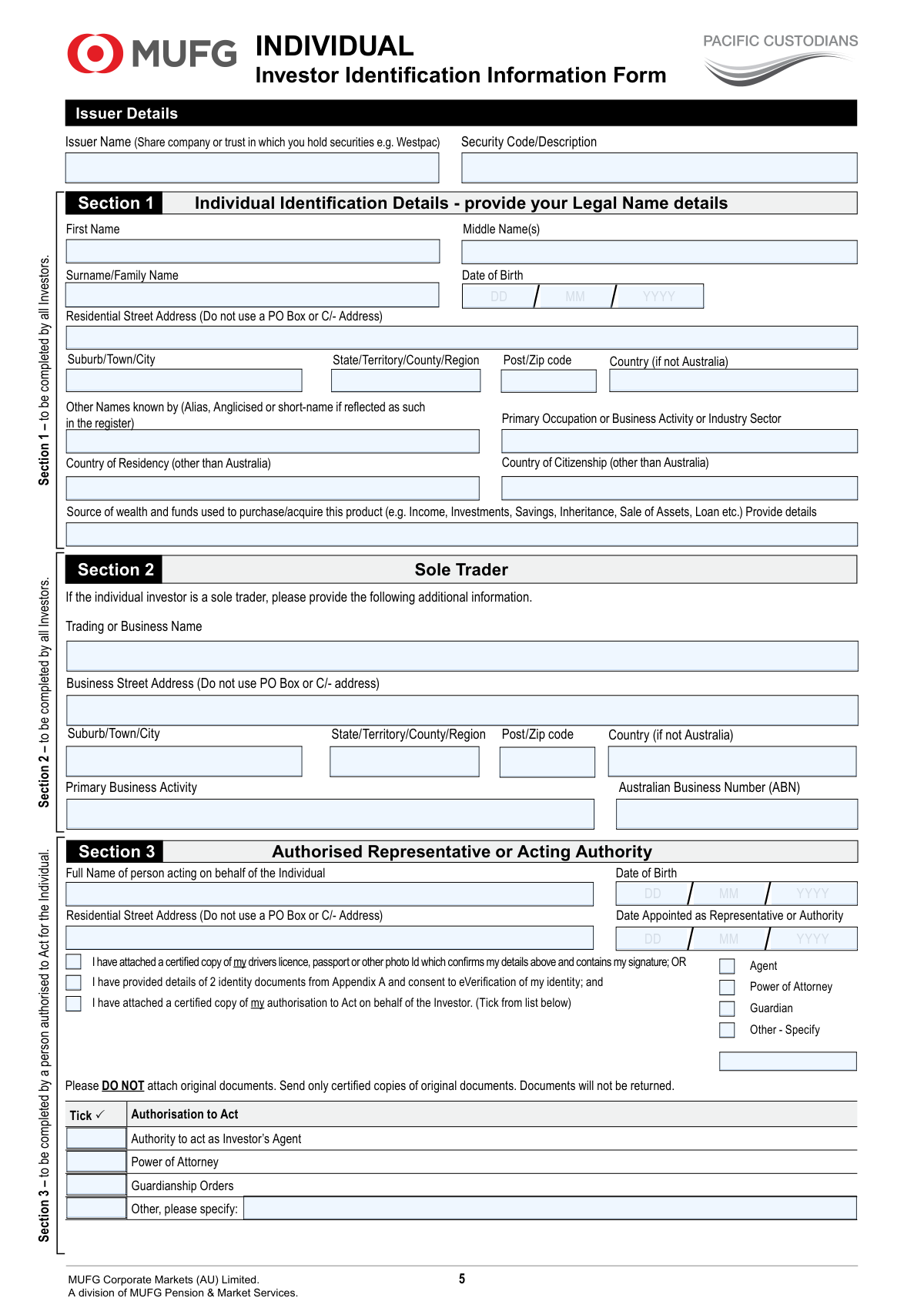
- Identity Verification: To satisfy "Know Your Customer" laws, use the AML/CTF Investor Identification Information Form or the AMP Know Your Client form.
- Tax Reporting: If you are a member of a pass-through entity in Ohio, you will need the Ohio Form IT K-1 to report your share of income.
- Immigration (EB-5): Investors seeking U.S. residency should use Forms I-526/I-526E to start the process or Form I-829 to remove conditions on their permanent resident status.
Tips for investor forms
When filling out forms for trusts, corporations, or LLCs, use the exact legal name registered with the government. Any discrepancy between the form and your supporting articles of incorporation or trust deeds can cause significant delays in the compliance review process.
Most investor forms require your Tax Identification Number (TIN), Social Security Number, or Employer Identification Number for FATCA and CRS compliance. Having these ready, along with your global tax residency details, prevents interruptions while completing complex multi-page applications.
AI-powered tools like Instafill.ai can complete these detailed investor forms in under 30 seconds with high accuracy. Your data stays secure during the process, providing a practical and reliable way to manage paperwork across multiple different investment categories.
Incorrect routing or account numbers for ACH and wire transfers are common errors that lead to failed distributions or lost funds. Always verify your bank's specific instructions for incoming wires, as these numbers may differ from the information found on your standard paper checks.
For forms like the Institutional Investors Organization Resolution, ensure that the individuals signing have the documented legal authority to bind the organization. Banks typically require a separate board resolution or a certified list of authorized signers to accompany the primary application.
Investor forms almost always require supplemental 'Know Your Customer' (KYC) documents, such as government IDs or proof of address. Keep high-quality digital copies of these organized in a secure folder so you can quickly attach them to your completed PDF forms.
Many private placement and hedge fund forms require you to certify as an 'accredited investor' based on specific income or net worth thresholds. Carefully review the qualification criteria listed in the questionnaire to ensure you select the correct category before signing the subscription agreement.
Frequently Asked Questions
Investor forms are legal and administrative documents used to open accounts, subscribe to funds, and ensure regulatory compliance. They help financial institutions verify your identity, understand your financial goals, and report tax information to the relevant authorities.
You should use an individual investor form if you are investing personal funds in your own name or as a joint account holder. If you are investing on behalf of a company, trust, or partnership, you must use the legal entity version of the application to provide corporate registration and beneficial ownership details.
Anti-Money Laundering (AML) and Know Your Customer (KYC) regulations require financial institutions to verify the identity of their investors to prevent financial crimes. These sections typically ask for government-issued IDs, proof of address, and information regarding the source of your investment funds.
Yes, you can use AI tools like Instafill.ai to complete complex investor applications and subscription agreements in under 30 seconds. The AI accurately extracts data from your source documents and places it into the correct fields, significantly reducing the risk of manual entry errors.
These questionnaires are used to verify that an investor meets specific income or net worth thresholds required by law to participate in private placements or hedge funds. Completing this form is a mandatory step for investments that are not registered with securities regulators like the SEC.
Yes, international investors often need to complete forms like the W-8BEN to certify their foreign status and claim potential tax treaty benefits. Additionally, those seeking residency through investment will use specialized forms like the I-526 for the EB-5 Immigrant Investor Program.
While manual completion of multi-page investor packets can take 30 minutes or more, using an AI-powered service like Instafill.ai allows you to finish the process in less than 30 seconds. The tool automates the repetitive parts of the form, ensuring all mandatory fields are addressed quickly and accurately.
You will typically need to complete a 'Transfer Initiation' or 'Transfer Out' form provided by your brokerage or fund manager. These forms authorize the movement of assets and ensure that the receiving party has the necessary information to accept the transfer.
Most modern investor applications include sections for the Foreign Account Tax Compliance Act (FATCA) and the Common Reporting Standard (CRS). These are international standards for the automatic exchange of financial account information to help prevent tax evasion across borders.
Submission instructions vary by the type of form and the organization issuing it. Most retail investor forms are submitted directly to the fund manager or brokerage via their online portal, while government forms must be filed with specific agencies like the IRS or USCIS.
A Subscription Agreement is a formal contract between an investor and a company or fund for the purchase of shares or interests. It is commonly required for private equity, venture capital, and real estate investments like Delaware Statutory Trusts (DSTs) to outline the terms and risks of the investment.
Glossary
- Form Complexity Index
- Instafill’s 0–100 measure of how much effort a form takes to complete, calculated deterministically from the form’s own structure rather than estimated. It combines the number of fillable fields (the largest factor), how difficult those fields are to complete based on their type, the number of pages that contain fields, the amount of conditional “fill-only-if” logic, and how many sections the form is divided into, then adds modifiers for tables and repeating lists, bundled instruction pages, and dense page layouts. A higher score means the form is harder to fill out by hand. The forms in this category have a median Form Complexity Index of 62/100 (Moderate). See exactly how it is calculated.
- KYC (Know Your Customer)
- A standard verification process used by financial institutions to confirm the identity, suitability, and risks involved with a potential investor.
- AML/CTF
- An abbreviation for Anti-Money Laundering and Counter-Terrorism Financing, referring to laws that require investors to prove their identity to prevent illegal financial activities.
- FATCA / CRS
- International tax compliance standards (Foreign Account Tax Compliance Act and Common Reporting Standard) that require investors to declare their tax residency to prevent tax evasion across borders.
- Accredited Investor
- A legal designation for an individual or entity with sufficient net worth or income to be permitted to invest in high-risk or private securities not available to the general public.
- Subscription Agreement
- A formal contract between an investor and a company or fund where the investor agrees to purchase a specific number of shares or units at a set price.
- EB-5 Program
- A U.S. government program that allows foreign nationals to obtain a green card by investing a minimum amount of capital in a U.S. business that creates at least 10 full-time jobs.
- Schedule K-1
- A tax document issued by partnerships, S corporations, or trusts to report an individual investor's share of the entity's income, deductions, and credits.
- DST (Delaware Statutory Trust)
- A legal entity that allows multiple investors to hold fractional ownership in a single property or portfolio, often used for tax-deferred real estate exchanges.
- FICA
- The Financial Intelligence Centre Act, a South African law that requires financial institutions to verify client information to combat money laundering and financial crimes.