Yes! You can use AI to fill out AMP Know Your Client Individual, Joint Investors and Sole Trader
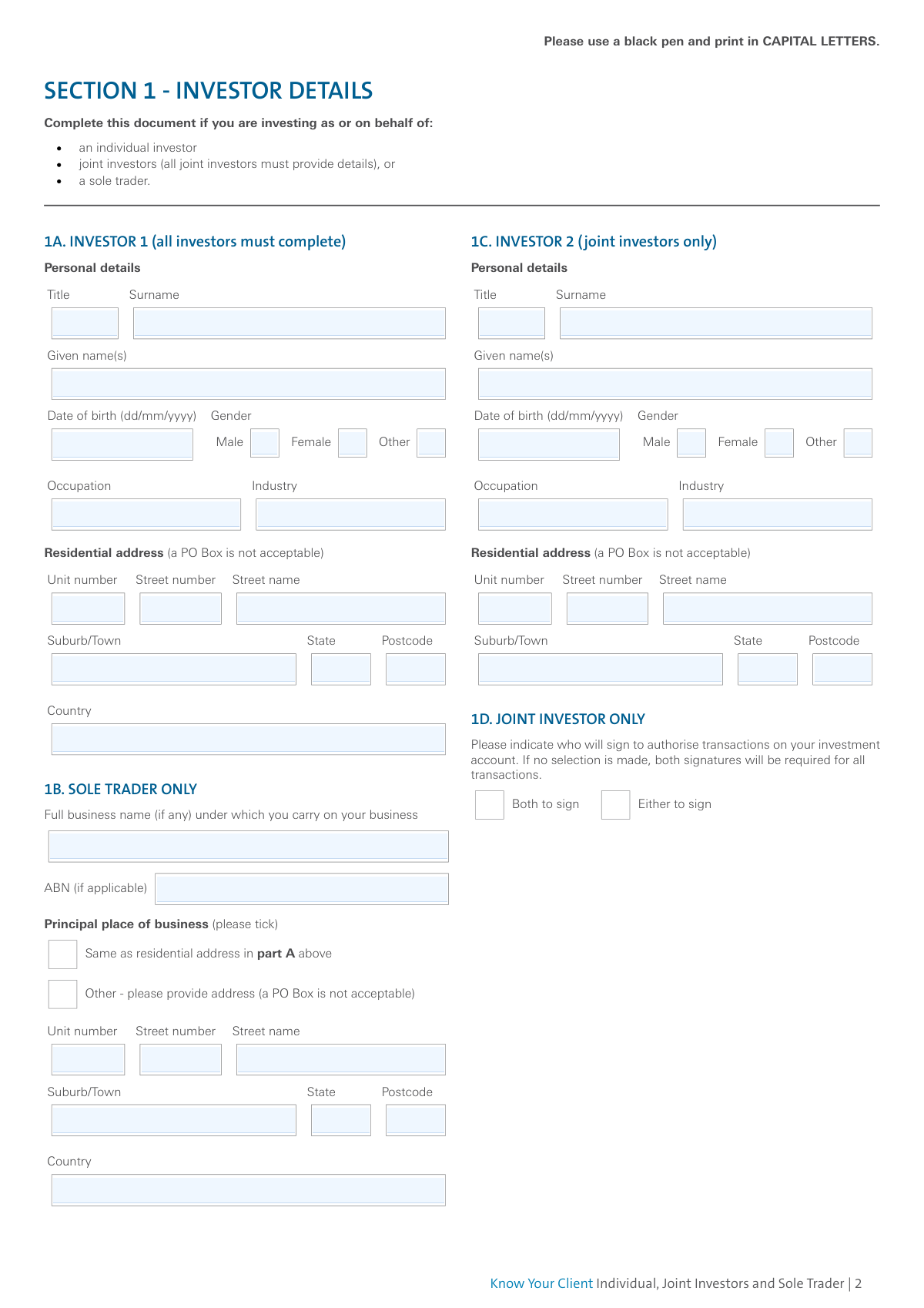
This form is used by AMP to gather essential information to verify an investor's identity and comply with legal requirements, including the Anti-Money Laundering and Counter-Terrorism Financing Act 2006 (AML/CTF), the Foreign Account Tax Compliance Act (FATCA), and the Common Reporting Standard (CRS). It requires personal details, tax residency information, and supporting identification documents to prevent illegal financial activities. Today, this form can be filled out quickly and accurately using AI-powered services like Instafill.ai, which can also convert non-fillable PDF versions into interactive fillable forms.
Our AI automatically handles information lookup, data retrieval, formatting, and form filling.
It takes less than a minute to fill out AMP KYC - Individual using our AI form filling.
Securely upload your data. Information is encrypted in transit and deleted immediately after the form is filled out.
Form specifications
| Form name: | AMP Know Your Client Individual, Joint Investors and Sole Trader |
| Number of pages: | 1 |
| Language: | English |
| Categories: | investment forms, financial services forms |
Instafill Demo: How to fill out PDF forms in seconds with AI
How to Fill Out AMP KYC - Individual Online for Free in 2026
Are you looking to fill out a AMP KYC - INDIVIDUAL form online quickly and accurately? Instafill.ai offers the #1 AI-powered PDF filling software of 2026, allowing you to complete your AMP KYC - INDIVIDUAL form in just 37 seconds or less.
Follow these steps to fill out your AMP KYC - INDIVIDUAL form online using Instafill.ai:
- 1 Navigate to Instafill.ai and upload or select the AMP Know Your Client form.
- 2 Use the AI assistant to automatically populate your personal details in Section 1, including name, date of birth, and residential address for all investors.
- 3 If you are a sole trader, provide your full business name, ABN, and principal place of business.
- 4 Complete Section 2 by answering the tax residency questions and providing your Tax Identification Number (TIN) for each relevant country.
- 5 Carefully read the declarations in Section 3 regarding AML/CTF, FATCA, and CRS obligations.
- 6 Electronically sign and date the form in the designated signature fields for all required signatories.
- 7 Review all the information for accuracy, then download the completed form to attach certified copies of your identification documents before submission.
Our AI-powered system ensures each field is filled out correctly, reducing errors and saving you time.
Why Choose Instafill.ai for Your Fillable AMP KYC - Individual Form?
Speed
Complete your AMP KYC - Individual in as little as 37 seconds.
Up-to-Date
Always use the latest 2026 AMP KYC - Individual form version.
Cost-effective
No need to hire expensive lawyers.
Accuracy
Our AI performs 10 compliance checks to ensure your form is error-free.
Security
Your personal information is protected with bank-level encryption.
Frequently Asked Questions About Form AMP KYC - Individual
This form is used by AMP to verify your identity and collect information to meet legal obligations under Anti-Money Laundering, Counter-Terrorism Financing, and international tax laws like FATCA and CRS.
This form must be completed by individual investors, joint investors, and sole traders. It also needs to be completed by agents or attorneys acting on behalf of an investor.
You need to provide either one primary photo ID (like a passport or driver's license) or a combination of two other documents, such as a birth certificate and a recent utility bill showing your address.
No, do not send original documents. You must provide original certified copies of your identification documents.
A certified copy must be signed by an authorized person, such as a Justice of the Peace, police officer, legal practitioner, pharmacist, or a member of certain accounting bodies. A full list is available on the AMP Capital website.
If a document is not in English, you must attach an English translation prepared by a translator accredited by the National Accreditation Authority for Translators and Interpreters (NAATI).
As a sole trader, you must complete Section 1A with your personal details and Section 1B with your business name, ABN, and principal place of business.
This information is required to comply with the US Foreign Account Tax Compliance Act (FATCA) and the Common Reporting Standard (CRS), which are global standards for automatic exchange of financial account information.
A TIN is a Tax Identification Number issued by a country for tax purposes. If you are a tax resident of another country but cannot provide a TIN, you must select one of the reasons (A, B, or C) listed in Section 2.
In Section 1D, you can choose whether 'Either to sign' or 'Both to sign' is required for transactions. If you make no selection, both signatures will be required by default.
The form provides contact details for Client Services, including a fax number and email address. You should contact them directly to confirm the preferred submission method.
Yes, services like Instafill.ai use AI to accurately auto-fill form fields with your information, which can save you time and reduce errors.
You can use a service like Instafill.ai to upload the PDF. The platform allows you to fill out the form digitally from any device before printing it for signature and submission.
If you have a non-fillable PDF, you can use a tool like Instafill.ai. It can convert flat PDFs into interactive, fillable forms that are easy to complete online.
Compliance AMP KYC - Individual
Validation Checks by Instafill.ai
1
Date of Birth Validity and Age Check
This check ensures the Date of Birth for each investor is a valid date entered in DD/MM/YYYY format. It verifies the date is in the past and that the investor is of a minimum legal age, typically 18 years, to enter into a financial agreement. A failure would prevent the form from being processed, as age is a critical component of identity verification and legal capacity.
2
Prohibits PO Box for Residential Address
Validates that the residential address fields for all investors do not contain 'PO Box' or similar post office box indicators. Anti-Money Laundering (AML) regulations require a physical residential address for identity verification and risk assessment. If a PO Box is detected, the submission must be rejected and the user prompted to provide a valid physical street address.
3
Conditional Requirement for Foreign Tax Details
This check enforces a conditional logic rule in the tax information section. If an investor answers 'Yes' to being a tax resident of another country, the system must verify that at least one foreign country, along with its Tax Identification Number (TIN) or a reason for not providing it, is supplied. This is crucial for compliance with FATCA and CRS reporting obligations.
4
Exclusive Selection of TIN or Reason for No TIN
For each foreign tax residency declared, this validation ensures that either a TIN is provided or a reason (A, B, or C) is selected, but not both. It also confirms that one of these two options is mandatorily provided for each listed country. This prevents ambiguous or incomplete tax data, which could lead to compliance reporting errors and penalties.
5
Joint Investor Data Completeness
If details for a second investor are entered in Section 1C, this validation confirms that the corresponding tax information in Section 2 and the signature block for Signatory 2 are also completed. This ensures that all required KYC, tax, and declaration information is captured for all parties to a joint investment. An incomplete submission for any joint investor would render the entire application invalid.
6
Signature Name Matches Investor Name
This validation cross-references the name entered in the signature block (e.g., Signatory 1) with the investor name in the corresponding details section (e.g., Investor 1). This ensures the person signing the declaration is the same individual whose details are being provided. A mismatch could indicate a potential error or fraudulent activity and must be flagged for review.
7
Sole Trader Section Requirement
Checks if the 'Signing as' capacity for Signatory 1 is marked as 'Sole trader'. If it is, the validation ensures that the 'Sole Trader Only' section (1B), including the full business name and ABN (if applicable), is fully completed. This is necessary to correctly identify the legal entity of the investor for regulatory and reporting purposes.
8
Australian Business Number (ABN) Format
When an ABN is provided in the Sole Trader section, this check verifies that it conforms to the correct 11-digit format and passes the official checksum algorithm. This helps prevent data entry errors and ensures the ABN is a syntactically valid number before it is used for any verification or reporting. An invalid ABN would be rejected, requiring the user to correct it.
9
Sole Trader Principal Place of Business Logic
In the Sole Trader section (1B), if the 'Other' option is selected for the principal place of business, this validation makes the subsequent address fields mandatory. It also ensures this address is not a PO Box. This rule ensures a complete and valid business address is captured when it differs from the investor's residential address.
10
Mandatory Gender Selection
Verifies that for each investor, one and only one option from 'Male', 'Female', or 'Other' has been selected. This field is a required part of an individual's personal details for KYC records. A missing or multiple selection would result in an incomplete record, and the form submission would be halted pending correction.
11
Signature Date Logical Check
Ensures the signature date is a valid date in DD/MM/YYYY format, is not a future date, and is on or after the investor's 18th birthday. This confirms the declaration was signed after the investor reached legal age and on a plausible date. An illogical date would invalidate the legal declaration and require correction.
12
Joint Investor Signature Authority Selection
This check verifies that for a joint investment, a selection has been made in Section 1D to specify whether 'Both to sign' or 'Either to sign' is required for future transactions. Although the form has a default, flagging a missing selection ensures the investors' intent is explicitly captured, preventing future transaction disputes or processing errors. The system should prompt for a selection if none is made.
13
Completeness of Investor 1 Personal Details
This validation ensures all fields within Section 1A for the primary investor are filled out, including Surname, Given name(s), Date of birth, Industry, Occupation, and the full residential address. These details are the absolute minimum required for KYC identity verification. Any missing field will cause the validation to fail and block the submission.
14
Mandatory Tax Residency Declaration
For each investor, this check confirms that both tax residency questions ('tax resident of Australia?' and 'tax resident of another country?') have been answered with a 'Yes' or 'No'. These declarations are non-optional and fundamental to determining the necessary FATCA/CRS reporting requirements. Leaving either question blank would result in an incomplete and non-compliant form.
Common Mistakes in Completing AMP KYC - Individual
Applicants often send original ID documents instead of certified copies, or the copies are certified by an unauthorized person. This happens due to not reading the instructions carefully and can lead to the loss of original documents or immediate application rejection. To avoid this, always send an original certified copy, ensuring the certifier is on the approved list (e.g., Justice of the Peace, police officer) and includes their full name, title, and date as shown in the form's example.
An applicant might enter a nickname, omit a middle name, or use initials in Section 1, causing a mismatch with the full legal name on their passport or driver's license. This discrepancy is a primary reason for AML/KYC verification failure, leading to processing delays and rejection. Always enter your full legal name, including all given names, exactly as it appears on the identification documents you are providing.
The form explicitly states that a PO Box is not acceptable for a residential or principal business address, yet people frequently enter one out of habit. This is a strict anti-money laundering requirement to establish a physical location for the investor. Using a PO Box will result in the form being returned for correction, delaying your investment, so you must provide a full physical street address.
When two people apply jointly, the second investor often forgets to complete their personal details in Section 1C or their tax information in Section 2. Furthermore, applicants often overlook Section 1D to specify signing authority, which then defaults to 'Both to sign'. This can be inconvenient for future transactions and requires all investors to complete their respective sections and consciously choose their signing authority.
Applicants, particularly dual citizens or expatriates (e.g., a US citizen living in Australia), often mistakenly believe their tax residency is only where they currently live and answer 'No' to being a tax resident of another country. This is a serious compliance error under FATCA/CRS rules that can lead to account restrictions. You must declare all countries where you are a tax resident, which can be based on citizenship, time spent in a country, or other specific tax laws.
If an applicant declares they are a tax resident of another country, they must provide their Tax Identification Number (TIN) for that country. Many people leave this field blank because they don't know their TIN or forget to look it up. This incomplete information will halt the application until the TIN or a valid reason for its absence (A, B, or C) is provided.
In the final step, applicants may forget to sign, enter the date, or tick the box indicating their signing capacity (e.g., 'Individual', 'Joint investor'). For joint accounts, both investors must sign. A missing signature or date invalidates the entire declaration and the form will be rejected. Always double-check that all required signatories have signed, dated, and checked the appropriate box in Section 3.
The form provides two options (A or B) for identity verification with specific document requirements, such as a current driver's license or a combination of a birth certificate and a recent utility bill. Applicants sometimes provide expired documents (where not permitted) or fail to provide the second required document under Option B. This results in a failed verification, so you must carefully review the list and ensure you provide valid and complete documentation for either Option A or Option B.
The form specifies a DD/MM/YYYY format for dates, but applicants from regions like the US often default to an MM/DD/YYYY format. This simple data entry error can cause verification failures when the system checks the date against ID documents, leading to unnecessary delays. To prevent this, carefully follow the specified format. AI-powered form filling tools like Instafill.ai can automatically validate and format dates correctly, preventing such errors.
The form clearly states that any identification document not in English must be accompanied by an English translation prepared by an accredited translator. Applicants may overlook this requirement or provide a self-made, unaccredited translation, which will cause the identity verification to fail. If your documents are not in English, you must engage a professional, accredited translator and submit the translation along with the certified copy of the original document.
Saved over 80 hours a year
“I was never sure if my IRS forms like W-9 were filled correctly. Now, I can complete the forms accurately without any external help.”
Kevin Martin Green
Your data stays secure with advanced protection from Instafill and our subprocessors

Robust compliance program
Transparent business model
You’re not the product. You always know where your data is and what it is processed for.
ISO 27001, HIPAA, and GDPR
Our subprocesses adhere to multiple compliance standards, including but not limited to ISO 27001, HIPAA, and GDPR.
Security & privacy by design
We consider security and privacy from the initial design phase of any new service or functionality. It’s not an afterthought, it’s built-in, including support for two-factor authentication (2FA) to further protect your account.
Fill out AMP KYC - Individual with Instafill.ai
Worried about filling PDFs wrong? Instafill securely fills amp-know-your-client-individual-joint-investors-and-sole-trader forms, ensuring each field is accurate.