Fill out investor onboarding forms
with AI.
Investor onboarding forms are the critical first step in establishing a professional relationship between an individual and a financial institution or investment platform. These documents are designed to capture essential data required for regulatory compliance, such as Know Your Client (KYC) and Anti-Money Laundering (AML) standards. By collecting detailed information on tax residency and identity, these forms ensure that both the investor and the institution remain compliant with international laws like FATCA and CRS, effectively mitigating risks associated with financial fraud and ensuring the integrity of the investment process.
By continuing, you acknowledge Instafill's Privacy Policy and agree to get occasional product update and promotional emails.
About investor onboarding forms
Typically, individual investors, joint account holders, and sole traders encounter these forms when opening new investment accounts or updating their existing profiles. Whether you are moving assets into a managed fund or setting up a retirement account with a provider like AMP, providing accurate personal and financial details is mandatory. These documents often require a significant amount of manual data entry, including tax identification numbers and employment details, which can be time-consuming for those managing multiple portfolios or complex financial arrangements.
Completing these requirements does not have to be a manual burden. Tools like Instafill.ai use AI to fill these forms in under 30 seconds, handling the data accurately and securely to save time during the onboarding process. This allows investors to focus on their financial strategy rather than the administrative hurdles of account setup.
Every form on this page can be completed without typing. Instafill is form filling software that reads a PDF and fills it for you — including flat and scanned documents that carry no fillable fields at all.
Forms in This Category
The forms in this category have a median Form Complexity Index of 50/100 (Moderate), measured across 1 forms by field count, input difficulty, length, conditional logic and structure. See how it is calculated.
| Form Name | Pages | FCI | |
|---|---|---|---|
| 1. | AMP Know Your Client Individual, Joint Investors and Sole Trader | 1 | Moderate 50 |
- Enterprise-grade security & data encryption
- 99%+ accuracy powered by AI
- 1,000+ forms from all industries
- Complete forms in under 60 seconds
How to Choose the Right Form
Choosing the right investor onboarding form is critical for ensuring your investment account is set up correctly and remains compliant with Australian financial regulations. While onboarding requirements vary by institution, the forms in this category are designed to streamline the "Know Your Client" (KYC) process for specific types of investors.
Identify Your Investor Type
The primary factor in choosing the right form is the legal structure of the investing entity.
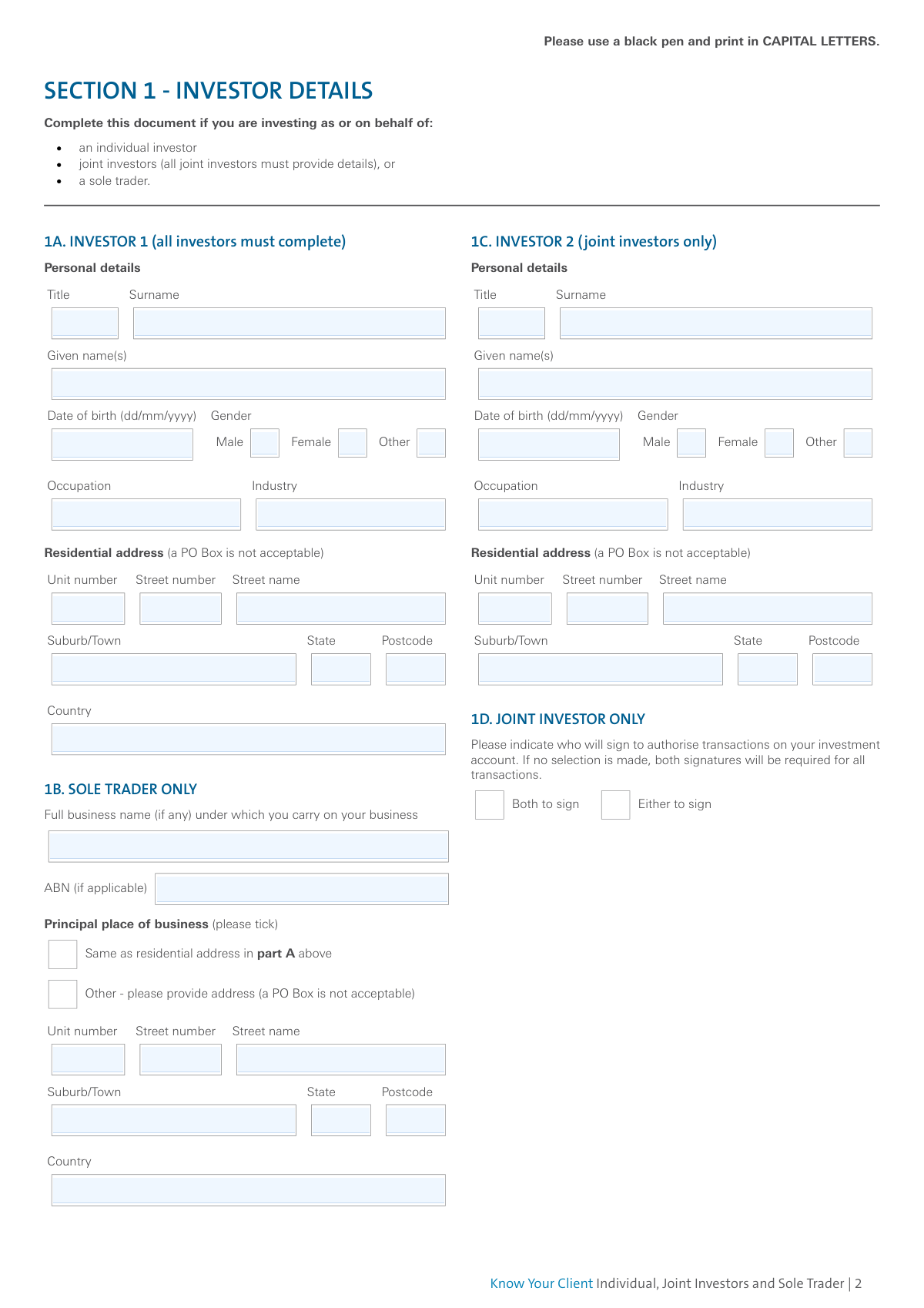
- Individual and Joint Investors: If you are opening an account in your own name or together with another person (such as a spouse), the AMP Know Your Client Individual, Joint Investors and Sole Trader form is the correct choice. It captures personal data for all parties involved to ensure the account is legally registered.
- Sole Traders: If you operate a business as an individual without a separate company or trust structure, you should also use the AMP Know Your Client Individual, Joint Investors and Sole Trader form. It includes sections to verify your business activities alongside your personal identity.
Compliance and Regulatory Requirements
Investor onboarding forms are not just administrative hurdles; they are legal necessities. The forms in this category, such as the AMP Know Your Client Individual, Joint Investors and Sole Trader document, are specifically designed to address:
- AML/CTF Act 2006: These forms verify your identity to prevent money laundering and financial crime.
- FATCA and CRS: These sections determine your tax residency status to comply with international tax reporting standards.
Tips for a Smooth Onboarding
To ensure your application is processed without delays, have your supporting identification (such as a Passport or Driver’s License) and your Tax File Number (TFN) ready. Using Instafill.ai to complete the AMP Know Your Client Individual, Joint Investors and Sole Trader form helps ensure that all mandatory fields are legible and accurate, preventing the back-and-forth often associated with manual paperwork.
Form Comparison
| Form | Purpose | Target Audience | Compliance Focus |
|---|---|---|---|
| AMP Know Your Client Individual, Joint Investors and Sole Trader | Verifies identity and tax residency for new investor accounts with AMP. | Individual investors, joint account holders, and sole traders opening accounts. | Satisfies AML/CTF Act 2006, FATCA, and Common Reporting Standard (CRS) requirements. |
Tips for investor onboarding forms
Most onboarding forms require government-issued IDs like a passport or driver's license to meet AML/CTF requirements. Having digital copies ready before you start will prevent delays and ensure your identity verification is processed smoothly.
Forms often include FATCA and CRS sections that require your Tax Identification Number (TIN) if you have tax obligations outside your home country. Double-check your residency status to avoid errors that could lead to account freezes or reporting issues.
AI-powered tools like Instafill.ai can complete complex investor onboarding forms in under 30 seconds with high accuracy. Your sensitive financial data stays secure throughout the process, making it a significant time-saver for those managing multiple investment accounts.
If you are applying as a sole trader or through a joint account, ensure you fill out the specific sections designated for those entities. Mixing personal details with business information is a common mistake that often results in the form being rejected.
Ensure that any physical or digital signatures match the identification documents you provide. Financial institutions strictly compare signatures to prevent fraud, so any variation can cause significant delays in the onboarding process.
Many KYC forms require a utility bill or bank statement dated within the last three to six months to verify your address. Ensure the name on the document matches your ID exactly to satisfy legal compliance standards.
Small typos in your name, date of birth, or tax ID can lead to automated system rejections. Take a final moment to cross-reference your entries against your official documents before submitting the completed form.
Frequently Asked Questions
Investor onboarding forms are used by financial institutions to verify the identity of their clients and ensure compliance with regulatory standards. These documents help prevent illegal activities such as money laundering and terrorism financing by documenting the source of funds and the investor's background.
Anyone looking to open a new investment account or update their existing profile with a financial services provider must complete these forms. This includes individual investors, joint account holders, and sole traders who are entering into a formal investment relationship.
These forms typically request personal identification details, contact information, tax residency status, and financial background. You may also be asked about your source of wealth and the intended nature of your investment activities to satisfy regulatory requirements.
Financial institutions are required by law to identify the tax residency of their account holders to comply with international agreements like the Foreign Account Tax Compliance Act (FATCA) and the Common Reporting Standard (CRS). This information is shared with relevant tax authorities to ensure global tax transparency and compliance.
You will generally need primary identification documents such as a valid passport, driver’s license, or national ID card. Depending on the institution's requirements, you might also need proof of address, such as a utility bill or bank statement issued within the last few months.
Yes, modern AI tools like Instafill.ai allow you to fill out complex investor onboarding forms by automatically extracting data from your ID and source documents. These tools can accurately map your information to the correct fields, significantly reducing the risk of manual entry errors.
While manual completion can take 15 to 30 minutes due to the detailed nature of the questions, using AI-powered services like Instafill.ai can reduce this time to under 30 seconds. The technology instantly extracts data from your source files and places it accurately into the PDF fields.
An individual form is for a single person opening an account in their own name, whereas a joint investor form is used when two or more people share ownership of the investment. Both parties in a joint account must typically provide their personal details and identification for verification purposes.
Sole traders are generally required to provide their personal identification as well as details about their business operations. Because a sole trader is not a separate legal entity from the individual, the KYC process focuses on the individual's identity while acknowledging their business status.
Once the forms are completed and signed, they are usually submitted directly to the financial institution or investment platform through their secure online portal. Some institutions may still require physical copies to be mailed if original signatures or certified copies of documents are needed.
Providing incomplete information can delay the account opening process or result in the rejection of your application. It is crucial to ensure all data matches your official identification documents to avoid discrepancies that might trigger additional compliance reviews.
Glossary
- Form Complexity Index
- Instafill’s 0–100 measure of how much effort a form takes to complete, calculated deterministically from the form’s own structure rather than estimated. It combines the number of fillable fields (the largest factor), how difficult those fields are to complete based on their type, the number of pages that contain fields, the amount of conditional “fill-only-if” logic, and how many sections the form is divided into, then adds modifiers for tables and repeating lists, bundled instruction pages, and dense page layouts. A higher score means the form is harder to fill out by hand. The forms in this category have a median Form Complexity Index of 50/100 (Moderate). See exactly how it is calculated.
- KYC (Know Your Client)
- A mandatory verification process used by financial institutions to confirm the identity and risk profile of an investor before providing services.
- AML/CTF
- Stands for Anti-Money Laundering and Counter-Terrorism Financing, which are legal regulations requiring firms to monitor transactions and prevent the movement of illegal funds.
- Tax Residency
- The country or jurisdiction where an individual is legally required to pay taxes, usually determined by where they live and work for the majority of the year.
- TIN (Tax Identification Number)
- A unique set of numbers used by tax authorities to identify individuals or businesses; examples include a Tax File Number (TFN) or Social Security Number (SSN).
- FATCA (Foreign Account Tax Compliance Act)
- A U.S. federal law requiring financial institutions worldwide to report information about accounts held by U.S. taxpayers to the Internal Revenue Service.
- CRS (Common Reporting Standard)
- An international standard for the automatic exchange of financial information between different countries to help prevent global tax evasion.
- Sole Trader
- A simple business structure where one person owns and operates the business alone and is personally responsible for all its debts and legal actions.
- PEP (Politically Exposed Person)
- An individual who holds a prominent public position, or their close family members, who may require additional scrutiny due to potential exposure to bribery or corruption.