Fill out individual investor forms
with AI.
Individual investor forms are the essential gateway for anyone looking to enter the financial markets or manage their private wealth through structured investment vehicles. These documents are designed to establish new accounts, such as retail hedge funds or Individual Retirement Accounts (IRAs), while ensuring that all global regulatory standards are met. By collecting personal details, financial objectives, and tax residency information, these forms help institutions maintain compliance with anti-money laundering (AML) laws and tax transparency standards like FATCA and CRS.
By continuing, you acknowledge Instafill's Privacy Policy and agree to get occasional product update and promotional emails.
About individual investor forms
Typically, these forms are required when an individual is opening a brokerage account, applying for specialized 'qualified investor' funds, or setting up corporate equity compensation plans. Whether you are a first-time investor setting up a Vanguard account or an experienced professional navigating the requirements for a Monthly Liquidity fund, providing precise data is critical for a smooth onboarding process. These documents often require detailed background information, including source of funds and identity verification, to satisfy mandatory 'Know Your Client' (KYC) protocols.
Navigating these multi-page documents can be a time-consuming task, but tools like Instafill.ai use AI to fill these forms in under 30 seconds, handling your data accurately and securely. This technology significantly reduces the administrative burden, allowing investors to focus on their financial goals rather than manual data entry.
Every form on this page can be completed without typing. Instafill is form filling software that reads a PDF and fills it for you — including flat and scanned documents that carry no fillable fields at all.
Forms in This Category
The forms in this category have a median Form Complexity Index of 64/100 (Complex), measured across 10 forms by field count, input difficulty, length, conditional logic and structure. See how it is calculated.
- Enterprise-grade security & data encryption
- 99%+ accuracy powered by AI
- 1,000+ forms from all industries
- Complete forms in under 60 seconds
How to Choose the Right Form
Selecting the correct individual investor form depends primarily on the financial institution you are working with, your investor classification, and your tax residency status. Use the groups below to identify the specific document required for your transaction.
Hedge Fund Applications (Fundrock)
If you are applying for a hedge fund managed by Fundrock, you must distinguish between retail and qualified investor status:
- Retail Investors: Choose the Application Form: Individual Investor | Retail Hedge Fund or the Monthly Liquidity – Retail Hedge Fund version if your fund offers monthly exit options.
- Qualified Investors: High-net-worth or experienced investors should use the Fundrock Qualified Investor Hedge Fund Application Form for Individual Investors. Similar to retail forms, ensure you select the Monthly Liquidity – Qualified Investor Hedge Fund version if applicable to your specific fund.
Corporate Equity and Brokerage (Merrill)
For those managing corporate equity compensation, such as stock options or restricted stock units, choose based on your tax status:
- U.S. Persons: Use the Merrill AwardChoice® Individual Investor Account Application Form for U.S. Persons, which includes the necessary W-9 tax certification.
- Non-U.S. Persons: Use the AwardChoice Limited Individual Investor Account Form, which includes a Substitute Form W-8BEN to certify your foreign status for U.S. tax withholding purposes.
Retirement and General Account Setup
- Retirement Planning: To establish a new Traditional, Roth, or SEP IRA, use the New York Life Investments Funds Individual Retirement Account Application and NYLIFE Securities LLC Investor Profile.
- General Investment: For standard brokerage accounts, use the Vanguard Account Opening Form for Individual Investors.
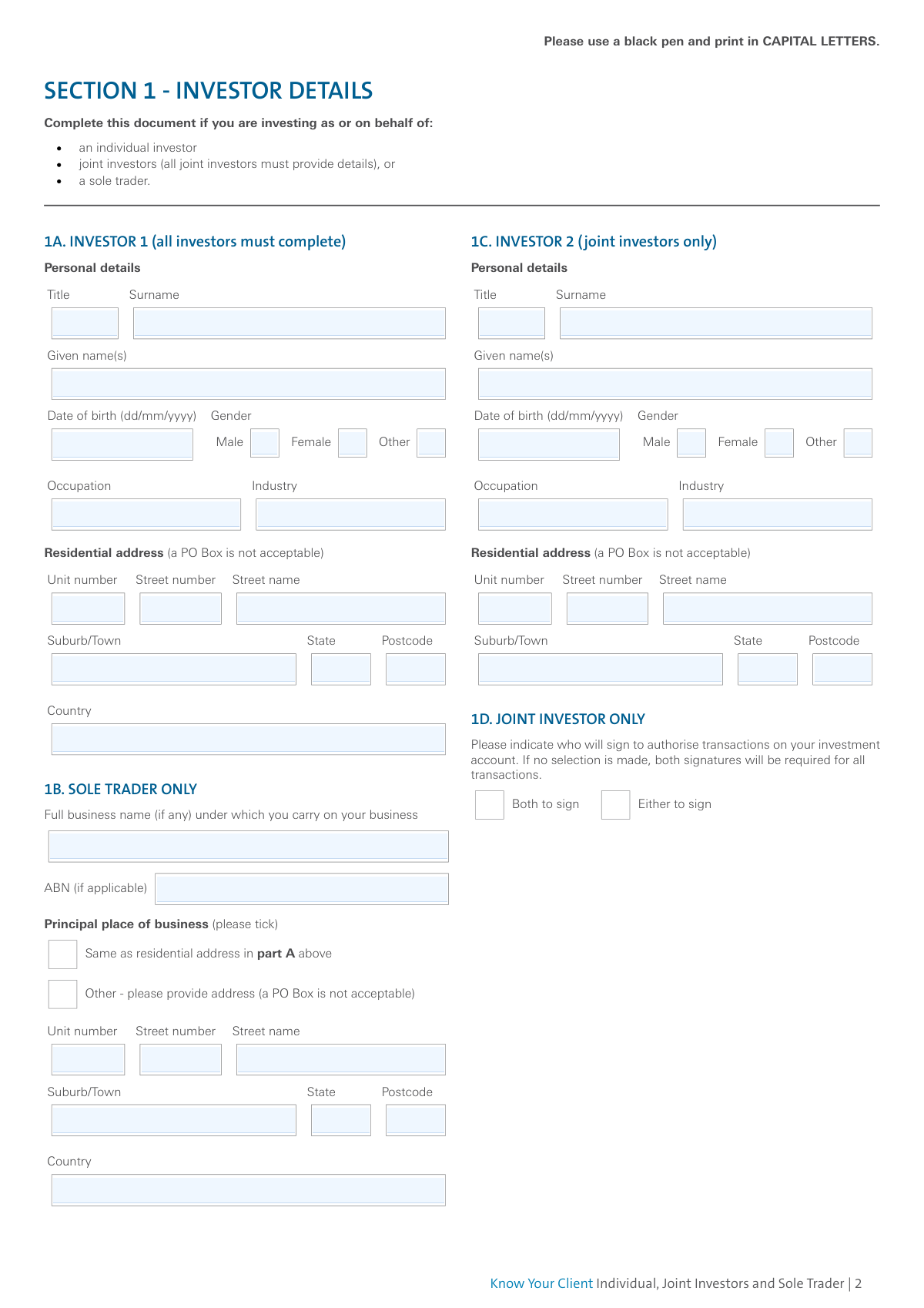
- Identity Verification: If you only need to satisfy regulatory requirements rather than open a new account, the AMP Know Your Client Individual, Joint Investors and Sole Trader form is used specifically for AML, FATCA, and CRS compliance.
Form Comparison
| Form | Investor Eligibility | Main Objective | Compliance Focus |
|---|---|---|---|
| AMP Know Your Client Individual, Joint Investors and Sole Trader | Individual or sole trader | Verify identity and legal standing | AML/CTF and tax residency requirements |
| Application Form: Individual Investor | Monthly Liquidity – Retail Hedge Fund | General retail investors | Apply for retail fund with monthly liquidity | FATCA, CRS, and FICA regulations |
| Application Form: Individual Investor | Qualified Investor Hedge Fund | Qualified/sophisticated investors | High-threshold hedge fund investment | FICA and source of funds verification |
| Application Form: Individual Investor | Retail Hedge Fund | Standard retail investors | General retail hedge fund participation | Tax residency and legal FICA obligations |
| AwardChoice Limited Individual Investor Account Form | Non-U.S. corporate employees | Manage corporate equity and stock options | W-8BEN foreign status certification |
| Fundrock Application Form: Individual Investor | Monthly Liquidity – Qualified Investor Hedge Fund | Qualified investors | Qualified fund access with monthly liquidity | KYC due diligence and FATCA/CRS |
| Fundrock Qualified Investor Hedge Fund - Application Form for Individual Investor | Qualified/Accredited individuals | Establishment of hedge fund investment account | FICA compliance and qualified status declaration |
| Merrill AwardChoice® Individual Investor Account Application Form for U.S. Persons | U.S. persons/employees | Open brokerage account for equity plans | W-9 certification and arbitration agreement |
| New York Life Investments Funds Individual Retirement Account Application and NYLIFE Securities LLC Investor Profile | Retirement savers | Establish Traditional, Roth, or SEP IRAs | Investor profiling and risk assessment |
| Vanguard Account Opening Form for Individual Investors | General individual investors | Setup new investment account with Vanguard | AML documentation and regulatory standards |
Tips for individual investor forms
Double-check your Tax Identification Number (TIN) or Social Security Number before submitting. Errors in tax residency declarations for FATCA or CRS compliance are the most common reasons for application delays or rejected accounts.
Most individual investor forms require Know Your Client (KYC) documentation, such as a valid passport and proof of address. Having these files scanned and ready to upload alongside your form will prevent the need to restart the application process later.
Anti-money laundering regulations require clear information on where your investment capital originated. Instead of using vague terms, provide specific details like 'monthly salary,' 'inheritance,' or 'proceeds from property sale' to satisfy compliance checks quickly.
Using AI-powered tools like Instafill.ai can complete these complex investor forms in under 30 seconds with high accuracy. Your sensitive financial data stays secure during the process, providing a reliable way to handle multiple fund applications without manual data entry.
Ensure the bank account provided for distributions or liquidity matches the name on the investment application exactly. Most hedge funds and investment firms will reject forms that list third-party bank accounts to prevent fraudulent transfers.
If you are applying as a joint investor, verify whether the form requires signatures from all parties involved. Missing a single signature on multi-page applications is a frequent mistake that can stall your account setup for weeks.
Frequently Asked Questions
These forms are primarily used to open new investment accounts, apply for specific mutual or hedge funds, and verify your identity with financial institutions. They collect personal data, financial history, and tax information to ensure the provider complies with international banking and security regulations.
Retail investor forms are generally for the general public, while qualified investor forms are for individuals who meet specific high-net-worth or professional experience thresholds. You should check the eligibility criteria of the specific fund, as qualified investor funds often have higher minimum investment amounts and different regulatory oversight.
Financial institutions are legally required to determine where their clients are tax residents to prevent international tax evasion. FATCA applies specifically to U.S. taxpayers, while the Common Reporting Standard (CRS) is used by many other countries to share financial account information with tax authorities.
Most applications require a government-issued photo ID, such as a passport, and proof of residential address like a utility bill or bank statement. Depending on the fund type, you may also be asked for documentation that verifies your source of wealth or source of funds to comply with anti-money laundering laws.
This depends on your citizenship, residency, and tax obligations; U.S. citizens and residents typically use forms requiring a W-9 certification. International investors generally use forms for Non-U.S. Persons, which often incorporate a W-8BEN to certify foreign status and potentially claim tax treaty benefits.
Yes, you can fill out individual investor forms using AI tools like Instafill.ai. These tools can accurately extract data from your existing documents and automatically place it into the correct fields, reducing the risk of manual entry errors on complex financial applications.
While manually completing multi-page investment documents can take 20 minutes or more, AI-powered services like Instafill.ai can fill these forms in under 30 seconds. The AI quickly processes your source information to complete the form accurately and efficiently.
Know Your Client (KYC) and Anti-Money Laundering (AML) sections are mandatory requirements for financial firms to verify the identity of their investors. These sections help prevent financial crimes by ensuring that the person opening the account is who they claim to be and that their investment funds are legitimate.
You should use an Individual Retirement Account (IRA) application if you intend to invest specifically for retirement purposes under U.S. tax laws. These forms include specific sections for choosing the type of IRA, such as Traditional or Roth, which carry different tax advantages and contribution rules compared to standard brokerage accounts.
Once completed, these forms are typically submitted directly to the fund manager, brokerage firm, or financial institution via their secure digital portal or by email. Some institutions may still require physical copies or 'wet ink' signatures for certain high-security accounts, so it is important to review the submission instructions provided by the firm.
Glossary
- Form Complexity Index
- Instafill’s 0–100 measure of how much effort a form takes to complete, calculated deterministically from the form’s own structure rather than estimated. It combines the number of fillable fields (the largest factor), how difficult those fields are to complete based on their type, the number of pages that contain fields, the amount of conditional “fill-only-if” logic, and how many sections the form is divided into, then adds modifiers for tables and repeating lists, bundled instruction pages, and dense page layouts. A higher score means the form is harder to fill out by hand. The forms in this category have a median Form Complexity Index of 64/100 (Complex). See exactly how it is calculated.
- FATCA (Foreign Account Tax Compliance Act)
- A United States law requiring foreign financial institutions to report information about accounts held by U.S. taxpayers to the IRS to prevent tax evasion.
- CRS (Common Reporting Standard)
- An international framework for the automatic exchange of financial account information between participating countries to combat global tax avoidance.
- KYC (Know Your Client)
- A mandatory process used by investment firms to verify the identity, suitability, and risks of an investor before providing financial services.
- Qualified Investor
- An individual who meets specific high-net-worth or professional experience criteria, allowing them to invest in complex vehicles like hedge funds.
- FICA (Financial Intelligence Centre Act)
- A South African regulatory requirement that forces financial institutions to perform due diligence and verify the identity of clients to prevent money laundering.
- AML/CTF
- Standing for Anti-Money Laundering and Counter-Terrorism Financing, these are the laws and procedures used to detect and report suspicious financial activities.
- W-8BEN
- A U.S. tax form used by non-U.S. individuals to certify their foreign status and claim a reduced rate of tax withholding under an existing tax treaty.
- Retail Hedge Fund
- An investment fund that uses advanced strategies like short-selling or leverage but is structured to be accessible to the general public rather than just institutional investors.