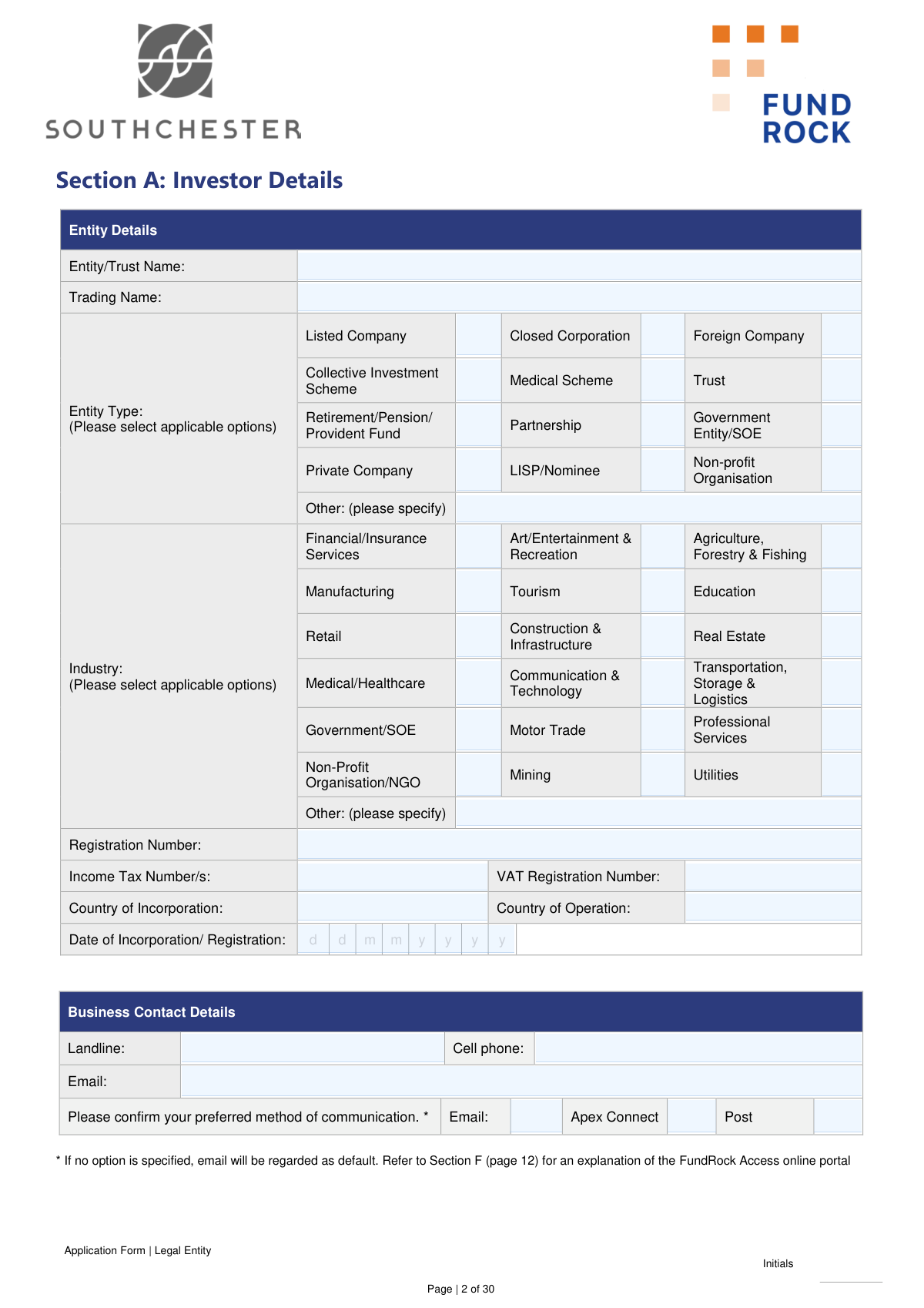
Yes! You can use AI to fill out Application Form: Legal Entities | Qualified Investor Hedge Fund

This is an application form for legal entities, such as companies and trusts, wishing to invest in a Qualified Investor Hedge Fund managed by FundRock. It gathers essential information about the investing entity, its financial advisor, investment choices, and compliance details required under FICA, FATCA, and CRS regulations. Today, this form can be filled out quickly and accurately using AI-powered services like Instafill.ai, which can also convert non-fillable PDF versions into interactive fillable forms.
Our AI automatically handles information lookup, data retrieval, formatting, and form filling.
It takes less than a minute to fill out QI Hedge Fund Application (Legal Entities) using our AI form filling.
Securely upload your data. Information is encrypted in transit and deleted immediately after the form is filled out.

Form specifications

Form name: Application Form: Legal Entities | Qualified Investor Hedge Fund
Number of pages: 1
Language: English
Categories: NY legal forms, legal application forms, legal forms
main-image

Instafill Demo: How to fill out PDF forms in seconds with AI

How to Fill Out QI Hedge Fund Application (Legal Entities) Online for Free in 2026

Are you looking to fill out a QI HEDGE FUND APPLICATION (LEGAL ENTITIES) form online quickly and accurately? Instafill.ai offers the #1 AI-powered PDF filling software of 2026, allowing you to complete your QI HEDGE FUND APPLICATION (LEGAL ENTITIES) form in just 37 seconds or less.
Follow these steps to fill out your QI HEDGE FUND APPLICATION (LEGAL ENTITIES) form online using Instafill.ai:
  1. 1 Navigate to Instafill.ai and upload or select the 'Application Form: Legal Entities | Qualified Investor Hedge Fund'.
  2. 2 Use the AI assistant to automatically fill in Section A with your entity's details, including name, type, registration numbers, and contact information.
  3. 3 In Section B, specify your investment choices, including the fund, investment amount, and any regular withdrawal instructions.
  4. 4 Complete the tax declarations in Sections D (Dividend Withholding Tax) and E (FATCA/CRS Tax Residency Self-Certification) by answering the guided questions.
  5. 5 Provide details for all ultimate beneficial owners, controlling persons, and authorized representatives as required in Sections G and K.
  6. 6 Review all auto-filled information for accuracy, electronically sign the declarations in the relevant sections, and upload all necessary supporting documents as per the FICA checklist in Section K.
  7. 7 Download the complete, signed application package and submit it via email to the address provided on the form.

Our AI-powered system ensures each field is filled out correctly, reducing errors and saving you time.

Why Choose Instafill.ai for Your Fillable QI Hedge Fund Application (Legal Entities) Form?

Speed

Complete your QI Hedge Fund Application (Legal Entities) in as little as 37 seconds.

Up-to-Date

Always use the latest 2026 QI Hedge Fund Application (Legal Entities) form version.

Cost-effective

No need to hire expensive lawyers.

Accuracy

Our AI performs 10 compliance checks to ensure your form is error-free.

Security

Your personal information is protected with bank-level encryption.

Frequently Asked Questions About Form QI Hedge Fund Application (Legal Entities)

This form is for legal entities, like companies and trusts, to apply for an investment in the FundRock Qualified Investor Hedge Fund. It must be completed by entities that meet the 'Qualified Investor' criteria, either through demonstrable financial experience or by appointing a qualified Financial Services Provider (FSP).

Submit the fully completed application form, with each page initialed, along with all required supporting documents to the following email address: [email protected].

The cut-off time for investment subscriptions is 10:00 am on the last business day of the prior month. If your application and funds are received after this deadline, your investment will be processed on the first business day of the following month.

You must provide all necessary FICA documents as listed in the Onboarding Checklist (Section K). The specific documents vary based on your entity type (e.g., company, trust) but generally include incorporation certificates, proof of address, and ID copies for directors and beneficial owners.

For security reasons, the fund's bank details are not included on the form. Upon approval of your application, you will receive an email containing the bank account details for the portfolio you wish to invest in.

While not mandatory, you must meet the 'Qualified Investor' criteria, which can be satisfied by appointing a qualified FSP. If you use an advisor, their details and the agreed-upon fees must be completed in Section C.

Providing UBO information in Section G is a legal requirement to identify any individual who owns or controls 25% or more of the entity. This is a standard part of anti-money laundering and customer due diligence procedures.

Section D (DWT) is a declaration to determine if your entity is exempt from Dividend Withholding Tax. Section E (FATCA/CRS) is a mandatory self-certification to establish your entity's tax residency for international tax reporting compliance.

The Apex Connect Portal is an online platform that gives you access to view your investment holdings, transaction history, and investor statements. You can request access for yourself and other individuals by completing Section F.

If you, or a person closely associated with your entity, is a Politically Exposed Person (PEP), you must declare this in Section J. This information is required for enhanced due diligence under financial regulations.

Yes, services like Instafill.ai use AI to accurately auto-fill form fields, which can save you significant time and reduce errors. This is especially helpful for lengthy and complex forms like this one.

Simply upload the PDF to the Instafill.ai platform. The AI will identify the fields, allowing you to provide your information once to have it automatically and accurately populated throughout the document.

If you have a non-fillable PDF, you can use a service like Instafill.ai. It can convert the flat document into an interactive, fillable form, enabling you to complete and sign it digitally without printing.

Compliance QI Hedge Fund Application (Legal Entities)
Validation Checks by Instafill.ai

1
Conditional 'Other' Field Completion for Entity and Industry
This check ensures that if the 'Other' checkbox is selected for either 'Entity Type' or 'Industry' in Section A, the adjacent text field must be filled out. This is crucial for capturing specific entity or industry classifications not covered by the standard options, which is vital for accurate client profiling and regulatory reporting. An application with 'Other' selected but no specification is incomplete and will be rejected pending clarification.
2
Valid and Historical Date of Incorporation
This validation verifies that the 'Date of Incorporation/Registration' in Section A is a valid date formatted as ddmmyyyy and is not a date in the future. This check is fundamental to confirming the legal existence and operational history of the applying entity. An invalid or future date would indicate a significant data entry error and would prevent the system from proceeding with the FICA verification process.
3
Investor Bank Account Holder Name Consistency
This check ensures the 'Name of Account Holder' in the investor's banking details (Section A) is an exact match for the 'Entity/Trust Name' provided at the start of the same section. This is a critical anti-money laundering control, as regulations prohibit payments to third-party accounts. A mismatch will immediately halt the application until the banking details are corrected and verified to prevent fraudulent fund transfers.
4
Source of Funds and Wealth Declaration Completeness
This validation confirms that at least one option is selected for both 'Source of Funds' and 'Source of Wealth' in Section A. This information is a mandatory requirement under the FIC Act to understand the origin of the investor's capital and assess potential money laundering risks. An application with an incomplete declaration in this area is considered non-compliant and will be blocked from further processing.
5
Investment and Income Distribution Pairing
This check validates that if an 'Investment Amount' is entered in Section B, a corresponding 'Income Distribution' option ('Re-invest' or 'Pay-out') must also be selected for that investment. This ensures the investor's instructions for handling investment returns are clear and unambiguous. Missing information would create processing ambiguity, requiring manual follow-up and delaying the execution of the investment.
6
Logical Regular Withdrawal Setup
This validation ensures that if a withdrawal frequency (e.g., 'Monthly', 'Quarterly') is selected in Section B, then both the 'Regular Withdrawal Amount' and 'First withdrawal payment date' fields must be completed. It also verifies that the specified date is not in the past. This prevents the setup of incomplete or logically impossible withdrawal instructions, which would fail to execute and could cause financial hardship for an investor expecting regular income.
7
Advisor Fee and Investor Authorization Link
This check verifies that if a non-zero percentage is entered for either the 'Initial Advice Fee' or 'Ongoing Advice Fee' in Section C, the 'Signature of the Investor or Authorised Representative' within that same section is mandatory. This signature provides explicit consent for the fee deduction, which is a legal requirement. Without this authorization, the fees cannot be processed, and the instruction will be flagged as incomplete.
8
DWT Exemption Reason Mandate
This validation ensures that if an investor signs the declaration in Section D to claim an exemption from Dividend Withholding Tax (DWT), they must also select the specific 'Reason for Exemption' that applies to their entity. This provides the necessary legal justification for the exemption as required by SARS. Failure to specify a reason will cause the exemption claim to be disregarded, and the standard DWT rate will be applied by default.
9
Foreign Tax Residency TIN/Reason Logic
In Section E, if an entity is marked as a tax resident in another country, this check verifies that for each country listed, either a 'TIN or equivalent' number is provided or a valid reason code ('A', 'B', or 'C') is selected for its absence. This is a core requirement for FATCA and CRS reporting. An incomplete declaration for any jurisdiction will render the tax self-certification invalid and block the application.
10
Passive Entity Controlling Person Disclosure
This check enforces that if the entity is classified as a 'Passive NFFE' (FATCA) or 'Passive NFE' (CRS) in Section E, the 'Controlling Persons' section (Section G) must be completed for at least one individual. This is a critical 'look-through' provision for tax transparency to identify the ultimate beneficial owners. An application for a passive entity without this information is non-compliant and cannot be approved.
11
Politically Exposed Person (PEP) Status Clarification
This validation verifies that the PEP status question in Section J is answered 'Yes' or 'No', and if the answer is 'Yes', the corresponding details field must be filled out. Identifying PEPs is a key part of enhanced due diligence under FICA to mitigate risks associated with corruption. An unanswered PEP question, or a 'Yes' without details, will automatically flag the application for mandatory compliance review.
12
Mandatory Investor Declaration Agreement
This check confirms that the final mandatory checkbox in the Investor Declaration (Section J) has been ticked. This action serves as the investor's explicit agreement, legally binding them to the terms, conditions, and warranties stated in the declaration. An application cannot be considered complete or submitted without this final confirmation.

Common Mistakes in Completing QI Hedge Fund Application (Legal Entities)

Incomplete or Incorrect FICA Documentation

Applicants frequently fail to submit all the required supporting documents as detailed in the extensive checklist in Section K. This often happens because the requirements vary significantly based on the entity type (e.g., Trust vs. Private Company), and applicants overlook specific documents like a board resolution or an ownership structure diagram. Missing even one document will halt the application process until all FICA requirements are met, causing significant delays. To avoid this, carefully review the checklist for your specific entity type before submission.

Missing Initials on Pages or Signatures in Key Sections

The form requires an initial on every page and multiple signatures across different sections, such as the Investor Declaration (Section J), Financial Advisor Fees (Section C), and Tax Declarations (Sections D & E). It is very common for applicants to miss one or more of these, which invalidates the submission. This oversight often occurs due to the form's length and complexity, leading to rejection and the need to resubmit the entire application. Using a tool that highlights all mandatory signature and initial fields can prevent this error.

Incorrect FATCA/CRS Classification

In Section E, legal entities often struggle to correctly identify their status as a 'Financial Institution' (FFI) or 'Non-Financial Entity' (NFE), and further sub-classifications like 'Active NFE' or 'Passive NFE'. This mistake stems from a misunderstanding of complex international tax regulations. An incorrect classification can lead to improper tax reporting to authorities and may require remediation with the help of a tax advisor. If the entity is a 'Passive NFE', applicants also frequently forget to complete the mandatory 'Controlling Persons' section.

Failure to Fully Disclose Ultimate Beneficial Owners (UBOs)

Section G requires detailed information for every natural person who owns 25% or more of the entity or exercises control, yet applicants often provide incomplete information. Common errors include failing to list all qualifying individuals, omitting the required organogram of the ownership structure, or forgetting to attach copies of their ID and proof of address. This is a critical anti-money laundering (AML) step, and any deficiency will immediately stop the application from being approved.

Mismatched Investor Entity and Bank Account Names

The form explicitly states that payments will only be made to an account in the name of the registered investor, yet applicants sometimes provide banking details for a parent company, a director, or use a trading name that doesn't exactly match the legal entity name in Section A. This discrepancy prevents the verification of banking details and will lead to the rejection of any future disinvestment or payout requests. It is crucial to ensure the 'Name of Account Holder' in the banking section is identical to the 'Entity/Trust Name' at the start of the form.

Omitting Proof of Authority to Act

For most legal entities, Section K requires a 'Board resolution' or similar document delegating authority to the person signing the application. Applicants, particularly the signatories themselves, often forget to obtain and include this crucial document. Without this proof, the fund manager cannot verify that the signatory is authorized to make the investment on behalf of the entity, rendering the entire application invalid until the resolution is provided.

Submitting Outdated or Unacceptable Verification Documents

The 'Acceptable Verification Documentation' section specifies strict validity periods, such as proof of address documents being less than 3 months old. Applicants often submit documents like a 4-month-old utility bill or a driver's license for ID (which is explicitly not accepted), leading to automatic rejection of their FICA pack. It is essential to check the issue date on all supporting documents to ensure they comply with the stated requirements. AI-powered form fillers like Instafill.ai can help by validating data formats and reminding users of document requirements.

Ambiguous Investment or Withdrawal Instructions

In Section B, applicants may enter an investment amount but fail to select a fund 'Class' or specify whether income distributions should be 'Re-invest' or 'Pay-out'. Similarly, when setting up a regular withdrawal, they might enter an amount but not the frequency or start date. This ambiguity makes it impossible for the administrator to process the instruction, causing the investment or withdrawal plan to be delayed until clarification is received.

Incorrect Dividend Withholding Tax (DWT) Exemption Claim

The DWT declaration in Section D is a technical section that is often misunderstood, leading applicants to either not complete it (resulting in default tax being withheld) or incorrectly claim an exemption. For example, an entity might select an exemption paragraph that does not apply to its legal structure. This can cause tax compliance issues and financial loss if tax is withheld unnecessarily. Since this form is a non-fillable PDF, a tool like Instafill.ai could convert it into a fillable version, making it easier to complete these complex sections accurately.

Vague 'Source of Funds' and 'Source of Wealth' Descriptions

In Section A, applicants are required to declare the source of funds for the transaction and their overall source of wealth. Many simply tick a box like 'Savings' or 'Sale of Assets' without providing necessary context, especially for large amounts. Regulators require more specific information (e.g., 'Savings from 20 years of employment as an engineer' or 'Sale of a commercial property'), and a vague answer will trigger further inquiries and delay the investment.
Saved over 80 hours a year

“I was never sure if my IRS forms like W-9 were filled correctly. Now, I can complete the forms accurately without any external help.”

Kevin Martin Green

Your data stays secure with advanced protection from Instafill and our subprocessors

Robust compliance program

Transparent business model

You’re not the product. You always know where your data is and what it is processed for.

ISO 27001, HIPAA, and GDPR

Our subprocesses adhere to multiple compliance standards, including but not limited to ISO 27001, HIPAA, and GDPR.

Security & privacy by design

We consider security and privacy from the initial design phase of any new service or functionality. It’s not an afterthought, it’s built-in, including support for two-factor authentication (2FA) to further protect your account.

Fill out QI Hedge Fund Application (Legal Entities) with Instafill.ai

Worried about filling PDFs wrong? Instafill securely fills application-form-legal-entities-qualified-investor-hedge-fund forms, ensuring each field is accurate.