Fill out hedge fund forms
with AI.
Hedge fund forms are essential documents used to facilitate investments into private investment vehicles and manage ongoing participation. These forms are designed to collect critical information required by fund managers and regulatory bodies to ensure that all participants meet specific eligibility criteria. Whether you are dealing with a Retail Hedge Fund application or a Qualified Investor Hedge Fund subscription, these documents handle everything from initial investor details to tax residency declarations under FATCA and CRS. They serve as the formal legal record and compliance foundation for both the investor and the fund administrator.
By continuing, you acknowledge Instafill's Privacy Policy and agree to get occasional product update and promotional emails.
About hedge fund forms
Typically, these financial application forms are required by high-net-worth individuals, trusts, and corporate entities during the onboarding process or when making additional investments into a portfolio. Because hedge funds operate under strict regulatory frameworks, such as FICA and KYC due diligence, the forms are often detailed and require precise financial data and personal history. Completing these accurately is vital to avoid processing delays or compliance issues that could impact investment timelines. Tools like Instafill.ai use AI to fill these forms in under 30 seconds, handling the data accurately and securely to simplify the administrative burden.
Beyond initial applications, this category also includes forms for legal entities and documents for additional investment contributions. These allow existing investors to adjust their holdings or update their information as their financial situation evolves. By streamlining the way these complex documents are handled, investors and financial advisors can focus more on portfolio strategy and less on manual paperwork.
Every form on this page can be completed without typing. Instafill is form filling software that reads a PDF and fills it for you — including flat and scanned documents that carry no fillable fields at all.
Forms in This Category
The forms in this category have a median Form Complexity Index of 63/100 (Complex), measured across 11 forms by field count, input difficulty, length, conditional logic and structure. See how it is calculated.
- Enterprise-grade security & data encryption
- 99%+ accuracy powered by AI
- 1,000+ forms from all industries
- Complete forms in under 60 seconds
How to Choose the Right Form
Selecting the correct hedge fund application depends on your legal status, your investor qualification, and the specific liquidity terms of the fund. Most forms in this category are provided by Fundrock and require detailed information for FICA, FATCA, and CRS compliance.
By Investor Type
- Individual Investors: If you are investing as a person, look for forms labeled "Individual Investor." For standard retail access, use the Application Form: Individual Investor | Retail Hedge Fund. If you are an international investor, the Protea International Hedge Fund Subscription Form (Individual) is tailored for global compliance.
- Legal Entities: Companies, trusts, or partnerships must use the specific entity versions to provide beneficial ownership details. Use the Application Form: Legal Entities | Retail Hedge Fund - Fundrock or the Application Form: Legal Entities | Qualified Investor Hedge Fund depending on the fund type.
Retail vs. Qualified Investor Funds
- Retail Hedge Funds (RHF): These are designed for a broader range of investors with lower entry requirements. Choose the Application Form: Individual Investor | Retail Hedge Fund if you do not meet the "Qualified" criteria.
- Qualified Investor Hedge Funds (QIHF): These are restricted to sophisticated investors with higher net worth or specific financial expertise. Use the Fundrock Qualified Investor Hedge Fund - Application Form for Individual Investor or the Monthly Liquidity – Qualified Investor Hedge Fund version if you require more frequent access to your capital.
Liquidity and Additional Investments
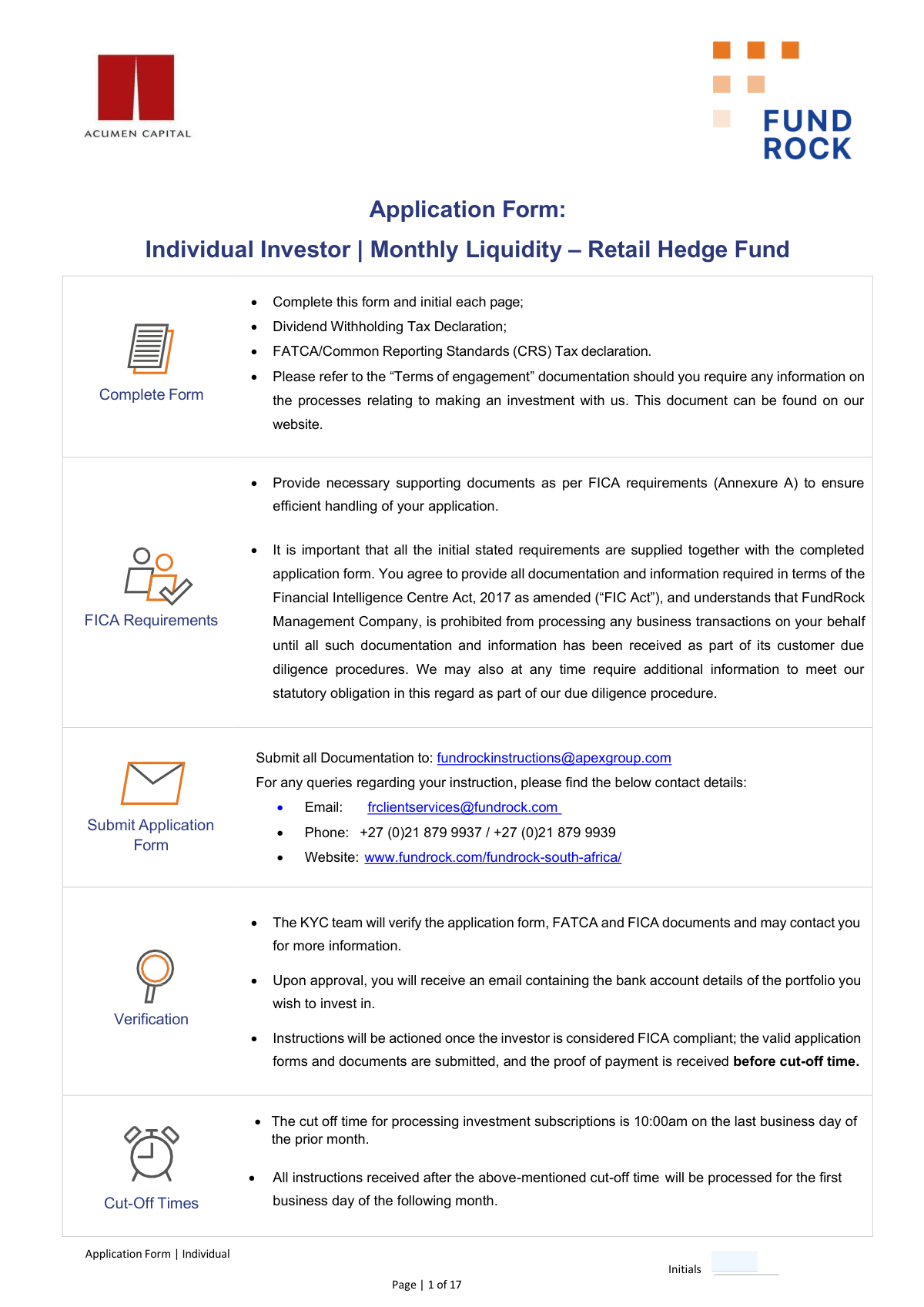
- Monthly Liquidity: If you are selecting a fund that allows for monthly redemptions, ensure you use a form specifically labeled for it, such as the Application Form: Individual Investor | Monthly Liquidity – Retail Hedge Fund.
- Existing Investors: If you already have an active account and simply want to increase your position or set up a debit order, use the Hedge Fund Portfolios Additional Investment Form rather than a full new application.
Tips for hedge fund forms
Hedge fund applications require detailed tax residency information to comply with international reporting standards. Double-check your Tax Identification Number (TIN) and residency status to avoid administrative delays or potential compliance issues.
Distinguish between 'Retail' and 'Qualified' investor forms, as they have different regulatory requirements and eligibility criteria. Choosing the wrong category may result in your application being rejected and requiring a full resubmission.
Keep digital copies of your ID, proof of address, and entity registration documents nearby while filling out these forms. Ensuring the data on the form matches your official documentation exactly is crucial for passing AML and KYC checks.
AI-powered tools like Instafill.ai can complete these multi-page hedge fund forms in under 30 seconds with high accuracy. This technology ensures your data stays secure during the process and eliminates the risk of manual entry errors in high-stakes documents.
When applying as a legal entity, you must provide details for all individuals who exercise significant control. Failing to list all beneficial owners accurately is a common mistake that can trigger extensive follow-up requests from fund administrators.
Hedge fund forms often contain multiple declaration sections that require separate signatures or initials. Review every page carefully before submission, as a single missing signature can halt the entire onboarding process.
Frequently Asked Questions
These forms are legal documents required to establish an investment account with a hedge fund. They collect essential data including personal or entity identification, tax residency, and banking details to ensure the fund manager complies with financial regulations and properly registers your investment.
Retail hedge fund forms are designed for the general public and typically have lower minimum investment requirements. Qualified Investor forms are reserved for individuals or entities that meet specific financial net worth or professional experience criteria as defined by local financial authorities.
Individual forms are for single persons investing their own private capital, while Legal Entity forms are for companies, trusts, or partnerships. Entity forms require extra documentation regarding the organization's registration, its authorized signatories, and its ultimate beneficial owners.
The Foreign Account Tax Compliance Act (FATCA) and Common Reporting Standard (CRS) are international regulations meant to prevent tax evasion. Hedge funds must collect this information to determine your tax residency and report relevant financial data to the appropriate tax authorities.
Yes, complex financial documents like these can be completed quickly using AI tools. Services like Instafill.ai can fill out these forms in under 30 seconds by accurately extracting data from your source documents and placing it directly into the required fields.
Manually filling out multi-page financial applications can take significant time, but using AI-powered automation can complete the process in less than 30 seconds. This technology ensures that data like tax numbers and banking details are transcribed accurately without manual entry errors.
Monthly liquidity indicates the frequency at which an investor can buy into or withdraw money from the fund. If a form specifies monthly liquidity, it generally means the fund processes redemptions and subscriptions once per month, often requiring a specific notice period.
Most applications require 'Know Your Customer' (KYC) documentation, such as a certified copy of your identity document, proof of residential address, and a recent bank statement. Legal entities will additionally need to provide incorporation certificates or trust deeds.
The Additional Investment Form is for existing investors who already have an account with the fund and wish to contribute more capital. It is much shorter than the initial application because it only requires you to specify the new investment amount and update any FICA or contact information that has changed.
Completed and signed forms, along with their supporting documents, are typically sent to the fund's administrator or the management company via email or a secure portal. You can usually find the specific submission address in the instructions section at the beginning or end of the document.
FICA refers to the Financial Intelligence Centre Act, which is a set of anti-money laundering regulations. Hedge funds are legally obligated to verify the identity of their clients and the source of their investment funds to prevent financial crimes like money laundering or terrorism financing.
Glossary
- Form Complexity Index
- Instafill’s 0–100 measure of how much effort a form takes to complete, calculated deterministically from the form’s own structure rather than estimated. It combines the number of fillable fields (the largest factor), how difficult those fields are to complete based on their type, the number of pages that contain fields, the amount of conditional “fill-only-if” logic, and how many sections the form is divided into, then adds modifiers for tables and repeating lists, bundled instruction pages, and dense page layouts. A higher score means the form is harder to fill out by hand. The forms in this category have a median Form Complexity Index of 63/100 (Complex). See exactly how it is calculated.
- FATCA
- The Foreign Account Tax Compliance Act is a U.S. law requiring financial institutions to report information about accounts held by U.S. taxpayers to prevent tax evasion.
- CRS
- The Common Reporting Standard is an international framework for the automatic exchange of financial account information between countries to combat global tax non-compliance.
- FICA
- The Financial Intelligence Centre Act is a regulatory framework, primarily in South Africa, used to combat money laundering and financial crimes through mandatory identity and document verification.
- Qualified Investor
- An investor who meets specific high-net-worth or professional experience thresholds, permitting them to invest in complex or higher-risk hedge fund products.
- Monthly Liquidity
- A fund feature that restricts when an investor can withdraw their money, typically allowing redemptions only once per month with a specified notice period.
- Retail Hedge Fund
- A hedge fund structure designed for the general public that typically carries more stringent regulatory protections and lower minimum investment requirements than qualified funds.
- Ultimate Beneficial Owner (UBO)
- The natural person who ultimately owns or controls a legal entity, such as a company or trust, through direct or indirect ownership of a certain percentage of shares.
- SICAV
- An acronym for Société d'Investissement à Capital Variable, which is a common European open-ended collective investment scheme similar to a mutual fund.