Fill out legal entity forms
with AI.
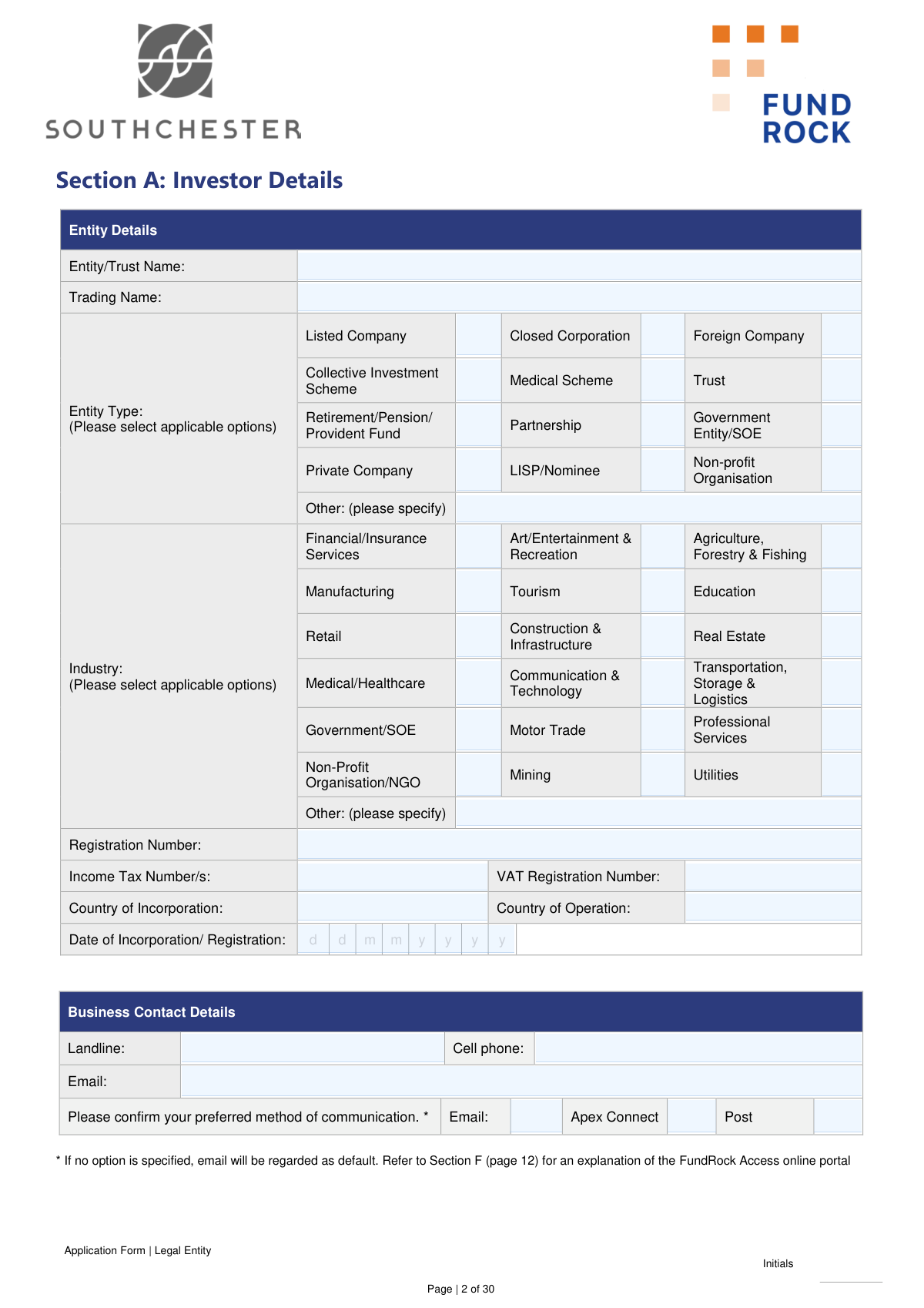
Legal entity forms are essential documents used by corporations, trusts, and LLCs to establish financial accounts or enter into complex investment agreements. These forms are critical for regulatory compliance, specifically regarding anti-money laundering (AML) and "Know Your Customer" (KYC) standards. They often require detailed disclosures about tax residency under FATCA or CRS, financial standing, and the identification of ultimate beneficial owners. By standardizing how entities provide this information, these forms ensure that financial institutions and fund managers can verify the legitimacy of the investing body and its controllers.
By continuing, you acknowledge Instafill's Privacy Policy and agree to get occasional product update and promotional emails.
About legal entity forms
Typically, these forms are utilized by institutional investors, business owners, and legal representatives when applying for specialized financial products or opening corporate brokerage accounts. For example, entities might need to complete a Beneficial Ownership Certification to satisfy federal law or fill out specific application forms for Retail or Qualified Investor Hedge Funds. These situations involve high-stakes financial decisions where precision is paramount, as missing or incorrect information can delay fund access or lead to regulatory non-compliance. Tools like Instafill.ai use AI to fill these legal entity forms in under 30 seconds, handling data accurately and securely to streamline the application process.
Every form on this page can be completed without typing. Instafill is form filling software that reads a PDF and fills it for you — including flat and scanned documents that carry no fillable fields at all.
Forms in This Category
The forms in this category have a median Form Complexity Index of 63/100 (Complex), measured across 4 forms by field count, input difficulty, length, conditional logic and structure. See how it is calculated.
| Form Name | Pages | FCI | |
|---|---|---|---|
| 1. | Application Form: Legal Entities | Qualified Investor Hedge Fund | 1 | Moderate 62 |
| 2. | Fundrock Application Form: Legal Entities | Monthly Liquidity – Qualified Investor Hedge Fund | 1 | Complex 63 |
| 3. | Fundrock Application Form: Legal Entities | Monthly Liquidity – Retail Hedge Fund | 1 | Complex 70 |
| 4. | Legal Entity Beneficial Ownership/Trust Certification Form | 1 | Moderate 58 |
- Enterprise-grade security & data encryption
- 99%+ accuracy powered by AI
- 1,000+ forms from all industries
- Complete forms in under 60 seconds
How to Choose the Right Form
Selecting the correct document for your legal entity involves identifying whether you are applying for a new investment or fulfilling regulatory compliance requirements. These forms are designed for corporations, trusts, and LLCs to navigate financial applications and anti-money laundering (AML) protocols efficiently.
Investing in FundRock Hedge Funds
If your organization is looking to allocate capital into a FundRock-managed fund, your choice depends on your classification as an investor and your specific liquidity needs:
- For Qualified Investors: Use the Application Form: Legal Entities | Qualified Investor Hedge Fund if you meet the specific regulatory criteria for a qualified investor. If you specifically require monthly liquidity options for this fund type, select the Fundrock Application Form: Legal Entities | Monthly Liquidity – Qualified Investor Hedge Fund.
- For Retail Investors: If your entity does not meet the "Qualified" threshold or is opting for a retail-tier product, use the Fundrock Application Form: Legal Entities | Monthly Liquidity – Retail Hedge Fund. This form ensures compliance with FICA, FATCA, and CRS while facilitating your entry into the retail hedge fund space.
Compliance and Ownership Verification
Before an account can be fully activated or during periodic reviews, financial institutions require specific certification regarding who controls the entity to satisfy federal "Know Your Customer" (KYC) requirements:
- Certifying Beneficial Ownership: If you need to identify the individuals who ultimately own or control your corporation, LLC, or trust (specifically for Vanguard accounts), choose the Legal Entity Beneficial Ownership/Trust Certification Form. This is a mandatory document used to prevent illicit financial activities and is often a prerequisite for other financial applications.
Streamline Your Filing
All these forms require extensive data regarding tax residency and ultimate beneficial owners. Using Instafill.ai, you can quickly complete these complex PDFs by letting AI handle the repetitive data entry, ensuring your legal entity remains compliant without the manual paperwork burden.
Form Comparison
| Form | Fund/Account Type | Primary Purpose | Regulatory Focus |
|---|---|---|---|
| Application Form: Legal Entities | Qualified Investor Hedge Fund | Qualified Investor Hedge Fund | Applying for investment in FundRock managed hedge funds | FICA, FATCA, CRS, and investment choice details |
| Fundrock Application Form: Legal Entities | Monthly Liquidity – Qualified Investor Hedge Fund | Qualified Investor Hedge Fund (Monthly Liquidity) | Investment application for specific monthly liquidity portfolios | Tax status declarations and beneficial ownership details |
| Fundrock Application Form: Legal Entities | Monthly Liquidity – Retail Hedge Fund | Retail Hedge Fund (Monthly Liquidity) | Investment application for entities in retail hedge fund portfolios | Tax residency and ultimate beneficial owner compliance |
| Legal Entity Beneficial Ownership/Trust Certification Form | General Financial Accounts (Vanguard) | Certifying beneficial ownership or trust details for account opening | Federal law compliance to prevent illicit financial activities |
Tips for legal entity forms
Legal entity forms require detailed information about individuals who own or control a significant percentage of the entity. Gather their identification documents and tax details beforehand to avoid delays in the application process for hedge funds or trusts.
Hedge fund applications require specific tax residency classifications to comply with international regulations like FATCA and CRS. Consult with your tax advisor to ensure your entity's status is correctly identified to prevent future compliance issues or account freezes.
Always use the exact legal name of the company or trust as it appears on official registration papers or trust deeds. Discrepancies between the application form and supporting KYC documents can lead to immediate rejection by financial institutions.
Many legal entity forms require signatures from specific individuals authorized by a board resolution or trust deed. Ensure you have the necessary internal authorizations ready to prove that the person signing has the legal power to bind the entity.
Managing multiple legal entity applications is time-consuming, but AI-powered tools like Instafill.ai can complete these forms in under 30 seconds with high accuracy. Your sensitive data stays secure during the process, making it a reliable way to handle high-volume financial paperwork.
Different hedge fund forms specify varying liquidity terms, such as monthly or quarterly withdrawal windows. Ensure the form you are filling out matches your entity's liquidity needs to avoid being locked into an unsuitable investment structure.
Financial applications are rarely processed without a full Know Your Customer (KYC) packet, including proof of address and registration. Keep a digital folder of these common documents to quickly attach them whenever you submit a new legal entity form.
Frequently Asked Questions
These forms are used by non-individual entities, such as corporations, trusts, and partnerships, to apply for investment products or open financial accounts. They help financial institutions verify the identity of the entity and ensure compliance with international financial regulations like FICA and FATCA.
The choice depends on your entity's net worth, investment experience, and the specific fund's requirements. Qualified Investor funds often have higher entry thresholds and different risk profiles, whereas retail hedge funds are generally designed to be more accessible to a broader range of legal entities.
Federal regulations require financial institutions to identify the natural persons who ultimately own or control a legal entity to prevent money laundering and other illicit activities. This form ensures transparency by documenting individuals with significant control or ownership stakes within the organization.
These are international tax reporting standards designed to prevent tax evasion across borders. Legal entities must disclose their tax residency and status so that financial institutions can report necessary data to the relevant tax authorities in compliance with global laws.
Yes, AI tools like Instafill.ai can process these complex legal entity forms by accurately extracting data from your source documents and placing it into the required fields. This technology significantly reduces the manual effort involved in documenting entity structures and beneficial owners.
While manual entry for these multi-page documents can take a significant amount of time, using AI tools like Instafill.ai allows you to complete the process in under 30 seconds. The AI quickly maps information from your corporate records directly into the application form.
An authorized signatory, such as a CEO, Managing Member, or Trustee, must usually sign these documents. You may also be required to provide a corporate resolution or a letter of authority to prove that the individual has the legal power to bind the entity to the investment.
You will likely need to provide the entity's registration number, tax identification details, registered address, and financial advisor information. Additionally, details regarding the source of funds and the primary nature of the business are often required for regulatory compliance.
While the core information requested is often standardized by law, each fund manager or bank, such as Fundrock or Vanguard, has its own specific application layout and internal requirements. It is important to use the specific form provided by the institution where you are opening the account.
Once submitted, the financial institution will review the information for compliance and perform 'Know Your Customer' (KYC) checks. If the application is approved, the entity's account will be established, and you will receive instructions on how to finalize the investment or fund the account.
Glossary
- Form Complexity Index
- Instafill’s 0–100 measure of how much effort a form takes to complete, calculated deterministically from the form’s own structure rather than estimated. It combines the number of fillable fields (the largest factor), how difficult those fields are to complete based on their type, the number of pages that contain fields, the amount of conditional “fill-only-if” logic, and how many sections the form is divided into, then adds modifiers for tables and repeating lists, bundled instruction pages, and dense page layouts. A higher score means the form is harder to fill out by hand. The forms in this category have a median Form Complexity Index of 63/100 (Complex). See exactly how it is calculated.
- Beneficial Owner
- An individual who ultimately owns or controls a legal entity, even if the entity is registered under a different name or organization. Identifying these individuals is a legal requirement for financial institutions to prevent money laundering and financial crimes.
- FICA (Financial Intelligence Centre Act)
- A regulatory framework used to combat financial crimes such as money laundering and terrorism financing. It requires legal entities to provide specific verification documents, such as proof of address and registration, when applying for financial products.
- FATCA (Foreign Account Tax Compliance Act)
- A U.S. law that requires non-U.S. financial institutions to report information about accounts held by U.S. taxpayers. Legal entities must disclose their U.S. tax status on these forms to ensure international tax compliance.
- CRS (Common Reporting Standard)
- An international standard for the automatic exchange of financial account information between countries to fight tax evasion. It requires entities to certify their tax residency status so that financial data can be shared with the appropriate global tax authorities.
- Qualified Investor
- A sophisticated investor who meets specific financial thresholds, such as a high net worth or significant investment experience. These investors are permitted to enter into complex hedge fund structures that are not available to the general public.
- Retail Hedge Fund
- A type of hedge fund designed for the general public that typically has lower minimum investment requirements than qualified investor funds. These funds are subject to more stringent regulatory limits to protect less experienced investors.
- Monthly Liquidity
- A fund feature that determines how often an investor can withdraw or 'redeem' their money, specifically allowing for exits once per month. This is a common restriction in hedge funds where assets may take time to sell.
- Legal Entity
- An organization, such as a corporation, trust, or partnership, that is recognized by law as having its own rights and duties separate from its individual members. These forms are specifically designed for these organizations rather than individual people.