Fill out investor application forms
with AI.
Investor application forms are the primary gateway for individuals and legal entities looking to allocate capital into various financial vehicles. These documents are essential for establishing investment accounts, subscribing to hedge funds, or purchasing shares in specific stock offerings. Beyond simple data collection, these forms serve a critical regulatory purpose, ensuring that both the investor and the fund manager comply with international standards like FATCA, CRS, and KYC (Know Your Customer) protocols. Accurate completion is vital to prevent delays in processing and to protect the legal interests of all parties involved.
By continuing, you acknowledge Instafill's Privacy Policy and agree to get occasional product update and promotional emails.
About investor application forms
This category encompasses a wide range of documents tailored to different financial scenarios. For instance, individual investors might encounter applications for retail hedge funds or rollover IRAs, while legal entities like corporations and trusts use specific forms to manage institutional investments or business investor accounts. Whether you are an accredited investor applying for a private placement or a business owner joining a local Chamber of Commerce, these forms require detailed disclosures regarding financial standing, tax residency, and investment objectives. Completing these multi-page documents manually can be a tedious and error-prone process.
Tools like Instafill.ai use AI to fill these forms in under 30 seconds, handling complex financial data accurately and securely to ensure your applications are ready for submission without the usual administrative burden.
Every form on this page can be completed without typing. Instafill is form filling software that reads a PDF and fills it for you — including flat and scanned documents that carry no fillable fields at all.
Forms in This Category
The forms in this category have a median Form Complexity Index of 63/100 (Complex), measured across 23 forms by field count, input difficulty, length, conditional logic and structure. See how it is calculated.
- Enterprise-grade security & data encryption
- 99%+ accuracy powered by AI
- 1,000+ forms from all industries
- Complete forms in under 60 seconds
How to Choose the Right Form
Private Equity and Hedge Fund Applications
If you are looking to invest in a specific fund, your choice depends on your status as an individual or a legal entity, and whether you are a retail or qualified investor.
- For Individuals: Use the Application Form: Individual Investor | Retail Hedge Fund for general access. If you meet higher net worth or experience thresholds, select the Fundrock Qualified Investor Hedge Fund Application Form for Individual Investors.
- For Entities: If you are representing a company or trust, use the Application Form: Legal Entities | Qualified Investor Hedge Fund.
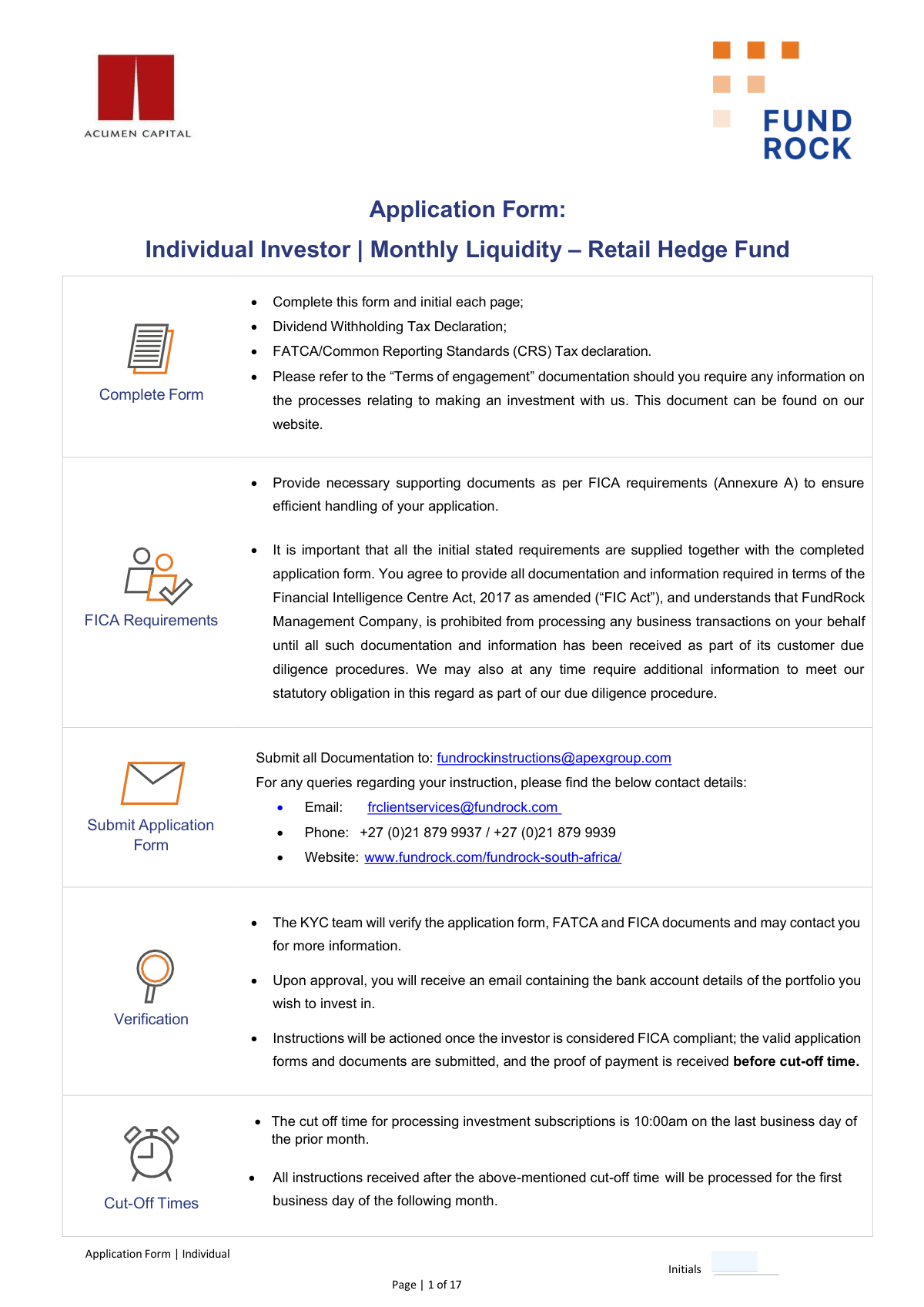
- Liquidity Preferences: If the fund offers specific withdrawal intervals, look for "Monthly Liquidity" versions, such as the Application Form: Individual Investor | Monthly Liquidity – Retail Hedge Fund.
Business and Institutional Accounts
For organizations setting up brokerage or management accounts, the forms focus on corporate transparency and tax status.
- Corporate Trading: Choose the Merrill Business Investor Account (BIA) or the Merrill Edge® Self‑Directed Business Investor Account for self-managed business trading.
- Institutional Assets: Large organizations, foundations, or trusts should use the Northern Trust Institutional Investor Application or the Corporate Investor Application and Agreement - SEI.
Retirement and Individual Brokerage
If your goal is long-term savings or specific stock purchases, look for forms tailored to tax-advantaged accounts.
- IRAs: Use the New York Life Investments Funds Individual Retirement Account Application for new accounts, or the Transamerica Premier Funds Direct Rollover IRA Application to move funds from a previous employer.
- Specific Stock Offerings: For niche opportunities, select the Eagle Point Credit Company Inc. Convertible Preferred Stock Investor Application or the Investor Application and Subscription Agreement for Shares of Common Stock in Oxford Park Income Fund, Inc.
Community and Economic Development
Not all "investments" are financial securities. If you are joining a local business organization, look for membership-based forms like the EDAWN Investor Application or the Huntinging Beach Chamber of Commerce New Investor Packet and Application, which function as membership agreements for regional economic growth.
Tips for investor application forms
Many investor forms require self-certification of your tax residency status to comply with international regulations like FATCA and CRS. Providing incorrect tax identification numbers or failing to disclose all jurisdictions where you are a tax resident can lead to significant processing delays or account rejection.
Hedge funds and private equity often distinguish between Retail, Qualified, and Accredited investors based on net worth or income. Carefully review the eligibility criteria listed in the form to ensure you meet the specific financial thresholds required for that fund class before submission.
Most applications are incomplete without accompanying Know Your Customer (KYC) documents, such as certified IDs, proof of address, and entity registration papers. Having these digital copies ready to upload alongside your application will streamline the verification process with the fund manager.
AI-powered tools like Instafill.ai can complete these complex investor forms in under 30 seconds with high accuracy. Your sensitive financial data stays secure during the process, making it a practical time-saver for investors managing multiple fund applications or rollover requests.
If applying as a trust, company, or partnership, ensure that the individual signing the form has the documented legal authority to bind the entity. Incomplete authorized signatory sections or missing corporate resolutions are among the most common reasons for application delays in institutional investing.
Regulators require fund managers to verify where investment capital originated, such as from salary, inheritance, or business profits. Avoid vague descriptions; providing a clear and specific origin of wealth helps the compliance team clear your application much faster.
Errors in account numbers or routing details can cause failed distributions or delayed investment processing. Pay close attention to sections regarding monthly liquidity or dividend reinvestment options to ensure your funds are managed according to your preferences from day one.
Frequently Asked Questions
These forms are used to establish a formal legal and financial relationship between an investor and a fund or company. They collect essential data for regulatory compliance, such as personal identification, tax residency, and the source of funds, ensuring the investment meets anti-money laundering (AML) and know-your-customer (KYC) standards.
You should select the 'Individual' form if you are investing personal assets in your own name. The 'Legal Entity' forms are specifically designed for corporations, trusts, partnerships, or LLCs where the investment is being made on behalf of an organization rather than a private individual.
A qualified investor is generally someone who meets specific financial thresholds, such as a high net worth or a high level of professional investment experience. Many hedge funds require this designation because their investment products may carry higher risks or have more complex liquidity terms than standard retail funds.
Yes, you can use AI tools like Instafill.ai to complete these complex forms in under 30 seconds. The AI accurately extracts data from your source documents and places it directly into the required fields, significantly reducing the risk of manual entry errors.
Most applications require proof of identity, such as a passport or driver's license, and proof of residence, like a recent utility bill. Depending on the specific fund, you may also need to provide bank statements to verify the source of your investment capital and tax identification numbers for global reporting compliance.
The Foreign Account Tax Compliance Act (FATCA) and Common Reporting Standard (CRS) are international regulations designed to prevent tax evasion. Financial institutions are legally required to collect this information to report the tax residency and account details of their investors to the relevant government authorities.
While manually filling out multi-page investor documents can take 20 to 30 minutes, using an AI-powered service like Instafill.ai can reduce this to less than 30 seconds. The tool automates the data entry process by pulling information from your existing records and accurately populating the PDF.
Retail hedge funds are generally accessible to the broader public and often have lower minimum investment requirements. In contrast, qualified investor hedge funds are intended for individuals or entities with significant assets and expertise, and the application process typically involves more stringent eligibility checks.
Submission instructions are usually detailed at the end of the form or in the investment memorandum. Most modern funds allow for digital submission via secure portals or encrypted email, though some institutions may still require physical copies to be mailed to their transfer agent or administrative office.
A subscription agreement is a legally binding contract where the investor agrees to purchase a specific number of shares at a set price. It is frequently bundled with the application form to formalize the investor's commitment and ensure they have acknowledged the terms, conditions, and risks associated with the investment.
Glossary
- Form Complexity Index
- Instafill’s 0–100 measure of how much effort a form takes to complete, calculated deterministically from the form’s own structure rather than estimated. It combines the number of fillable fields (the largest factor), how difficult those fields are to complete based on their type, the number of pages that contain fields, the amount of conditional “fill-only-if” logic, and how many sections the form is divided into, then adds modifiers for tables and repeating lists, bundled instruction pages, and dense page layouts. A higher score means the form is harder to fill out by hand. The forms in this category have a median Form Complexity Index of 63/100 (Complex). See exactly how it is calculated.
- FATCA (Foreign Account Tax Compliance Act)
- A U.S. law requiring foreign financial institutions to report information about accounts held by U.S. taxpayers to help prevent tax evasion.
- CRS (Common Reporting Standard)
- An international standard for the automatic exchange of financial account information between countries to combat global tax non-compliance.
- KYC (Know Your Customer)
- The mandatory process of verifying an investor's identity and assessing their suitability to prevent money laundering and illegal activities.
- Qualified Investor
- An individual or entity that meets high financial thresholds, such as a significant net worth, which allows them to invest in complex or high-risk hedge funds.
- Accredited Investor
- A person or business entity that is legally permitted to invest in private securities not registered with financial authorities, based on their income or net worth.
- Subscription Agreement
- A legally binding contract between an investor and a company where the investor agrees to buy a set number of shares at a specific price.
- FICA (Financial Intelligence Centre Act)
- A regulatory framework, often found in South African investment forms, used to identify and verify investors to prevent financial crimes like money laundering.
- Beneficial Owner
- The individual who ultimately owns or controls a legal entity (like a company or trust) and benefits from the assets held in its name.