Yes! You can use AI to fill out Investment Funds Distributor Due Diligence Questionnaire
This questionnaire is a standardized document designed to help fund sponsors and manufacturers conduct thorough due diligence on their distribution partners. It covers critical areas such as the distributor's legal structure, business model, operational capabilities, regulatory compliance, risk management, and anti-money laundering (AML) procedures. Completing this form ensures that distributors meet the necessary standards for partnership. Today, this form can be filled out quickly and accurately using AI-powered services like Instafill.ai, which can also convert non-fillable PDF versions into interactive fillable forms.
Investment Funds Distributor DDQ is part of the
due diligence forms, investment forms, fund investment forms, investment fund forms, financial due diligence forms, distributor compliance forms and fund management forms categories on Instafill.
Rather not fill this in by hand? Instafill is an online form filler that completes PDF forms automatically — upload the blank form, answer a few questions, and the AI fills every field.
Form specifications
| Form name: | Investment Funds Distributor Due Diligence Questionnaire |
| Number of pages: | 1 |
| Language: | English |
Our AI automatically handles information lookup, data retrieval, formatting, and form filling.
It takes less than a minute to fill out Investment Funds Distributor DDQ using our AI form filling.
Securely upload your data. Information is encrypted in transit and deleted immediately after the form is filled out.
Instafill Demo: How to fill out PDF forms in seconds with AI
How to Fill Out Investment Funds Distributor DDQ Online for Free in 2026
Are you looking to fill out a INVESTMENT FUNDS DISTRIBUTOR DDQ form online quickly and accurately? Instafill.ai offers the #1 AI-powered PDF filling software of 2026, allowing you to complete your INVESTMENT FUNDS DISTRIBUTOR DDQ form in just 37 seconds or less.
Follow these steps to fill out your INVESTMENT FUNDS DISTRIBUTOR DDQ form online using Instafill.ai:
- 1 Navigate to Instafill.ai and upload or select the Investment Funds Distributor Due Diligence Questionnaire.
- 2 Use the AI assistant to automatically populate Section 1 with your financial institution's general information, such as legal name, address, regulatory status, and ownership structure.
- 3 Complete Section 2 by providing details on your business model, assets under distribution, trading methods, and the types of clients you serve.
- 4 Answer the detailed questions in Sections 3 and 4 regarding your distribution practices, suitability assessments, marketing material policies, and oversight of any sub-distributors.
- 5 Fill out the sections on Legal Oversight, Risk Management, and Anti-Money Laundering (Sections 5-7) by detailing your firm's compliance programs, internal controls, and policies.
- 6 Review all the information entered with the help of the AI tool to ensure accuracy and completeness across all sections of the questionnaire.
- 7 Securely download, print, or share the completed due diligence questionnaire directly from the platform.
Our AI-powered system ensures each field is filled out correctly, reducing errors and saving you time.
Why Choose Instafill.ai for Your Fillable Investment Funds Distributor DDQ Form?
Speed
Complete your Investment Funds Distributor DDQ in as little as 37 seconds.
Up-to-Date
Always use the latest 2026 Investment Funds Distributor DDQ form version.
Cost-effective
No need to hire expensive lawyers.
Accuracy
Our AI performs 10 compliance checks to ensure your form is error-free.
Security
Your personal information is protected with bank-level encryption.
Frequently Asked Questions About Investment Funds Distributor DDQ
This questionnaire is designed to help fund sponsors and manufacturers conduct due diligence on their distribution partners. It ensures that distributors like your firm meet the necessary regulatory, operational, and compliance standards before and during your partnership.
Financial institutions and intermediaries, such as private banks, wealth managers, financial advisers, and fund platforms, that distribute or intend to distribute investment funds must complete this form for the fund sponsor.
You must identify any individual who directly or indirectly owns 25% or more of your company's shares or voting rights. You will need to provide their full name and the percentage of control they hold.
Yes, if you use a third-party sub-distribution network, you must complete Section 4, 'Oversight of Sub-Distribution'. This section covers your due diligence, contracting, and monitoring processes for those partners.
You must disclose this in Section 5.1. Be prepared to provide details, links to public information, and an explanation of the corrective actions your firm has taken to address the deficiencies.
The Wolfsberg Questionnaire is a standardized due diligence tool used by financial institutions to assess their anti-money laundering (AML) and counter-terrorist financing (CTF) policies. If you perform KYC on clients, you are asked to include your completed questionnaire.
MiFID stands for the Markets in Financial Instruments Directive, a key EU regulation for financial services. A MiFID entity is a firm that is subject to this regulation, which imposes specific requirements for client protection, transparency, and reporting.
A suitability test is more comprehensive and ensures an investment aligns with a client's full financial situation and objectives, typically for advisory services. An appropriateness test simply checks if a client has the knowledge and experience to understand the risks of a product, used for non-advised services.
The form itself does not specify submission methods. You should submit the completed questionnaire directly to the fund sponsor or manufacturer who requested it, following their specific delivery instructions.
Yes, services like Instafill.ai use AI to help you fill out complex forms accurately and efficiently. These tools can auto-fill many fields based on your company's data, saving you significant time.
If you have a non-fillable or 'flat' PDF, you can use a service like Instafill.ai. It can convert the static document into an interactive, fillable form that you can complete and save online.
Simply upload the Investment Funds Distributor Due Diligence Questionnaire to the Instafill.ai platform. The AI will identify all the form fields, allowing you to fill them out online, save your progress, and download the completed document.
Be prepared to provide links to your company website, your regulator's website, and details on your board of directors. You may also need to provide information on public regulatory actions or attach documents like the Wolfsberg questionnaire.
If your firm is not regulated, you must select 'No' and provide a rationale explaining why you are qualified to act as an investment fund distributor. This is a critical part of the due diligence process for the fund sponsor.
Review times vary depending on the fund sponsor's internal processes and the completeness of your submission. For an estimated timeline, it is best to ask the requesting firm directly after you have submitted the form.
Compliance Investment Funds Distributor DDQ
Validation Checks by Instafill.ai
1
Legal Entity Identifier (LEI) Format
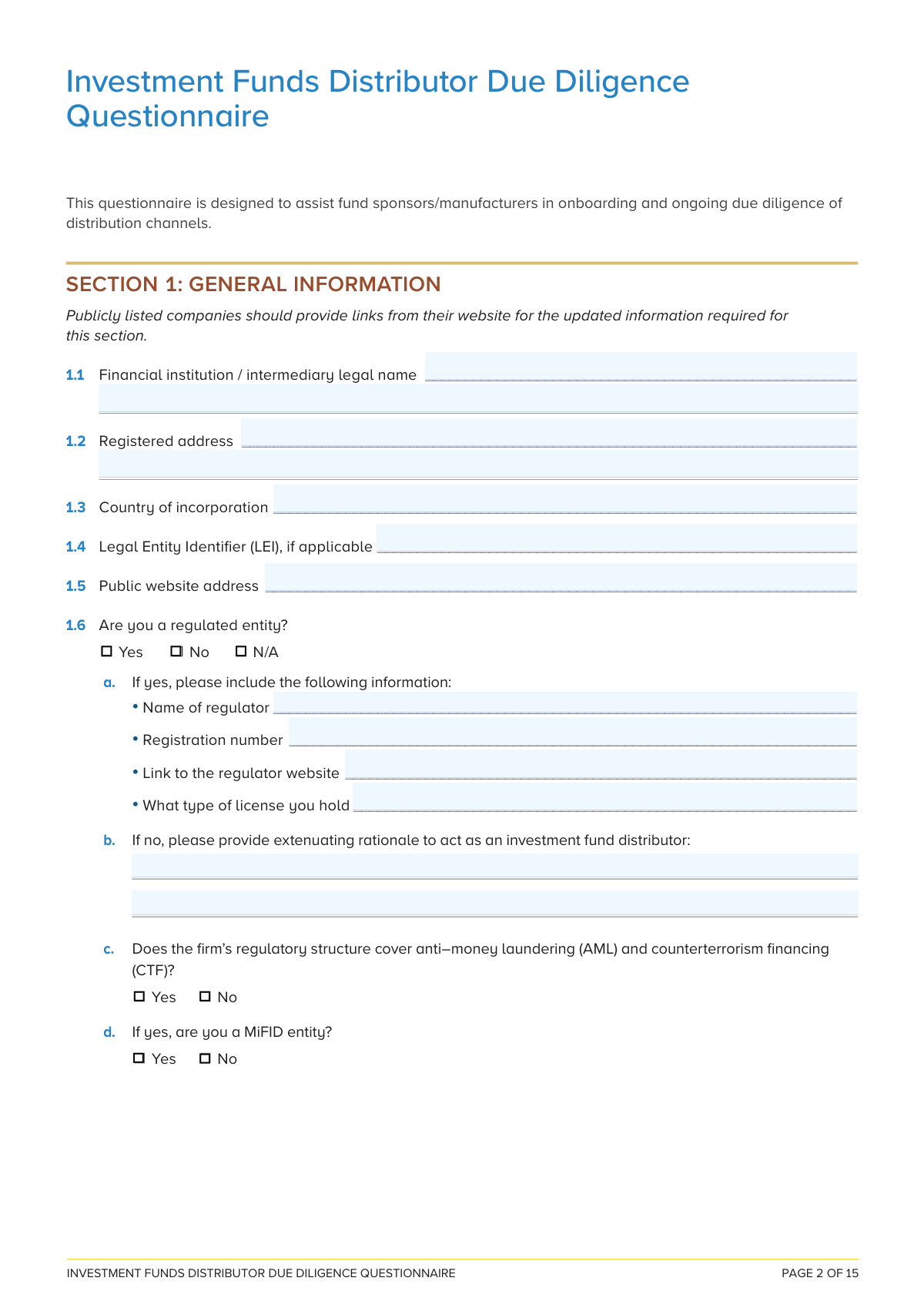
This check validates that the value entered in the 'Legal Entity Identifier (LEI)' field (1.4) conforms to the standard 20-character alphanumeric format. The LEI is a global standard for identifying legal entities, and an incorrect format would make the identifier useless for automated verification and regulatory reporting. If the format is invalid, the submission should be blocked with an error message explaining the correct format.
2
Conditional Requirement for Regulator Details
This validation ensures that if the user answers 'Yes' to being a regulated entity (1.6), then the subsequent fields for 'name of regulator', 'registration number', 'link to the regulator website', and 'What type of license you hold' are mandatory. This is crucial for due diligence, as it provides the necessary information to verify the entity's regulatory standing. A failure to provide these details would render the 'Yes' answer incomplete and unverified.
3
Regulator Website URL Validation
This check verifies that the input for 'link to the regulator website' (1.6a) is a valid and properly formatted URL (e.g., starts with http:// or https://). This ensures that the provided link is functional and can be used by the reviewing party to directly access the regulator's site for verification purposes. An invalid URL would create a dead end in the due diligence process, requiring manual follow-up.
4
Conditional Requirement for Parent Company Details
This validation rule is triggered if the user answers 'Yes' to being a wholly owned subsidiary (1.7). It makes the parent company's 'Full legal name' and 'country of registration' mandatory fields. This information is essential for understanding the complete ownership structure and assessing group-level risk. Without it, a significant part of the entity's corporate structure remains unknown.
5
Ultimate Beneficial Owner (UBO) Details Completeness
If the user answers 'Yes' to having a UBO (1.9), this check ensures that at least one row is completed with the UBO's name and their percentage of control. It also validates that the 'Percentage controlled' value is a number greater than or equal to 25. This is a critical anti-money laundering (AML) requirement to identify the natural persons who ultimately own or control the entity.
6
Mandatory Rationale for Non-Regulated Status
This check ensures that if a firm indicates it is not a regulated entity by selecting 'No' in question 1.6, it must provide a justification in the 'extenuating rationale' field. Acting as an investment fund distributor without regulatory oversight is a significant risk flag. This validation forces the applicant to explain their position, which is critical for the risk assessment process.
7
Mandatory Description for 'Other' Selections
This validation applies to multiple questions (e.g., 2.3, 2.4, 2.5) where an 'other' option can be selected. If the 'other' checkbox is ticked, the corresponding text field to describe the 'other' category must not be empty. This prevents ambiguous responses and ensures that all aspects of the distributor's business model are clearly documented and understood.
8
Conditional Logic for Sub-Distribution Section
This rule governs the visibility and requirement of Section 4. If the user answers 'No' to using sub-distributors (4.1), the rest of Section 4 is not required and should be hidden or disabled. If the answer is 'Yes', then subsequent questions, such as 4.1a ('are they internal or external'), become mandatory, ensuring that the full oversight process for sub-distributors is documented.
9
Mandatory Rationale for No Formal Sub-Distributor Contracts
If a firm uses sub-distributors but answers 'No' to having formal contracts with them (4.4), a rationale must be provided. The absence of formal contracts is a major compliance and operational risk, as it implies a lack of defined obligations and liabilities. This validation ensures that such a high-risk practice is explicitly justified by the applicant.
10
Nested Conditional Logic for Audit Findings
This check implements a two-level condition for question 5.4. If the answer to 'Were any material audit findings...?' is 'Yes', then question 5.4a ('were all the audit findings resolved?') becomes mandatory. Furthermore, if the answer to 5.4a is 'No', the explanation field becomes mandatory, ensuring that any outstanding material issues are disclosed and explained.
11
Mandatory Explanation for Negative Risk Control Answers
This validation applies to several questions in Section 6 (e.g., 6.1, 6.2, 6.3). If the user answers 'No' to having a specific risk management or control function (like an internal compliance function), the corresponding 'please explain' field becomes mandatory. This is vital for understanding potential gaps in the firm's risk and control framework and assessing their mitigating actions.
12
Mandatory Details for Sanctioned Customer Dealings
This is a critical AML validation for question 7.6. If the firm confirms 'Yes' to having dealings with customers on a sanctions list, the text field to provide details becomes mandatory. This disclosure is essential for the fund sponsor to understand the nature of the risk and ensure compliance with global sanctions regulations.
13
Completeness of Core Entity Information
This is a fundamental check to ensure that the most basic identifying information in Section 1 is complete. The fields for 'Financial institution / intermediary legal name' (1.1), 'registered address' (1.2), and 'country of incorporation' (1.3) must not be left empty. Without this core data, the entire due diligence questionnaire is meaningless as the subject entity is not properly identified.
14
Logical Consistency for MiFID Status
This check ensures a logical flow between related questions 1.6c and 1.6d. The question 'are you a MiFID entity?' (1.6d) should only be answerable if the firm has already confirmed that its regulatory structure covers AML/CTF by answering 'Yes' to question 1.6c. This prevents contradictory or nonsensical answers regarding the firm's regulatory framework.
Common Mistakes in Completing Investment Funds Distributor DDQ
Applicants often enter their commonly used trading name or brand name in field 1.1 instead of the complete, official legal entity name as it appears on incorporation documents. This creates discrepancies during verification against official registries and can delay the due diligence process. Always use the full, registered legal name to ensure accuracy and avoid mismatches with regulatory and legal records.
When an applicant confirms they are a regulated entity in question 1.6, they frequently fail to provide all the required follow-up information, such as the specific license type or a valid link to their registration on the regulator's website. This omission forces the reviewing party to conduct manual research and can be interpreted as a lack of transparency. To avoid this, double-check that all sub-fields are completed accurately if you answer 'Yes' to being regulated.
In question 1.9, filers often misinterpret the 25% ownership threshold or the concept of 'indirect' control, leading to an incorrect or incomplete list of UBOs. This is a critical compliance failure that can have serious AML/CTF implications. It is essential to carefully trace the ownership structure to identify all individuals who meet the UBO criteria and list them accurately.
The form requires supplementary information, such as a list of directors (Q1.11), the Wolfsberg questionnaire (Q7.2), or details of regulatory actions (Q5.1), which can be provided as attachments or links. A common mistake is to mention these documents but forget to attach them or to provide broken or outdated URLs. This results in an incomplete submission, requiring follow-up and delaying the review process.
Throughout the questionnaire, selecting 'No' for critical control questions (e.g., 4.4, 5.5, 6.1) triggers a requirement for a written rationale. Applicants frequently leave these explanation fields blank, which is a major red flag suggesting a potential gap in their control framework. Always provide a clear and comprehensive explanation whenever one is required to justify a negative response.
Applicants sometimes provide contradictory information across different sections, creating confusion and undermining the credibility of the submission. For example, they might indicate they are not a MiFID entity (Q1.6d) but then select MiFID-specific advisory services (Q2.4). Such inconsistencies require clarification and can be prevented by reviewing the entire form for consistency before submission.
In complex sections like 'types of services' (Q2.4) or 'AML policies' (Q7.8), users may rush and select only the most obvious options or, conversely, check boxes for policies that are not fully implemented. This provides an inaccurate picture of the firm's business model and compliance maturity. Carefully review each option and select all that accurately and fully describe your firm's activities and controls.
Questions regarding MiFID target markets (Q3.10) and suitability tests (Q3.9) are highly specific to certain regulatory regimes. Firms may incorrectly answer 'Yes' without having the necessary frameworks in place, or answer 'N/A' when the rules do apply to them. This can lead to significant compliance risks, so it is crucial to understand the specific regulatory obligations before answering.
This form is often distributed as a non-fillable PDF, leading users to print and complete it by hand. This can result in illegible handwriting, information written outside the designated fields, and poor-quality scans, which complicates data processing and can lead to errors. Using a tool like Instafill.ai can convert the flat PDF into a fillable form, ensuring all entries are clear, legible, and correctly placed.
The form contains conditional logic, such as instructing applicants to skip the sub-distribution section (Section 4) if they answer 'No' to question 4.1. A common error is to either ignore this instruction and fill out the irrelevant section, or to mistakenly skip a required section. AI-powered form fillers like Instafill.ai can help by automatically hiding or showing relevant sections based on your answers, preventing this type of error.
Saved over 80 hours a year
“I was never sure if my IRS forms like W-9 were filled correctly. Now, I can complete the forms accurately without any external help.”
Kevin Martin Green
Your data stays secure with advanced protection from Instafill and our subprocessors




Robust compliance program
Transparent business model
You’re not the product. You always know where your data is and what it is processed for.
ISO 27001, HIPAA, and GDPR
Our subprocesses adhere to multiple compliance standards, including but not limited to ISO 27001, HIPAA, and GDPR.
Security & privacy by design
We consider security and privacy from the initial design phase of any new service or functionality. It’s not an afterthought, it’s built-in, including support for two-factor authentication (2FA) to further protect your account.
Fill out Investment Funds Distributor DDQ with Instafill.ai
Worried about filling PDFs wrong? Instafill securely fills investment-funds-distributor-due-diligence-questionnaire forms, ensuring each field is accurate.
