Fill out financial institution forms
with AI.
Financial institution forms are essential for regulatory compliance and operational transparency in the global banking and investment sectors. These documents ensure that organizations adhere to strict Anti-Money Laundering (AML) and Know Your Customer (KYC) regulations, which are designed to prevent financial crimes such as money laundering and terrorism financing. By collecting detailed information on legal structures and internal controls, these forms help maintain the integrity of the financial system and protect institutions from significant legal and financial risks.
By continuing, you acknowledge Instafill's Privacy Policy and agree to get occasional product update and promotional emails.
About financial institution forms
These forms are typically required by corporate entities, investment firms, and non-financial institutions when opening new accounts, certifying beneficial ownership, or undergoing periodic due diligence reviews. For instance, an organization might need to complete an AML & KYC Questionnaire or a Beneficial Ownership Certification when partnering with international development banks or asset management groups. Because these documents often demand granular details about ownership structures and tax reporting statuses, they can be time-consuming and complex to navigate manually.
Tools like Instafill.ai use AI to fill these forms in under 30 seconds, handling the data accurately and securely so you can focus on your core business operations. This automated approach eliminates the friction of manual data entry while ensuring that all required fields are addressed in compliance with international reporting standards.
Every form on this page can be completed without typing. Instafill is form filling software that reads a PDF and fills it for you — including flat and scanned documents that carry no fillable fields at all.
Forms in This Category
The forms in this category have a median Form Complexity Index of 58/100 (Moderate), measured across 5 forms by field count, input difficulty, length, conditional logic and structure. See how it is calculated.
| Form Name | Pages | FCI | |
|---|---|---|---|
| 1. | Account Opening Form for Professional Clients (Institutions, Companies, Intermediaries and Eligible Counterparties) | 1 | Complex 63 |
| 2. | IsDB Group AML & KYC Questionnaire (Financial Institutions) | 1 | Moderate 54 |
| 3. | IsDB Group AML & KYC Questionnaire (Non-Financial Institutions) | 1 | Moderate 50 |
| 4. | Legal Entity Beneficial Ownership/Trust Certification Form | 1 | Moderate 58 |
| 5. | Macquarie Asset Management AML/KYC Form | 1 | Moderate 61 |
- Enterprise-grade security & data encryption
- 99%+ accuracy powered by AI
- 1,000+ forms from all industries
- Complete forms in under 60 seconds
How to Choose the Right Form
Choosing the right financial institution form depends primarily on whether you are opening a new account, undergoing a periodic compliance review, or certifying the ownership structure of a legal entity. Most of these documents are mandatory for meeting Anti-Money Laundering (AML) and Know Your Customer (KYC) regulations.
Investment Account Onboarding
If you are an institutional investor or a corporate entity looking to establish a new investment position, you will need forms specific to the fund manager:
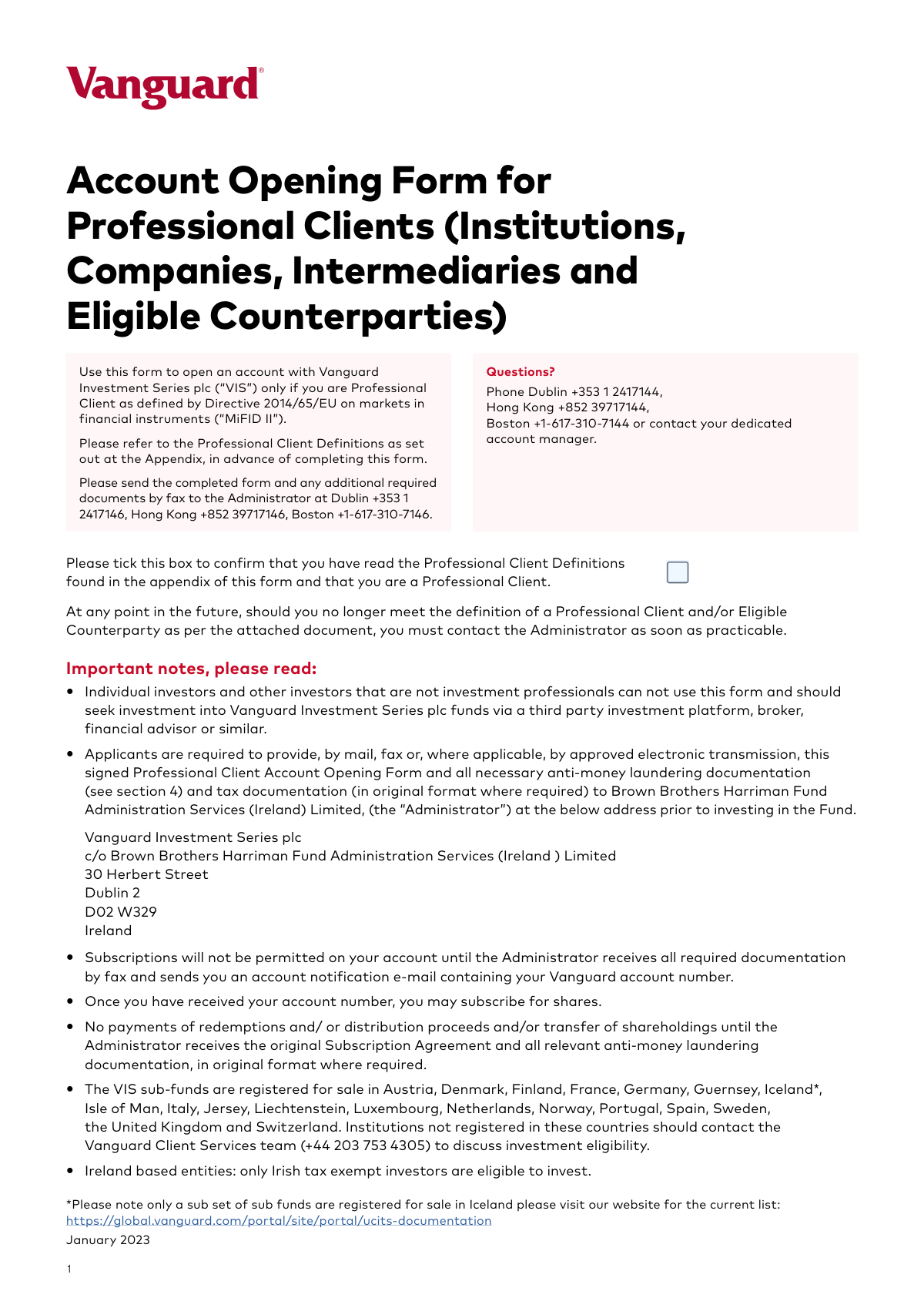
- Account Opening Form for Professional Clients (Institutions, Companies, Intermediaries and Eligible Counterparties): Use this for Vanguard Investment Series plc accounts to establish status under MiFID II.
- Macquarie Asset Management AML/KYC Form: This is the mandatory starting point for new investors with Macquarie to verify background information and the legitimacy of funds.
International Compliance & Due Diligence
If you are establishing or maintaining a business relationship with the Islamic Development Bank (IsDB) Group, your choice depends strictly on your entity type:
- IsDB Group AML & KYC Questionnaire (Financial Institutions): Select this if you represent a bank, insurance company, or other regulated financial firm.
- IsDB Group AML & KYC Questionnaire (Non-Financial Institutions): Use this version for all other corporate structures, legal entities, and commercial businesses.
Ownership & Trust Certification
When federal law requires you to disclose the individuals who ultimately own or control a legal entity—such as an LLC, corporation, or trust—use the Legal Entity Beneficial Ownership/Trust Certification Form. This form is essential for preventing illicit financial activity and is a standard requirement for most entity-based account registrations in the United States.
Whether you are dealing with non-fillable PDFs or complex multi-page questionnaires, you can use Instafill.ai to quickly complete these documents with AI assistance, ensuring all regulatory data is captured accurately.
Form Comparison
| Form | Primary Purpose | Target Entity | Key Compliance Area |
|---|---|---|---|
| Account Opening Form for Professional Clients (Institutions, Companies, Intermediaries and Eligible Counterparties) | Open investment accounts and establish professional client status. | Institutions, companies, and professional intermediaries. | MiFID II classification, FATCA/CRS tax reporting, and AML. |
| IsDB Group AML & KYC Questionnaire (Financial Institutions) | Perform customer due diligence for IsDB business relationships. | Banks and other registered financial institutions. | Institutional AML/CFT controls and international standards compliance. |
| IsDB Group AML & KYC Questionnaire (Non-Financial Institutions) | Conduct due diligence for non-financial entity customers. | Corporations and non-financial legal entities. | Legal structure verification and entity-level AML/CFT policies. |
| Legal Entity Beneficial Ownership/Trust Certification Form | Identify individuals who ultimately own or control an entity. | Corporations, LLCs, and various trust structures. | Federal beneficial ownership laws and illicit finance prevention. |
| Macquarie Asset Management AML/KYC Form | Provide mandatory identification and background for new investors. | New individual or entity investors with Macquarie. | Anti-Money Laundering and Counter-Terrorism Financing Act 2006. |
Tips for financial institution forms
Ensure you have the full legal names, dates of birth, and tax identification numbers for all individuals with significant ownership or control. Incomplete or inconsistent ownership data is one of the most common reasons financial institutions reject these applications during the due diligence phase.
Most financial institution forms require accompanying documents like Articles of Incorporation, trust deeds, or government-issued IDs for signatories. Having digital copies of these files ready before you start filling out the forms will prevent delays and help you cross-reference details accurately.
Discrepancies between the address on a utility bill and the address entered on a KYC questionnaire can trigger lengthy manual reviews. Double-check that every field matches your official registration documents exactly to ensure a smooth and rapid approval process.
AI-powered tools like Instafill.ai can complete these forms in under 30 seconds with high accuracy, significantly reducing the burden of manual data entry. The data stays secure during the process, providing a practical and safe solution for professionals dealing with high volumes of institutional paperwork.
When filling out forms for professional clients or intermediaries, clearly indicate your MiFID II status or equivalent local regulatory standing. Misclassifying your entity can lead to incorrect tax reporting under FATCA/CRS or the application of unsuitable investment protections.
Identify which individuals have the legal authority to bind the institution before starting the form. Many financial documents require multiple signatures from specific roles, such as a CEO or Compliance Officer, so mapping this out early avoids last-minute coordination issues.
Frequently Asked Questions
These forms are standardized documents used by banks, investment firms, and credit unions to collect essential information from clients. They are primarily used for account registration, tax reporting, and ensuring compliance with international financial regulations.
Anti-Money Laundering (AML) and Know Your Customer (KYC) forms are required by law to prevent financial crimes like money laundering and terrorism financing. These questionnaires help institutions verify the identity of their clients and the legitimacy of their business activities.
A Professional Client typically refers to large entities such as institutions, companies, and eligible counterparties that possess the experience and expertise to make their own investment decisions. These entities are often subject to different regulatory requirements than individual retail investors.
This form is used to identify the specific individuals who ultimately own or control a legal entity, such as a corporation or a trust. Financial institutions are legally required to collect this data to ensure transparency and prevent the misuse of legal structures for illicit activities.
Yes, you can use AI tools like Instafill.ai to complete these complex documents in under 30 seconds. The AI accurately extracts data from your source documents and places it directly into the required fields, even on non-fillable PDF forms.
Forms for financial institutions often focus on technical details regarding the entity's internal compliance controls and regulatory oversight. In contrast, forms for non-financial institutions focus more on the entity's legal structure, ownership, and general business operations.
You should generally have your entity's registration documents, tax identification numbers, and identification for all beneficial owners or controllers. Having these digital documents ready allows AI tools to scan and populate your forms much more efficiently.
While manual entry can take an hour or more due to the technical nature of the questions, using an AI-powered service like Instafill.ai can reduce this time to less than 30 seconds. The tool automates the data entry process by pulling information directly from your existing records.
Completed forms are typically submitted directly to the compliance or onboarding department of the specific institution, such as Vanguard, Macquarie, or the IsDB Group. Most modern institutions provide a secure portal for digital uploads or accept encrypted email submissions.
Yes, financial institutions require you to submit updated forms whenever there is a significant change in ownership, legal status, or control. Maintaining current information is a key part of ongoing regulatory compliance and ensures your account remains in good standing.
Completing these forms is a mandatory legal requirement for any entity or individual wishing to establish a business relationship with a regulated financial institution. Failure to provide the requested information will result in the institution being unable to open or maintain your account.
Many financial institution forms include sections for FATCA (Foreign Account Tax Compliance Act) and CRS (Common Reporting Standard) details. These sections are used to identify the tax residency of account holders to ensure proper reporting to relevant global tax authorities.
Glossary
- Form Complexity Index
- Instafill’s 0–100 measure of how much effort a form takes to complete, calculated deterministically from the form’s own structure rather than estimated. It combines the number of fillable fields (the largest factor), how difficult those fields are to complete based on their type, the number of pages that contain fields, the amount of conditional “fill-only-if” logic, and how many sections the form is divided into, then adds modifiers for tables and repeating lists, bundled instruction pages, and dense page layouts. A higher score means the form is harder to fill out by hand. The forms in this category have a median Form Complexity Index of 58/100 (Moderate). See exactly how it is calculated.
- AML (Anti-Money Laundering)
- A set of laws and regulations designed to prevent criminals from disguising illegally obtained funds as legitimate income.
- KYC (Know Your Customer)
- A mandatory process for financial institutions to verify the identity and background of their clients to prevent fraud and financial crimes.
- Beneficial Owner
- The individual who ultimately owns or controls a legal entity, such as a company or trust, regardless of who is listed as the legal owner.
- FATCA (Foreign Account Tax Compliance Act)
- A United States law that requires international financial institutions to report information about accounts held by U.S. taxpayers.
- CRS (Common Reporting Standard)
- An international framework for the automatic exchange of financial information between countries to combat global tax evasion.
- CFT (Counter-Financing of Terrorism)
- Regulatory measures and internal bank policies specifically aimed at detecting and stopping the flow of funds to terrorist organizations.
- Legal Entity
- An organization like a corporation, partnership, or trust that has the legal standing to enter into contracts and open financial accounts.
- MiFID II
- A European regulatory framework used to classify investors as retail or professional to ensure they receive appropriate levels of protection and disclosure.