Fill out banking compliance forms
with AI.
Banking compliance forms are essential for maintaining the integrity of the global financial system and ensuring that institutions adhere to strict regulatory standards. These documents, which cover critical areas such as Anti-Money Laundering (AML) and Know Your Customer (KYC) protocols, serve as a primary defense against financial crime. By standardizing the collection of data regarding institutional policies and procedures, these forms help organizations verify the legitimacy of their partners and maintain transparency in international transactions.
By continuing, you acknowledge Instafill's Privacy Policy and agree to get occasional product update and promotional emails.
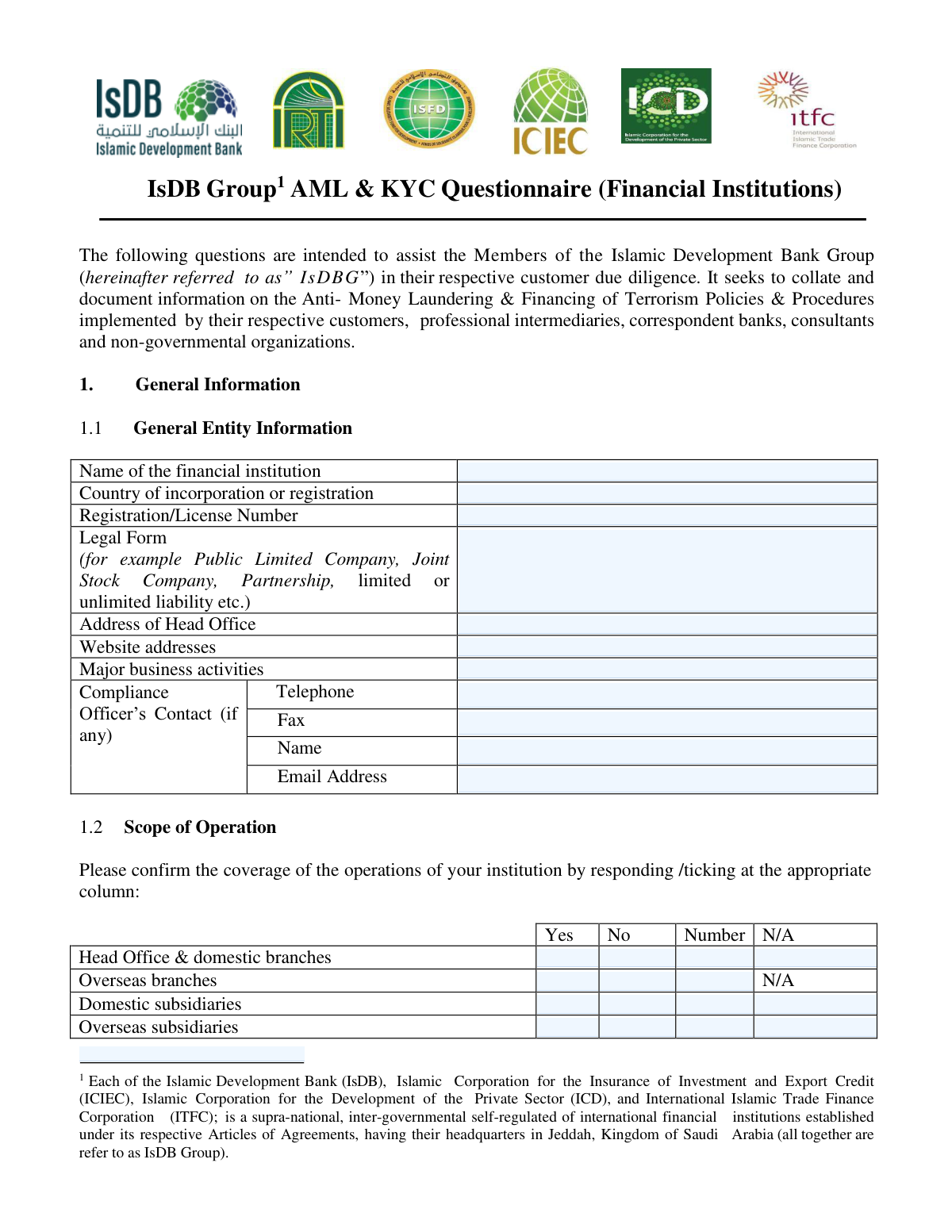
About banking compliance forms
These forms are typically required by compliance officers, legal departments, and financial analysts at banks and investment firms. They are most commonly needed during the onboarding of new institutional clients or when conducting periodic due diligence reviews. For instance, questionnaires like those used by the IsDB Group are vital for assessing the risk profile of financial institutions before establishing a working relationship. Completing these documents accurately is necessary to avoid regulatory penalties and ensure smooth operational workflows.
While the information required is often complex, the process of data entry does not have to be a manual burden. Tools like Instafill.ai use AI to fill these compliance forms in under 30 seconds, handling sensitive data accurately and securely. This practical application of technology helps professionals streamline their administrative tasks and focus on higher-level risk management.
Every form on this page can be completed without typing. Instafill is form filling software that reads a PDF and fills it for you — including flat and scanned documents that carry no fillable fields at all.
Forms in This Category
The forms in this category have a median Form Complexity Index of 54/100 (Moderate), measured across 1 forms by field count, input difficulty, length, conditional logic and structure. See how it is calculated.
| Form Name | Pages | FCI | |
|---|---|---|---|
| 1. | IsDB Group AML & KYC Questionnaire (Financial Institutions) | 1 | Moderate 54 |
- Enterprise-grade security & data encryption
- 99%+ accuracy powered by AI
- 1,000+ forms from all industries
- Complete forms in under 60 seconds
How to Choose the Right Form
Navigating banking compliance requires precision and strict adherence to international standards. While this category currently focuses on a specific high-stakes document, understanding its purpose is essential for financial entities engaging with international development organizations.
Identifying the Right Documentation
If your organization is establishing or maintaining a relationship with the Islamic Development Bank (IsDB) Group, you will likely be required to submit the IsDB Group AML & KYC Questionnaire (Financial Institutions). This is not a general-purpose form; it is specifically designed for:
- Financial Institutions: Banks, investment firms, and credit unions partnering with or seeking funding from the IsDB.
- Due Diligence Processes: Organizations undergoing periodic compliance reviews or initial onboarding procedures.
- Compliance Officers: Teams responsible for demonstrating robust Anti-Money Laundering (AML) and Counter-Financing of Terrorism (CFT) frameworks.
Key Sections of the Questionnaire
Before you begin the filing process, ensure you have the necessary internal documentation ready. The IsDB Group AML & KYC Questionnaire typically requests detailed information on:
- Institutional Policies: Documentation of your internal AML/CFT controls and risk management strategies.
- Regulatory Standing: Information regarding your local regulatory body, licensing status, and legal jurisdiction.
- Transaction Monitoring: Specific details on how your institution identifies, investigates, and reports suspicious activity.
- Sanctions Screening: Processes and software used for checking clients against international watchlists and PEP (Politically Exposed Persons) databases.
Streamlining Your Compliance Workflow
Filling out complex questionnaires like the IsDB Group AML & KYC Questionnaire can be time-consuming and prone to manual errors. Using Instafill.ai allows you to:
- Convert Static PDFs: Instantly turn non-fillable compliance documents into interactive, fillable forms.
- AI-Assisted Completion: Use AI to help populate standard institutional data, ensuring consistency across your compliance filings.
- Accuracy: Reduce the risk of missing critical fields that could delay your partnership with the IsDB Group.
If your institution is not working with the IsDB Group specifically, you may need to look for standard Wolfsberg Group questionnaires or regional regulatory forms. However, for IsDB partners, this specific questionnaire is the mandatory tool for verifying your compliance integrity.
Form Comparison
| Form | Primary Purpose | Target Audience | Regulatory Focus | Key Information Required |
|---|---|---|---|---|
| IsDB Group AML & KYC Questionnaire (Financial Institutions) | Conduct customer due diligence and assess AML/CFT compliance of partner institutions. | Financial institutions engaging in business or partnerships with the IsDB Group. | Anti-Money Laundering (AML) and Counter-Financing of Terrorism (CFT) standards. | Details on internal controls, risk assessment policies, and management oversight procedures. |
Tips for banking compliance forms
AI-powered tools like Instafill.ai can complete these extensive banking compliance forms in under 30 seconds with high accuracy. Your data stays secure during the process, making it a highly efficient way to manage repetitive regulatory paperwork across multiple institutions.
Banking compliance forms often require specific attachments such as AML policies, business licenses, and organizational charts. Having these digitized and ready will prevent interruptions and ensure your answers align perfectly with your official documentation.
Ensure that the information provided matches your institution's public filings and previous KYC submissions to other international banks. Discrepancies in ownership details or policy descriptions can trigger red flags and lead to lengthy manual review processes.
Vague information regarding ultimate beneficial owners (UBOs) is a common cause for form rejection. Be prepared to provide precise percentages of ownership and identify individuals who exercise significant control over the financial institution.
Leaving fields blank can cause the receiving bank to flag the form as incomplete and return it for correction. If a specific AML control or regulatory requirement does not apply to your specific jurisdiction, explicitly state 'N/A' to show the section was reviewed.
Compliance forms usually require signatures from high-ranking officers, such as a Chief Compliance Officer or an authorized Director. Confirm the specific authority level required by the IsDB Group before finalizing to ensure the document is legally valid upon submission.
Frequently Asked Questions
Banking compliance forms are standardized documents used by financial institutions to assess the risk profiles of their partners and clients. These forms ensure that all parties adhere to international regulations regarding Anti-Money Laundering (AML), Know Your Customer (KYC), and Counter-Financing of Terrorism (CFT) standards.
These questionnaires are primarily required for banks, credit unions, and other financial entities that wish to establish a business relationship with large development banks or correspondent partners. They are used to verify that the participating institution has robust internal controls and regulatory oversight in place.
The Islamic Development Bank (IsDB) Group uses these forms to perform mandatory due diligence on the institutions it works with globally. This process ensures that all financial transactions and partnerships comply with international legal frameworks and do not involve illicit activities.
You will typically need to provide details about your institution's ownership structure, the names of senior management, and a description of your internal AML/CFT policies. Some forms also require information regarding independent audit histories and the specific regulatory bodies that oversee your institution.
Yes, AI tools like Instafill.ai can process complex banking compliance forms in under 30 seconds. The technology accurately extracts data from your existing institutional records and places it directly into the required fields of the PDF form.
While manual completion of a detailed AML/KYC questionnaire can take several hours due to the technical data required, AI-powered services can complete the task almost instantly. By mapping data from your source documents to the form, the process is reduced to less than a minute.
Most financial institutions require these forms to be reviewed and updated on an annual basis or whenever there is a significant change in your organization's ownership or internal policies. Keeping your compliance documentation current is essential for maintaining uninterrupted business operations and access to credit lines.
Errors or omissions in banking compliance forms can lead to significant delays in onboarding or the potential suspension of financial services. Using AI to fill these forms helps minimize human error by ensuring that data is pulled directly and accurately from official corporate source documents.
Yes, the information provided in these questionnaires is used for legal and regulatory verification. The authorized signatory typically attests that the information provided is accurate and complete, and false statements can lead to legal repercussions or the termination of the banking relationship.
Completed forms are generally submitted directly to the compliance or legal department of the requesting institution, often through a secure digital portal or encrypted email. Always refer to the specific submission instructions provided by the organization, such as the IsDB Group, to ensure your sensitive data is handled correctly.
Glossary
- Form Complexity Index
- Instafill’s 0–100 measure of how much effort a form takes to complete, calculated deterministically from the form’s own structure rather than estimated. It combines the number of fillable fields (the largest factor), how difficult those fields are to complete based on their type, the number of pages that contain fields, the amount of conditional “fill-only-if” logic, and how many sections the form is divided into, then adds modifiers for tables and repeating lists, bundled instruction pages, and dense page layouts. A higher score means the form is harder to fill out by hand. The forms in this category have a median Form Complexity Index of 54/100 (Moderate). See exactly how it is calculated.
- KYC (Know Your Customer)
- A standard process used by financial institutions to verify the identity of their clients and assess potential risks of illegal intentions.
- AML (Anti-Money Laundering)
- A set of laws, regulations, and procedures intended to prevent criminals from disguising illegally obtained funds as legitimate income.
- CFT (Counter-Financing of Terrorism)
- Regulations and investigative techniques used by banks to identify and stop the flow of funds to individuals or groups involved in terrorist activities.
- CDD (Customer Due Diligence)
- The act of collecting and verifying information about a customer's identity and financial activities to ensure they are not involved in financial crimes.
- Beneficial Owner
- The natural person who ultimately owns or controls a company or entity, even if the legal title is held in another name.
- PEP (Politically Exposed Person)
- An individual who holds a prominent public position, such as a government official, who may be at higher risk for potential involvement in bribery or corruption.
- Sanctions Screening
- The process of checking names against government-issued lists of individuals, companies, or countries that are restricted from certain financial activities.
- Shell Bank
- A financial institution that has no physical presence, employees, or management in any country and is not affiliated with a regulated financial services group.