Fill out foreign company forms
with AI.
Foreign company forms are a critical component of international business compliance and regulatory oversight. These documents are designed to facilitate transparency between non-resident corporate entities and the financial institutions or government agencies they interact with. Most often, these forms center on "Know Your Client" (KYC) protocols, anti-money laundering (AML) regulations, and international tax standards such as the Foreign Account Tax Compliance Act (FATCA) or the Common Reporting Standard (CRS). By providing detailed information about a company's identity, ownership structure, and tax status, these forms help maintain the integrity of the global financial system.
By continuing, you acknowledge Instafill's Privacy Policy and agree to get occasional product update and promotional emails.
About foreign company forms
These forms are typically required by business owners, legal advisors, and corporate officers when establishing a presence in a new jurisdiction or opening international bank accounts. Whether you are managing a multinational corporation or a small foreign enterprise, you will likely encounter these requirements during the onboarding process with banks, investment firms, or insurance providers. Accurately documenting the beneficial ownership and legal standing of a foreign company is essential for meeting statutory obligations and avoiding delays in business operations.
Managing these administrative requirements can be a significant burden, especially when dealing with complex corporate structures. Tools like Instafill.ai use AI to fill these forms in under 30 seconds, handling sensitive data accurately and securely to streamline the compliance process. This technology allows professionals to focus on higher-value tasks by automating the repetitive data entry often associated with international regulatory paperwork.
Every form on this page can be completed without typing. Instafill is form filling software that reads a PDF and fills it for you — including flat and scanned documents that carry no fillable fields at all.
Forms in This Category
| Form Name | Pages | FCI | |
|---|---|---|---|
| 1. | Know Your Client - Foreign Company | 1 | – |
- Enterprise-grade security & data encryption
- 99%+ accuracy powered by AI
- 1,000+ forms from all industries
- Complete forms in under 60 seconds
How to Choose the Right Form
Navigating international business regulations requires precise documentation to ensure compliance with global financial standards. If you are representing an entity incorporated outside of the local jurisdiction, you will likely need to complete specific identification and verification procedures to establish your legal and financial standing.
When to Use the Foreign Company KYC Form
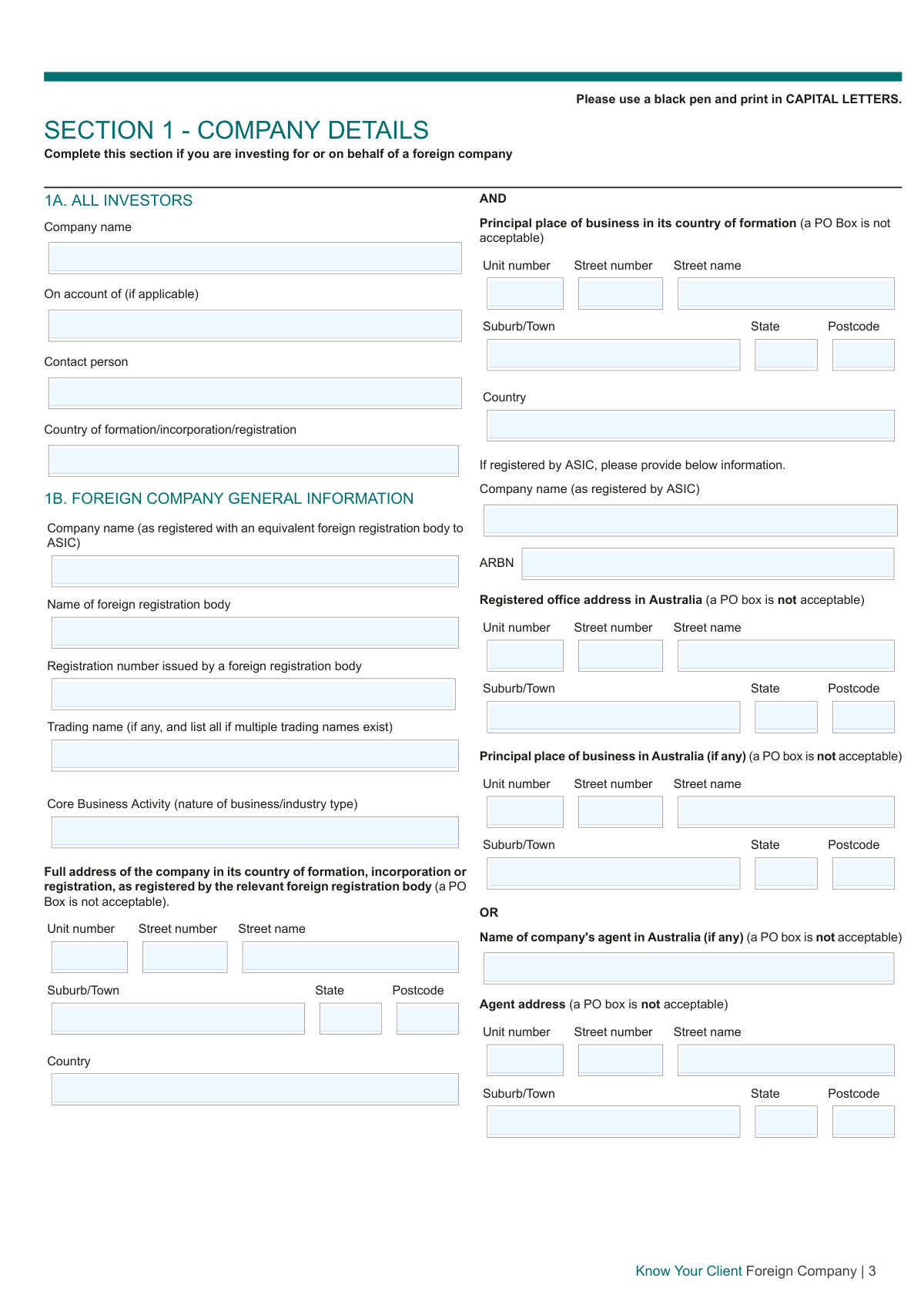
The Know Your Client - Foreign Company form is the primary document required for overseas businesses looking to establish a relationship with financial institutions, law firms, or real estate agencies. You should select this form if your business:
- Is incorporated or registered in a country outside of the local jurisdiction.
- Needs to open a corporate bank account or an investment portfolio.
- Is undergoing periodic compliance reviews to maintain existing financial services.
Key Information for Completion
The Know Your Client - Foreign Company form is designed to capture a comprehensive snapshot of your business's legal and financial standing. When filling this out via Instafill.ai, ensure you have the following details ready to ensure a smooth process:
- Entity Identity: Full legal name, country of incorporation, and any local registration numbers (such as an ARBN).
- Ownership Structure: Details of Ultimate Beneficial Owners (UBOs) or individuals who own or control 25% or more of the company.
- Tax Compliance: Information regarding the Foreign Account Tax Compliance Act (FATCA) and the Common Reporting Standard (CRS) to determine the company's tax residency status.
Regulatory Compliance Standards
Using the Know Your Client - Foreign Company form ensures that your business meets the rigorous standards set by the Anti-Money Laundering and Counter-Terrorism Financing Act 2006. By providing accurate identity and ownership data, you help financial institutions mitigate risk and fulfill their legal obligations. Utilizing AI-powered tools can streamline this process, making it easier to handle complex PDF layouts and ensuring all required fields are addressed accurately to avoid delays in your application.
Form Comparison
| Form | Primary Purpose | Information Required | Compliance Focus |
|---|---|---|---|
| Know Your Client - Foreign Company | Verifies identity, ownership structure, and tax status for foreign business entities. | Details on beneficial owners, registration numbers, and tax residency status. | Meets legal obligations under AML/CTF Act 2006, FATCA, and CRS regulations. |
Tips for foreign company forms
Foreign company forms often require identifying all individuals who own or control 25% or more of the entity. Be prepared to map out every layer of ownership, including parent companies and ultimate individual shareholders, to meet strict compliance standards.
Ensure the company name, registration number, and registered address match your official Certificate of Incorporation exactly. Minor discrepancies between your form and your legal documents are a primary cause for processing delays in KYC reviews.
AI-powered tools like Instafill.ai can complete these intricate forms in under 30 seconds with high accuracy. Your corporate data stays secure during the process, providing a massive time-saving advantage when managing multiple international filings.
Forms involving FATCA or CRS require accurate reporting of every jurisdiction where your company has tax obligations. Keep your Tax Identification Numbers (TINs) for each country of operation ready to ensure these technical sections are completed correctly.
Check if the form requires a specific director, a company secretary, or an individual with Power of Attorney to sign. Submitting a document signed by an unauthorized representative is a common mistake that leads to automatic rejection.
If your company's founding documents are in a foreign language, most institutions will require certified English translations to accompany the form. Having these digital copies ready will prevent bottlenecks during the identity verification phase.
Save digital copies of every submitted KYC and tax status form to ensure consistency during annual reviews or when opening new accounts. Maintaining a centralized record of your filings makes it much easier to update information if your corporate structure changes.
Frequently Asked Questions
These forms are primarily used by financial institutions and regulatory bodies to verify the identity and legitimacy of businesses operating across international borders. They ensure that the company complies with local and international laws regarding taxation, ownership transparency, and financial safety.
Any foreign-registered business entity looking to open a bank account, establish a credit facility, or enter into significant commercial contracts in another jurisdiction may need to complete these forms. This includes corporations, trusts, and partnerships with international ownership structures.
Institutions are legally obligated to prevent financial crimes like money laundering under regulations such as the Anti-Money Laundering and Counter-Terrorism Financing Act. Additionally, these forms help satisfy global tax reporting standards like FATCA and the Common Reporting Standard (CRS).
You will generally need to provide the company’s legal name, registration number, registered address, and details regarding its ultimate beneficial owners. Information about the nature of the business activities and the source of funds is also standard for most compliance reviews.
Yes, AI tools like Instafill.ai can automatically fill out these complex foreign company forms in under 30 seconds. The AI accurately extracts data from your existing source documents and places it directly into the required fields, reducing manual entry errors.
While manual completion can take a significant amount of time due to the detailed information required, using an AI-powered service speeds up the process. These platforms can process and complete a standard KYC form in less than a minute by mapping data from your corporate records.
It is helpful to have your certificate of incorporation, corporate structure charts, and identification documents for directors and major shareholders available. Having these in digital format allows AI tools to scan and extract the necessary details more efficiently.
While most institutions follow the same international regulatory standards, the specific layout and additional questions on a KYC form may vary. Some might require more granular detail depending on the risk level of the jurisdiction where the company is registered.
Submitting incomplete forms can lead to significant delays in account opening or the rejection of business applications. Using digital tools helps ensure that all mandatory fields are recognized and filled before you submit the document to the requesting institution.
Yes, advanced AI services can convert non-fillable or static PDF versions of foreign company forms into interactive, fillable documents. This makes it much easier to enter information digitally without needing to print and scan the document manually.
Glossary
- Ultimate Beneficial Owner (UBO)
- The individual or individuals who ultimately own or control more than a specific percentage (usually 25%) of a company's shares or voting rights.
- FATCA (Foreign Account Tax Compliance Act)
- A United States law that requires foreign financial institutions to report information about accounts held by U.S. taxpayers to the Internal Revenue Service (IRS).
- Common Reporting Standard (CRS)
- An international standard for the automatic exchange of financial account information between different countries to help prevent global tax evasion.
- AML/CTF
- An abbreviation for Anti-Money Laundering and Counter-Terrorism Financing, referring to the legal framework intended to prevent the movement of illegally obtained funds.
- Controlling Person
- A natural person who exercises significant influence or control over a legal entity, often including directors or senior managing officials if no majority owner exists.
- GIIN (Global Intermediary Identification Number)
- A unique 19-character identification number issued by the IRS to entities that have registered for FATCA compliance.
- Legal Entity Identifier (LEI)
- A 20-digit, alphanumeric code used to uniquely identify legally distinct entities that engage in global financial transactions.
- Tax Residency
- The country or jurisdiction where a company is legally obligated to pay taxes, usually determined by where the company was incorporated or where it is managed.