Fill out FMS forms
with AI.
Financial Management Services (FMS) forms are essential documents used by individuals and families who manage their own care services, often through self-directed Medicaid or disability programs. These forms act as the administrative backbone for tracking expenses, managing budgets, and ensuring that caregivers and service providers are compensated accurately. Whether you are managing a personal support budget or working as a direct service professional, these documents ensure that every dollar spent aligns with the approved spending plan and regulatory requirements.
By continuing, you acknowledge Instafill's Privacy Policy and agree to get occasional product update and promotional emails.
About FMS forms
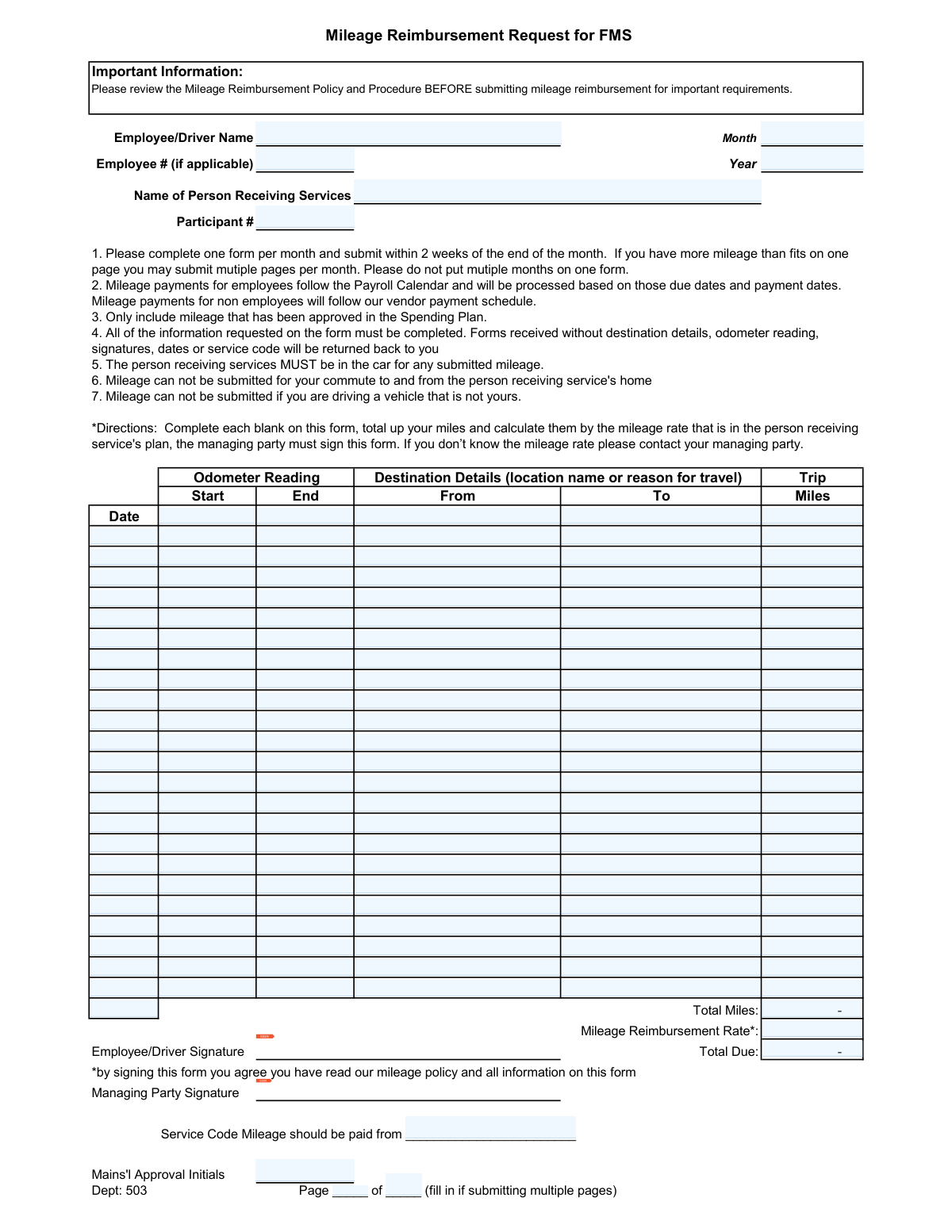
Commonly utilized by employees and drivers who transport individuals receiving services, these forms are critical for documenting work-related activities that occur outside of a fixed location. For instance, mileage reimbursement request forms require precise tracking of trip dates, odometer readings, and specific destinations to ensure proper payment. These records are not just for reimbursement; they serve as vital audit trails for state and federal programs. Managing this paperwork manually can be a significant administrative burden for families and caregivers who would rather focus on providing quality support and care.
To simplify this administrative process, tools like Instafill.ai use AI to fill these forms in under 30 seconds, handling complex data like odometer logs and expense details with high accuracy and security. By automating the data entry process, users can ensure their reimbursement requests are professional and error-free without the manual effort typically required for detailed financial reporting.
Every form on this page can be completed without typing. Instafill is form filling software that reads a PDF and fills it for you — including flat and scanned documents that carry no fillable fields at all.
Forms in This Category
The forms in this category have a median Form Complexity Index of 73/100 (Complex), measured across 1 forms by field count, input difficulty, length, conditional logic and structure. See how it is calculated.
| Form Name | Pages | FCI | |
|---|---|---|---|
| 1. | Mileage Reimbursement Request for FMS | 1 | Complex 73 |
- Enterprise-grade security & data encryption
- 99%+ accuracy powered by AI
- 1,000+ forms from all industries
- Complete forms in under 60 seconds
How to Choose the Right Form
Choosing the right FMS form is essential for ensuring that caregivers and employees are reimbursed accurately and on time. In this category, the focus is on tracking transportation costs associated with providing care and support services.
Tracking Your Travel Expenses
The Mileage Reimbursement Request for FMS is the primary document used by employees or authorized drivers who transport individuals receiving services. If you are operating under a self-directed care model or a specific spending plan, this is the essential form you need to capture your travel costs and ensure compliance with program regulations.
When to Use This Specific Form
You should select the Mileage Reimbursement Request for FMS if:
- You are an employee or driver: You provide transportation for a person receiving services as part of your job duties.
- You need mileage reimbursement: You are seeking payment for miles driven rather than a flat travel stipend.
- You have a spending plan: Your travel is pre-authorized and must be documented to be paid out of an approved budget.
Essential Details for Accurate Filing
To ensure your expense reimbursement forms are processed without delay, the Mileage Reimbursement Request for FMS requires specific data for each trip. Be prepared to provide:
- Exact dates of service.
- Start and end destinations for every trip.
- Beginning and ending odometer readings.
- Total miles accumulated for the reimbursement period.
Streamlining FMS Forms with AI
FMS forms and other travel expense forms can be tedious to complete, especially when tracking multiple trips with varying odometer readings. Using Instafill.ai, you can quickly complete the Mileage Reimbursement Request for FMS by letting AI assist with data entry. If you only have a non-fillable PDF version of this form, our platform can convert it into an interactive, fillable document, ensuring your mileage reimbursement forms are professional, legible, and submitted on time.
Form Comparison
| Form | Primary Purpose | Who Submits | Key Data Required | Submission Frequency |
|---|---|---|---|---|
| Mileage Reimbursement Request for FMS | Requesting payment for travel expenses incurred while transporting individuals receiving services. | Employees or drivers providing authorized transportation for FMS program participants. | Date of travel, odometer readings, specific destinations, and total mileage calculated. | Typically submitted monthly or according to the individual's approved spending plan. |
Tips for FMS forms
Double-check that your starting and ending odometer readings match the total miles calculated for each individual trip entry. Discrepancies between these numbers are a primary cause for reimbursement delays and may require you to resubmit the entire log.
Before filling out your mileage or expense forms, ensure the totals fall within your pre-authorized FMS budget. Reimbursement requests that exceed the allocated spending plan limits often require additional justification or may be rejected by the fiscal intermediary.
Dealing with repetitive mileage logs can be time-consuming, but AI-powered tools like Instafill.ai can complete these forms in under 30 seconds with high accuracy. Your data stays secure during the process, providing a fast and safe way to manage recurring FMS paperwork.
Avoid waiting until the end of the pay period to reconstruct your travel history from memory. Recording destinations and mileage immediately after each trip ensures you capture the precise details required for FMS compliance without the stress of backtracking.
FMS forms typically require signatures from both the service provider and the individual receiving services or their representative. Review the signature lines carefully before submission, as missing authorization is one of the most common reasons for payment processing holds.
Always save a digital copy of your completed forms and any supporting receipts before sending them to your FMS coordinator. Having an organized archive provides a clear audit trail and makes it easier to resolve any discrepancies regarding past payments.
Frequently Asked Questions
FMS forms, or Financial Management Services forms, are used by participants, caregivers, and employees in self-directed service programs to document and request reimbursement for expenses. These forms ensure that all spending aligns with an individual's approved service plan and budget.
This form should be used whenever a caregiver or employee uses a personal vehicle to transport a person receiving services as part of their care plan. It acts as a formal record to justify the reimbursement of travel costs based on the distance traveled.
You will generally need to provide the date of the trip, starting and ending odometer readings, the purpose of the travel, and the total miles driven. Ensuring these details are recorded for every trip is essential for the claim to be approved by the fiscal agent.
Yes, you can use AI tools like Instafill.ai to complete these forms in under 30 seconds. The AI can accurately extract mileage and destination data from your source logs and place it directly into the appropriate fields on the PDF.
Submission deadlines depend on your specific agency or program guidelines, but most require forms to be submitted on a weekly, bi-weekly, or monthly basis. Regularly submitting your forms helps ensure consistent and timely payment for your expenses.
If you have a static or scanned PDF, AI-powered services can convert these into interactive fillable forms. This allows you to type your information directly into the document online rather than filling it out by hand.
Completed forms are typically submitted to the Financial Management Services provider or the agency managing the individual's budget. Many providers now offer digital submission options through secure portals or email to expedite the review process.
Odometer readings provide a verifiable record of the distance traveled, which is a standard requirement for most state-funded or insurance-based programs. These readings help prevent errors and ensure that the reimbursement amount is calculated correctly.
While manual entry can take several minutes, using an AI-powered tool allows you to fill out these forms in less than 30 seconds. These tools automate the process by accurately pulling data from your records and populating the form for you.
No, mileage reimbursement is strictly for trips that are directly related to the services provided to the recipient. Personal errands, even if conducted while the recipient is in the vehicle, are generally not eligible and should be excluded from the log.
Errors in calculations or missing information can lead to the form being rejected or the payment being delayed. Using digital filing tools can help minimize these risks by providing clear, legible text and ensuring all required sections are addressed.
It is highly recommended to keep digital or physical copies of every form you submit for at least several years. These records are vital for personal bookkeeping, tax documentation, and any future audits of the service program.
Glossary
- Form Complexity Index
- Instafill’s 0–100 measure of how much effort a form takes to complete, calculated deterministically from the form’s own structure rather than estimated. It combines the number of fillable fields (the largest factor), how difficult those fields are to complete based on their type, the number of pages that contain fields, the amount of conditional “fill-only-if” logic, and how many sections the form is divided into, then adds modifiers for tables and repeating lists, bundled instruction pages, and dense page layouts. A higher score means the form is harder to fill out by hand. The forms in this category have a median Form Complexity Index of 73/100 (Complex). See exactly how it is calculated.
- FMS (Financial Management Services)
- An organization that helps individuals manage their self-directed care budgets by handling payroll, taxes, and processing reimbursement requests.
- Spending Plan
- An authorized budget that details how a person's service funds are allocated, including specific limits for transportation and mileage expenses.
- Fiscal Intermediary
- An entity that acts as a bridge between the funding source and the service recipient to ensure all payments and reimbursements comply with state and federal regulations.
- Odometer Reading
- The exact numbers displayed on a vehicle's dashboard at the start and end of a trip, used to calculate the total distance traveled for reimbursement.
- Reimbursement Rate
- The set dollar amount paid per mile, often based on IRS standard mileage rates, intended to cover fuel, insurance, and vehicle maintenance.
- Service Recipient
- The individual receiving support services whose approved budget is being used to pay for the mileage or travel expenses.
- Direct Service Provider (DSP)
- The employee or caregiver who provides the actual service and is typically the person submitting the mileage reimbursement form.
- Commute Miles
- The distance traveled between a provider's home and their primary work location, which is usually not eligible for reimbursement under FMS rules.