Fill out Georgia DMV forms
with AI.
Georgia motor vehicle forms are essential for maintaining legal compliance when buying, selling, or registering vehicles within the state. Managed by the Georgia Department of Revenue, these documents ensure that ownership transfers are recorded correctly and that all necessary taxes and fees are properly assessed. Having the correct paperwork is vital for a smooth title transfer and helps avoid lengthy delays or rejections at the county tag office.
By continuing, you acknowledge Instafill's Privacy Policy and agree to get occasional product update and promotional emails.
About Georgia DMV forms
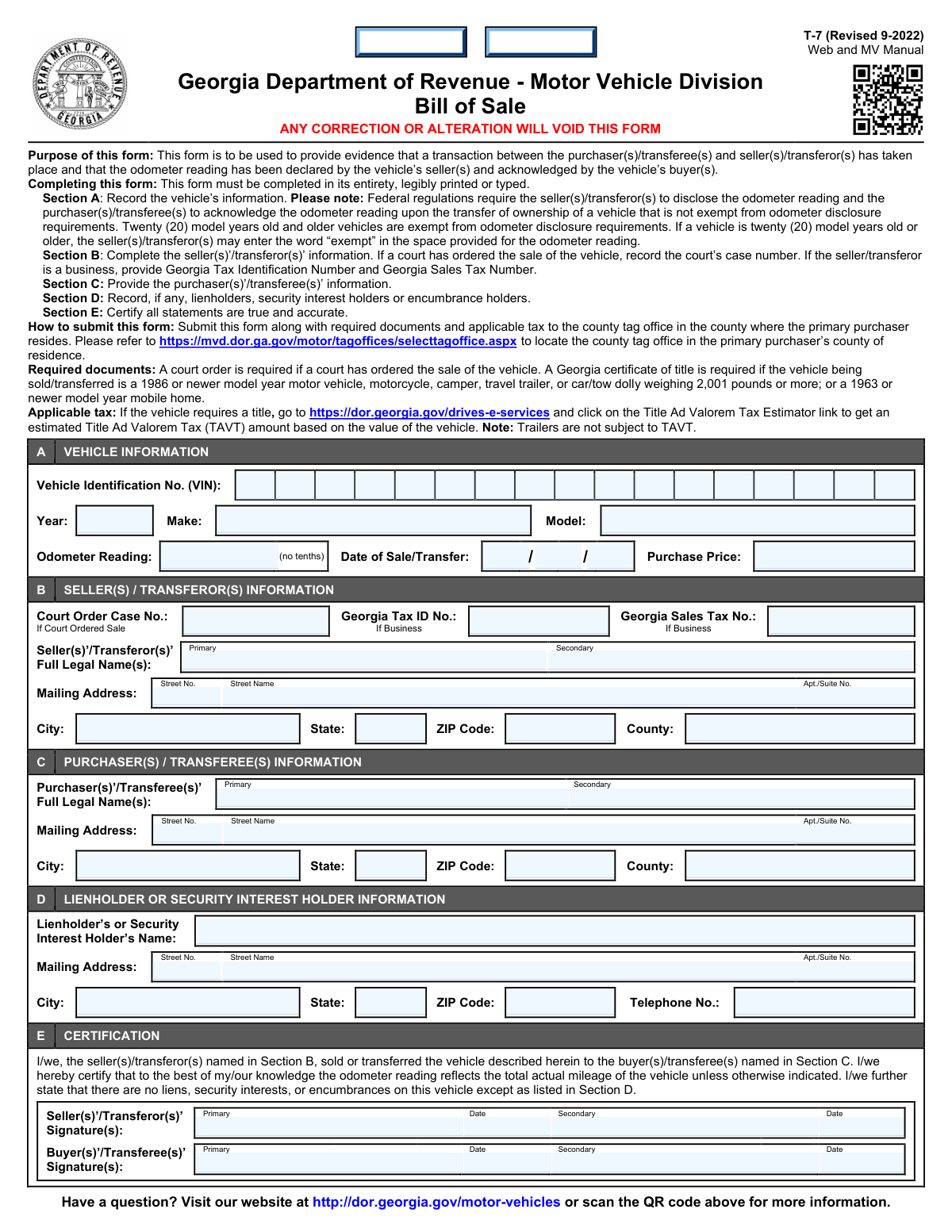
These forms are typically required by individuals engaged in private vehicle sales, those gifting a vehicle to a family member, or residents updating their registration details. For example, the Form T-7 Bill of Sale serves as the official record of a transaction, documenting the purchase price, vehicle details, and odometer reading. Anyone navigating the secondary automotive market in Georgia will need these documents to establish proof of purchase and secure a new title in their name.
Manually completing these forms can be time-consuming and prone to small errors that complicate the registration process. Tools like Instafill.ai use AI to fill these Georgia DMV forms in under 30 seconds, handling your data accurately and securely to provide a practical, digital alternative to traditional paperwork. This allows you to complete your documentation quickly so you can finalize your vehicle transaction without unnecessary stress.
Every form on this page can be completed without typing. Instafill is form filling software that reads a PDF and fills it for you — including flat and scanned documents that carry no fillable fields at all.
Forms in This Category
The forms in this category have a median Form Complexity Index of 57/100 (Moderate), measured across 1 forms by field count, input difficulty, length, conditional logic and structure. See how it is calculated.
| Form Name | Pages | FCI | |
|---|---|---|---|
| 1. | Georgia Department of Revenue Form T-7, Bill of Sale | 1 | Moderate 57 |
- Enterprise-grade security & data encryption
- 99%+ accuracy powered by AI
- 1,000+ forms from all industries
- Complete forms in under 60 seconds
How to Choose the Right Form
Navigating the Georgia Department of Revenue (DOR) requirements for vehicle transactions is straightforward when you have the correct documentation. While there are various motor vehicle forms for specialized situations, the requirements for private sales and ownership transfers in the state of Georgia center on one primary document.
The Essential Document for Vehicle Sales
If you are buying or selling a vehicle in Georgia through a private party (rather than a dealership), you will almost certainly need the Georgia Department of Revenue Form T-7, Bill of Sale. This is the standard, official document required by the state to verify the transfer of ownership.
This form is used to:
- Establish Proof of Purchase: It serves as the legal record showing that the seller has transferred the vehicle to the buyer.
- Record Odometer Readings: Federal and state laws require an accurate mileage disclosure at the time of sale, which is a key component of the T-7.
- Determine Tax Obligations: The purchase price listed on the form helps the county tag office calculate the Title Ad Valorem Tax (TAVT) or other applicable fees.
When to Use Georgia Form T-7
You should select the Georgia Form T-7 if your situation involves:
- Private Party Transfers: You are purchasing a car, truck, or motorcycle from an individual rather than a licensed dealer.
- Titling and Registration: You are preparing to visit your local county tag office to register the vehicle in your name.
- Gift Transfers: In many cases, even if the vehicle is a gift, a Bill of Sale is required to document the change in ownership and the valuation for tax purposes.
Filling Out Your Georgia DMV Forms
Completing Georgia motor vehicle forms manually can lead to errors that delay your registration. By using Instafill.ai, you can quickly complete the Georgia Form T-7 online. Our AI-powered platform ensures that all critical fields—including vehicle details, purchase price, and odometer readings—are filled out clearly. If you are working with a non-fillable PDF version of a Georgia DMV form, Instafill.ai can convert it into an interactive, fillable document to save you time and hassle.
Form Comparison
| Form | Primary Purpose | Key Information Required | Submission Requirement |
|---|---|---|---|
| Georgia Department of Revenue Form T-7, Bill of Sale | Documents the legal transfer of vehicle or vessel ownership between private parties. | Includes vehicle details, purchase price, odometer reading, and buyer/seller signatures. | Submitted by the buyer to the local county tag office for title and registration. |
Tips for Georgia DMV forms
AI-powered tools like Instafill.ai can complete these forms in under 30 seconds with high accuracy, ensuring all fields are correctly identified and populated. Your data stays secure during the process, making it a reliable and efficient way to handle high-stakes Georgia motor vehicle documentation.
Ensure the mileage recorded on the form matches the vehicle's dashboard exactly at the time of the transaction. Even minor discrepancies in the odometer reading can lead to delays or the rejection of your title application at the county tag office.
Always transcribe the VIN directly from the vehicle's physical plate rather than relying on memory or old insurance cards. A single character error on a Georgia Bill of Sale can invalidate the transfer, requiring you to restart the paperwork process.
For a Georgia Bill of Sale to be legally binding, both the buyer and the seller must sign and date the document. Forgetting a signature is a common mistake that necessitates tracking down the other party later, which can be difficult after a sale is finalized.
In Georgia, motor vehicle forms must be submitted to the Tax Commissioner’s tag office in the purchaser's specific county of residence. Confirming the correct local office address beforehand ensures your registration and titling are processed without geographic errors.
Always keep a digital or physical copy of the completed and signed form before submitting the original to the state. This serves as your primary proof of transfer, which is essential for canceling insurance and protecting the seller from future liability or citations.
Frequently Asked Questions
These forms are primarily used for documenting the transfer of vehicle ownership, registering a vehicle, or applying for a title within the state. They ensure that the Georgia Department of Revenue has an accurate record of the vehicle's history and the identity of the current legal owner.
A Bill of Sale is required whenever a vehicle is sold or transferred between private parties to document the transaction details. It serves as legal proof of the purchase price and the date of sale, which is necessary for calculating taxes and completing the registration process at the county tag office.
Both the buyer and the seller are typically involved in completing these forms. The seller provides vehicle details and signs the document to release interest, while the buyer must ensure the information is accurate before submitting the paperwork to their local county tag office for a title transfer.
Most completed forms, including title applications and bills of sale, should be submitted to the Tax Commissioner’s tag office in the county where the buyer resides. Some forms may also be submitted online through the Georgia Department of Revenue's digital portal, depending on the specific transaction type.
You will need the Vehicle Identification Number (VIN), the year, make, and model of the vehicle, the odometer reading at the time of sale, and the contact information for both the buyer and seller. Having the current title and previous registration handy can help ensure all technical details are entered correctly.
Yes, AI tools like Instafill.ai can be used to fill out these forms by automatically extracting data from your source documents and placing it into the correct fields. This technology can also take non-fillable PDF versions of Georgia forms and convert them into interactive, easy-to-complete documents.
Using AI-powered services, most Georgia motor vehicle forms can be completed in under 30 seconds. The system identifies relevant information from your ID or previous records and populates the form accurately, significantly reducing the time spent on manual data entry.
While not all Georgia motor vehicle forms require notarization, certain documents or specific circumstances, such as a missing title or specific affidavits, may require a notary's seal. It is always best to check the specific instructions on the form or consult your local county tag office to confirm if a notary is necessary for your transaction.
Errors on official forms can lead to delays in processing your title or registration. If an error is discovered, you may be required to submit a corrected form or an additional affidavit explaining the correction to the Georgia Department of Revenue or your local tag office.
Yes, while a Bill of Sale is used for traditional sales, Georgia may require different documentation or specific affidavits if a vehicle is being gifted between family members. These forms help the state determine if the transaction is exempt from certain taxes or fees usually associated with a standard sale.
Glossary
- Form Complexity Index
- Instafill’s 0–100 measure of how much effort a form takes to complete, calculated deterministically from the form’s own structure rather than estimated. It combines the number of fillable fields (the largest factor), how difficult those fields are to complete based on their type, the number of pages that contain fields, the amount of conditional “fill-only-if” logic, and how many sections the form is divided into, then adds modifiers for tables and repeating lists, bundled instruction pages, and dense page layouts. A higher score means the form is harder to fill out by hand. The forms in this category have a median Form Complexity Index of 57/100 (Moderate). See exactly how it is calculated.
- Georgia Department of Revenue (DOR)
- The state agency responsible for overseeing motor vehicle registrations, titling, and the collection of related taxes in Georgia.
- County Tag Office
- The local administrative office where Georgia residents must submit vehicle forms, pay fees, and receive license plates or registration decals.
- TAVT (Title Ad Valorem Tax)
- A one-time tax based on the vehicle's value that is paid when a title is transferred, replacing the older system of annual property taxes on vehicles.
- Odometer Disclosure Statement
- A mandatory declaration on forms like the T-7 where the seller certifies the vehicle's current mileage to the buyer and the state.
- VIN (Vehicle Identification Number)
- A unique 17-character code that serves as a serial number for a specific vehicle, required on all Georgia motor vehicle forms.
- Lienholder
- A bank or financial institution that has a legal claim on a vehicle's title until the owner has fully paid off the auto loan.
- Form MV-1
- The standard Title/Tag Application that must often be submitted to the Tag Office along with a Bill of Sale to complete a vehicle transfer.
- Grantor and Grantee
- Legal terms used in state documents to identify the parties in a transaction; the Grantor is the seller, and the Grantee is the buyer.