Fill out gifting forms
with AI.
Gifting forms and asset transfer authorizations are essential financial documents used to move wealth or specific investments from one party to another. Whether you are transferring shares of stock to a family member or donating securities to a charitable organization, these forms ensure that the transfer of ownership is documented correctly for tax and compliance purposes. These documents are particularly important for "in-kind" transfers, allowing securities to move between accounts without being liquidated, which helps preserve the original investment structure and avoid unnecessary capital gains triggers.
By continuing, you acknowledge Instafill's Privacy Policy and agree to get occasional product update and promotional emails.
About gifting forms
These forms are typically required by individual investors, financial advisors, and estate planners during significant life events. Common scenarios include providing a financial gift to a relative, settling an estate, or moving assets between different brokerage firms, such as transferring from a Merrill Cash Management Account to another institution. Accuracy is critical in these situations; errors in account numbers or security identifiers can lead to significant delays or rejected transfers, potentially impacting market timing or tax filing deadlines. Using tools like Instafill.ai allows you to complete these forms using AI in under 30 seconds, ensuring that your data is handled accurately and securely while saving you the hassle of manual entry.
Every form on this page can be completed without typing. Instafill is form filling software that reads a PDF and fills it for you — including flat and scanned documents that carry no fillable fields at all.
Forms in This Category
The forms in this category have a median Form Complexity Index of 47/100 (Moderate), measured across 1 forms by field count, input difficulty, length, conditional logic and structure. See how it is calculated.
| Form Name | Pages | FCI | |
|---|---|---|---|
| 1. | Outgoing Partial Asset/Gifting Transfer Authorization Letter | 1 | Moderate 47 |
- Enterprise-grade security & data encryption
- 99%+ accuracy powered by AI
- 1,000+ forms from all industries
- Complete forms in under 60 seconds
How to Choose the Right Form
When managing your wealth or planning a significant gift, choosing the correct documentation ensures that your assets move securely and efficiently. In this category, the focus is on transferring specific securities between financial institutions without the need to sell them first.
When to Use the Outgoing Partial Asset/Gifting Transfer Authorization Letter
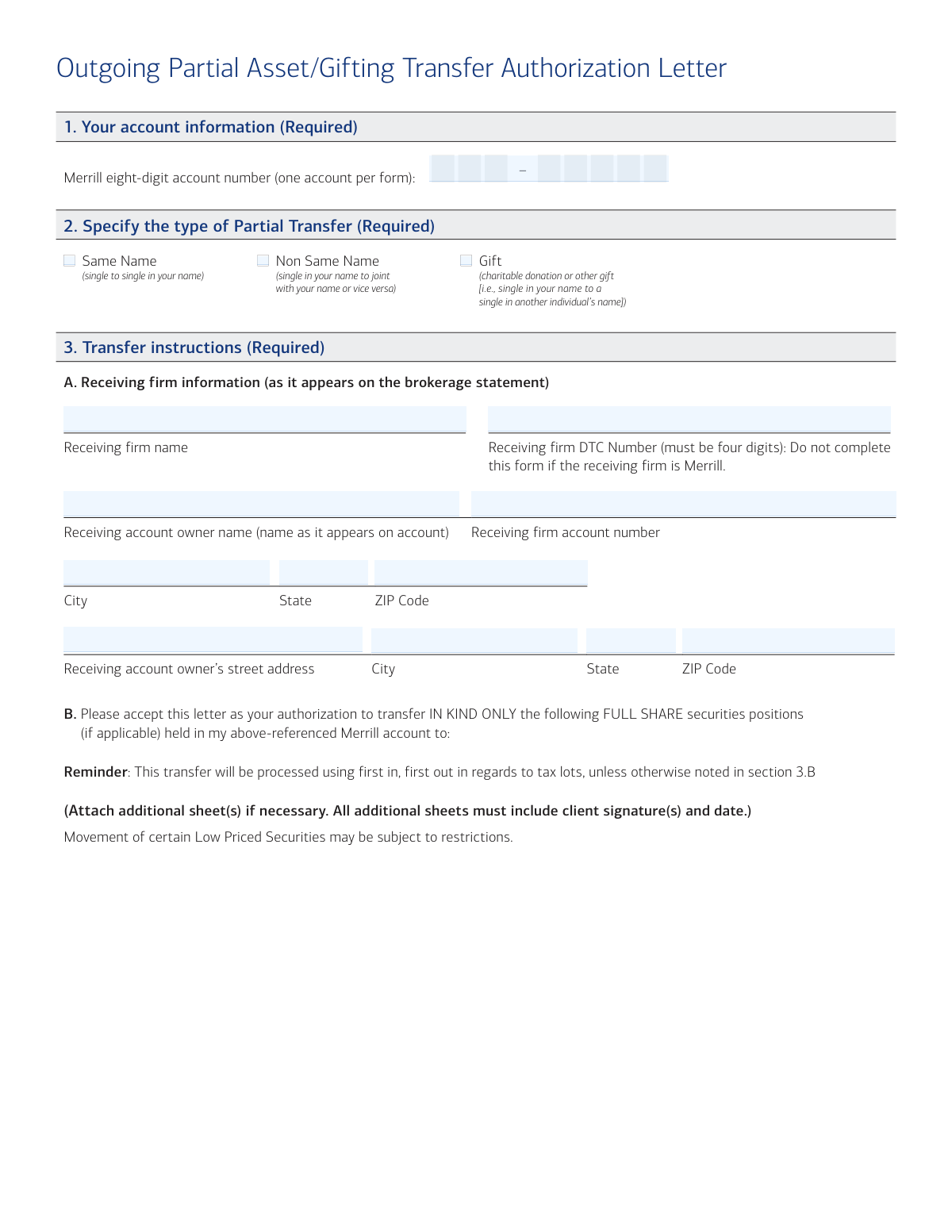
This specific form is designed for Merrill clients who need to move a portion of their holdings to an external account. You should choose the Outgoing Partial Asset/Gifting Transfer Authorization Letter if your situation meets the following criteria:
- You are a Merrill Client: This form is specifically tailored for accounts held within the Merrill ecosystem, such as a Cash Management Account (CMA).
- Non-Retirement Assets: This form is intended for standard brokerage accounts. If you are looking to transfer funds from an IRA or 401(k), you would typically need a different set of distribution or rollover documents.
- Partial Transfers: Use this form when you are not closing your entire account but rather moving specific stocks, bonds, or mutual funds.
- Gifting or External Transfers: Whether you are gifting shares to a family member’s account at another firm or simply consolidating your own holdings elsewhere, this is the primary authorization tool.
The Benefit of "In-Kind" Transfers
The Outgoing Partial Asset/Gifting Transfer Authorization Letter is essential because it facilitates "in-kind" transfers. This means your investments are moved as-is. Choosing this path is often preferred over liquidating assets because it avoids triggering immediate capital gains taxes that would occur if you sold the securities, and it keeps your market positions intact during the transition period.
By using Instafill.ai, you can quickly complete the Outgoing Partial Asset/Gifting Transfer Authorization Letter using AI to ensure all account numbers and security identifiers are accurate, significantly reducing the risk of your transfer being rejected by the receiving institution.
Form Comparison
| Form | Purpose | Eligible Account Type | Transfer Method | Target Destination |
|---|---|---|---|---|
| Outgoing Partial Asset/Gifting Transfer Authorization Letter | Authorizing the partial transfer or gifting of specific brokerage account assets. | Non-retirement brokerage accounts, such as Cash Management Accounts (CMA). | In-kind transfer of securities without requiring liquidation of assets. | External accounts held at a different financial institution. |
Tips for gifting forms
Ensure the account numbers for both the sending and receiving institutions are exact. Even a single digit error can cause the transfer to be rejected or delayed by several weeks during the processing phase.
When gifting assets, clearly indicate if you want to transfer the actual securities or sell them and transfer the cash value. In-kind transfers are often preferred to avoid triggering immediate capital gains taxes for the sender while maintaining the investment's growth potential.
Many financial institutions require a Medallion Signature Guarantee rather than a standard notary for high-value asset transfers. Check with your firm beforehand to see if this specific security stamp is necessary to validate your authorization letter.
AI-powered tools like Instafill.ai can complete these complex gifting forms in under 30 seconds with high accuracy. Your sensitive financial data stays secure during the process, making it a highly efficient way to manage multiple transfers at once.
Always keep a copy of the original purchase price and date for the assets being transferred. Providing this information to the recipient helps them accurately calculate their future tax obligations when they eventually sell the gifted securities.
Contact the receiving institution to obtain their specific delivery instructions, such as their DTC number or clearing house information. Including these technical details on your transfer form prevents assets from getting stuck in a pending status.
Be precise about which specific shares or dollar amounts you wish to move when using partial transfer forms. This ensures the correct portion of your portfolio is gifted while leaving the remainder of your brokerage account active and intact.
Frequently Asked Questions
Gifting forms facilitate the legal and administrative transfer of ownership for specific assets like stocks, bonds, or cash from one party to another without a sale. They are commonly used for charitable donations, gifting to family members, or moving specific assets between personal accounts at different firms.
A partial transfer form is ideal when you want to move specific securities or a set amount of cash while keeping your original account open. This is different from a full account transfer, which would close the source account and move all holdings simultaneously to a new institution.
No, many gifting forms allow for 'in-kind' transfers, meaning the securities are moved exactly as they are without being sold first. This is a common strategy to avoid triggering capital gains taxes that would occur if you liquidated the assets before gifting the cash proceeds.
The account holder, or the donor, must initiate and sign the transfer authorization to legally release the assets. The receiving party, or the donee, must provide their specific account details, such as the firm name and account number, to ensure the assets are delivered correctly.
You will typically need your current account number, the specific names and quantities of the securities being moved, and the receiving institution's information, such as their DTC number. Some financial institutions may also require a Medallion Signature Guarantee to verify the authenticity of the request.
Yes, these forms are specifically designed to bridge the gap between different brokerage firms, banks, or investment houses. They provide the necessary legal authorization for your current firm to release assets to an account held at a third-party institution.
Gifting assets can have significant tax implications for both the donor and the recipient, depending on the value of the gift and current annual exclusion limits. It is generally recommended to consult with a tax professional to understand reporting requirements for the IRS or other tax authorities.
Yes, you can fill out gifting forms using AI tools like Instafill.ai. These tools can accurately extract data from your source documents and place it into the required form fields in under 30 seconds, significantly reducing the risk of manual entry errors.
Preparing these forms online using AI-powered services usually takes less than a minute. By automating the data entry process, users can quickly generate ready-to-sign documents without having to manually type out long account numbers or complex security descriptions.
Once the form is completed and signed, it is usually submitted to the financial institution where the assets are currently held. Depending on the firm's specific policy, you may be able to upload the document through a secure client portal, mail it, or deliver it to a local branch office.
Glossary
- Form Complexity Index
- Instafill’s 0–100 measure of how much effort a form takes to complete, calculated deterministically from the form’s own structure rather than estimated. It combines the number of fillable fields (the largest factor), how difficult those fields are to complete based on their type, the number of pages that contain fields, the amount of conditional “fill-only-if” logic, and how many sections the form is divided into, then adds modifiers for tables and repeating lists, bundled instruction pages, and dense page layouts. A higher score means the form is harder to fill out by hand. The forms in this category have a median Form Complexity Index of 47/100 (Moderate). See exactly how it is calculated.
- In-Kind Transfer
- The process of moving securities like stocks or bonds to another account exactly as they are, without selling them for cash first. This allows the recipient to receive the actual investment rather than the liquidated proceeds.
- Medallion Signature Guarantee
- A specific certification stamp provided by a financial institution that verifies the legitimacy of a signature for the transfer of securities. It provides a higher level of security than a standard notary and is often required for large asset transfers.
- Cost Basis
- The original value or purchase price of an asset, used to determine capital gains or losses for tax purposes. When gifting assets, the cost basis often carries over from the giver to the recipient.
- Contra-Firm
- The external financial institution or brokerage that will be receiving the assets. You must provide the name and specific account details of this firm to authorize an outgoing transfer.
- CMA (Cash Management Account)
- A type of non-retirement brokerage account that combines investment services with banking features like check-writing. It is a common account type used as the source for gifting assets at firms like Merrill.
- Partial Transfer
- A transaction where only a specific portion of an account's holdings or a specific dollar amount is moved to another party, rather than transferring the entire account balance.
- DTC Number
- A unique four-digit code used to identify a brokerage firm or bank for the electronic transfer of securities. This number ensures that the gifted assets are routed to the correct financial institution.
- Letter of Authorization (LOA)
- A formal document signed by an account owner that provides specific instructions and legal permission for a financial institution to move assets to a third party or external account.