Fill out grievance appeal forms
with AI.
Grievance and appeal forms are essential administrative documents used when an individual disagrees with a decision made by an organization, typically an insurance provider or healthcare entity. These forms provide a formal channel for members to voice complaints about the quality of care received or to challenge a denial of services or payments. Navigating the complexities of healthcare coverage can be daunting, and these documents serve as a vital tool for ensuring that your rights are protected and that your concerns are addressed through a structured, official process.
By continuing, you acknowledge Instafill's Privacy Policy and agree to get occasional product update and promotional emails.
About grievance appeal forms
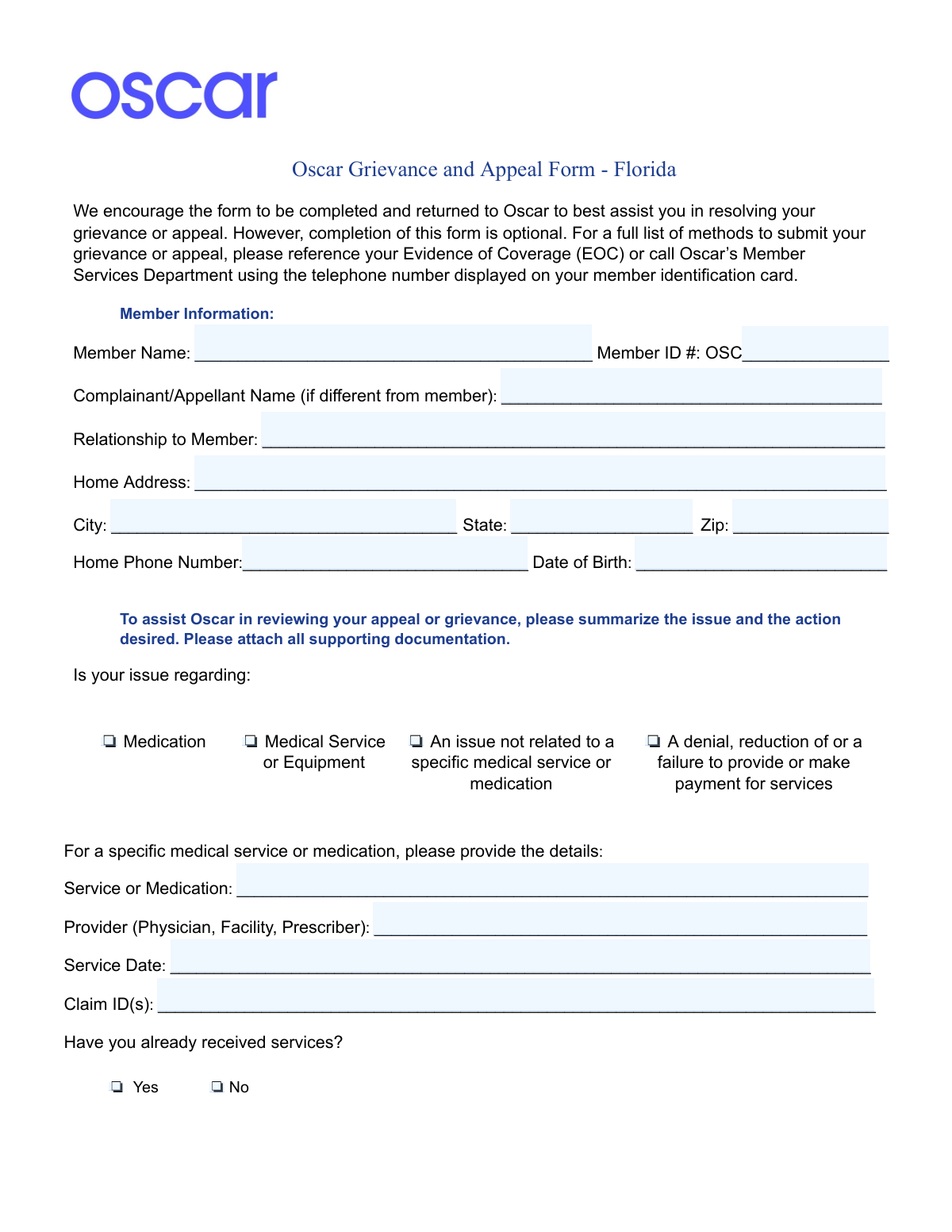
Typically, these forms are required by policyholders or patients who have encountered issues such as unexpected billing, a refusal to authorize a specific medical procedure, or dissatisfaction with the conduct of a healthcare provider. For example, members might use specific documents like the Oscar Grievance and Appeal Form for Florida to request a formal reconsideration of a denied claim. Because these documents often involve strict deadlines and specific legal requirements, providing clear and detailed information is crucial for a successful and timely resolution.
Completing these forms manually can be time-consuming and prone to errors, which may delay the resolution of your appeal. Tools like Instafill.ai use AI to accurately and securely populate these forms in under 30 seconds, ensuring that all necessary data is captured correctly while saving you the frustration of repetitive data entry. This allows you to focus on the details of your case rather than the mechanics of the paperwork.
Every form on this page can be completed without typing. Instafill is form filling software that reads a PDF and fills it for you — including flat and scanned documents that carry no fillable fields at all.
Forms in This Category
The forms in this category have a median Form Complexity Index of 44/100 (Basic), measured across 2 forms by field count, input difficulty, length, conditional logic and structure. See how it is calculated.
| Form Name | Pages | FCI | |
|---|---|---|---|
| 1. | Oscar Grievance and Appeal Form - Florida | 4 | Basic 44 |
| 2. | Supreme Court of New Jersey Disciplinary Review Board Notice of Appeal from the Dismissal of an Ethics Grievance | 1 | Simple 25 |
- Enterprise-grade security & data encryption
- 99%+ accuracy powered by AI
- 1,000+ forms from all industries
- Complete forms in under 60 seconds
How to Choose the Right Form
Selecting Your Grievance or Appeal Form
When you encounter an issue with your healthcare provider—whether it is a denial of service, a billing dispute, or a complaint regarding the quality of care—submitting a formal grievance or appeal is the necessary next step to protect your rights. Choosing the correct document ensures your case is reviewed by the right department without administrative delays.
For Oscar Health Members in Florida
Currently, the primary document available in this category is the Oscar Grievance and Appeal Form - Florida. You should select this specific form if you meet all of the following criteria:
- Insurance Provider: Your health coverage is provided through Oscar Health.
- Location: You reside in or receive medical care within the state of Florida.
- Action Needed: You wish to file a formal complaint (grievance) regarding your experience or ask the insurer to reconsider a decision to deny a specific service or payment (appeal).
When to Look for a Different Form
Because grievance and appeal processes are highly specific to both the insurance company and the state's regulatory requirements, this document is not interchangeable. You should seek a different form if:
- Different Carrier: You are insured through another provider such as Florida Blue, Aetna, or UnitedHealthcare.
- Different State: You are an Oscar member but live outside of Florida (e.g., Texas, California, or New York), as those states have unique legal disclosures and different mailing addresses for their appeals departments.
Preparing to Fill Out Your Form
Before you begin completing the Oscar Grievance and Appeal Form - Florida using Instafill’s AI tools, ensure you have your Member ID number, the specific date of the service in question, and a clear, chronological summary of your concern. Providing specific details and attaching supporting documentation helps the review committee process your appeal more efficiently and increases the likelihood of a favorable resolution.
Form Comparison
| Form | Primary Purpose | Applicable State | Submission Deadline | Key Requirements |
|---|---|---|---|---|
| Oscar Grievance and Appeal Form - Florida | Submit formal complaints or appeal denied healthcare service or payment decisions. | Restricted to Oscar health insurance plan members residing in Florida. | Typically within 60 days of the original claim denial or incident. | Member ID, provider information, and a detailed explanation of the issue. |
Tips for grievance appeal forms
Before filling out the form, determine if you are filing a grievance for a complaint about service or an appeal to contest a denied claim. Selecting the correct category ensures your request is routed to the right department for a faster resolution.
Include any relevant medical records, bills, or letters from your healthcare provider that support your case. Providing clear evidence upfront can significantly strengthen your position and reduce the need for back-and-forth communication.
Ensure that your insurance member ID and the specific claim numbers in question are entered accurately. Simple clerical errors in these fields are a common cause for processing delays or the immediate rejection of the form.
AI-powered tools like Instafill.ai can complete these complex forms in under 30 seconds with high accuracy, ensuring all required fields are addressed. This is a major time-saver for those managing multiple claims, and your data remains completely secure during the process.
Most insurance plans have a limited window of time following a denial or incident during which you can file a formal request. Review your policy documents to ensure you submit the form within these timeframes to avoid losing your right to appeal.
Always save a digital or physical copy of the final form and any attachments you submit for your personal records. Having a dated copy is essential if you need to follow up on the status or provide proof of submission later.
Frequently Asked Questions
These forms allow individuals to formally challenge a decision made by an organization, such as an insurance provider, regarding coverage or service quality. A grievance is typically a complaint about a specific experience or service quality, while an appeal is a request to reconsider a formal decision to deny benefits or payment.
You should file a grievance if you are unhappy with the quality of care, facility conditions, or customer service you received. You should file an appeal specifically if you disagree with a decision to deny, reduce, or terminate a medical service or a request for payment.
Generally, the policyholder or the person receiving the services is the one who submits the form. In many cases, a legal representative, family member, or a healthcare provider can also file on behalf of the member, provided that a signed authorization form is included.
You will need to provide your full name, member identification number, and current contact details. The form also requires a detailed description of the incident or the specific claim you are disputing, including relevant dates and any reference numbers provided by the insurer.
Yes, AI tools like Instafill.ai can fill these forms in under 30 seconds by accurately extracting and placing data from your source documents. This technology ensures that your member details and claim information are entered correctly without the need for manual typing.
Using AI-powered services, you can complete a grievance or appeal form in less than a minute. These tools can even convert non-fillable PDF versions into interactive forms, making the submission process much faster than traditional manual methods.
Most organizations have strict timeframes for filing an appeal, which are often mentioned in the initial denial letter you received. While these deadlines vary, they typically range from 60 to 180 days from the date of the decision you are challenging.
It is helpful to attach any relevant medical records, doctor's notes, or bills that support your case. Providing a clear explanation or a letter of medical necessity from your healthcare provider can often strengthen your appeal.
Completed forms are usually submitted to the member services or appeals department of the insurance company via mail, fax, or through a secure online member portal. Specific submission instructions and addresses are generally located at the bottom of the form or in your member handbook.
Yes, if your health is in immediate danger or a delay would cause significant pain, you can request an expedited or 'fast' appeal. These are prioritized by the reviewer and typically result in a decision within a few days rather than weeks.
After submission, the organization will review your request and any supporting evidence you provided. You will usually receive an acknowledgment letter followed by a formal written decision once the internal review process is complete.
Glossary
- Form Complexity Index
- Instafill’s 0–100 measure of how much effort a form takes to complete, calculated deterministically from the form’s own structure rather than estimated. It combines the number of fillable fields (the largest factor), how difficult those fields are to complete based on their type, the number of pages that contain fields, the amount of conditional “fill-only-if” logic, and how many sections the form is divided into, then adds modifiers for tables and repeating lists, bundled instruction pages, and dense page layouts. A higher score means the form is harder to fill out by hand. The forms in this category have a median Form Complexity Index of 44/100 (Basic). See exactly how it is calculated.
- Grievance
- A formal complaint regarding any matter other than an adverse benefit determination, such as quality of care, waiting times, or the behavior of healthcare staff.
- Appeal
- A formal request for a health insurance provider to reconsider a decision to deny, reduce, or terminate a service or payment for a medical claim.
- Adverse Benefit Determination
- A notification from an insurer that a requested service or claim has been denied, which provides the legal basis for a member to file an appeal.
- Authorized Representative
- A person designated by the member, such as a family member or attorney, to act on their behalf during the grievance or appeal process.
- Expedited Appeal
- An accelerated review process used when a standard appeal timeframe could seriously jeopardize the member's life, health, or ability to regain maximum function.
- Utilization Management
- The system used by insurance companies to evaluate the medical necessity and appropriateness of healthcare services before they are provided or paid for.
- Clinical Peer Reviewer
- A healthcare professional in the same or similar specialty as the provider who typically manages the medical condition or treatment under review.
- External Review
- An independent review of an insurance company's final decision by a third party, typically requested after all internal appeal levels have been exhausted.