Fill out habitational insurance forms
with AI.
Habitational insurance forms are essential documents for property owners and managers seeking coverage for multi-unit residential properties. This category encompasses the specialized paperwork required to assess risks for structures such as apartment complexes, condominiums, student housing, and affordable housing developments. These forms are critical because they allow insurance underwriters to evaluate the unique liabilities associated with high-density living, including fire safety systems, tenant demographics, and property maintenance standards. Providing thorough information ensures that the property is adequately protected against potential claims and losses.
By continuing, you acknowledge Instafill's Privacy Policy and agree to get occasional product update and promotional emails.
About habitational insurance forms
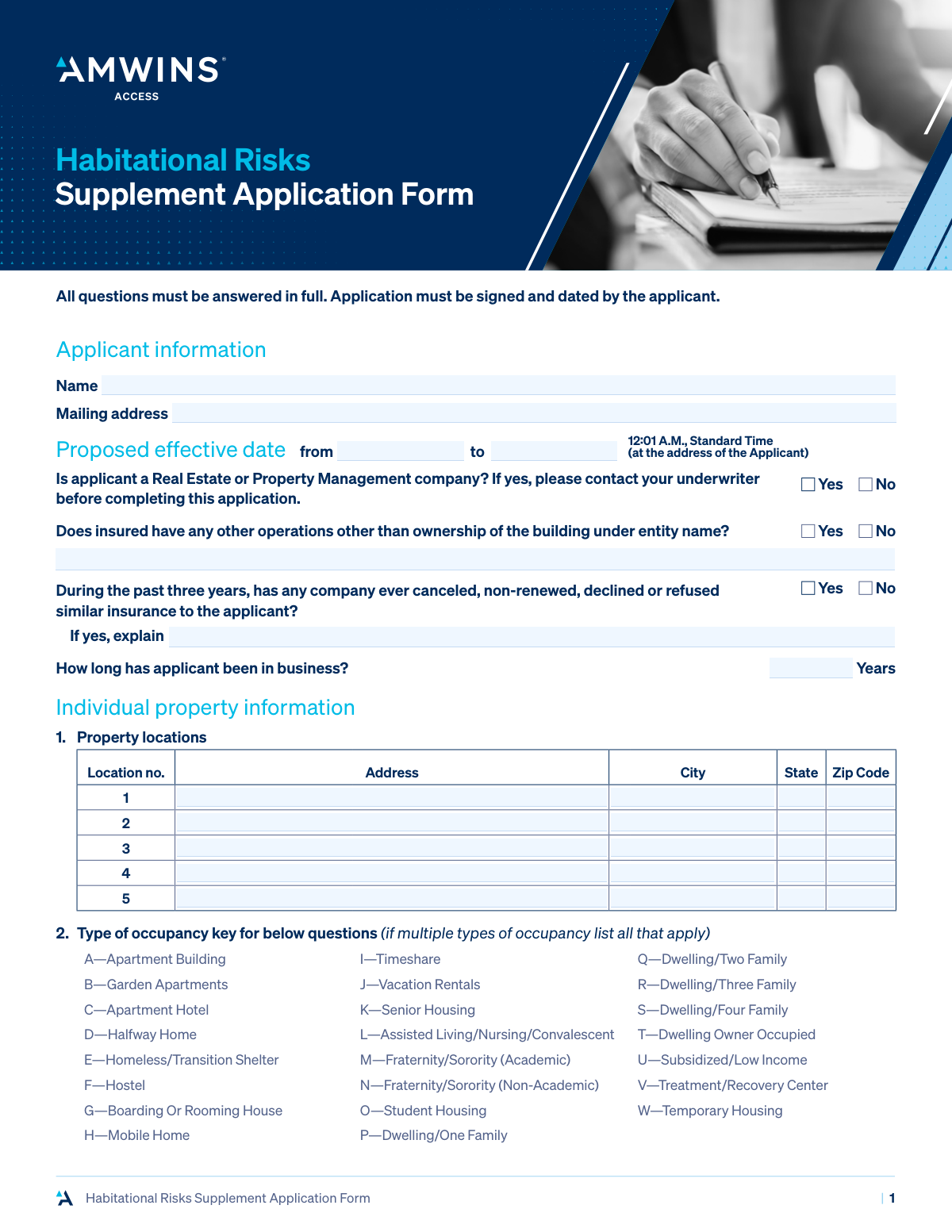
Typically, real estate investors, property management firms, and insurance brokers use these forms during the application or policy renewal process. Whether you are securing a new policy for a senior living facility or updating coverage for a portfolio of rental units, providing precise data is vital for obtaining accurate premium quotes. Forms like the Habitational Risks Supplement Application require detailed disclosures about building age, electrical updates, and security measures to ensure the policy reflects the actual risk profile of the premises. Accurate documentation helps avoid coverage gaps and ensures compliance with carrier requirements.
Managing these detailed documents can be a significant administrative burden, especially when dealing with complex supplements. Tools like Instafill.ai use AI to fill these habitational insurance forms in under 30 seconds, ensuring data is handled accurately and securely while saving time. This approach allows professionals to focus on property management and client relations rather than manual data entry.
Every form on this page can be completed without typing. Instafill is form filling software that reads a PDF and fills it for you — including flat and scanned documents that carry no fillable fields at all.
Forms in This Category
The forms in this category have a median Form Complexity Index of 74/100 (Complex), measured across 1 forms by field count, input difficulty, length, conditional logic and structure. See how it is calculated.
| Form Name | Pages | FCI | |
|---|---|---|---|
| 1. | Habitational Risks Supplement Application Form | 7 | Complex 74 |
- Enterprise-grade security & data encryption
- 99%+ accuracy powered by AI
- 1,000+ forms from all industries
- Complete forms in under 60 seconds
How to Choose the Right Form
Selecting the right documentation for habitational insurance is essential for securing accurate coverage for residential business properties. Unlike standard homeowner policies, habitational insurance covers multi-unit dwellings where the risk profile is significantly more complex due to high density and shared liabilities.
Identifying Your Insurance Needs
The primary document in this category is the Habitational Risks Supplement Application Form. You should choose this form if you are seeking coverage for the following property types:
- Multi-Family Dwellings: Traditional apartment buildings, gated communities, or large complexes.
- Specialized Housing: Student housing, senior living facilities, or boarding houses.
- Social Services Properties: Homeless shelters, transitional housing units, or group homes.
- Mixed-Use Buildings: Properties that combine residential units with commercial ground-floor retail or office space.
When to Use the Habitational Risks Supplement
Standard commercial property applications often lack the granularity needed for residential risks. You will typically need to complete the Habitational Risks Supplement Application Form when an underwriter requires deep-dive data on specific risk factors that affect premiums, such as:
- Occupancy Details: Underwriters need to know the percentage of student residents, vacancy rates, or subsidized housing ratios.
- Safety and Life Systems: This form captures essential details on smoke detectors, fire extinguishers, sprinkler systems, and secondary means of egress.
- Property Infrastructure: You will be asked for specific information regarding the age of the roof, type of plumbing (e.g., copper vs. PEX), and electrical systems (e.g., presence of circuit breakers or aluminum wiring).
Streamlining Your Application
Navigating these detailed questionnaires can be time-consuming for property managers and brokers alike. By using the Habitational Risks Supplement Application Form on Instafill.ai, you can leverage AI to pull data from your existing property records directly into the PDF. This ensures that technical details—like construction classifications and square footage—are accurate, reducing the likelihood of delays during the underwriting process.
Form Comparison
| Form | Purpose | Who Files It | Key Information Required | Property Types Covered |
|---|---|---|---|---|
| Habitational Risks Supplement Application Form | Assesses residential property risks to determine insurance eligibility and premium rates. | Property owners or managers applying for or renewing habitational insurance policies. | Safety features, construction materials, occupancy details, and liability history. | Apartment complexes, student housing, boarding houses, and residential shelters. |
Tips for habitational insurance forms
Underwriters closely examine the age of roofing, plumbing, and electrical systems in habitational risks. Ensure you have the exact years of the most recent upgrades ready, as outdated systems often trigger higher premiums or coverage denials.
Be specific about fire protection measures like sprinkler systems, smoke detectors, and fire extinguishers. Including details about gated access or security cameras can significantly improve your risk profile during the assessment.
Clearly distinguish between long-term residents, student housing, or subsidized units. Misrepresenting the occupancy type is a common mistake that can lead to claim denials later if the risk profile doesn't match the reality of the property.
Habitational forms often ask about regular maintenance schedules for elevators, pools, and walkways. Having these records organized allows you to answer questions about risk mitigation strategies confidently and accurately.
Be transparent about past insurance claims or incidents on the property. Providing context for previous losses and detailing the corrective actions taken shows underwriters that you are proactive about risk management.
AI-powered tools like Instafill.ai can complete these complex habitational forms in under 30 seconds with high accuracy. Your sensitive property data stays secure during the process, making it a major time-saver for property managers handling multiple locations.
Many habitational applications require additional attachments like site maps or building photos. Check the requirements early to ensure you have all visual evidence ready before you begin the digital filing process.
Frequently Asked Questions
These forms are used by insurance underwriters to evaluate the specific risks associated with multi-unit residential properties. They provide a deeper level of detail than a standard commercial policy application, focusing on safety features, tenant demographics, and property maintenance.
Typically, the property owner, a real estate developer, or a designated property manager is responsible for completing these forms. They must ensure that all operational and structural details are accurately reported to the insurance carrier to secure proper coverage.
This category generally includes multi-family dwellings such as apartment complexes, residential condominiums, student housing, and senior living facilities. It can also cover specialty housing like homeless shelters, boarding houses, or subsidized housing units.
A supplement application provides specific data that a general liability or property form might miss, such as the age of the roof, plumbing types, or the presence of carbon monoxide detectors. This additional information helps insurers price the policy accurately based on the actual physical and liability risks of the building.
Yes, you can use AI tools like Instafill.ai to automate the completion of these complex forms. The AI can accurately extract data from your property records or previous applications and place it directly into the required fields in under 30 seconds.
While manual entry can take a significant amount of time due to the technical details required, using an AI-powered service allows you to complete the process in seconds. Tools like Instafill.ai extract and map data from your source documents to the PDF fields with high accuracy.
Insurers usually ask for details regarding fire protection systems, such as the frequency of extinguisher inspections and the presence of functional sprinklers. They also look for information on security measures, swimming pool safety, and the condition of electrical and heating systems.
Once the forms are filled and signed, they are typically submitted to your insurance broker or directly to the commercial insurance carrier's underwriting department. They will use the data provided to determine your eligibility for coverage and calculate your premium.
While many carriers use industry-standard forms, some insurance companies have their own proprietary supplement applications with unique questions. It is important to confirm with your broker which specific version is required by the underwriting company you are approaching.
You should include details of any upgrades to major systems like HVAC, roofing, or wiring on the application form. Providing documentation of these improvements can often lead to better coverage terms or lower premiums because the physical risk of the property has been reduced.
Glossary
- Form Complexity Index
- Instafill’s 0–100 measure of how much effort a form takes to complete, calculated deterministically from the form’s own structure rather than estimated. It combines the number of fillable fields (the largest factor), how difficult those fields are to complete based on their type, the number of pages that contain fields, the amount of conditional “fill-only-if” logic, and how many sections the form is divided into, then adds modifiers for tables and repeating lists, bundled instruction pages, and dense page layouts. A higher score means the form is harder to fill out by hand. The forms in this category have a median Form Complexity Index of 74/100 (Complex). See exactly how it is calculated.
- Habitational Risk
- A category of commercial insurance specifically designed for multi-unit residential properties such as apartment buildings, condominiums, and student housing.
- Loss Runs
- Official reports from previous insurance carriers that detail the history of claims filed for a property, usually required for the past three to five years.
- Life Safety Systems
- A collective term for the equipment installed in a building to protect occupants, including fire sprinklers, smoke alarms, fire extinguishers, and emergency exit lighting.
- ISO Construction Class
- A standard classification system (numbered 1 through 6) that describes how fire-resistant a building is based on its construction materials, such as wood frame or masonry.
- Subsidized Housing
- Properties where rent is partially paid by government programs like Section 8; insurers often ask for this detail to assess specific regulatory and liability risks.
- Building Ordinance or Law Coverage
- An insurance provision that covers the extra cost of repairing or rebuilding a structure to comply with modern building codes that did not exist when the property was originally built.
- Hard-Wired Smoke Detectors
- Fire detection devices that are connected directly to the building's electrical wiring, which are considered more reliable than battery-only units in habitational underwriting.
- Premises Liability
- Coverage that protects the property owner against legal claims for bodily injury or property damage sustained by third parties, such as tenants or guests, while on the property.