Fill out installation risk forms
with AI.
Installation risk forms are essential tools for managing liability and property protection during the specialized phases of construction or equipment setup. Unlike standard property insurance, these forms focus on the unique vulnerabilities of materials and equipment that are not yet permanent fixtures. They cover a wide range of scenarios, from transportation to the job site to the actual installation process, ensuring that unforeseen events like theft, fire, or natural disasters do not result in catastrophic financial losses for the parties involved.
By continuing, you acknowledge Instafill's Privacy Policy and agree to get occasional product update and promotional emails.
About installation risk forms
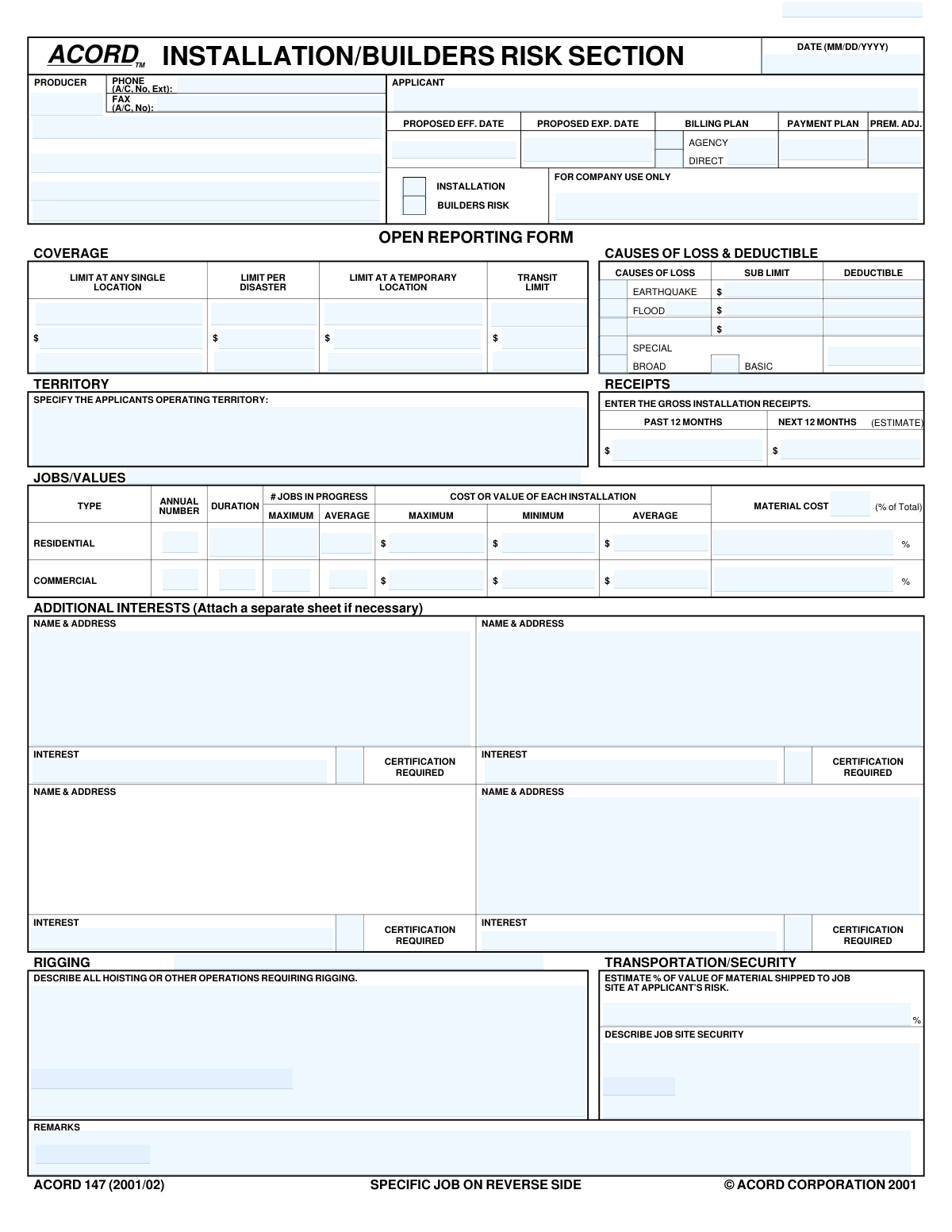
These forms are typically required by general contractors, specialized subcontractors, and property owners who are overseeing significant upgrades or new builds. Insurance producers use documents like the ACORD 147 to gather granular data on project values, site security, and specific perils such as floods or earthquakes. Whether you are installing a high-value HVAC system or managing a large-scale commercial build, having accurate risk documentation is a prerequisite for securing the necessary underwriting and coverage limits. Completing these detailed supplemental sections can be a tedious manual process, but tools like Instafill.ai use AI to fill these forms in under 30 seconds while maintaining high standards for data accuracy and security.
Every form on this page can be completed without typing. Instafill is form filling software that reads a PDF and fills it for you — including flat and scanned documents that carry no fillable fields at all.
Forms in This Category
The forms in this category have a median Form Complexity Index of 76/100 (Complex), measured across 2 forms by field count, input difficulty, length, conditional logic and structure. See how it is calculated.
| Form Name | Pages | FCI | |
|---|---|---|---|
| 1. | ACORD 147 (2001/02), Installation/Builders Risk Section | 2 | Complex 76 |
| 2. | ACORD 147, Installation / Builders Risk Section | 3 | Complex 64 |
- Enterprise-grade security & data encryption
- 99%+ accuracy powered by AI
- 1,000+ forms from all industries
- Complete forms in under 60 seconds
How to Choose the Right Form
Understanding Installation and Builders Risk
Installation risk forms are essential for contractors, developers, and property owners who need to protect materials, machinery, and equipment while they are in transit or being installed. Whether you are managing a new construction project or upgrading existing infrastructure, the right documentation ensures that your assets are covered against theft, damage, or natural disasters before the project is completed.
The Industry Standard: ACORD 147
Currently, the primary document in this category is ACORD 147, Installation/Builders Risk Section. This is a supplemental insurance application used to provide underwriters with a detailed risk profile of a specific project. You should choose this form if you need to report on:
- Project Values and Limits: Use this to specify the total value of the installation and the desired coverage limits for various perils.
- Job Site Security: This form captures critical data regarding site protection, such as fencing, lighting, and surveillance, which can impact your premiums.
- Transportation and Storage: If materials are being stored at a temporary location or moved between sites, ACORD 147 allows you to detail these off-site risks.
- Catastrophic Perils: It provides specific sections for requesting coverage related to floods or earthquakes, which are often excluded from basic policies.
Is This the Right Form for You?
You should select ACORD 147 if your project involves the installation of high-value items like HVAC systems, electrical grids, or large-scale machinery. It is the standard choice for insurance producers who need to provide a comprehensive supplemental application to a carrier.
Efficiency with Instafill.ai
Insurance applications require high levels of accuracy to avoid coverage gaps. By using Instafill.ai, you can complete the ACORD 147, Installation/Builders Risk Section quickly using AI-powered tools. Our platform simplifies the process of turning static PDFs into interactive, fillable forms, helping you submit your project details to underwriters with confidence and speed.
Form Comparison
| Form | Primary Purpose | Who Files It | Key Information Required |
|---|---|---|---|
| ACORD 147, Installation/Builders Risk Section | Underwrites property coverage for materials and equipment during construction or installation phases. | Insurance producers and applicants seeking specialized builders risk or installation insurance policies. | Project values, job site security, transportation risks, and specific peril coverage limits. |
Tips for installation risk forms
Ensure the total value of materials and labor is accurate to avoid being underinsured. Underestimating the project cost can lead to significant coverage gaps if a loss occurs during the installation process, potentially leaving you responsible for the difference.
Be specific about the type of installation, whether it involves HVAC systems, electrical components, or heavy machinery. Vague descriptions can lead to delays in underwriting or disputes regarding whether certain activities are covered under the policy.
Many installation projects involve materials being stored at a warehouse or transported to the job site. Check that your forms include adequate limits for these in-transit or off-site phases, as standard property insurance often excludes these specific risks.
Underwriters prioritize projects with robust security, such as perimeter fencing, motion-sensing lighting, or 24/7 monitoring. Documenting these preventative measures on your risk forms can often lead to more favorable terms or lower premiums for the applicant.
Filling out complex insurance sections can be time-consuming, but AI-powered tools like Instafill.ai can complete these forms in under 30 seconds with high accuracy. This practical approach ensures your data stays secure during the process while allowing you to focus on project management.
Ensure that your installation risk form doesn't overlap or leave gaps with a general contractor’s builder’s risk policy. Reviewing these forms side-by-side helps clarify which party is responsible for specific perils and property types during the construction phase.
Frequently Asked Questions
Installation risk forms, such as the ACORD 147, are used to provide detailed information to insurance underwriters about property and equipment being installed at a project site. These forms help assess the specific risks associated with materials, labor, and job site conditions during the construction or installation phase.
These forms are generally completed by contractors, developers, or property owners who are seeking specialized insurance coverage for a project. Insurance agents or brokers often assist in the process by collecting the necessary project data from the applicant to secure a policy quote.
While both cover property under construction, an installation risk form is often focused on specific equipment or systems being installed, such as HVAC units, electrical systems, or heavy machinery. Builder's risk is a broader category that usually covers the entire structure from the ground up.
It is best to submit these forms well before the project start date to ensure coverage is active as soon as materials arrive at the job site. Most insurance carriers require the application to be reviewed and the policy bound before any significant risk exposure occurs.
You will typically need to provide the project location, the total value of the materials, the expected duration of the work, and details regarding job site security. Information about how materials are transported to the site and where they are stored before installation is also standard.
Yes, AI tools like Instafill.ai can automatically fill out installation risk forms by extracting data from your project contracts or existing records. This technology ensures that technical data regarding project values and site conditions is accurately placed into the correct PDF fields without manual entry.
While manual entry for complex insurance forms can take a significant amount of time, using AI-powered services like Instafill.ai allows you to complete these forms in under 30 seconds. The AI accurately extracts and places data from your source documents directly into the form.
Once the form is finalized, it should be submitted to your insurance agent, broker, or the underwriting department of the insurance company. They will use the information to determine the premium and the specific terms of your coverage.
While not a government requirement, most lenders and project owners require proof of installation or builder's risk insurance before work can begin. Completing these forms is a standard industry practice for managing financial risk in commercial and residential projects.
The forms allow you to request coverage for common perils such as fire, theft, and vandalism. They also include sections to specify if you need additional protection for specialized risks like floods, earthquakes, or damage that might occur during transit to the site.
Generally, installation risk forms are project-specific because risks vary significantly based on the location and security of each site. If you have multiple ongoing installations, you will typically need to complete a separate form for each individual job site.
If the project duration extends or the value of the materials increases significantly, you should notify your insurance provider immediately. They may require an updated form or a policy endorsement to ensure your coverage remains adequate for the new project parameters.
Glossary
- Form Complexity Index
- Instafill’s 0–100 measure of how much effort a form takes to complete, calculated deterministically from the form’s own structure rather than estimated. It combines the number of fillable fields (the largest factor), how difficult those fields are to complete based on their type, the number of pages that contain fields, the amount of conditional “fill-only-if” logic, and how many sections the form is divided into, then adds modifiers for tables and repeating lists, bundled instruction pages, and dense page layouts. A higher score means the form is harder to fill out by hand. The forms in this category have a median Form Complexity Index of 76/100 (Complex). See exactly how it is calculated.
- Installation Floater
- A specialized insurance policy that covers materials, equipment, and machinery while they are in transit, being stored, or being installed at a job site until the project is complete.
- Builders Risk Insurance
- A form of property insurance that covers a building under construction, including the materials and labor costs, against perils like fire, wind, and vandalism.
- Inland Marine Insurance
- The broader category of insurance that includes installation risks, covering property that is mobile, in transit, or part of a construction project over land.
- Soft Costs
- Indirect expenses resulting from a construction delay caused by a covered loss, such as additional interest on loans, legal fees, or property taxes.
- Testing and Commissioning
- A coverage extension that protects equipment against mechanical or electrical breakdown during the initial phase when it is first powered on and tested.
- Transit Coverage
- Protection for equipment and materials while they are being moved from a warehouse or supplier to the installation site.
- Off-Site Storage
- Coverage for project-related materials that are being kept at a temporary location or warehouse before they are delivered to the primary job site.
- Completed Value Basis
- A method of setting insurance limits based on the total anticipated value of the project once all work is finished, rather than the current value during construction.